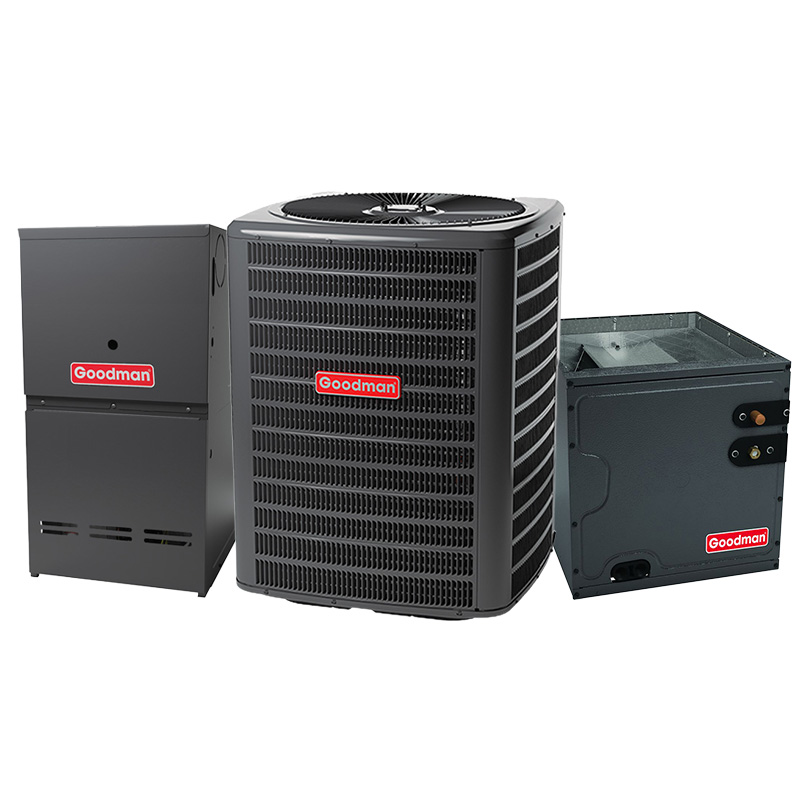
Goodman 3.5 Ton AC And 100000 BTU 80% AFUE Gas Furnace System | 15.2 SEER2 AC | Multi-Speed ECM Low NOx Furnace | Downflow | R32
View on AC Direct see your lowest price →Check current price on AC Direct →
Key features
- 3.5-ton cooling capacity with 15.2 SEER2 efficiency rating
- 100,000 BTU output, 80% AFUE downflow gas furnace
- Multi-speed ECM blower motor for quieter, more even airflow
- R-32 refrigerant with lower global warming potential than R-410A
- Low NOx combustion meets California and strict-state emissions standards
- Downflow cabinet orientation for platform or elevated-closet installations
About this system
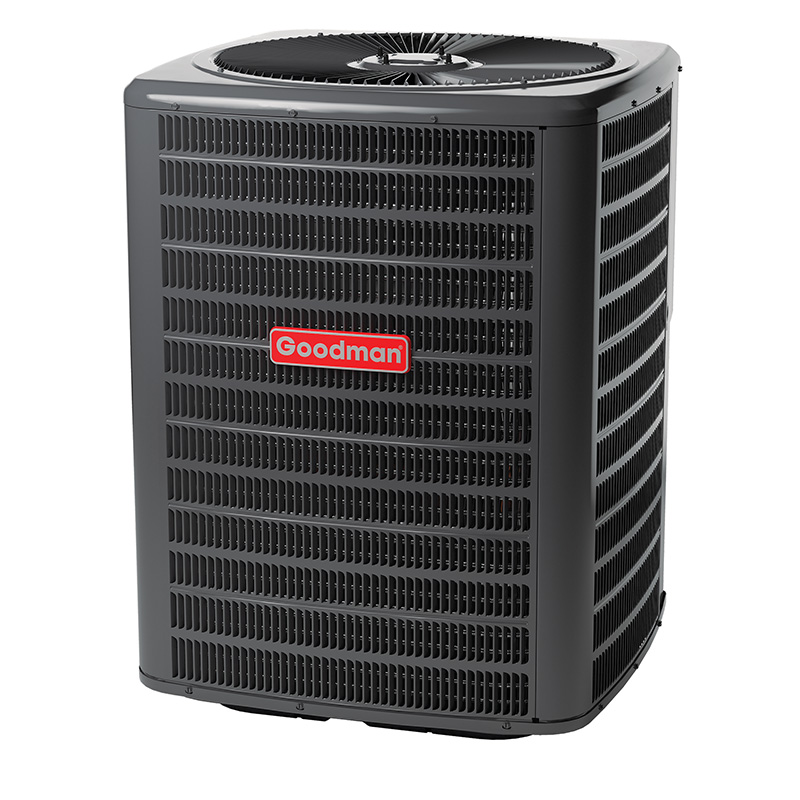
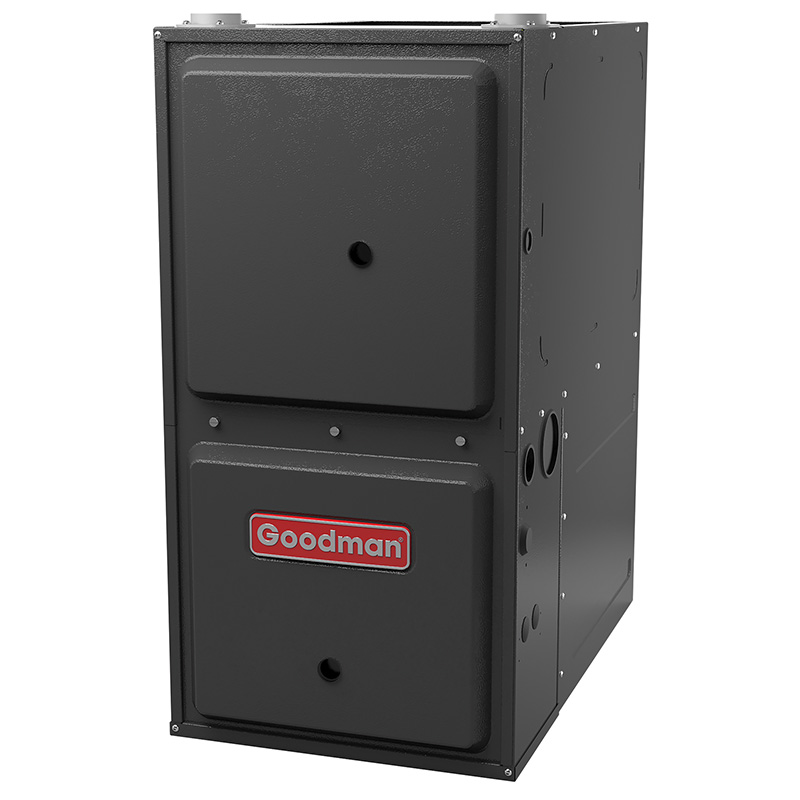
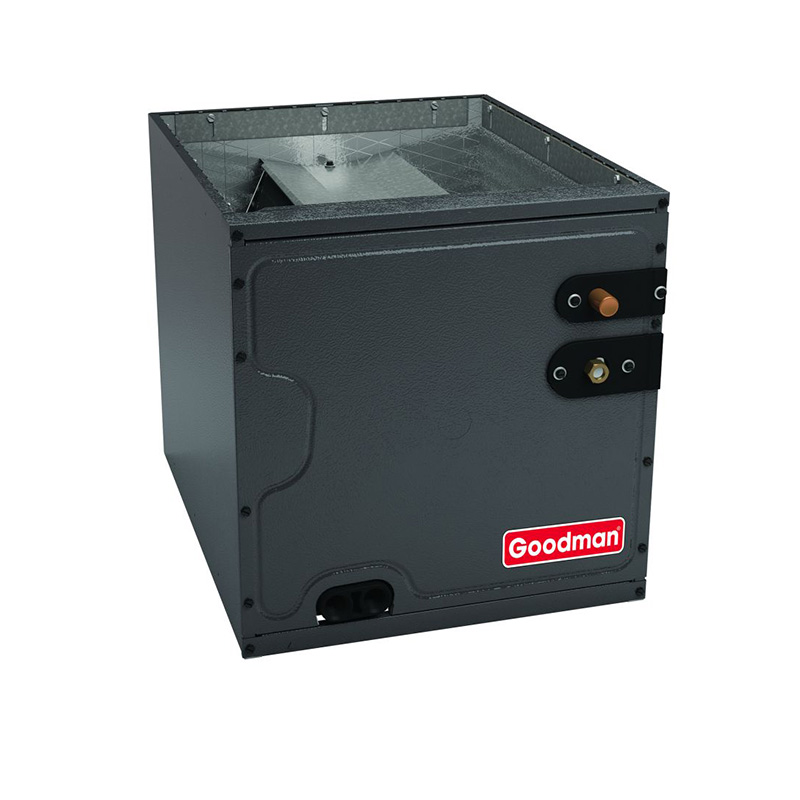
This Goodman bundle pairs a 3.5-ton, 15.2 SEER2 air conditioner with a 100,000 BTU, 80% AFUE downflow gas furnace to cover homes in roughly the 1,800 to 2,400 square-foot range, depending on your climate zone and insulation. The air conditioner uses R-32 refrigerant, a lower-GWP option that has become standard in newer residential equipment, and the furnace runs a multi-speed ECM blower that modulates airflow for quieter operation and more even temperature distribution than a single-speed unit would provide. The downflow configuration means conditioned air is discharged through the bottom of the cabinet, which suits homes where the furnace sits in a closet or utility room above the duct system, typically a platform-on-slab or upstairs mechanical room setup.
At 15.2 SEER2, this system clears the federal minimum threshold for most U.S. regions but sits at the lower end of the efficiency range rather than the middle or top. That is a reasonable trade-off if your primary goal is keeping the purchase price down and your cooling season is moderate. The 80% AFUE rating on the furnace means one dollar in five is lost as flue gas, so if you are in a cold northern climate with high gas prices, a 96% unit would recover that gap in operating costs over time. For mild-to-moderate heating loads, or where natural gas is inexpensive, the 80% tier is often the practical choice. The Low NOx designation on the furnace satisfies air-quality regulations in California and other states with strict emissions rules.
This Goodman bundle delivers solid entry-level performance at a price that undercuts Carrier, Trane, and Lennox by a meaningful margin, making it a credible choice for budget-conscious buyers who plan to invest in a quality installation. The 15.2 SEER2 and 80% AFUE specs are functional rather than impressive, and long-term ownership costs depend heavily on how well it is installed and whether a service contract covers the documented weak points like capacitors and evaporator coils. It is not the system for someone who wants to buy it and forget about it for 20 years.
Overall score is the average of the five ratings above.
What we like
- Purchase price runs 15 to 25 percent below comparable Trane, Lennox, and Carrier systems
- Multi-speed ECM blower improves comfort and reduces noise versus single-speed alternatives
- R-32 refrigerant is widely available and accepted under current and near-future regulations
- Low NOx certification keeps the system legal in California and other emissions-restricted markets
- Downflow configuration suits a specific and common installation layout that not every bundle addresses
Trade-offs
- 80% AFUE loses 20 cents of every heating dollar and will cost more to operate than a 96% furnace in cold climates
- 15.2 SEER2 sits at the low end of the efficiency range, limiting long-term energy savings compared to 17+ SEER2 options
- Compressor lifespan averages 10 to 14 years versus 15 to 20 years for premium-brand compressors, per documented owner experience
- Dual-run capacitor failures and evaporator coil leaks are recurring issues in owner reports, adding to post-warranty service costs
What homeowners and pros say about Goodman
Homeowners discussing Goodman equipment online tend to split into two camps: those who had a clean installation and years of uneventful service, and those who ran into repair costs that eroded the upfront savings. The brand’s ConsumerAffairs score sits around 2.5 out of 5, a channel that draws disproportionately from frustrated owners, where the recurring pattern is rising repair bills after roughly year seven. Google dealer reviews average closer to 3.8 out of 5, with affordability cited most often as the reason buyers chose the brand. Neither number is exceptional, but together they sketch a realistic picture: Goodman works, with conditions attached.
HVAC technicians who work on Goodman equipment regularly point to dual-run capacitor failures as the most common service call, typically a low-drama fix in the 300 to 600 dollar range. More consequential are evaporator coil leaks, which show up in a notable share of owner reports and can mean significant refrigerant and labor costs. A smaller group of owners has reported refrigerant leaks in the first year, generally traced back to installation or initial charge issues rather than defective equipment. Compressor longevity is another honest caveat: documented experience puts Goodman compressors at 10 to 14 years on average, versus 15 to 20 years for top-tier brands. For this specific downflow R-32 system, the practical takeaway is that the savings at purchase are real, but budgeting for a service plan or a capacitor replacement somewhere in years five through nine is a reasonable expectation rather than a worst case.
Sources: ConsumerAffairs Goodman owner reviews, AHRI Directory of Certified Product Performance, U.S. DOE appliance and equipment efficiency standards, Goodman product specification sheets.
What it costs to run
At 15.2 SEER2, cooling this 3.5-ton system for a typical 1200-hour cooling season at the U.S. average electricity rate of $0.17/kWh works out to roughly $564 per year in cooling, about $75 less per year than a minimum-efficiency 13.4 SEER2 unit of the same size. Your real cost depends on your climate and local rate.
Method: (42,000 BTU/hr ÷ 15.2 SEER2) × 1200 hours ÷ 1000 × $0.17/kWh. Rate source: U.S. EIA average; cooling hours: moderate-climate estimate.
How it compares
| Brand | Comparable model | SEER2 | Stage | Price position |
|---|---|---|---|---|
| Goodman | GSXH5 / GMVC8 Downflow Bundle | 15.2 | Single-stage / Multi-speed | Value pick |
| Carrier | Comfort 24ACC636 with 58STA Gas Furnace | 15.2 | Single-stage | 15 to 25 percent higher than this Goodman bundle |
| Trane | XR15 with S9V2 Gas Furnace | 15.0 | Single-stage / Variable-speed blower | 20 to 30 percent higher than this Goodman bundle |
| Lennox | Merit ML14XC1 with ML195 Gas Furnace | 15.0 | Single-stage | 15 to 25 percent higher than this Goodman bundle |
Competitor rows are comparable single-stage units at similar efficiency; price is relative position, not a quote.
Questions about this system
Is a downflow furnace the right configuration for my house?
Downflow furnaces discharge air through the bottom of the cabinet and are designed for installations where the unit sits above the duct system, such as a closet on a raised platform, a second-floor mechanical room, or a garage application. If your ducts run under a slab or in a basement below the furnace, you need an upflow unit instead. Confirm your duct layout with your installer before ordering.
Will R-32 refrigerant be easy to service in a few years?
R-32 is already widely used in residential equipment globally and is increasingly stocked by U.S. distributors as the industry moves away from R-410A. It is mildly flammable, which requires certified technicians to follow specific handling procedures, but availability is not expected to be a problem for residential service over the life of this system.
How much does the 80% AFUE versus a 96% AFUE furnace actually cost in extra heating bills?
For every 100,000 BTU of heat produced, an 80% unit consumes roughly 125,000 BTU of gas while a 96% unit consumes about 104,000 BTU. In a cold climate burning 800 to 1,000 therms per season, that gap can translate to a meaningful annual difference depending on your local gas rate, and a 96% unit often pays back the price premium within five to eight years in northern regions.
What are the most likely repairs on this system, and what do they cost?
The most commonly reported failure on Goodman AC equipment is the dual-run capacitor, which typically costs 300 to 600 dollars to diagnose and replace and is usually a straightforward fix. Evaporator coil leaks appear in a notable share of owner reports and can run considerably more, particularly if refrigerant recovery and recharge are involved. Compressors on Goodman units average 10 to 14 years before failure, shorter than the 15 to 20 years often seen on premium brands.
Does Goodman's warranty require professional registration, and what does it actually cover?
Goodman requires the system to be registered within a set window after installation to receive the full extended parts warranty; failure to register typically drops coverage to a shorter base period. The warranty covers parts but not labor, which means a compressor replacement under warranty can still cost you several hundred dollars in service fees. Confirm registration requirements and labor coverage options with your dealer at the time of purchase.
Specifications
| Cooling capacity | 3.5 Ton |
| Efficiency | 15.2 SEER2 |
| Furnace output | 100000 BTU |
| Furnace efficiency | 80% AFUE |
| Configuration | Downflow |
| Refrigerant | R-32 |