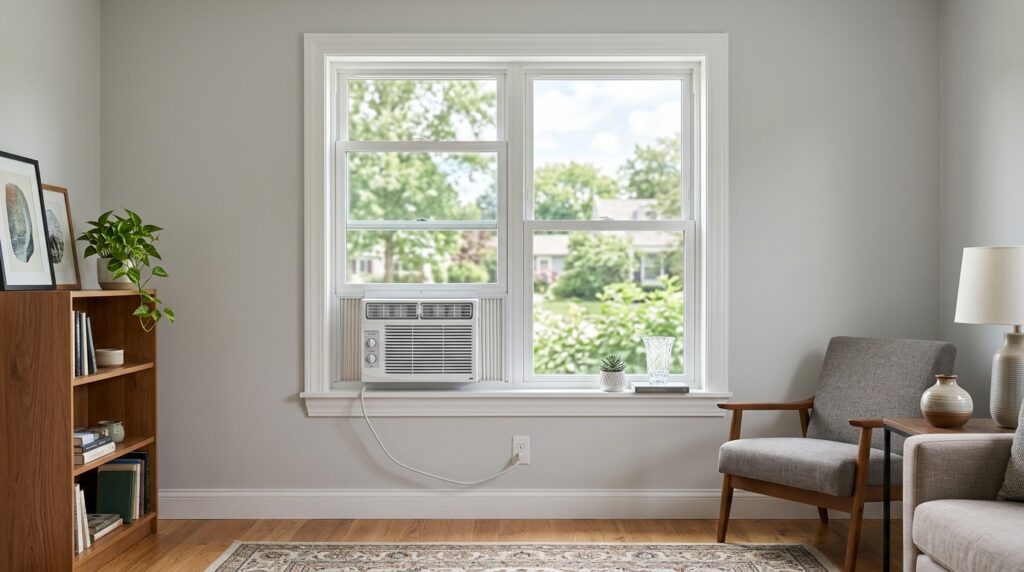
Window air conditioner installation typically costs between $210 and $1,100 when you combine the unit and professional setup, with most homeowners landing in the $313 to $400 range for a standard unit plus a basic install. Larger or more complex jobs can climb toward $1,200 or more once you factor in higher-BTU units and any electrical work.
That spread is wide because the term “installation” covers everything from a $139 labor-only setup of a unit you already own to a fully outfitted, bracket-mounted, high-capacity unit with a dedicated circuit. Below you will find the price ranges by size, what actually moves the number, the efficiency ratings that matter for window units, the truth about tax credits, and clear signs it is time to replace rather than repair.
What window AC installation actually costs
Browse ductless mini-split systems at contractor pricing, then have a local pro install. Compare models and current prices on our ductless mini-split systems page.
The biggest variables are the unit’s cooling capacity (measured in BTUs), whether you hire a pro, and whether your room needs any electrical upgrades. Labor for professional installation generally runs $60 to $300 and takes two to four hours, depending on the unit’s weight, your window type, and local labor rates.
Unlike central systems, window units are self-contained and vent directly outdoors, so ductwork is not a cost factor here. That keeps the overall job simpler and cheaper than almost any other type of cooling installation.
Cost by unit size
| Unit Size (BTUs) | Room Size (Sq. Ft.) | Estimated Total (Unit + Install) |
|---|---|---|
| 5,000–8,000 | 100–350 | $210–$830 |
| 8,000–12,000 | 350–550 | $280–$880 |
| 12,000–18,000 | 550–1,000 | $360–$1,100 |
| 18,000–24,000 | 1,000–1,500 | $660–$1,500 |
These totals combine a unit price of roughly $150 to $1,200 with $60 to $300 in labor. The unit alone usually falls between $150 and $800 for the most common residential sizes. A good sizing rule of thumb is about 20 BTUs per square foot, so a 100 to 350 square foot room typically needs a 5,000 to 8,000 BTU unit, while a 350 to 550 square foot space steps up to 8,000 to 12,000 BTUs.
What drives the cost up or down
- Unit size and weight: Higher-BTU units cost more to buy and may need extra support hardware, which adds labor and parts.
- Features: Smart Wi-Fi or app-controlled units, ENERGY STAR-rated models, and inverter technology all raise the purchase price compared with a basic unit.
- Electrical work: If you need a dedicated circuit or an outlet upgrade to match the unit’s voltage and amperage, expect to add $150 to $400. Window units must plug into a properly grounded, dedicated outlet, never an extension cord or power strip.
- Permits: Where required, permit fees typically run $25 to $150 depending on your jurisdiction.
- Region and labor: Rates vary widely by location and technician experience, which is why the labor band is so broad.
Efficiency ratings for window units
You may see SEER2, HSPF2, and AFUE in HVAC marketing, but those ratings apply to central systems, heat pumps, and furnaces, not window air conditioners. Window units are rated by EER (Energy Efficiency Ratio) or CEER (Combined Energy Efficiency Ratio).
Higher EER or CEER units generally cost more upfront but use less electricity, so they can lower your operating costs over the unit’s life. If you run a unit heavily through the summer, paying a bit more for a higher-efficiency, ENERGY STAR-certified model often pays back over time. You can compare certified models at ENERGY STAR and review cooling basics through the U.S. Department of Energy at energy.gov.
Tax credits and rebates: what to expect
Here is the short version: standard window air conditioners generally do not qualify for the federal 25C Energy Efficient Home Improvement Credit. That credit is aimed at central air conditioners, heat pumps, furnaces, boilers, insulation, and qualifying windows and skylights that meet specific high-efficiency standards.
For context, the 25C credit covers 30% of qualified expenses with an annual maximum of $1,200 for most improvements, a separate $2,000 annual limit for qualified heat pumps and biomass equipment, and an overall annual cap of $3,200 when a qualifying heat pump is included. For air conditioners, eligibility typically requires central split systems of 17.0 SEER2 and 12.0 EER2 or higher (or 16.0 SEER2 and 11.5 EER2 for packaged systems) that are ENERGY STAR certified. None of that applies to a standard window unit.
Important timing note: as of late 2025, the federal 25C credit is set to expire on December 31, 2025. For improvements placed in service in 2026, this federal credit is generally no longer available. Because the rules can change, confirm current status directly with the official sources before you rely on any number. Check the IRS and the credit details at ENERGY STAR.
On the rebate side, the Inflation Reduction Act’s state-run programs (the Home Energy Rebates, sometimes called HEEHRA) were still being rolled out in many states as of late 2025. These focus on whole-home electrification and efficiency upgrades such as heat pumps, insulation, and electrical panels, so standard window units are unlikely to qualify for meaningful federal rebates. Some local utilities may offer smaller incentives for ENERGY STAR-certified window units, so check with your state energy office and your utility provider.
DIY vs. professional installation
Installing a window AC is one of the more DIY-friendly cooling projects. Most units ship with easy-install kits, side panels, and weatherstripping, and you only need basic tools: a drill, screwdrivers, a level, and a tape measure. The catch is weight, which is why it is often a two-person job.
Typical installation steps
- Prepare the window: check for obstructions, clean the sill and frame, and confirm the unit fits.
- Attach the side panels (accordion panels) to the unit.
- Lift and set the unit into the window opening, ideally with a second person.
- Secure the unit with screws and lower the upper sash onto the top flange.
- Extend and seal the accordion panels, then add foam insulation between the sashes.
- Set a slight outward tilt so condensation drains outside, not into your room.
- Plug into a grounded, dedicated three-pronged outlet that matches the unit’s voltage and amperage.
Safety and code realities
- Support brackets: Use a load-rated bracket, especially for heavier units, to transfer weight to the wall and exterior rather than the window sash alone. Some jurisdictions, including New York City, require external brackets regardless of unit weight, so check your local code.
- Electrical: Make sure the circuit can handle the load. Larger units may need a dedicated circuit, and you should never use extension cords or power strips.
- Egress: Do not install a unit in an egress window or a fire escape route.
A professional is worth it when you need electrical upgrades, you are mounting a heavy or high-capacity unit, your window configuration is awkward, or you want to be certain the install meets local code and avoids leaks, drafts, and electrical hazards.
EPA 608 and refrigerant rules
Window units contain refrigerant and are classified as “small appliances” (5 pounds or less of refrigerant). Installing a new, pre-charged unit does not normally involve handling refrigerant, so a typical install does not trigger certification requirements. However, EPA Section 608 of the Clean Air Act prohibits knowingly releasing refrigerant, and anyone who services, repairs, or disposes of a unit by opening the refrigerant system must hold a Type I EPA 608 certification. When you scrap an old unit, the final disposer must recover and document the refrigerant. You can review these rules through the U.S. Environmental Protection Agency.
How to save money
- Right-size the unit. Oversizing wastes money upfront and runs less efficiently. Match BTUs to your room’s square footage.
- Handle a simple install yourself. If your window is standard and you already have a grounded dedicated outlet, DIY can save the $60 to $300 labor charge.
- Reuse hardware. A quality support bracket from a previous unit can carry over if it is load-rated and compatible.
- Buy a higher EER/CEER model if you cool heavily. The lower running cost can outweigh the higher sticker price.
- Check local utility incentives. Smaller rebates for ENERGY STAR-certified window units sometimes exist even when federal credits do not apply.
- Seal it properly. Good weatherstripping and foam insulation reduce air leaks and lower your cooling bill.
Signs you need to replace your window AC
Repair makes sense for minor issues on a newer unit, but replacement is usually the smarter call when several of these apply:
- The unit is more than eight years old.
- It is out of warranty.
- Repairs are frequent or costly, especially when a single repair exceeds 50% of the price of a new unit.
- The unit has extensive physical damage.
- Cooling performance and efficiency have clearly declined.
- There is a refrigerant leak, which requires certified handling and often is not worth fixing on a small unit.
When you do replace, remember that the old unit must be disposed of properly so its refrigerant is recovered. Many municipal recycling programs and appliance retailers accept old window units, often for free or a small fee.
The bottom line for buyers
For a standard room, budget roughly $300 to $400 for a quality unit installed by a pro, and expect the full range to run from about $210 on the low end to $1,100 or more for larger or more complex jobs. Add $150 to $400 if you need new electrical, and a modest permit fee in some areas. Skip the search for federal tax credits on window units, focus on right-sizing and EER/CEER efficiency, and always use a load-rated bracket and a dedicated grounded outlet. That combination gets you reliable cooling at the lowest realistic cost.
Get quotes from vetted HVAC contractors in your area. Comparing two or three installers is the single best way to control the price.
Frequently Asked Questions
How much does it cost to install a window air conditioner professionally?
Professional installation typically costs between $60 and $300, on top of the unit's price. The job usually takes two to four hours, and rates vary by region and the unit's size and weight.
Do window air conditioners qualify for federal tax credits in 2025 or 2026?
Standard window air conditioners generally do not qualify for the federal 25C Energy Efficient Home Improvement Credit, which targets central AC, heat pumps, and other major upgrades. As of late 2025, that credit is set to expire on December 31, 2025, so confirm current status with the IRS and ENERGY STAR before relying on any 2026 figure.
Is it hard to install a window AC unit yourself?
Installing a window AC is generally a straightforward DIY project with basic tools, but it often needs two people because of the unit's weight. You should also use a load-rated support bracket and a grounded dedicated outlet.
Do I need a support bracket for my window AC?
In most cases yes. A load-rated support bracket is recommended or required by local codes to prevent sagging and accidents and to transfer the unit's weight to the wall rather than the window sash. Some jurisdictions, such as New York City, require brackets regardless of weight.
What size window AC do I need for my room?
A common guideline is about 20 BTUs per square foot. A 100 to 350 square foot room typically needs 5,000 to 8,000 BTUs, while a 350 to 550 square foot room needs 8,000 to 12,000 BTUs.
Can I use an extension cord with a window AC unit?
No. Never use an extension cord or power strip with a window AC, since it creates an overload and fire risk. Plug the unit into a properly grounded, dedicated outlet that matches its voltage and amperage.
What is EPA 608 certification, and does it apply to window ACs?
EPA 608 certification is federally required for anyone who handles refrigerants. Installing a new, pre-charged window unit usually does not require it, but servicing, repairing, or disposing of a unit by opening the refrigerant system requires a Type I EPA 608 certification.
When should I replace my window AC unit?
Consider replacing your unit if it is more than eight years old, out of warranty, needs frequent or costly repairs (especially a repair exceeding 50% of a new unit's cost), has extensive damage, has poor efficiency, or has a refrigerant leak.