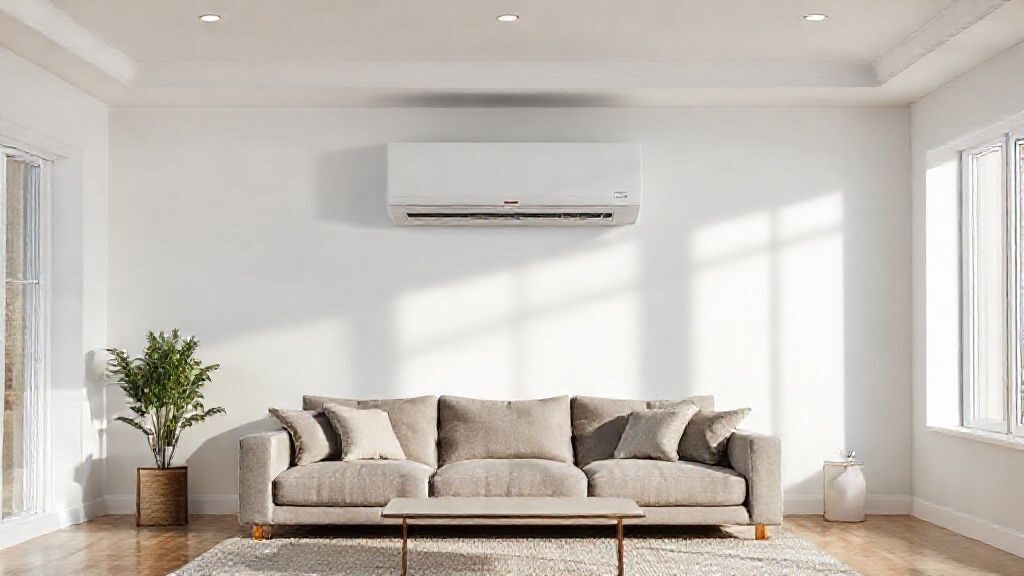
When I talk to homeowners about mini splits, the single most common mistake I see isn’t the brand they choose or where they locate the heads—it’s the sizing. People tend to treat BTUs like horsepower: if some is good, more must be better. That approach is expensive and will absolutely ruin your system’s efficiency and comfort.
I remember a job in Tampa a few years back. The owner was installing a single mini split in an enclosed Florida room—mostly glass, facing west, with zero insulation in the ceiling. He calculated the size based only on the 300 square feet of floor space and bought a 9,000 BTU unit. He thought he was saving money. What happened? That unit ran non-stop from noon until sunset, struggled to hit 78 degrees, and never pulled enough moisture out of the air. It was undersized by 50% for the thermal load. The point is, sizing a mini split correctly requires looking at the whole picture: volume, materials, sun, and local climate.
Key Highlights
- Do not size a mini split based on square footage alone. This is the primary reason for failure.
- BTU stands for British Thermal Unit and represents the amount of heat energy the unit moves per hour.
- An oversized unit cycles on and off too quickly (short-cycling), which destroys energy efficiency and leaves humidity in the air.
- A rule of thumb is 20–25 BTUs per square foot, but adjustments must be made for insulation, windows, and occupancy.
- For multi-zone systems, the outdoor unit (condenser) does not need to equal the sum of the indoor head units’ BTUs (this is called the diversity factor).
Why Proper Sizing is Crucial for Mini Splits Efficiency
I want to be clear: an improperly sized mini split will operate far less efficiently than a properly sized ducted heat pump or furnace setup, despite the inherent efficiency of the ductless technology. The mini split system is designed to provide variable capacity. It ramps up or down based on the exact load requirement of the zone. This is why they are so good at maintaining precise temperatures.
When you install a unit that is too large (oversized), you defeat the main advantage of the variable speed compressor. The unit blasts cold or hot air, satisfies the thermostat setpoint rapidly, and then shuts off. It satisfies the temperature requirement before it has run long enough to achieve proper dehumidification in the cooling mode. This is called short cycling.
Short cycling means:
- The evaporator coil doesn’t stay cold long enough to condense and drain moisture properly, leading to a clammy feeling even if the temperature is right.
- The unit consumes a high amount of energy during startup, which is inefficient.
- The compressor and other components suffer excess wear and tear because they are constantly turning on and off under high load.
If the unit is undersized, it runs constantly at 100% capacity, never reaching the desired temperature on the hottest or coldest days. This stresses the system and increases your utility bills unnecessarily. You must find the balance point.
Understanding BTUs (British Thermal Units) for Cooling and Heating
BTU is the cornerstone of HVAC sizing. A British Thermal Unit is simply the amount of energy required to raise the temperature of one pound of water by one degree Fahrenheit. In practical terms for your home, the BTU rating on a mini split tells you its capacity to move heat out of the space (cooling) or into the space (heating) over the course of an hour.
When you see ratings like 9,000, 12,000, 18,000, or 24,000 BTUs, those numbers correspond directly to the size of the system. We often reference capacity in tons. One ton of cooling capacity equals 12,000 BTUs per hour.
It’s important to note that mini splits typically have a slightly different BTU rating for heating capacity versus cooling capacity, especially at extreme outdoor temperatures. You need to ensure the unit you select meets the required heating load for your specific climate, particularly if you live in a Northern state where heating is the primary concern. In very cold climates, some standard mini splits may lose significant heating capacity, requiring supplemental systems, possibly even high-efficiency units like a gas floor furnace depending on the age and existing infrastructure of the home.
Step-by-Step Mini Split Sizing Calculation
Calculating the correct BTU load is not guesswork. It is a methodical calculation known in the industry as a load calculation. While a full Manual J calculation requires specialized software and detailed measurements, for a mini split serving a single room or simple zone, you can use a reliable, three-step methodology.
Sizing Factor 1: Square Footage and Room Dimensions
The calculation always starts with the square footage of the room or zone you intend to cool and/or heat. This provides the baseline BTU requirement. We typically use a range of 20 to 25 BTUs per square foot for a standard home with average ceiling heights (8–10 feet).
- Step 1a: Calculate Area. Measure the length and width of the room. Multiply them together. (Example: 20 feet x 15 feet = 300 square feet.)
- Step 1b: Determine Baseline BTU. Multiply the square footage by the standard load factor (we use 25 for a reasonable average). (Example: 300 sq ft x 25 BTU/sq ft = 7,500 BTUs.)
This baseline calculation—7,500 BTUs—is your starting point. However, if you simply stop here and buy the closest unit (which would be a standard 9,000 BTU mini split), you are ignoring heat gain or loss factors that significantly alter the final number. This is where most DIY installations go wrong.
Sizing Factor 2: Insulation, Windows, and Sun Exposure
Heat transfer happens through your walls, ceilings, floors, and glass. The material quality and age of your home drastically impact the required capacity.
You must apply adjustment percentages to your baseline BTU calculation (from Step 1b). These factors are cumulative:
A. Window and Door Adjustments
- Standard Windows (Double Pane, Average Size): Add 500 BTUs for the first window, and 200 BTUs for each subsequent window or standard exterior door.
- Large Windows or Glass Sliding Doors (High Heat Gain): Add 800–1,000 BTUs per large glass surface, especially if facing South or West.
- Severe Sun Exposure (South/West Facing): If the room receives direct afternoon sunlight, increase the total calculated BTU load by an additional 10%.
B. Insulation and Structure Adjustments
- Excellent Insulation (New construction, high R-value): Subtract 10% from the baseline BTU.
- Average Insulation (Modern homes, well-maintained): Use the baseline BTU (no change).
- Poor Insulation (Older homes, drafty windows, uninsulated attics): Add 15% to the baseline BTU.
- Cathedral or Vaulted Ceilings: If your ceiling height is 12 feet or more, you must calculate volume, not just area. For every extra foot of height above 8 feet, add 5% to the baseline calculation.
If you are dealing with a historic home or a space that is structurally difficult to cool—maybe a converted barn or sunroom—you might need to consider highly specialized equipment like a high-velocity system, which might increase the cost of unico system installation, but solves difficult air delivery issues where standard ducting is impossible.
Sizing Factor 3: Climate Zone and Occupancy Load
The location of your home and how the room is used are the final major factors in sizing.
A. Occupancy and Heat Generating Equipment
Every person generates approximately 400 BTUs per hour of heat. If your zone is a bedroom, this factor is minor. If it’s a living area frequently used for gatherings, or a home gym, it’s critical.
- Standard Occupancy (1–2 people): Add 800 BTUs.
- High Occupancy (Kitchens, Offices, Gyms): Add 1,200 BTUs plus 400 BTUs for every person over two regularly occupying the space.
- Kitchen Load: Kitchens require a significant boost due to heat generated by cooking appliances. Add 4,000 BTUs for a standard kitchen, or up to 6,000 BTUs for a large, professional-style kitchen.
B. Climate Zone Priority
If you live in a deep Southern zone (e.g., Miami), your calculation must prioritize cooling and dehumidification load. If you live in a deep Northern zone (e.g., Minneapolis), your calculation must prioritize heating load.
- Cooling Priority: Use the highest possible heat gain calculation to determine the required BTU capacity.
- Heating Priority (low ambient temps): If your average winter temperature drops below 20°F, you need to ensure the unit is specifically rated for low-ambient heating. Often, you need to select a system that is one size larger than your cooling calculation dictates just to maintain heat output when it is below freezing.
Single-Zone vs. Multi-Zone Mini Split Sizing Calculations
A single-zone system is straightforward: calculate the required BTU for the room, then choose the unit that matches or slightly exceeds that number (without dramatically oversizing). If your calculation lands exactly on 11,000 BTUs, you buy a 12,000 BTU unit.
Multi-zone systems complicate the sizing because you are matching multiple indoor heads (e.g., three 9,000 BTU heads) to one outdoor condenser unit.
The key concept here is the **diversity factor.** It is highly unlikely that every single head in your multi-zone system will be running at 100% capacity simultaneously. For example, if you have four bedrooms (4 x 9,000 BTUs = 36,000 BTUs total potential demand), you do not need a 36,000 BTU outdoor unit. You might only need a 27,000 or 30,000 BTU outdoor unit.
HVAC manufacturers build in flexibility. If you demand 36,000 BTUs simultaneously, the condenser will pull maximum power and distribute it, meaning each head will receive slightly less than its full potential—perhaps 80% to 90%. However, this seldom affects comfort and saves significantly on equipment cost and operational efficiency.
- Multi-Zone Rule: Calculate the total required BTUs of all indoor heads, and then select an outdoor condenser with a capacity that is 70% to 85% of that total sum. Always consult the manufacturer’s specific pairing charts, as they dictate the exact efficiency and performance of linked components.
What Happens If Your Mini Split Is Oversized or Undersized?
I cannot stress this enough: Oversizing is more common, and often leads to more homeowner complaints than undersizing in mild climates.
The Problem with Oversizing (Too Many BTUs)
When a unit is too large, it satisfies the temperature quickly. Because it satisfies temperature so quickly, it prevents the system from running long enough to enter the critical dehumidification phase. This results in the room feeling cold but sticky or clammy.
Furthermore, an oversized system rapidly cycles the compressor—on, off, on, off. This defeats the purpose of the inverter technology designed for long, low-power runtimes. It burns extra energy during startup surges and dramatically reduces the lifespan of the equipment. If you are struggling with a system that short cycles, you might want to look into finding the best hvac solution for your home that allows for better modulation or zoning control.
The Problem with Undersizing (Too Few BTUs)
If the unit is undersized, especially in high-load areas (like the Tampa sunroom I mentioned), it will run continuously. The unit will never cycle off, trying desperately to keep up with the heat gain. You will pay for constant electricity use, and the temperature will creep up during peak demand times. While running constantly may seem bad, the wear and tear is often less severe than short cycling, but the comfort and energy efficiency are unacceptable.
When to Consult an HVAC Professional for Expert Sizing
For a standard bedroom or office in a modern home, you can likely calculate the load accurately using the step-by-step method outlined above. However, complex situations demand a professional Manual J calculation.
You should call a professional if your zone involves any of the following:
- A multi-zone system with five or more indoor units.
- Rooms with excessive glass, especially high walls of windows or unique skylights.
- Areas with high ceiling heights (cathedral or vaulted ceilings over 14 feet).
- Rooms that are partially underground (basements or cellar conversions).
- New construction or major additions, where the entire thermal envelope is changing.
- Homes located in extreme climate zones where the temperature differential between indoor and outdoor is consistently 50 degrees Fahrenheit or more.
A certified professional will use software to calculate every surface area, insulation value (R-value), orientation, and air infiltration rate. This precision removes the guesswork. When you are ready for a definitive calculation and installation proposal, please contact us for a quote. We ensure the sizing is right the first time, and often, we have access to manufacturer rebates and ac coupons that can reduce the overall equipment cost.
FAQ
How much space can a 12,000 BTU mini split cool?
A 12,000 BTU unit (1 Ton) is often rated for rooms between 450 to 550 square feet under standard conditions (average insulation, average climate). However, if that 500 sq ft room is a sunroom with poor insulation, it might only effectively cool 300 sq ft. You must perform the load calculation; do not rely on rough square footage estimates.
Should I round up or round down if my calculated BTU falls between standard sizes?
If your final, fully adjusted load calculation lands exactly between two standard unit sizes (e.g., 14,500 BTUs, which falls between 12,000 BTU and 18,000 BTU), you should typically round down to the 14,000 BTU range if possible, or choose the 12,000 BTU unit and monitor performance closely. Mini splits are variable speed, so they can typically ramp up slightly past their nominal rating for a short time. Rounding down slightly encourages longer, more energy-efficient run cycles that prioritize dehumidification, which is especially important for comfort.
Do I need more BTUs if I plan to use the mini split for both heating and cooling?
Yes, often you do, particularly if you live in a cold region. While the unit may be perfectly sized for cooling (which is usually the higher requirement in terms of capacity), cold weather severely degrades the heat output of a standard heat pump. For example, a 12,000 BTU unit might only put out 9,000 BTUs of heat when it’s 10°F outside. If heating is critical, look for a hyper-heat or cold-climate rated mini split, or size the unit based on the lowest expected heating temperature, which usually means selecting one size up from your cooling calculation.
Does the height of the mini split head on the wall affect performance?
The placement of the indoor head matters significantly for comfort, but generally does not affect the sizing calculation itself. For cooling, placing the head high allows the heavy cold air to cascade down and fill the room. For heating, this placement is less ideal as heat naturally rises, but most mini splits have powerful fans to counteract this effect. The critical factor is unobstructed air flow in and out of the unit.
Final Thoughts
Sizing is the technical hinge upon which the success of your mini split installation rests. Get it wrong, and you waste the efficiency that ductless systems are famous for. Get it right, and you gain reliable, hyper-efficient, quiet comfort for years.
My advice remains simple: Start with your square footage, apply the critical adjustments for windows, insulation, and usage, and then prioritize run-time over brute force capacity. Err slightly on the side of smaller capacity if your calculation falls between sizes. This disciplined approach ensures you utilize the variable speed technology as it was designed—for long, steady, highly efficient performance.