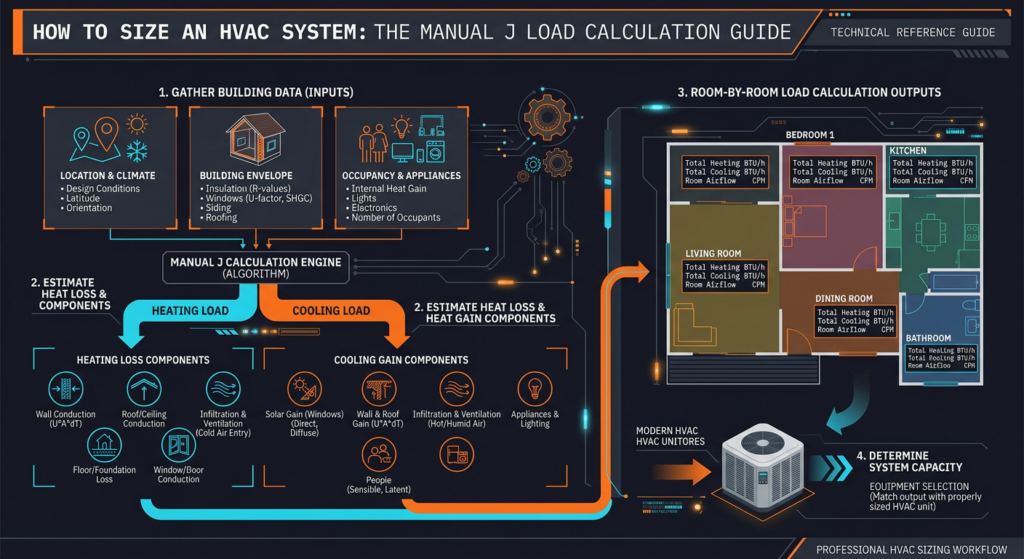
Properly sizing an HVAC system is the most important step in ensuring comfort, efficiency, and equipment longevity. The industry standard for residential load calculations is ACCA Manual J — and understanding how it works helps homeowners ask the right questions and hold contractors accountable.
Why Sizing Matters
- Oversized systems short-cycle: they cool or heat quickly, shut off, then restart — never running long enough to properly dehumidify the air or reach steady-state efficiency. The result is clammy, uncomfortable spaces and premature equipment wear.
- Undersized systems run continuously on the hottest and coldest days, never reaching setpoint. They wear out faster and leave occupants uncomfortable during peak weather.
- Correctly sized systems run longer cycles at design conditions, maintain low humidity, operate efficiently, and last longer.
What Manual J Accounts For
Manual J is a room-by-room calculation. For each space, it calculates:
Heat Loss (Winter)
- Conduction through walls, ceilings, floors, windows, and doors (based on R-values, area, and indoor-outdoor temperature difference)
- Infiltration: air leakage through the building envelope
- Ventilation: intentional fresh air introduction
Heat Gain (Summer)
- Solar gains through windows (direction, shading, glass type)
- Conduction gains through envelope
- Internal gains: occupants (250 BTU/hr each), lighting, appliances
- Infiltration and ventilation latent (humidity) loads
Key Inputs
- Design temperatures: ACCA-published 99% heating and 1% cooling design temperatures for your location (e.g., Chicago: -4 F heating, 89 F cooling)
- Building envelope: Wall construction, insulation levels, window specs
- Orientation: Which direction the house faces affects solar gains
- Occupancy: Number of permanent occupants
- Infiltration rate: Estimated from construction quality or blower door test results
The Manual J Process
- Gather building plans or measure the existing home
- Input all envelope components room by room into ACCA-approved software
- Software calculates room-by-room loads
- Sum room loads to get whole-building peak load
- Use Manual S to select equipment that matches the calculated load
- Use Manual D to design duct system sized for room-by-room airflows
Red Flags in Contractor Quotes
- Contractor sizes equipment based only on square footage (e.g., 1 ton per 400 sq ft) without a full Manual J — this is not acceptable
- Contractor replaces like-for-like without verifying the original equipment was correctly sized
- No room-by-room analysis provided
Ask your contractor: Do you perform Manual J load calculations? Can you provide the report? A reputable contractor will say yes to both.
Tools Used
- Wrightsoft Right-J (most common)
- Elite RHVAC
- ACCA’s own Manual J software
- Carrier, Lennox, and other manufacturer selection tools (these use Manual J internally)