HVAC warranties are more complex than most homeowners realize. Understanding exactly what is covered, for how long, and under what conditions can save thousands of dollars and prevent nasty surprises when equipment fails.
Types of HVAC Warranties
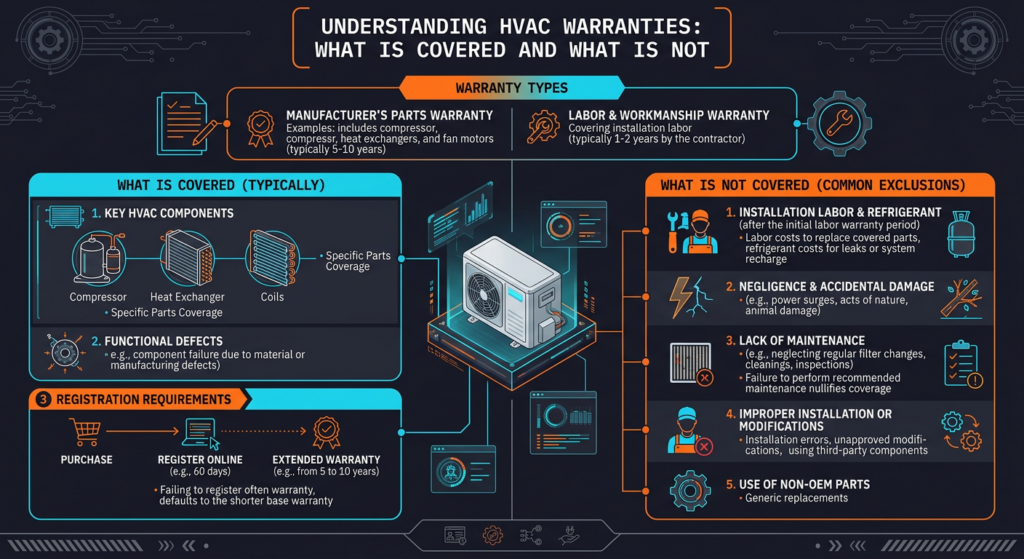
1. Manufacturer Parts Warranty
Covers defective components (compressors, heat exchangers, coils, circuit boards, motors). Standard terms:
- 5 years parts on basic residential equipment
- 10 years parts if registered within 60–90 days of installation (most manufacturers)
- Lifetime compressor or heat exchanger warranties on premium product lines
2. Manufacturer Labor Warranty
Rarely offered directly by manufacturers — this is typically 1 year if included at all. Most manufacturers cover parts only; labor costs are the contractor’s or homeowner’s responsibility after the first year.
3. Contractor Labor Warranty
Your installing contractor may offer 1–2 years of labor coverage as part of their installation quote. This is separate from the manufacturer warranty and varies by company.
4. Extended Warranties / Service Contracts
Third-party or manufacturer-backed service contracts that cover both parts and labor for 5–10 years. Can be valuable but read the fine print carefully.
Registration Requirements
Most major manufacturers (Carrier, Trane, Lennox, Rheem, Goodman, etc.) require warranty registration within 60 days of installation to receive the full extended warranty term. If you do not register:
- Parts warranty typically defaults to 5 years (base term)
- You forfeit the 10-year extended term
Your contractor should handle registration, but verify it was done. Keep the confirmation email.
Common Warranty Exclusions
- Improper installation: If the installing contractor made errors, the manufacturer may deny the claim. This is why using a licensed, qualified contractor matters.
- Lack of maintenance: Warranties typically require annual maintenance by a qualified technician. Skipping tune-ups can void coverage.
- Improper refrigerant charge: Overcharging or undercharging refrigerant voids many compressor warranties.
- Unauthorized modifications: Any non-factory modifications can void coverage.
- Non-matched systems: Using an outdoor unit from one brand with an indoor unit from another (mismatched systems) can void warranties on both units.
- Acts of God: Lightning strikes, floods, and other casualty events are typically not covered (use homeowners insurance).
- Consequential damages: Warranties cover parts and sometimes labor — not the cost of a hotel stay when your AC fails in July.
Heat Exchanger Warranties
The heat exchanger is the most critical (and expensive) furnace component. A cracked heat exchanger can leak carbon monoxide. Most quality manufacturers offer a 20-year to lifetime warranty on primary heat exchangers for registered units. This is one of the most valuable warranty provisions in HVAC.
Tips for Maximizing Warranty Protection
- Register the equipment immediately after installation
- Keep all paperwork: installation invoice, serial numbers, registration confirmation
- Schedule annual maintenance and keep records (receipts, invoices)
- Use only matched, approved systems
- When selling your home, many warranties are transferable (check manufacturer terms)