Air conditioning accounts for roughly 17% of total residential electricity consumption in the United States, making it one of the largest energy expenses in most homes. Yet few homeowners understand the science that keeps their living spaces comfortable during scorching summers. An air conditioner does more than just cool air. It controls humidity, filters particulates, and circulates conditioned air throughout a building. Understanding how these systems work empowers you to make smarter purchasing decisions, troubleshoot basic problems, reduce energy bills, and communicate effectively with HVAC technicians. This guide covers the thermodynamic principles behind cooling, the refrigeration cycle, key components, system types, efficiency ratings, common problems, and practical tips for optimal performance.
The Science of Cooling: Thermodynamics and Heat Transfer
Air conditioners do not create cold. They move heat from one place to another. This distinction is fundamental. Heat is energy that transfers from a warmer object to a cooler one, and an air conditioner exploits this principle by using a chemical refrigerant to absorb indoor heat and dump it outside.
Laws of Thermodynamics
The First Law of Thermodynamics states that energy cannot be created or destroyed, only transferred or converted. When your AC removes heat from indoor air, that thermal energy does not vanish. It gets relocated outdoors. The Second Law of Thermodynamics tells us that heat naturally flows from hot to cold. Moving heat against this natural direction, from your cool interior to the hotter exterior, requires work. That work comes from the compressor, which is why air conditioners consume electricity.
Heat Transfer Mechanisms
Three mechanisms govern heat transfer: conduction (direct contact between materials), convection (heat transfer through fluid or air movement), and radiation (electromagnetic waves). Air conditioning systems rely primarily on forced convection, using fans to push air across cold and hot coils to accelerate heat exchange.
Phase Change and Latent Heat
The real secret behind air conditioning is phase change. When a liquid evaporates into a gas, it absorbs a large amount of energy called latent heat of vaporization. Think about how rubbing alcohol feels cold on your skin as it evaporates. Refrigerants work the same way but far more efficiently. When the gaseous refrigerant later condenses back into a liquid, it releases that stored energy as heat. This absorption and release of latent heat allows refrigerants to move enormous quantities of thermal energy with relatively small volumes of fluid.
The pressure-temperature relationship makes this cycle controllable. A refrigerant’s boiling point changes with pressure. Lower the pressure and the refrigerant boils at a lower temperature, allowing it to absorb heat from indoor air. Raise the pressure and its boiling point increases, forcing it to condense and release heat even into hot outdoor air.
The Refrigeration Cycle: Step by Step
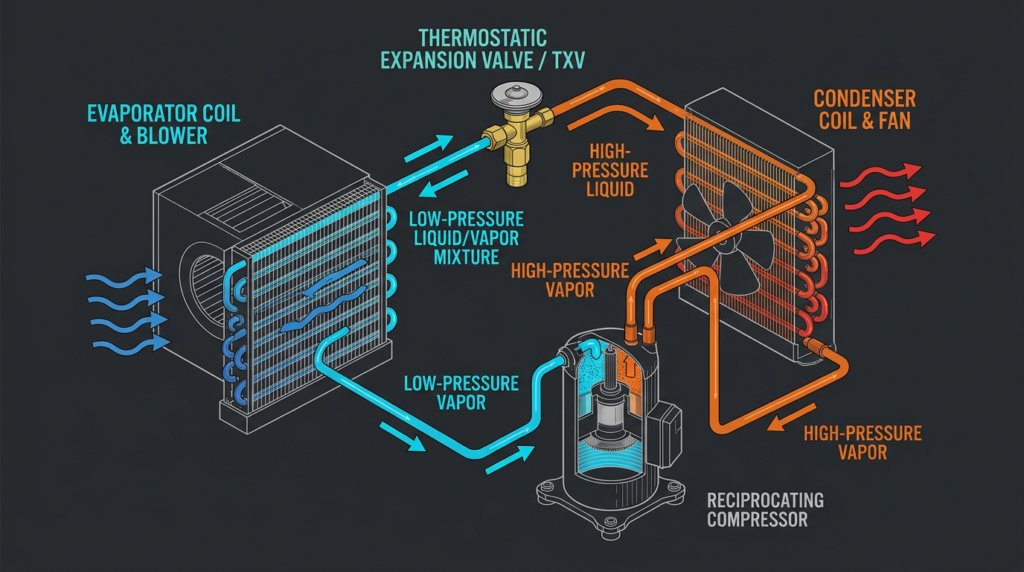
The refrigeration cycle is a continuous loop with four stages: evaporation, compression, condensation, and expansion. Every air conditioner, from a window unit to a large commercial system, uses this same fundamental process.
Step 1: Evaporation
Cold, low-pressure liquid refrigerant enters the evaporator coil, located inside your home within the air handler. A blower fan pushes warm indoor air across this coil. Because the refrigerant is colder than the air (typically around 40°F), heat transfers from the air into the refrigerant. This causes the refrigerant to boil and change from a liquid into a low-pressure, low-temperature gas. The air passing over the coil loses heat and moisture, emerging cooler and drier before returning to your living space through the ductwork.
Step 2: Compression
The low-pressure gas then travels through a copper line to the compressor, located in the outdoor condensing unit. The compressor squeezes the refrigerant gas, dramatically increasing both its pressure and temperature. The gas exits the compressor as a superheated, high-pressure vapor, often reaching temperatures above 150°F. This temperature increase is critical because the refrigerant must be hotter than the outdoor air to release its stored heat.
Step 3: Condensation
The superheated gas flows into the condenser coil in the outdoor unit. A condenser fan blows outdoor air across the coil. Even on a 95°F day, the refrigerant is significantly hotter than the ambient air, so heat flows from the refrigerant to the outdoors. As the refrigerant loses energy, it condenses back into a high-pressure, high-temperature liquid. This is where your home’s captured heat is finally rejected to the environment.
Step 4: Expansion
The high-pressure liquid refrigerant passes through an expansion valve (also called a metering device), which rapidly reduces its pressure. This pressure drop causes the refrigerant’s temperature to plummet, preparing it to absorb heat again as it re-enters the evaporator coil. The cycle then repeats continuously until the thermostat signals the desired temperature has been reached.
Refrigerants: Past, Present, and Future
Refrigerants are the working fluids that make this cycle possible. R-22 (Freon) dominated the industry for decades but was phased out under the Montreal Protocol due to its ozone-depleting potential. R-410A replaced it and remains common in existing systems, though its Global Warming Potential (GWP) of 2,088 has prompted a further transition. R-32, with a GWP of 675, is gaining traction globally. In the United States, the industry is increasingly adopting A2L refrigerants such as R-454B (GWP of 466), which are classified as mildly flammable and require updated safety standards under UL 60335-2-40. HVAC technicians must receive specific training to handle A2L refrigerants safely. The EPA’s AIM Act mandates an 85% phasedown of high-GWP hydrofluorocarbons by 2036.
Key Components of an Air Conditioner
Compressor
The compressor is often called the heart of the system. Three main types exist: reciprocating compressors use pistons and are common in older or budget systems; rotary compressors are compact and found in smaller units; and scroll compressors use two spiral-shaped scrolls and are the most efficient and quietest option, now standard in most residential systems. Variable-speed (inverter-driven) compressors adjust their output to match the cooling load, significantly reducing energy consumption compared to fixed-speed models that cycle fully on and off.
Evaporator and Condenser Coils
Both coils are typically constructed from copper tubing with aluminum fins to maximize surface area for heat exchange. The evaporator coil sits in the indoor air handler and absorbs heat. The condenser coil sits in the outdoor unit and rejects heat. Dirty coils act as insulation, reducing heat transfer efficiency by up to 30%. Keeping coils clean is one of the simplest ways to maintain system performance.
Expansion Valve
The metering device controls refrigerant flow. A fixed orifice is the simplest and cheapest option. A thermostatic expansion valve (TXV) adjusts flow based on evaporator temperature and provides better efficiency. An electronic expansion valve (EEV) offers the most precise control, adjusting in real time based on multiple sensor inputs, and is standard in high-efficiency and variable-speed systems.
Blower Fan and Motor
The indoor blower fan circulates air through the duct system and across the evaporator coil. Older systems use PSC (Permanent Split Capacitor) motors, which run at a single speed. Modern high-efficiency systems use ECM (Electronically Commutated Motor) blowers that vary their speed, using up to 75% less electricity and providing more consistent airflow and comfort.
Ductwork and Thermostat
Properly sealed and insulated ductwork is essential. The Department of Energy estimates that leaky ducts can waste 20% to 30% of conditioned air. The thermostat serves as the system’s brain. Programmable and smart thermostats, such as those that learn your schedule and adjust automatically, can reduce cooling costs by 10% to 15% annually.
Types of Air Conditioning Systems
- Central air conditioners use an outdoor condensing unit and an indoor air handler connected by refrigerant lines and ductwork to cool an entire home. They are the most common residential system in the US.
- Window air conditioners combine all components in a single box that fits in a window opening. They are affordable and effective for single rooms but are limited in capacity and can be noisy.
- Portable air conditioners sit on the floor and vent hot exhaust through a hose to a window. They offer flexibility but are generally less efficient than window units due to single-hose designs that create negative pressure.
- Ductless mini-split systems connect an outdoor unit to one or more wall-mounted indoor air handlers via refrigerant lines. They excel at zoned cooling, require no ductwork, and achieve high efficiency ratings. Their primary drawback is a higher upfront cost.
- Heat pumps use the same refrigeration cycle but include a reversing valve that allows them to heat in winter and cool in summer. Modern cold-climate heat pumps can operate effectively at temperatures well below 0°F and offer significant energy savings over traditional furnaces.
- Evaporative coolers (swamp coolers) pass air through water-saturated pads, using evaporation to reduce air temperature. They work well only in dry climates and do not use the refrigeration cycle. They are not true air conditioners because they cannot control humidity.
Air Conditioner Efficiency: SEER, EER, and HSPF
SEER (Seasonal Energy Efficiency Ratio) measures total cooling output divided by total energy input over a typical cooling season. As of January 2023, the Department of Energy requires minimum SEER2 ratings of 14.3 in the northern US and 15.0 in the southern US for split-system air conditioners. High-efficiency units now reach SEER2 ratings of 20 or higher.
EER (Energy Efficiency Ratio) measures efficiency at a specific outdoor temperature (typically 95°F) and is useful for comparing units operating in consistently hot conditions. HSPF (Heating Seasonal Performance Factor) measures heating efficiency for heat pumps, with the current minimum at HSPF2 of 7.5.
Energy Star certified central air conditioners must meet efficiency levels that exceed the federal minimum. An Energy Star certified unit can save approximately 8% on cooling costs compared to a standard model.
To estimate savings: replacing a 10 SEER system with a 16 SEER system reduces cooling energy consumption by roughly 37%. For a home spending $1,200 per year on cooling, that translates to approximately $444 in annual savings.
Common Air Conditioner Problems and Troubleshooting
Reduced Cooling Capacity
- A dirty air filter restricts airflow and is the most common cause of poor performance. Check filters monthly and replace them every 30 to 90 days.
- Dirty evaporator or condenser coils reduce heat transfer. Schedule professional cleaning annually.
- Low refrigerant from a leak reduces system capacity and can damage the compressor.
No Cooling at All
- Check for a tripped circuit breaker or blown fuse before calling a technician.
- A faulty thermostat may fail to signal the system. Replace batteries and verify settings.
- A frozen evaporator coil, often caused by restricted airflow or low refrigerant, will block cooling entirely. Turn the system off and let the ice melt before restarting.
Strange Noises and Water Leaks
- Rattling or banging may indicate loose fan blades or worn bearings.
- Hissing or bubbling can signal a refrigerant leak.
- Water around the indoor unit typically points to a clogged condensate drain line. Flushing the line with diluted vinegar can often clear the blockage.
Safety first: Always turn off power to the system before performing any inspection. Leave refrigerant handling, electrical repairs, and compressor work to licensed HVAC professionals.
Common Air Conditioning Misconceptions
- “Setting the thermostat lower cools the room faster.” Air conditioners cool at a fixed rate (or variable rate in inverter systems, but still based on capacity, not thermostat setting). Setting the thermostat to 60°F will not cool the room any faster than setting it to 72°F. It will only make the system run longer.
- “Closing vents in unused rooms saves energy.” This actually increases duct pressure, can cause leaks, and forces the blower to work harder, often reducing overall efficiency.
- “A bigger AC unit is always better.” An oversized system short-cycles, turning on and off frequently without running long enough to dehumidify properly. The result is a clammy, uncomfortable home and higher energy bills.
- “All refrigerants are interchangeable.” Each system is designed for a specific refrigerant. Substituting refrigerants without proper conversion can cause system failure, safety hazards, and voided warranties.
Optimizing Your Air Conditioner’s Performance
- Install a smart thermostat. Devices that learn your schedule and adjust temperatures automatically can cut cooling costs by 10% to 15%.
- Use zoned cooling. Ductless mini-splits or zoned duct systems let you cool occupied rooms without wasting energy on empty spaces.
- Improve insulation. Adequate insulation in walls, attics, and floors reduces heat gain and decreases the load on your AC system.
- Add window treatments. Reflective blinds, blackout curtains, and low-emissivity window film can reduce solar heat gain by up to 45%.
- Shade the outdoor unit. Strategic landscaping that shades the condenser (without restricting airflow) can improve efficiency by up to 10%.
- Schedule annual maintenance. A professional tune-up that includes coil cleaning, refrigerant charge verification, and electrical connection inspection keeps the system running at peak efficiency and extends its lifespan beyond the typical 15 to 20 years.
Future Trends and Related Topics
The HVAC industry is evolving rapidly. Variable Refrigerant Flow (VRF) systems, already popular in commercial buildings, are entering the residential market with precise zone control and high efficiency. Heat pump technology continues to advance, with cold-climate models now viable replacements for fossil-fuel heating in most regions. Integration with smart home platforms allows homeowners to monitor and control HVAC systems remotely, while building automation systems (BAS) optimize energy use across multiple systems simultaneously. Indoor air quality is gaining attention, with UV-C germicidal lights, HEPA filtration, and bipolar ionization becoming common add-ons. On the refrigerant front, the industry continues its march toward lower-GWP options and natural refrigerants like propane (R-290) for smaller applications.
Key Takeaways
Air conditioners work by exploiting the refrigeration cycle: refrigerant absorbs heat indoors as it evaporates, gets compressed to raise its temperature, releases heat outdoors as it condenses, and then expands to restart the process. Every component, from the compressor to the expansion valve, plays a specific role in this heat-transfer chain. Choosing the right system type and efficiency rating for your climate and home size directly affects comfort and operating costs. Regular maintenance, proper insulation, smart controls, and correctly sized equipment are the most effective strategies for maximizing performance and minimizing energy consumption. Understanding these fundamentals puts you in control of one of the most important and expensive systems in your home.