HVAC Compressors: Scroll, Reciprocating, and Rotary Types
The compressor is the mechanical heart of every HVAC system. It drives the refrigeration cycle by pressurizing refrigerant gas, enabling the heat transfer process that cools buildings in summer and heats them in winter through heat pump operation. Without a functioning compressor, the entire system stops. Three primary compressor technologies dominate the HVAC industry: scroll compressors, reciprocating compressors, and rotary compressors. Each type uses a fundamentally different mechanical approach to achieve the same goal of compressing refrigerant vapor. This article examines how each type works, where it excels, where it falls short, and which applications suit it best. Understanding these differences is essential for technicians selecting replacement compressors, engineers designing systems, and building owners evaluating equipment proposals.
The Refrigeration Cycle: A Quick Refresher
All three compressor types operate within the vapor-compression refrigeration cycle, which consists of four stages and four corresponding components. The evaporator absorbs heat from indoor air, causing liquid refrigerant to boil into a low-pressure gas. The compressor then takes this low-pressure, low-temperature gas and compresses it into a high-pressure, high-temperature gas. The condenser rejects that heat to the outdoor air (or a water loop), causing the refrigerant to condense back into a high-pressure liquid. Finally, the expansion device (typically a thermostatic expansion valve or electronic expansion valve) reduces the refrigerant pressure, dropping its temperature before it re-enters the evaporator.
The compressor’s specific role is critical: it creates the pressure differential that forces refrigerant to circulate through the system. By raising both the pressure and temperature of the refrigerant gas, the compressor ensures that the condenser can reject heat to the outdoor environment, even when outdoor temperatures are high. The efficiency with which a compressor performs this work directly affects the system’s overall coefficient of performance (COP) and energy consumption. A compressor that wastes energy through friction, heat loss, or poor volumetric efficiency forces the entire system to work harder and consume more electricity.
Reciprocating Compressors
Operating Principle
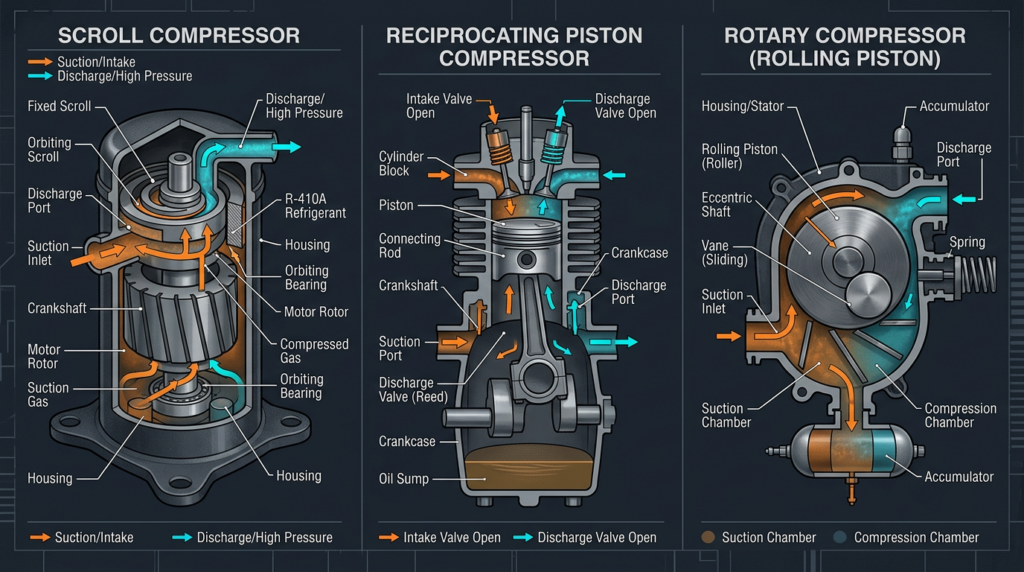
Reciprocating compressors use a piston-and-cylinder arrangement, operating on the same basic principle as an internal combustion engine. A crankshaft converts rotary motor motion into linear piston motion. As the piston moves down within the cylinder, it creates a low-pressure zone that opens the suction valve, drawing in refrigerant gas from the evaporator. As the piston moves back up, it compresses the trapped gas. When the gas pressure exceeds the pressure in the discharge line, the discharge valve opens and the compressed gas flows to the condenser.
This cycle has four distinct phases: suction (piston moves down, gas enters), compression (piston moves up, valves closed, pressure rises), discharge (compressed gas exits through the discharge valve), and re-expansion (residual gas in the clearance volume at the top of the cylinder expands before the next suction stroke begins). The clearance volume is an unavoidable dead space between the piston at top dead center and the valve plate. It reduces volumetric efficiency, meaning the cylinder does not fill completely with fresh refrigerant on each suction stroke. Typical volumetric efficiencies range from 60% to 85%, depending on the compression ratio and clearance volume design.
Technical Specifications and Design
Reciprocating compressors cover a wide capacity range, from fractional horsepower units in household refrigerators (under 1 kW) to multi-cylinder industrial units exceeding 150 kW. They can achieve compression ratios of 8:1 or higher, making them suitable for applications requiring large temperature lifts. Typical operating speeds range from 1,450 to 3,500 RPM.
Three construction types exist:
- Hermetic compressors seal the motor and compressor in a single welded housing. They cannot be field-repaired and are common in residential refrigerators and small air conditioners.
- Semi-hermetic compressors use bolted housings that allow access to internal components for repair. These are standard in commercial refrigeration.
- Open-type compressors have an external motor connected via a shaft seal. They are used in industrial applications and allow independent motor and compressor servicing.
Advantages
- Capable of high compression ratios, supporting wide temperature differentials in low-temperature refrigeration
- Relatively robust construction that can tolerate brief episodes of liquid slugging better than some alternatives
- Lower initial purchase cost in smaller capacities compared to scroll or screw compressors
- Well-understood technology with decades of field experience and widely available replacement parts
Disadvantages
- Higher noise and vibration levels due to the reciprocating motion and pulsating discharge flow
- More moving parts (pistons, connecting rods, valves, crankshaft) increase wear potential and maintenance frequency
- Lower isentropic efficiency than scroll compressors, particularly at part-load conditions
- Valve fatigue and failure represent a common point of breakdown
Applications
Reciprocating compressors remain standard in household refrigerators, standalone freezers, and small commercial refrigeration systems. They appear in older residential air conditioning units and window-type air conditioners. In industrial settings, multi-cylinder semi-hermetic and open-type reciprocating compressors serve cold storage facilities, blast freezers, and process cooling systems where high compression ratios are required.
Maintenance and Common Issues
Proper oil management is essential. Reciprocating compressors typically use polyolester (POE) oil with HFC refrigerants or mineral oil with older HCFC refrigerants. Common failure modes include suction and discharge valve breakage from liquid slugging or fatigue, piston ring wear leading to blow-by and reduced capacity, cylinder wall scoring from inadequate lubrication, and bearing failure from oil starvation. Technicians should monitor discharge temperatures (typically below 225°F for most refrigerants), oil level, and suction superheat to prevent damage.
Current Trends
Reciprocating compressors have lost significant market share to scroll compressors in residential and light commercial air conditioning since the early 2000s. However, manufacturers continue refining them for refrigeration applications with variable-speed drives and designs optimized for lower-GWP refrigerants such as R-290 (propane) and R-449A. Their ability to handle high compression ratios keeps them relevant in low-temperature and industrial refrigeration.
Scroll Compressors
Operating Principle
A scroll compressor uses two spiral-shaped scrolls: one fixed (stationary) scroll and one orbiting scroll. The orbiting scroll does not rotate on its own axis. Instead, an Oldham coupling constrains it to an orbital path, preventing rotation while allowing the circular orbiting motion. The two scrolls interleave with very tight clearances, creating crescent-shaped gas pockets between them.
As the orbiting scroll moves, refrigerant gas enters at the outer edge of the scroll set. The orbital motion progressively traps gas pockets and pushes them inward toward the center, reducing their volume and increasing pressure with each orbit. Multiple gas pockets are being compressed simultaneously at different stages, which produces a nearly continuous and smooth compression process. The compressed gas discharges from a port at the center of the fixed scroll. This continuous compression is a key differentiator from the intermittent compression of reciprocating designs.
Technical Specifications and Design
Scroll compressors typically cover a capacity range of approximately 1 to 60 tons (3.5 to 210 kW) of refrigeration, making them ideal for residential through medium commercial applications. Compression ratios typically range from 2:1 to 5:1 per stage. Operating speeds for fixed-speed models match the motor frequency (typically 3,500 RPM at 60 Hz).
Key design variations include:
- Fixed-speed scroll compressors operate at a single speed and cycle on and off to match cooling demand.
- Variable-speed (inverter-driven) scroll compressors modulate speed from roughly 900 to 7,200 RPM, matching capacity to the actual load for significantly improved part-load efficiency.
- Compliant scroll designs allow slight axial and radial movement of the orbiting scroll. This axial compliance allows the scrolls to separate momentarily if liquid refrigerant enters, providing a degree of liquid tolerance. Radial compliance maintains sealing between the scroll wraps as components wear over time.
Many scroll compressors include an internal pressure relief mechanism that allows the scrolls to separate under abnormal high-pressure conditions, protecting the motor and mechanical components.
Advantages
- Higher isentropic efficiency than reciprocating compressors, with seasonal energy efficiency ratio (SEER2) improvements of 10% to 15% in typical residential applications
- Significantly lower noise and vibration due to the continuous compression process and absence of suction and discharge valves
- Fewer moving parts (no valves, no pistons) result in higher reliability and longer service life, often exceeding 15 to 20 years in residential systems
- Compliant scroll designs offer moderate tolerance to liquid refrigerant ingestion
- Compact footprint relative to capacity
Disadvantages
- Susceptible to damage from contaminants, metal particles, or debris entering the scroll set, which can score the scroll surfaces and destroy sealing
- Higher initial cost than reciprocating compressors in equivalent capacities
- Hermetic scroll compressors cannot be field-repaired; the entire compressor must be replaced upon failure
- Inadequate lubrication causes accelerated wear of scroll tip seals and thrust bearings
Applications
Scroll compressors dominate modern residential and light commercial air conditioning and heat pump systems. Major manufacturers including Copeland (Emerson), Danfoss, and Daikin produce scroll compressors for split systems, packaged units, rooftop units, and air-cooled chillers. They are also widely used in supermarket refrigeration racks, walk-in cooler condensing units, and variable refrigerant flow (VRF) systems in smaller configurations.
Maintenance and Common Issues
Scroll compressors require clean, dry refrigerant systems. Contamination from brazing debris, moisture, or acid formation is the primary enemy of scroll longevity. Common failure modes include bearing wear from oil starvation, motor winding burnout from electrical issues or overheating, and scroll surface erosion from contaminated refrigerant. Technicians should verify proper superheat and subcooling values, confirm adequate oil charge and return, and check that the system is free of non-condensables.
Current Trends
Scroll compressors are the dominant technology in residential HVAC as of 2024. Inverter-driven scroll compressors are becoming the standard in premium equipment, delivering SEER2 ratings above 20 in many systems. Manufacturers are releasing scroll compressor models optimized for the transition to lower-GWP refrigerants, including R-32, R-454B, and R-410A replacements. Enhanced vapor injection (EVI) scroll compressors extend heat pump performance into colder climates by injecting intermediate-pressure refrigerant into the compression process, maintaining heating capacity at outdoor temperatures as low as -15°F.
Rotary Compressors
Operating Principle
Rotary compressors encompass two distinct subtypes: rotary vane and rotary screw compressors. Both use continuous rotary motion rather than reciprocating or orbital motion.
In a rotary vane compressor, a cylindrical rotor sits eccentrically inside a larger cylindrical housing. Sliding vanes mounted in slots on the rotor extend outward under centrifugal force or spring pressure to maintain contact with the housing wall. As the rotor turns, the space between adjacent vanes changes volume. Refrigerant enters through a suction port where the volume is expanding, becomes trapped between vanes, and is compressed as the volume decreases toward the discharge port.
A rotary screw compressor uses two intermeshing helical rotors, a male rotor with lobes and a female rotor with flutes, housed in a precision-machined casing. As the rotors turn, gas is trapped in the spaces between the lobes and the casing wall, then progressively compressed as it moves axially along the rotors from the suction end to the discharge end. Oil-injected screw compressors flood oil into the compression chamber for sealing, cooling, and lubrication, achieving compression ratios up to 20:1 in a single stage.
Technical Specifications and Design
Rotary vane compressors typically range from 0.5 to 5 tons (1.75 to 17.5 kW) and operate at speeds from 1,450 to 3,500 RPM. Rotary screw compressors serve much larger loads, from approximately 20 tons to over 800 tons (70 to 2,800 kW). Screw compressors use steel or cast iron rotors with specialized coatings to reduce friction and wear. Oil separation systems in screw compressors must achieve oil carryover rates below 5 ppm to protect downstream components.
Advantages
- Rotary vane: Extremely compact size, quiet operation, low vibration, simple construction with few parts, and low manufacturing cost at small capacities
- Rotary screw: High volumetric efficiency (often above 90%), capable of continuous duty at full load, smooth and nearly pulsation-free discharge, long service life exceeding 100,000 operating hours with proper maintenance
Disadvantages
- Rotary vane: Vane tip wear limits service life, lower efficiency than scroll compressors at comparable capacities, sensitivity to liquid slugging
- Rotary screw: High initial cost, complex oil management systems requiring dedicated oil separators and coolers, specialized maintenance knowledge required
Applications
Rotary vane compressors are found in ductless mini-split systems, portable air conditioners, automotive air conditioning, dehumidifiers, and small refrigeration units. Rotary screw compressors serve large commercial and industrial applications including water-cooled and air-cooled chillers above 50 tons, industrial process cooling, cold storage warehouses, and large VRF systems.
Maintenance and Current Trends
For rotary vane units, vane replacement and bearing inspection are the primary service items. For screw compressors, oil analysis, oil filter replacement, bearing inspection, and rotor clearance checks are critical. Screw compressors are increasingly paired with variable-speed drives to improve part-load efficiency, reducing energy consumption by 30% or more compared to fixed-speed operation with slide valve unloading. Both subtypes are being adapted for lower-GWP refrigerants in current product development cycles.
Comparison Summary
The following comparison highlights the key differences across the three compressor types:
- Operating principle: Reciprocating uses piston-and-cylinder action; scroll uses two interleaving spiral scrolls; rotary uses either sliding vanes or meshing helical screws.
- Efficiency: Scroll compressors generally offer the highest efficiency in residential and light commercial ranges. Screw compressors excel at large capacities. Reciprocating compressors are least efficient at part-load conditions.
- Noise and vibration: Scroll compressors are the quietest. Reciprocating compressors produce the most noise and vibration. Rotary types fall in between, with screw compressors being relatively quiet for their size.
- Reliability: Scroll compressors lead in reliability for their capacity range due to fewer moving parts. Screw compressors offer exceptional longevity with proper oil management. Reciprocating compressors require more frequent valve and piston maintenance.
- Cost: Reciprocating compressors have the lowest initial cost at small capacities. Scroll compressors carry a moderate premium. Screw compressors have the highest initial cost but lowest lifecycle cost in large applications.
- Liquid tolerance: Compliant scroll compressors offer moderate liquid tolerance. Reciprocating compressors can tolerate brief slugging events. Rotary vane compressors are most sensitive to liquid ingestion.
Common Misconceptions
- “All compressors are interchangeable.” Each type is engineered for specific capacity ranges, refrigerants, and operating conditions. Substituting one type for another without proper engineering analysis can result in poor performance or premature failure.
- “Reciprocating compressors are always the cheapest option.” While their purchase price may be lower, higher energy consumption and maintenance costs often make scroll or screw compressors more cost-effective over a system’s lifetime.
- “Scroll compressors cannot be damaged by liquid refrigerant.” Compliant scrolls tolerate minor liquid ingestion, but sustained liquid flooding will damage bearings, erode scroll surfaces, and wash out lubricating oil.
- “Rotary compressors are obsolete technology.” Rotary vane compressors remain the standard in mini-split systems worldwide, and rotary screw compressors are the backbone of large-scale industrial refrigeration.
- “A more expensive compressor always lasts longer.” Longevity depends on proper installation, correct refrigerant charge, clean system conditions, and adequate maintenance far more than on purchase price alone.
Future Outlook
The HVAC compressor market is moving decisively toward variable-speed operation across all three types, driven by increasingly stringent energy efficiency standards such as ASHRAE 90.1 and DOE minimum efficiency requirements. Compressor development for low-GWP refrigerants (R-32, R-454B, R-1234yf, R-290) is accelerating as global phase-down schedules tighten under the Kigali Amendment and EPA regulations. Smart compressor technologies incorporating onboard sensors, embedded diagnostics, and cloud-connected monitoring are enabling predictive maintenance strategies that reduce unplanned downtime and extend equipment life.
Key Takeaways
Selecting the right compressor type requires matching the technology to the application. Scroll compressors are the clear choice for most residential and light commercial air conditioning and heat pump systems, offering the best balance of efficiency, reliability, and quiet operation. Reciprocating compressors retain their place in small refrigeration units and specialized low-temperature applications where high compression ratios are needed. Rotary vane compressors serve compact, small-capacity applications such as mini-splits, while rotary screw compressors handle the heavy lifting in large commercial and industrial systems. Regardless of type, proper installation practices, correct refrigerant charge, system cleanliness, and routine maintenance are the most important factors determining compressor performance and lifespan. A well-maintained compressor of any type will outperform and outlast a poorly maintained premium unit every time.