Indoor air quality ranks among the most significant environmental health concerns of the 21st century. The EPA estimates that indoor air can be two to five times more polluted than outdoor air, and Americans spend roughly 90% of their time indoors. Within any HVAC system, the air filter serves as the primary line of defense against airborne contaminants. Understanding how filters work, what MERV ratings mean, how HEPA filtration differs, and how to select the right filter for a given application is essential knowledge for homeowners, building managers, and HVAC professionals alike. This article provides a comprehensive guide to air filtration principles, rating systems, and practical filter selection strategies that balance efficiency, system performance, cost, and occupant health.
Fundamentals of Air Filtration
Air filtration is the process of removing particulate matter from an air stream as it passes through a porous medium. In HVAC systems, filters intercept airborne particles before conditioned air is distributed throughout a building. The effectiveness of any filter depends on the types and sizes of particles present, the filter media and construction, and the velocity of air moving through the system.
Common Indoor Air Pollutants by Size
Indoor air contains a wide range of particulate contaminants. Understanding particle size, measured in microns (μm), is critical to selecting the right filter:
- Large particles (greater than 10 μm): Dust, pollen, pet dander, textile fibers, and carpet lint. These are visible to the naked eye and settle quickly on surfaces.
- Medium particles (1 to 10 μm): Mold spores, dust mite debris, skin flakes, and larger bacteria. These remain suspended in the air longer and are easily inhaled.
- Small particles (0.3 to 1 μm): Fine bacteria, combustion byproducts from cooking and fireplaces, and certain types of fine dust. These penetrate deeper into the respiratory system.
- Ultrafine particles (less than 0.3 μm): Viruses, tobacco smoke particles, and nanoparticles. These pose the greatest health risk because they can enter the bloodstream through lung tissue.
How Filters Capture Particles
Mechanical air filters rely on several physical mechanisms to capture particles, often working simultaneously:
- Impingement (inertial impaction): Larger, heavier particles cannot follow the air stream as it bends around filter fibers. Their inertia causes them to collide with and embed in the fiber surface.
- Interception: Mid-sized particles traveling along air streamlines come within one particle radius of a fiber and are captured on contact.
- Diffusion: Very small particles (typically below 0.1 μm) exhibit random Brownian motion, causing them to wander off their air streamline and collide with filter fibers.
- Straining: Particles physically larger than the gaps between filter fibers are simply blocked from passing through.
- Electrostatic attraction: Some filters, known as electret filters, carry a permanent or induced electrostatic charge that attracts and holds particles to the filter media, enhancing capture rates across all particle sizes.
Air filtration protects both occupants and equipment. Clean filters reduce allergen levels, lower the risk of respiratory illness, and prevent dust accumulation on coils, blower motors, and ductwork, all of which degrade HVAC efficiency over time.
Understanding MERV Ratings
The Minimum Efficiency Reporting Value (MERV) is a standardized rating system developed by the American Society of Heating, Refrigerating and Air-Conditioning Engineers (ASHRAE) under ASHRAE Standard 52.2. MERV provides a consistent method for comparing the particle removal efficiency of air filters across manufacturers and product lines.
How the MERV Scale Works
The MERV scale ranges from 1 to 20, with higher numbers indicating greater filtration efficiency. Ratings are determined by testing a filter’s ability to capture particles across three specific size ranges:
- E1: 0.3 to 1.0 μm
- E2: 1.0 to 3.0 μm
- E3: 3.0 to 10.0 μm
The MERV rating is assigned based on the lowest percentage efficiency achieved in any of these size ranges. A filter that captures 95% of particles in the 3 to 10 μm range but only 50% in the 0.3 to 1.0 μm range receives its MERV designation based on that 50% figure. This ensures the rating reflects worst-case performance rather than cherry-picked results.
MERV Rating Ranges and Applications
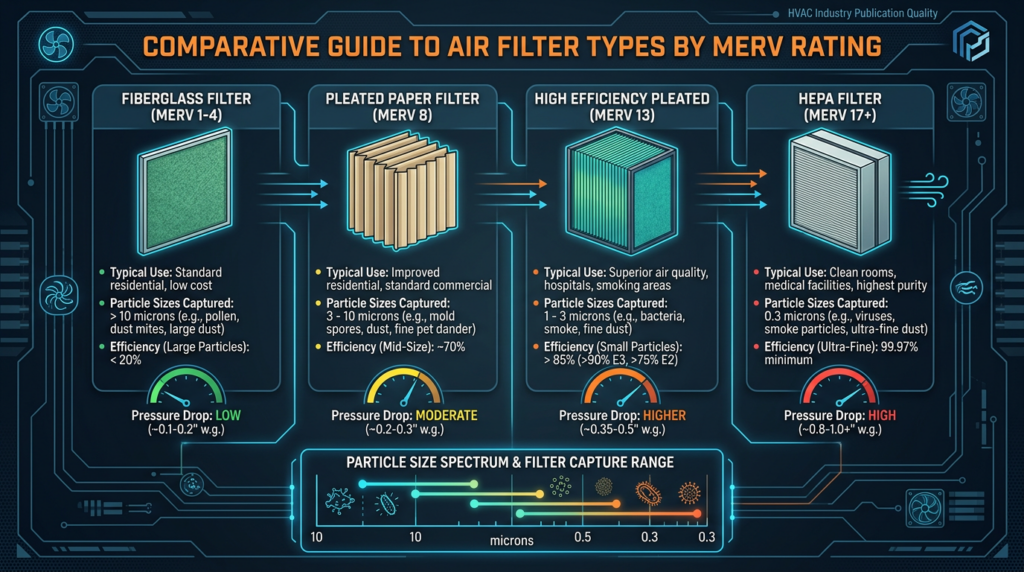
- MERV 1 to 4: Basic filtration that captures large particles such as dust, pollen, and carpet fibers. These inexpensive fiberglass or flat-panel filters provide minimal IAQ improvement but protect HVAC equipment from gross debris. Typical pressure drop is very low, generally under 0.10 inches of water column (in. w.c.).
- MERV 5 to 8: Improved residential and light commercial filtration. These pleated filters capture mold spores, dust mite allergens, and pet dander with moderate efficiency. They represent the most common choice for standard residential systems and offer a reasonable balance between cost and performance.
- MERV 9 to 12: Significant filtration suitable for better residential applications, commercial office buildings, and general hospital areas. Filters in this range capture fine dust, Legionella bacteria, and lead dust with efficiencies between 40% and 90% for particles in the 1 to 3 μm range.
- MERV 13 to 16: High-efficiency filtration that captures bacteria, tobacco smoke particles, and droplet nuclei that can carry viruses. Applications include hospital surgical suites, superior residential filtration, and commercial buildings with strict IAQ requirements. Pressure drop increases substantially at this level, typically ranging from 0.30 to 0.60 in. w.c. or higher depending on filter depth and design velocity.
- MERV 17 to 20: Specialized filtration for pharmaceutical manufacturing, semiconductor fabrication, and other environments requiring near-absolute particle removal. Filters at these ratings overlap with HEPA classification and require purpose-built air handling systems.
Pressure Drop and System Impact
Pressure drop, also called static pressure or resistance to airflow, is the reduction in air pressure as it passes through a filter. Higher MERV ratings generally correlate with higher pressure drop because denser filter media or tighter fiber spacing is needed to capture smaller particles.
Excessive pressure drop causes several problems: reduced airflow through the duct system, decreased heating and cooling capacity, increased energy consumption as the blower motor works harder, potential overheating of the motor or heat exchanger, and uneven temperature distribution throughout the building. Always verify that the HVAC system can handle the pressure drop of any filter before upgrading to a higher MERV rating.
The MERV-A Rating
ASHRAE introduced the optional MERV-A rating to address a known limitation of the standard MERV test. The standard test measures initial efficiency, but some filters, particularly electret types, lose efficiency after exposure to certain aerosols. The MERV-A test conditions the filter with potassium chloride (KCl) aerosol and isopropyl alcohol (IPA) vapor before retesting. The resulting MERV-A rating provides a more realistic picture of long-term filter performance. A filter rated MERV 13 might test as MERV-A 10 after conditioning, revealing significant efficiency degradation that the initial rating alone would not predict.
HEPA Filtration
A High-Efficiency Particulate Air (HEPA) filter represents the gold standard in particulate filtration. To earn the HEPA designation, a filter must capture at least 99.97% of particles measuring 0.3 μm in diameter. This specific size, 0.3 μm, is known as the Most Penetrating Particle Size (MPPS) because it falls in the gap between the effectiveness ranges of diffusion (which works best on smaller particles) and impaction/interception (which work best on larger particles). A true HEPA filter is therefore at least 99.97% efficient at its weakest performance point.
Where HEPA Filters Are Used
- Hospital operating rooms and isolation rooms for infection control
- Pharmaceutical manufacturing cleanrooms (ISO Class 5 and above)
- Semiconductor fabrication facilities
- Biological and chemical research laboratories
- Portable room air purifiers
- High-end vacuum cleaners to prevent particle re-emission
Limitations of HEPA in Residential HVAC
Despite their exceptional efficiency, HEPA filters present serious challenges when used in standard residential HVAC systems. The dense filter media creates extremely high pressure drop, often exceeding 1.0 in. w.c., which is far beyond the design capacity of most residential blower motors rated for 0.50 in. w.c. total external static pressure. Retrofitting a HEPA filter into a conventional system will dramatically reduce airflow, strain the blower motor, and can lead to frozen evaporator coils in cooling mode or cracked heat exchangers in heating mode.
HEPA filters also cost significantly more than standard filters, and the system modifications required to accommodate them, including upgraded blower motors, larger filter housings, and potentially resized ductwork, add further expense.
Practical Alternatives
For residential applications, two practical alternatives exist. Portable HEPA air purifiers can provide HEPA-level filtration in individual rooms without affecting the central HVAC system. Alternatively, high-MERV pleated filters (MERV 13 to 16) offer substantial particle removal with manageable pressure drop when the system is properly sized.
Consumers should also distinguish between True HEPA filters, which meet the 99.97% at 0.3 μm standard, and so-called “HEPA-type” or “HEPA-like” filters. These marketing terms describe filters that may capture only 85% to 95% of particles at 0.3 μm and do not meet the actual HEPA specification.
Filter Selection Considerations
Balancing Efficiency and Airflow
The single most important principle in filter selection is matching filtration efficiency to system capability. A MERV 16 filter installed in a system designed for MERV 8 will cause more harm than good. Before upgrading, check the HVAC system manual for the maximum recommended MERV rating, or have a technician measure the system’s total external static pressure to determine available capacity for a denser filter.
Assessing Indoor Air Quality Needs
- Allergy sufferers: MERV 11 to 13 filters capture the majority of common allergens, including pollen, mold spores, dust mite debris, and pet dander.
- Asthma and respiratory conditions: MERV 13 or higher provides meaningful reduction in fine particulate triggers. Supplementing with a portable HEPA purifier in the bedroom can offer additional relief.
- Homes near busy roads or industrial areas: MERV 13 filters help capture traffic-related fine particulates and combustion byproducts.
- Homes with pets: MERV 8 to 11 filters handle pet dander effectively, but more frequent replacement is necessary due to hair and dander loading.
- Post-construction or renovation: Use MERV 11 or higher immediately after any construction activity and run the system continuously for several days to clear airborne dust and debris.
Filter Types and Materials
- Pleated filters: Folded filter media provides a larger surface area within the same frame size, reducing velocity through the media and improving both efficiency and dust-holding capacity. A 4-inch or 5-inch deep pleated filter offers substantially lower pressure drop than a 1-inch filter at the same MERV rating.
- Electrostatic filters: Use charged fibers to attract particles. Effective when new but may lose charge over time, reducing efficiency. Check the MERV-A rating when evaluating these products.
- Washable filters: Reusable but typically limited to MERV 1 to 4. They require thorough cleaning and complete drying to prevent mold growth. Long-term cost savings are often offset by inferior filtration performance.
- Activated carbon filters: Effective at adsorbing odors, volatile organic compounds (VOCs), and gaseous pollutants, but they provide minimal particulate removal. Best used in combination with a particulate filter.
Filter Replacement Frequency
- MERV 1 to 4 (1-inch flat filters): Replace every 30 days.
- MERV 5 to 8 (1-inch pleated filters): Replace every 60 to 90 days.
- MERV 9 to 13 (1-inch or 2-inch pleated): Replace every 90 days. Four-inch and five-inch media filters in this range can last 6 to 12 months.
- MERV 13 and above (deep pleated media): Replace every 6 to 12 months depending on local air quality, occupancy, and presence of pets.
A clogged filter is worse than a low-MERV filter. When a filter loads beyond its capacity, pressure drop spikes, airflow drops, and particles begin to bypass the filter entirely through gaps in the frame or housing.
Common Misconceptions About Air Filtration
- “Higher MERV is always better.” A filter that restricts airflow beyond the system’s capacity reduces comfort, wastes energy, and can damage equipment. The best filter is the highest MERV rating your system can handle without exceeding its static pressure limits.
- “Everyone needs HEPA filtration.” HEPA filters are engineered for specialized environments. For most homes, a MERV 13 filter combined with a portable air purifier provides excellent results without system modifications.
- “Filters remove all pollutants.” Mechanical filters capture particulate matter only. They do not remove gases, VOCs, carbon monoxide, or radon. Activated carbon filtration and proper ventilation address gaseous contaminants.
- “Washable filters perform as well as disposable ones.” Most washable filters achieve MERV 1 to 4 at best and lose effectiveness if not cleaned meticulously and dried completely.
- “All filters with the same MERV rating are identical.” Filter construction, media quality, pleat count, frame seal, and real-world performance vary across manufacturers. The MERV-A rating helps reveal differences that the initial MERV test may not capture.
Emerging Trends and Technologies
Smart air filters with integrated pressure and particulate sensors are entering the market, enabling real-time monitoring of filter loading and air quality. These systems can alert homeowners when replacement is actually needed rather than relying on calendar-based schedules. Advances in nanofiber filter media promise higher efficiency at lower pressure drop by using ultra-thin fibers that increase surface area without proportionally increasing airflow resistance. UV-C germicidal systems are increasingly paired with mechanical filtration to inactivate bacteria and viruses on filter surfaces and in the air stream, though UV-C alone does not remove particles from the air. The growing availability of affordable IAQ monitoring systems that track PM2.5, PM10, CO2, humidity, and VOC levels in real time allows occupants to make data-driven decisions about ventilation and filtration, particularly during wildfire smoke events or periods of elevated outdoor pollution.
Key Takeaways
Effective air filtration requires matching the right filter to both the HVAC system’s capabilities and the occupants’ health needs. MERV ratings provide a standardized way to compare filter efficiency, but higher ratings come with higher pressure drop that can compromise system performance. HEPA filters offer exceptional particle removal for specialized applications, but they are impractical for most residential HVAC systems without significant modifications. For the majority of homes, a MERV 11 to 13 pleated filter in a 4-inch or 5-inch housing offers the best combination of filtration performance, manageable pressure drop, and reasonable cost. Replace filters on schedule, verify system compatibility before upgrading, and consult a qualified HVAC professional if you are unsure which filter is appropriate for your system. Clean air starts with an informed filter choice and consistent maintenance.