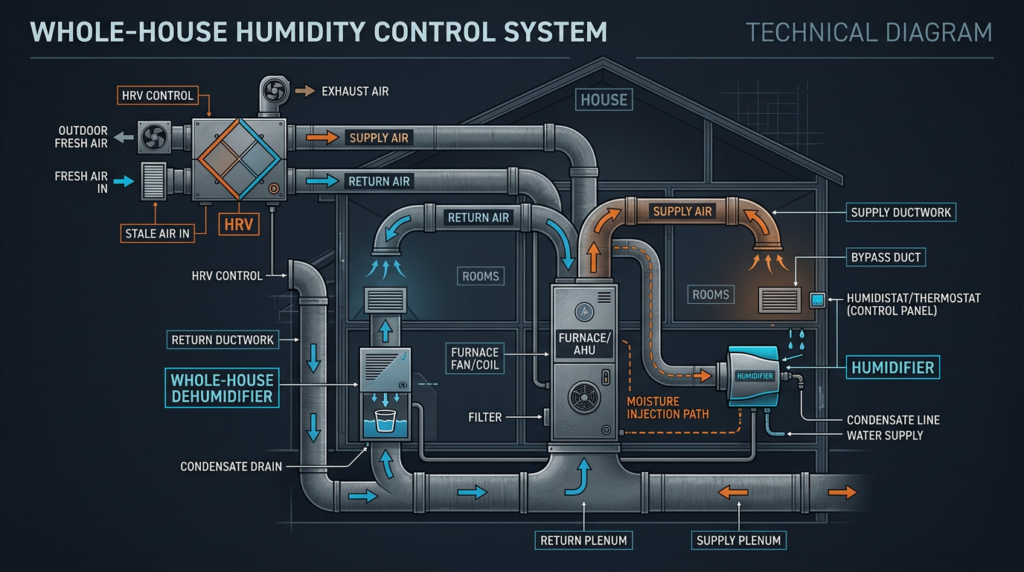
Waking up to foggy windows in winter or dealing with cracked wooden furniture in a dry climate are signs that your home’s humidity levels are out of balance. Humidity, the amount of water vapor present in the air, directly affects comfort, respiratory health, structural integrity, and energy efficiency. The standard measurement is relative humidity (RH), which expresses the current moisture content as a percentage of what the air can hold at a given temperature. ASHRAE (the American Society of Heating, Refrigerating and Air-Conditioning Engineers) recommends maintaining indoor RH between 30% and 50% in winter and 30% and 60% in summer. Falling outside this range invites problems ranging from mold growth and dust mite proliferation to dry skin, nosebleeds, and damage to building materials. Three primary technologies address home humidity control: dehumidifiers remove excess moisture, humidifiers add moisture to dry air, and heat recovery ventilators (HRVs) provide balanced ventilation that indirectly manages humidity while conserving energy. This article covers the science behind humidity, how each technology works, sizing and maintenance considerations, and common misconceptions that lead homeowners astray.
The Science of Humidity
Understanding a few core concepts makes it far easier to diagnose and solve humidity problems in any climate.
Absolute Humidity, Relative Humidity, and Dew Point
Absolute humidity is the actual mass of water vapor per unit volume of air, typically expressed in grams per cubic meter. It tells you exactly how much moisture is present regardless of temperature. Relative humidity, the metric most homeowners encounter, compares the current amount of water vapor to the maximum the air could hold at that temperature. An RH of 60% means the air contains 60% of its moisture capacity at the current temperature.
The dew point is the temperature at which air becomes fully saturated and water vapor begins condensing into liquid. A dew point above 65°F (18°C) feels oppressively muggy, while a dew point below 30°F (-1°C) feels uncomfortably dry. Because dew point reflects absolute moisture content independent of air temperature, many HVAC professionals consider it a more reliable comfort indicator than RH alone.
Temperature and Humidity: The Inverse Relationship
Warm air has a higher capacity to hold moisture than cold air. When outdoor air at 35°F and 80% RH enters a home heated to 72°F, that same parcel of air drops to roughly 15% to 20% RH because its moisture capacity has expanded dramatically. This explains why winter indoor air feels so dry even when outdoor humidity is high. In summer, the reverse problem occurs: warm, moisture-laden air raises indoor RH, especially in poorly ventilated spaces.
Measuring Humidity
A hygrometer measures relative humidity. Digital hygrometers are affordable (typically $10 to $30) and accurate to within 2% to 5% RH. Hair hygrometers use the expansion and contraction of human or synthetic hair to gauge moisture but are less precise. For serious diagnostics, HVAC technicians use psychrometric charts, which map the relationships among temperature, humidity, enthalpy, and dew point on a single diagram. Placing a digital hygrometer in your main living area and another in your basement or crawl space gives a reliable picture of where humidity problems originate.
Dehumidifiers: Reducing Excess Moisture
When indoor RH regularly exceeds 50% to 60%, a dehumidifier is often the most direct solution. Two main types dominate the residential market.
Refrigerant (Mechanical) Dehumidifiers
Refrigerant dehumidifiers work on the same principle as an air conditioner. A fan draws moist air across a set of cold evaporator coils. As the air cools below its dew point, water vapor condenses on the coils and drips into a collection reservoir or drains through a hose. The now-drier air passes over warm condenser coils, reheating slightly before returning to the room.
- Capacity: Rated in pints of water removed per day, commonly 22, 35, 50, or 70 pints. The U.S. Department of Energy (DOE) revised its testing standards in 2019, introducing the Integrated Energy Factor (IEF), measured in liters per kilowatt-hour, which accounts for both dehumidification performance and standby energy consumption. As of 2024, Energy Star certified dehumidifiers must meet minimum IEF thresholds (for example, 1.57 L/kWh for units with capacity between 25.01 and 50 pints per day).
- Operating range: Most effective above 65°F (18°C). Below this temperature, ice can form on the coils, reducing performance and potentially damaging the unit. Many models include an automatic defrost cycle to address this.
- Features: Adjustable humidistats, auto shut-off when the reservoir is full, continuous drain options, washable air filters, and caster wheels for portability.
Pros: Widely available, effective across a broad humidity range, and generally affordable ($150 to $400 for portable units). Cons: Can be noisy (45 to 55 dB), less efficient in cool environments, and require periodic emptying unless connected to a drain.
Desiccant Dehumidifiers
Desiccant dehumidifiers pass moist air over an absorbent material such as silica gel or zeolite mounted on a slowly rotating wheel. The desiccant captures water vapor from the incoming air stream. A separate heater then regenerates the desiccant by driving off the absorbed moisture, which is condensed and drained away.
- Operating range: Effective at temperatures as low as 33°F (1°C), making them ideal for unheated garages, crawl spaces, and cold basements where refrigerant units struggle.
- Energy efficiency: Generally consumes more energy than refrigerant models at room temperature, but outperforms them in cold conditions.
Pros: Quieter operation, no compressor noise, reliable performance in cold environments. Cons: Higher purchase price ($200 to $600+), generates noticeable heat during the regeneration cycle, and typically lower removal capacity than comparably priced refrigerant units.
Sizing, Placement, and Maintenance
Energy Star provides sizing guidelines based on room area and dampness severity. For a moderately damp 500-square-foot basement, a 30-pint unit is usually sufficient. For a wet space of the same size with visible moisture on walls, a 50-pint or larger unit is appropriate. Place dehumidifiers in central locations with at least 12 inches of clearance on all sides for proper airflow. Clean or replace filters every two to four weeks, and wipe down the reservoir with a diluted bleach solution monthly to prevent mold and bacterial growth.
Humidifiers: Adding Moisture to Dry Air
When winter heating drives indoor RH below 30%, a humidifier restores comfort and protects wood floors, musical instruments, and respiratory health.
Portable Humidifiers
Three types of portable humidifiers serve different needs:
- Evaporative humidifiers use a fan to blow air through a wet wick or filter. As air passes through the saturated media, water evaporates naturally. These are self-regulating because evaporation slows as RH rises. They cost $30 to $100, but the fan can be audible, and the wick requires replacement every one to three months to prevent microbial growth.
- Ultrasonic humidifiers use a high-frequency vibrating diaphragm to break water into a fine cool mist. They are exceptionally quiet and energy efficient. However, when used with hard water, they can disperse mineral particles as a fine white dust that settles on furniture and can irritate lungs. Using distilled or demineralized water eliminates this issue.
- Steam vaporizers heat water to boiling and release warm steam. The boiling process kills waterborne bacteria, making these units inherently more sanitary. The downside is a burn risk if the unit tips over, making them unsuitable for children’s rooms. They also consume more electricity than other portable types.
Whole-House Humidifiers
For consistent humidity throughout the home, whole-house units integrate directly with the HVAC system’s ductwork.
- Bypass humidifiers divert a portion of warm supply air through a water-soaked evaporator pad, then return the humidified air to the return duct. They are the most common whole-house option, priced between $150 and $300 plus installation. They add humidity only when the furnace fan is running and are somewhat less precise in output control.
- Fan-powered humidifiers operate similarly but include their own fan, allowing them to function independently of furnace airflow and deliver roughly 50% more moisture output than bypass models.
- Steam humidifiers generate steam electrically and inject it directly into the ductwork. They offer the most precise humidity control and the highest output, capable of humidifying homes exceeding 4,000 square feet. Prices range from $400 to $1,200 or more before installation, and they require a dedicated electrical circuit.
Sizing, Placement, and Maintenance
Whole-house humidifier sizing depends on home square footage, insulation quality, and the tightness of the building envelope. A typical 2,000-square-foot home with average insulation in a cold climate needs a unit capable of producing 10 to 12 gallons per day. Portable humidifiers should be placed on a flat, elevated surface away from walls to allow unrestricted mist distribution. All humidifiers require consistent cleaning. Portable units should be emptied and wiped down every one to three days, and whole-house evaporator pads should be replaced at least once per heating season. Neglected humidifiers become breeding grounds for mold and bacteria, which the unit then disperses into the air you breathe.
Heat Recovery Ventilators (HRVs): Balanced Ventilation and Humidity Control
In tightly sealed, energy-efficient homes, insufficient ventilation can trap moisture and pollutants indoors. An HRV solves this by exchanging stale indoor air with fresh outdoor air while recovering a significant portion of the thermal energy that would otherwise be lost.
How HRVs Work
An HRV contains a heat exchanger core, typically a series of thin plates or a counter-flow matrix, where the outgoing exhaust air stream and the incoming fresh air stream pass in close proximity without mixing. In winter, heat from the warm exhaust air transfers to the cold incoming air, pre-warming it before it enters the home. In summer, the process reverses, with outgoing cooled air tempering hot incoming air. Modern HRV cores achieve sensible heat recovery efficiencies of 70% to 85%, meaning they capture the majority of the thermal energy from the exhaust stream.
Balanced airflow is critical. An HRV supplies and exhausts roughly equal volumes of air, measured in cubic feet per minute (CFM). Residential units typically range from 50 to 300 CFM, sized according to home square footage and occupant count. ASHRAE Standard 62.2 recommends a minimum continuous ventilation rate based on floor area plus 7.5 CFM per occupant.
Humidity Control Through Ventilation
HRVs do not add or remove moisture directly the way humidifiers and dehumidifiers do. Instead, they influence indoor humidity by replacing moisture-laden indoor air with drier outdoor air (in winter, when outdoor absolute humidity is low) or by exhausting humid indoor air and bringing in conditioned outdoor air. In winter, this exchange tends to reduce indoor humidity, which can be beneficial in tightly sealed homes prone to condensation but may require supplemental humidification in very cold, dry climates. It is worth noting that an energy recovery ventilator (ERV), a close relative of the HRV, transfers both heat and moisture between air streams and is generally better suited for humid climates where you want to prevent outdoor moisture from entering the home.
Benefits, Specifications, and Maintenance
- Indoor air quality: HRVs continuously flush out volatile organic compounds (VOCs), carbon dioxide, cooking odors, and allergens.
- Energy savings: By recovering 70% to 85% of exhaust heat, HRVs drastically reduce the energy penalty of ventilation compared to simply opening a window.
- Condensation reduction: Regular air exchange prevents moisture from accumulating on windows and interior wall surfaces.
- Filtration: Most HRVs include filters rated MERV 8 or higher, capturing dust, pollen, and fine particulate matter. Higher MERV ratings (MERV 13+) capture smaller particles but increase static pressure and may reduce airflow if the unit is not designed for them.
Professional installation is essential for proper duct routing and airflow balancing. Maintenance involves cleaning or replacing filters every three to six months, inspecting and cleaning the heat exchanger core annually, and checking condensate drains for blockages.
Common Misconceptions and FAQs
Misconception: Opening windows is always the best way to ventilate. While cross-ventilation works in mild weather, it wastes conditioned air in winter and summer and can introduce outdoor pollutants, pollen, and uncontrolled moisture. An HRV provides filtered, energy-efficient ventilation year-round.
Misconception: Dehumidifiers are only for basements. Any room with persistent RH above 50% to 60% benefits from dehumidification, including bathrooms, laundry rooms, and even upper floors in humid climates.
Misconception: Humidifiers cause mold. A properly maintained humidifier set to keep RH below 50% does not cause mold. Problems arise when humidifiers are neglected, allowing microbial growth inside the unit, or when they are set too high and push indoor RH above safe levels.
How often should I clean my humidifier or dehumidifier? Portable humidifiers need cleaning every one to three days. Dehumidifier filters should be cleaned every two to four weeks, and the reservoir should be sanitized monthly. Whole-house humidifier pads should be replaced at least once per season.
Which is better, a dehumidifier or an HRV? They serve different purposes. A dehumidifier removes moisture from a specific space. An HRV ventilates the entire home while recovering energy. In a tightly sealed home with both moisture and air quality concerns, using both together often delivers the best results.
Key Takeaways
Maintaining indoor relative humidity between 30% and 50% protects your health, your comfort, and your home’s structural components. Refrigerant dehumidifiers handle most residential excess-moisture problems above 65°F, while desiccant models excel in cold spaces. Evaporative, ultrasonic, and steam humidifiers each serve different portable needs, and whole-house steam humidifiers offer the most precise control for large homes. HRVs provide continuous balanced ventilation with impressive energy recovery, making them essential in modern airtight construction. Regardless of which solution you choose, proper sizing and consistent maintenance determine whether the equipment performs as intended or becomes a source of new problems. Start by placing a digital hygrometer in your living space and basement, monitor readings for a week, and use those numbers to guide your next step. For complex situations involving whole-house systems, consult a qualified HVAC professional who can assess your building envelope, climate zone, and occupancy patterns to recommend the right combination of equipment.