Upgrade your home’s comfort and efficiency while keeping more money in your pocket. The Inflation Reduction Act (IRA), signed into law in August 2022, offers substantial federal tax credits for qualifying HVAC upgrades through 2032. For homeowners filing taxes in 2024 and 2025, these credits represent a significant opportunity to offset the cost of high-efficiency heating and cooling equipment. This guide covers everything you need to know about IRA tax credits for HVAC systems, including which equipment qualifies, how much you can save, eligibility requirements, and step-by-step instructions for claiming your credit. Whether you are replacing an aging furnace, upgrading to a heat pump, or improving your home’s overall energy envelope, understanding these incentives can save you thousands of dollars.
Key Concepts and Terminology
What Is the Inflation Reduction Act?
The Inflation Reduction Act is a federal law that allocates approximately $370 billion toward energy security and climate change initiatives. A core component of the legislation is a suite of financial incentives designed to encourage homeowners and businesses to adopt energy-efficient technologies. For residential HVAC systems, the IRA extends and expands tax credits that were previously available under the Energy Policy Act, making them more generous and accessible through 2032.
Tax Credits vs. Rebates
A tax credit directly reduces the amount of federal income tax you owe. If you owe $5,000 in taxes and claim a $2,000 tax credit, your tax bill drops to $3,000. A rebate, by contrast, is a refund or discount applied after purchase, often administered at the state level. The IRA offers both tax credits and rebates, but this article focuses on the federal tax credits for HVAC equipment. State-level rebate programs, such as the Home Efficiency Rebates and the Home Electrification and Appliance Rebates (HEAR), operate separately and may have income restrictions.
Energy Efficiency Ratings You Need to Know
Understanding efficiency ratings is essential because the IRA tax credits require equipment to meet specific performance thresholds. Here are the key metrics:
- SEER2 (Seasonal Energy Efficiency Ratio 2) measures the cooling efficiency of an air conditioner or heat pump over an entire cooling season. Higher SEER2 numbers indicate greater efficiency. The Department of Energy updated testing procedures in 2023, transitioning from SEER to SEER2, which uses a more realistic testing methodology with higher static pressure.
- HSPF2 (Heating Seasonal Performance Factor 2) measures the heating efficiency of a heat pump over a full heating season. Like SEER2, HSPF2 replaced the older HSPF metric under updated testing standards. Higher values mean better heating performance per unit of energy consumed.
- EER2 (Energy Efficiency Ratio 2) measures instantaneous cooling efficiency at a specific outdoor temperature (typically 95°F). This metric is particularly relevant for climates with sustained high temperatures.
- UEF (Uniform Energy Factor) measures the overall efficiency of water heaters. Higher UEF values indicate more efficient water heating.
Energy Star Certification and “Placed in Service”
Energy Star certification is a government-backed designation that identifies products meeting strict energy efficiency criteria. For many IRA tax credits, the qualifying equipment must meet or exceed Energy Star efficiency requirements. You can verify whether a specific product qualifies by searching the Energy Star product database at energystar.gov.
The term “placed in service” means the equipment has been installed and is ready for use in your home. The date placed in service determines which tax year you can claim the credit. Equipment purchased in December 2024 but not installed until January 2025 would be claimed on your 2025 tax return.
Qualifying HVAC Equipment for IRA Tax Credits
Advanced Central Air Conditioners
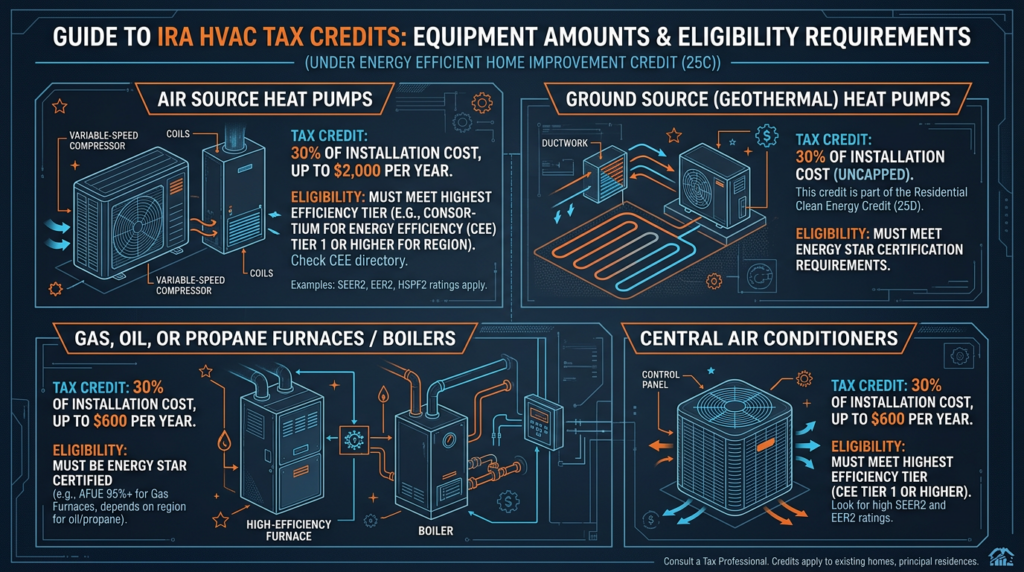
Central air conditioning systems that meet the highest efficiency tier of the Energy Star program qualify for a tax credit under the Energy Efficiency Home Improvement Credit (Section 25C). For 2024 and 2025, qualifying central AC units must meet the Energy Star Most Efficient criteria, which generally require:
- SEER2 of 16 or higher (split systems) depending on climate region
- EER2 requirements that vary by system type and region
The tax credit covers 30% of the project cost, up to a maximum of $600 for advanced central air conditioners. Eligible expenses include the cost of the unit itself. Always verify current efficiency requirements on the Energy Star website, as thresholds can be updated.
Air Source Heat Pumps
Air source heat pumps receive the most generous treatment under the IRA because they serve as both heating and cooling systems with exceptional efficiency. Qualifying heat pumps must meet the highest efficiency tier of Energy Star certification. For 2024 and 2025, this typically means:
- SEER2 of 16 or higher for split systems
- HSPF2 of 9.0 or higher for split systems
- EER2 of 12 or higher for split systems
The tax credit covers 30% of the project cost, up to a maximum of $2,000 for qualifying heat pumps. This $2,000 limit is separate from the $1,200 annual cap that applies to other home improvements, meaning you can claim up to $3,200 in total credits in a single year. Eligible expenses include the cost of the heat pump unit itself as well as installation labor costs.
Heat pumps are highlighted so prominently in the IRA because they can deliver two to three times more heating energy than the electrical energy they consume, making them among the most efficient HVAC technologies available today. Mini-split (ductless) heat pumps also qualify if they meet the required efficiency standards.
Geothermal Heat Pumps
Geothermal (ground source) heat pumps qualify under a separate provision of the IRA, the Residential Clean Energy Credit (Section 25D). This credit covers 30% of the total installed cost with no upper dollar limit through 2032. The credit percentage steps down to 26% in 2033 and 22% in 2034. Geothermal systems must meet Energy Star requirements at the time of installation. Because geothermal systems can cost $15,000 to $30,000 or more to install, the uncapped 30% credit can be worth $4,500 to $9,000 or more.
Heat Pump Water Heaters
Heat pump water heaters qualify for a tax credit of 30% of the project cost, up to $2,000. To qualify, the unit must meet the highest efficiency tier of Energy Star certification, which generally requires a UEF of 2.2 or higher for standard-size units. This $2,000 limit falls under the same heat pump category, so homeowners should be aware that the combined credit for heat pumps and heat pump water heaters shares this $2,000 annual cap.
Biomass Stoves and Boilers
Biomass stoves and boilers that burn plant-derived fuel (such as wood pellets or other biomass) qualify for a tax credit of 30% of purchase and installation costs, up to $2,000. These appliances must achieve a thermal efficiency rating of at least 75% as measured by the higher heating value (HHV) of the fuel. This $2,000 limit is grouped with heat pumps and heat pump water heaters in the annual cap structure.
Important Considerations for All Equipment
- Professional installation is generally required for the tax credit. The IRS expects qualified contractors to perform the work, and you will need documentation of the installation.
- Proper system sizing is critical. An oversized or undersized HVAC system will not perform efficiently regardless of its rated efficiency. A qualified contractor should perform a Manual J load calculation to determine the correct size for your home.
- Keep all documentation, including purchase receipts, manufacturer certification statements, model numbers, and contractor invoices. You will need these records when filing your tax return.
Home Energy Audit and the Energy Efficiency Home Improvement Credit
Home Energy Audit Credit
The IRA offers a tax credit of up to $150 for a qualified home energy audit. A certified home energy auditor evaluates your home’s energy performance and provides a written report identifying the most impactful improvements you can make. This audit can help you prioritize HVAC upgrades and other improvements to maximize your savings. The audit must be conducted by a qualified auditor who meets Department of Energy certification requirements.
Understanding the Section 25C Credit Structure
The Energy Efficiency Home Improvement Credit (Section 25C) covers 30% of qualified expenses with the following annual limits:
- $1,200 annual aggregate limit for most improvements, including insulation, windows, doors, skylights, central air conditioners, and electrical panel upgrades
- $600 per item limit for windows, central air conditioners, and certain other individual categories
- $2,000 annual limit for heat pumps, heat pump water heaters, and biomass stoves and boilers (this is separate from and in addition to the $1,200 limit)
- $150 limit for home energy audits (counted within the $1,200 aggregate)
This structure means a homeowner could potentially claim up to $3,200 in a single tax year: $1,200 for general improvements plus $2,000 for a heat pump or heat pump water heater. Because these are annual limits rather than lifetime limits, homeowners can spread improvements across multiple years to maximize their total credits.
Eligibility Requirements
To claim IRA HVAC tax credits, you must meet the following criteria:
- You must be the homeowner. Renters do not qualify for these credits. The property must be your existing primary residence or a home you own and use as a residence. New construction does not qualify under Section 25C.
- The property must be located in the United States.
- The equipment must be placed in service during the tax year for which you are claiming the credit.
- The equipment must meet the specific efficiency standards in effect at the time of installation.
One crucial clarification: the federal tax credits discussed in this article have no income limitations. Any homeowner who meets the criteria above can claim them regardless of household income. Income restrictions apply only to certain state-administered IRA rebate programs, which are entirely separate. Confusing these two programs is one of the most common mistakes homeowners make.
How to Claim the IRA HVAC Tax Credit
Filing with IRS Form 5695
Homeowners claim HVAC tax credits by completing IRS Form 5695 (Residential Energy Credits) and attaching it to their federal tax return. Part II of Form 5695 covers the Energy Efficiency Home Improvement Credit (Section 25C). You will need to enter the cost of qualifying equipment, calculate 30% of those costs, and apply the appropriate caps. The resulting credit amount transfers to your Form 1040.
Required Documentation
Maintain thorough records to support your claim:
- Purchase receipts showing the date and cost of equipment
- Installation invoices with the contractor’s name, address, and license information
- Equipment model numbers and serial numbers
- Manufacturer certification statement confirming the product meets IRA efficiency requirements
- Energy Star certification documentation
- Date the equipment was placed in service
Example Calculation
Consider a homeowner who purchases and installs a qualifying air source heat pump for a total cost of $8,000 (equipment plus installation). The tax credit equals 30% of $8,000, which is $2,400. However, the maximum credit for heat pumps is $2,000 per year, so the homeowner claims $2,000 on their tax return. If the same homeowner also installs $1,500 worth of qualifying insulation, they can claim an additional $450 (30% of $1,500), bringing their total credits for the year to $2,450.
Consult a Tax Professional
Tax situations vary. A qualified tax professional can help you determine exactly which credits you qualify for, how to coordinate them with state rebates, and how to spread improvements across multiple tax years for maximum benefit.
Common Misconceptions
- “The IRA will pay for my entire HVAC upgrade.” It will not. The credit covers 30% of qualifying costs, subject to annual caps. You are still responsible for the majority of the expense.
- “All energy-efficient HVAC systems qualify.” Only systems meeting the highest efficiency tier of Energy Star certification qualify. A system that is merely above the federal minimum efficiency standard will not earn you a tax credit.
- “IRA rebates and tax credits are the same thing.” They are not. Tax credits reduce your federal tax bill. Rebates are state-administered programs with different rules and often include income restrictions.
- “The tax credits are only for low-income households.” The federal tax credits have no income limits. Any qualifying homeowner can claim them.
- “I can install the equipment myself and still get the credit.” Professional installation by a qualified contractor is generally required. DIY installations may not qualify.
- “Last year’s requirements still apply.” Efficiency standards and program details can change. Always verify current requirements through the IRS and Energy Star before purchasing equipment.
Practical Benefits and Real-World Savings
Beyond the tax credit itself, upgrading to a high-efficiency HVAC system delivers ongoing financial and lifestyle benefits. A homeowner replacing a 10 SEER air conditioner with a 16 SEER2 heat pump can expect to reduce cooling energy costs by 35% to 45%. Heat pumps also eliminate the need for a separate furnace in many climates, consolidating heating and cooling into one system.
Energy-efficient upgrades consistently increase home resale value. Studies from the National Association of Realtors indicate that buyers are willing to pay a premium for homes with modern, efficient HVAC systems. Improved equipment also delivers better humidity control, more consistent temperatures, and quieter operation.
When selecting a contractor, obtain at least three written quotes, verify licensing and insurance, check references, and confirm that the contractor is familiar with IRA-qualifying equipment and can provide the necessary documentation for your tax credit claim.
Related Topics and Further Resources
- State and local rebates: Additional incentives may be available in your area. Search the DSIRE database at dsireusa.org for a comprehensive listing of programs by state.
- Weatherization: Insulation, air sealing, and duct sealing maximize the performance of any HVAC upgrade and may qualify for additional credits under Section 25C.
- Smart thermostats: While not directly covered by IRA tax credits, smart thermostats can reduce HVAC energy consumption by 10% to 15% and complement your new high-efficiency system.
- Official resources: Visit irs.gov for Form 5695 and tax credit guidance, energystar.gov for qualifying product lists, and energy.gov for general information about the IRA’s residential provisions.
Key Takeaways
The IRA HVAC tax credits represent one of the most accessible and valuable incentives available to homeowners in 2024 and 2025. Heat pumps qualify for credits up to $2,000, central air conditioners up to $600, and geothermal systems receive an uncapped 30% credit. These federal credits have no income restrictions and reset annually, allowing you to plan improvements across multiple years. Always verify that your chosen equipment meets the current highest efficiency tier of Energy Star certification, hire a qualified contractor, keep detailed records, and file IRS Form 5695 with your tax return. Combined with potential state rebates, reduced energy bills, and increased home value, investing in a high-efficiency HVAC system is a decision that pays returns for years to come.