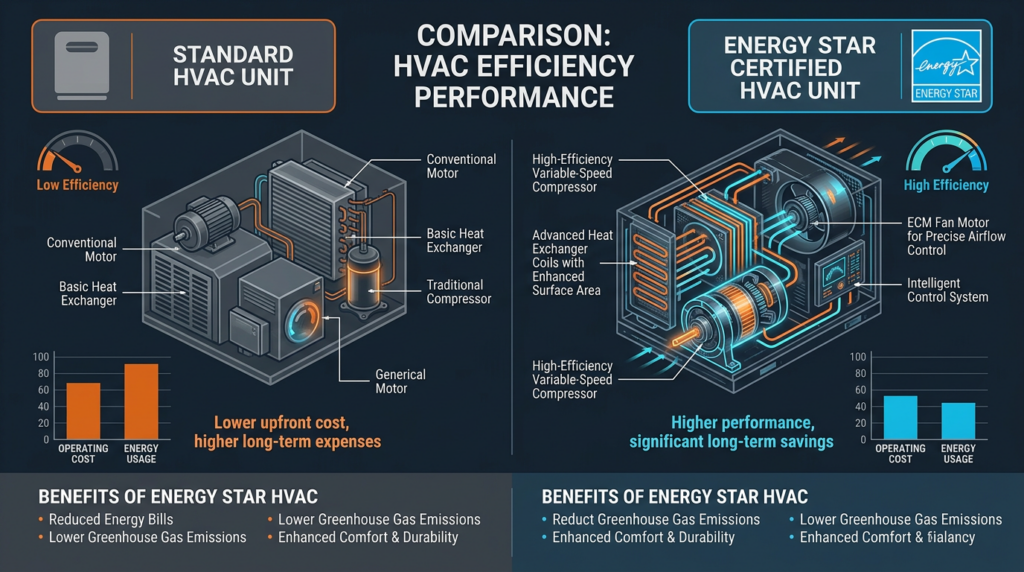
Heating, ventilation, and air conditioning systems account for roughly 48% of energy use in a typical U.S. home, making them the single largest energy expense for most households. With annual heating and cooling costs averaging over $1,000 per household, the efficiency of your HVAC equipment has a direct and measurable impact on your utility bills, your comfort, and the environment. ENERGY STAR HVAC certification provides a reliable, government-backed benchmark that identifies equipment meeting strict energy efficiency requirements set by the U.S. Environmental Protection Agency. This article explains what the ENERGY STAR label means when applied to HVAC equipment, breaks down the technical specifications for each equipment category, and outlines the practical benefits of choosing certified systems.
Understanding the ENERGY STAR Program
The ENERGY STAR program was established in 1992 by the U.S. Environmental Protection Agency (EPA) as a voluntary labeling initiative designed to identify and promote energy-efficient products. The program initially focused on computers and monitors before expanding to cover more than 75 product categories, including HVAC equipment, appliances, lighting, electronics, and even commercial buildings.
The EPA manages the ENERGY STAR program in partnership with the U.S. Department of Energy (DOE). The EPA sets the performance specifications, oversees third-party testing and certification, and manages the ENERGY STAR label. The DOE contributes technical expertise and supports the development of test procedures used to evaluate product performance.
ENERGY STAR standards are not static. The EPA periodically revises efficiency requirements to reflect advances in technology and to maintain the label’s meaning as a mark of superior performance. Typically, ENERGY STAR-qualified products must perform in the top 15% to 30% of their product category in terms of energy efficiency. When a product category matures and most products meet the current threshold, the EPA raises the bar.
The ENERGY STAR label serves as a simple, trusted signal for consumers. Rather than requiring buyers to interpret complex efficiency ratings on their own, the label confirms that a product has been independently tested and verified to meet or exceed specific efficiency criteria. Since its inception, the program has helped Americans save trillions of kilowatt-hours of electricity and avoid billions of metric tons of greenhouse gas emissions.
Technical Specifications of ENERGY STAR HVAC Certification
ENERGY STAR certification requirements vary by equipment type. Each category uses specific efficiency metrics, and minimum thresholds are updated periodically. Below is a detailed breakdown of the current standards and the metrics used to evaluate each type of HVAC equipment.
Air Conditioners and Heat Pumps
Central air conditioners and heat pumps are evaluated using several key efficiency metrics:
- SEER2 (Seasonal Energy Efficiency Ratio 2) measures cooling efficiency over an entire cooling season. It is calculated by dividing the total cooling output (in BTUs) by the total electrical energy input (in watt-hours) over a seasonal period using the updated M1 testing procedure. ENERGY STAR currently requires a minimum SEER2 of 16 for split-system central air conditioners and heat pumps and a minimum SEER2 of 15.2 for single-package systems. In certain regions, particularly the Southwest and Southeast, federal minimum standards are higher, and ENERGY STAR requirements reflect these regional variations.
- EER2 (Energy Efficiency Ratio 2) measures cooling efficiency at a specific high outdoor temperature (95°F), representing peak demand conditions. ENERGY STAR requires a minimum EER2 of 12 for split-system air conditioners. This metric is critical because it reflects how well equipment performs during the hottest periods when energy demand and costs are highest.
- HSPF2 (Heating Seasonal Performance Factor 2) measures the heating efficiency of heat pumps over a full heating season. It is calculated by dividing total heating output by total electrical input over the season. ENERGY STAR requires a minimum HSPF2 of 9.0 for split-system heat pumps.
- COP (Coefficient of Performance) expresses heating efficiency as the ratio of heating energy output to electrical energy input at a specific temperature, typically 47°F or 17°F. A COP of 3.0 means the system delivers three units of heat for every one unit of electricity consumed. COP is related to HSPF but provides a snapshot at a specific operating condition rather than a seasonal average.
Beyond minimum efficiency numbers, several advanced features contribute to the superior performance of ENERGY STAR-qualified cooling and heating systems:
- Variable-speed compressors adjust their output to match the actual cooling or heating load rather than cycling on and off at full capacity. This results in more precise temperature control, lower energy consumption during partial-load conditions, and quieter operation.
- Smart Thermostat Integration“>Smart thermostat integration allows ENERGY STAR systems to work with connected thermostats that learn occupancy patterns, adjust schedules automatically, and provide energy usage reports. ENERGY STAR-certified smart thermostats are independently verified to deliver energy savings.
- Enhanced dehumidification control is increasingly important for comfort and efficiency. Variable-speed systems naturally provide better moisture removal because they run longer at lower capacities, extracting more humidity without overcooling the space.
- Low-GWP refrigerants are becoming standard as the industry phases out older refrigerants with high global warming potential. The transition from R-410A to lower-GWP alternatives like R-32 and R-454B aligns with both environmental regulations and ENERGY STAR’s broader mission of environmental protection.
Furnaces
Gas and oil furnaces are evaluated using AFUE (Annual Fuel Utilization Efficiency), which measures the percentage of fuel converted into usable heat over a typical heating season. An AFUE of 97% means that 97 cents of every dollar spent on fuel becomes heat for your home, while 3 cents is lost through exhaust and other inefficiencies.
ENERGY STAR requires a minimum AFUE of 97% for gas furnaces and 90% for oil furnaces. These thresholds place ENERGY STAR-qualified furnaces well above the federal minimum standard of 80% AFUE for non-weatherized gas furnaces.
The distinction between condensing and non-condensing furnaces is central to achieving high AFUE ratings. Condensing furnaces extract additional heat from exhaust gases by cooling them until the water vapor condenses, releasing latent heat that would otherwise be lost up the flue. This process allows condensing furnaces to achieve AFUE ratings of 90% to 98.5%, while non-condensing models typically top out around 80% AFUE.
Additional features found in ENERGY STAR-qualified furnaces include:
- Variable-speed blower motors (also called ECM motors) that adjust airflow to match demand, reducing electricity consumption by up to 75% compared to standard single-speed motors while providing more even temperature distribution.
- Sealed combustion systems that draw combustion air from outside the home rather than from conditioned indoor air, improving both safety and efficiency.
- Electronic ignition systems that eliminate the need for a continuously burning pilot light, saving fuel whenever the furnace is not actively heating.
Boilers
Like furnaces, boilers are rated using AFUE. ENERGY STAR requires a minimum AFUE of 90% for gas boilers and 87% for oil boilers. Condensing boilers achieve these higher efficiencies by recovering heat from flue gases, similar to condensing furnaces.
Modulating boilers represent the highest tier of efficiency in this category. Rather than operating at a fixed output, modulating boilers continuously adjust their firing rate to match the building’s real-time heating demand. This reduces energy waste from short-cycling and maintains more consistent water temperatures, resulting in both higher efficiency and improved comfort.
Ductwork Considerations
While ductwork itself does not carry an ENERGY STAR certification, it plays a critical role in overall system efficiency. The DOE estimates that the average duct system loses 25% to 40% of the energy produced by a central furnace or air conditioner through leaks, gaps, and poor insulation. Even the most efficient ENERGY STAR-rated equipment cannot deliver its rated performance if connected to a leaky, uninsulated duct system. The Air Conditioning Contractors of America (ACCA) publishes standards for duct design, installation, and sealing that HVAC professionals should follow to maximize system performance.
Benefits of Choosing ENERGY STAR Certified HVAC Equipment
Energy savings represent the most immediate and quantifiable benefit. According to the EPA, replacing a 15-year-old central air conditioner with an ENERGY STAR-certified model can save homeowners 20% or more on cooling costs. For heating equipment, upgrading from a standard 80% AFUE furnace to a 97% AFUE ENERGY STAR model can reduce fuel consumption by roughly 17%. In dollar terms, homeowners can expect to save anywhere from $150 to $500 or more annually depending on climate, energy prices, home size, and the efficiency of the equipment being replaced.
Environmental impact reduction is significant at scale. Each household that upgrades to ENERGY STAR-certified HVAC equipment reduces its carbon dioxide emissions by an average of 2,000 to 4,000 pounds annually. Across millions of homes, these reductions contribute meaningfully to national greenhouse gas reduction goals.
Improved comfort is a benefit that efficiency ratings alone do not fully capture. Variable-speed compressors and blower motors, common in ENERGY STAR-qualified systems, deliver more consistent temperatures with fewer hot and cold spots. These systems also operate more quietly and provide better humidity control compared to standard single-stage equipment.
Increased home value is a practical consideration for homeowners planning to sell. Real estate studies consistently show that energy-efficient features, including ENERGY STAR-certified HVAC systems, are attractive to buyers and can contribute to higher resale values. Appraisers and home inspectors increasingly note the presence of high-efficiency systems in their reports.
Rebates and incentives can substantially offset the higher upfront cost of ENERGY STAR equipment. Federal tax credits under the Inflation Reduction Act of 2022 offer up to $2,000 for qualifying heat pumps and up to $600 for qualifying furnaces and boilers. Many state and local utilities offer additional rebates. The Database of State Incentives for Renewables and Efficiency (DSIRE) at dsireusa.org is the most comprehensive resource for finding available incentives by location.
Durability and longevity are often associated with ENERGY STAR-qualified equipment, though this is partly due to the higher quality components (such as variable-speed motors and advanced heat exchangers) that are necessary to meet stringent efficiency thresholds. These components tend to experience less wear from cycling and operate under less stress, which can contribute to a longer service life when properly maintained.
Common Misconceptions about ENERGY STAR HVAC Certification
Misconception: ENERGY STAR equipment is always the most expensive option. While certified models may carry a higher purchase price, the lifetime cost of ownership is typically lower due to reduced energy bills. Payback periods of three to seven years are common, after which the savings continue for the remaining life of the equipment.
Misconception: All ENERGY STAR certified equipment performs the same. ENERGY STAR is a minimum threshold, not a ceiling. Among certified models, there can be wide variation in SEER2, AFUE, and feature sets. A unit rated at SEER2 20 will perform substantially better than one rated at SEER2 16, even though both earn the ENERGY STAR label.
Misconception: Buying ENERGY STAR equipment guarantees energy savings. Equipment performance depends heavily on proper sizing, professional installation, adequate ductwork, and regular maintenance. An oversized system will short-cycle, waste energy, and provide poor humidity control regardless of its efficiency rating. The certification applies to the equipment’s potential, not to any specific installation.
Misconception: ENERGY STAR is just a marketing tool. The program requires independent, third-party testing and verification before any product can carry the label. The EPA conducts ongoing verification testing of certified products and can revoke certification if products fail to meet published specifications.
Selecting and Installing ENERGY STAR HVAC Equipment
Proper system sizing is the foundation of an efficient installation. HVAC contractors should perform a Manual J load calculation (per ACCA standards) that accounts for square footage, insulation levels, window area and orientation, climate zone, and occupancy patterns. Oversized equipment wastes energy and provides poor comfort. Undersized equipment runs continuously without meeting demand.
Professional installation is essential. Studies by the DOE have found that improper installation can reduce system efficiency by up to 30%. Look for contractors certified by North American Technician Excellence (NATE) or those who follow ACCA Quality Installation standards. A qualified contractor will verify proper refrigerant charge, airflow, electrical connections, and duct integrity.
Ongoing maintenance preserves efficiency over the life of the equipment. At minimum, homeowners should replace or clean air filters every one to three months, keep outdoor units clear of debris, and schedule professional maintenance at least once per year. Neglected systems lose efficiency gradually, and minor issues can escalate into costly repairs.
Duct sealing and insulation should be addressed whenever new equipment is installed. Professional duct sealing using mastic or metal-backed tape can recover much of the 25% to 40% energy loss that occurs in a typical duct system. Insulating ducts that run through unconditioned spaces like attics, crawlspaces, and garages further reduces thermal losses.
Integrating a smart thermostat with your ENERGY STAR system allows for scheduling, geofencing, and learning algorithms that can reduce heating and cooling costs by an additional 8% to 15% annually. Choose an ENERGY STAR-certified smart thermostat to ensure verified savings.
The Future of ENERGY STAR HVAC Standards
ENERGY STAR efficiency thresholds will continue to rise as technology advances. Variable refrigerant flow (VRF) systems, already common in commercial applications, are gaining traction in residential markets and offer exceptional part-load efficiency. Geothermal heat pumps, which exchange heat with the earth rather than outdoor air, achieve COPs of 3.5 to 5.0 and represent one of the most efficient heating and cooling technologies available.
The integration of HVAC systems with smart grid technology will allow equipment to respond to real-time electricity pricing and grid demand signals, shifting energy use to off-peak periods. Artificial intelligence and machine learning are increasingly being applied to optimize system operation, predict maintenance needs, and reduce energy waste through continuous performance monitoring.
Federal and state building codes are also tightening. Many jurisdictions now require or incentivize equipment that meets or exceeds ENERGY STAR levels, and the trend toward electrification of heating (favoring heat pumps over combustion equipment) will further reshape the ENERGY STAR landscape in the coming years.
Key Takeaways
- ENERGY STAR HVAC certification identifies equipment that meets rigorous, independently verified efficiency standards set by the EPA, covering air conditioners, heat pumps, furnaces, and boilers.
- Key metrics include SEER2 and EER2 for cooling efficiency, HSPF2 for heat pump heating efficiency, and AFUE for furnace and boiler fuel efficiency.
- Choosing ENERGY STAR-certified equipment can reduce heating and cooling costs by 20% or more compared to standard equipment, with annual savings typically ranging from $150 to $500.
- Federal tax credits of up to $2,000 for heat pumps and $600 for furnaces and boilers are available, along with many state and utility rebates.
- Proper sizing, professional installation, sealed ductwork, and regular maintenance are essential to achieving the full efficiency potential of any ENERGY STAR-rated system.
- ENERGY STAR standards will continue to become more stringent as technologies like VRF systems, geothermal heat pumps, and AI-driven optimization mature and become more widely available.
Investing in ENERGY STAR-certified HVAC equipment is one of the most effective steps homeowners can take to reduce energy costs, improve indoor comfort, and lower their environmental footprint. Consult with a qualified HVAC professional to evaluate your home’s specific needs, perform a proper load calculation, and ensure that your new system is installed and maintained to deliver the performance and savings it was designed to provide.