Efficient HVAC systems account for roughly 40% of total energy consumption in commercial buildings, making them the single largest target for reducing operating costs and carbon emissions. ASHRAE Standard 90.1 sets the minimum energy efficiency requirements for these systems, and understanding its HVAC provisions is essential for anyone involved in designing, constructing, or managing commercial buildings. This article explains what ASHRAE 90.1 requires for HVAC systems, defines the critical terminology, outlines major equipment and control requirements, and covers recent updates that affect how buildings are designed and operated today.
What Is ASHRAE Standard 90.1?
ASHRAE Standard 90.1, formally titled “Energy Standard for Sites and Buildings Except Low-Rise Residential Buildings,” is the primary energy efficiency benchmark for commercial and high-rise residential construction in the United States and many international markets. First published in 1975 in response to the energy crisis, the standard has undergone continuous revision, with major updates released approximately every three years. Key milestone editions include 1999, 2004, 2010, 2016, 2019, and the most recent 2022 edition.
It is important to understand that ASHRAE 90.1 is a standard, not a building code. It becomes legally enforceable only when adopted by a jurisdiction, either directly or through its incorporation into codes such as the International Energy Conservation Code (IECC). The U.S. Department of Energy uses ASHRAE 90.1 as the commercial building energy efficiency reference for state code compliance determinations.
Compliance Paths
ASHRAE 90.1 offers two primary paths to compliance:
- Prescriptive Path: The building must meet specific, fixed requirements for each component, including insulation R-values, equipment efficiency ratings, and lighting power densities. This approach is straightforward but allows limited design flexibility.
- Performance Path: The proposed building design is modeled using approved energy simulation software and compared against a baseline building that meets all prescriptive requirements. If the proposed design uses equal or less energy than the baseline, compliance is achieved. This path offers significantly more design freedom.
Each new edition raises the efficiency floor, reflecting advances in technology, updated research, and evolving energy policy goals.
Key HVAC Concepts and Terminology
Interpreting ASHRAE 90.1 requires fluency in several efficiency metrics. These terms appear throughout the standard and in equipment specifications.
Cooling Efficiency Metrics
- SEER2 (Seasonal Energy Efficiency Ratio 2): Measures cooling efficiency over an entire cooling season for equipment under 65,000 Btu/h. SEER2 replaced the original SEER metric as of January 2023, using updated testing procedures (AHRI 210/240-2023) with higher external static pressure to better reflect real-world installation conditions. Higher SEER2 values indicate greater efficiency.
- EER (Energy Efficiency Ratio): Measures cooling efficiency at a single operating point, typically at 95°F outdoor temperature and full load. It is commonly used for larger commercial equipment.
- IEER (Integrated Energy Efficiency Ratio): Accounts for part-load performance by weighting efficiency at 25%, 50%, 75%, and 100% load conditions. Since commercial equipment rarely operates at full capacity, IEER provides a more realistic picture of actual energy performance for packaged units and chillers.
Heating Efficiency Metrics
- HSPF2 (Heating Seasonal Performance Factor 2): Measures heat pump heating efficiency over a full heating season. Like SEER2, HSPF2 replaced HSPF with updated test procedures effective January 2023. Higher values mean greater heating efficiency.
- COP (Coefficient of Performance): The ratio of heating or cooling output to energy input, expressed as a dimensionless number. A COP of 3.0 means the system delivers three units of heating energy for every one unit of electrical energy consumed. COP is used for heat pumps, chillers, and other equipment.
- AFUE (Annual Fuel Utilization Efficiency): Expressed as a percentage, AFUE measures the fraction of fuel converted to useful heat over a full heating season for furnaces and boilers. An AFUE of 95% means 95 cents of every fuel dollar becomes usable heat.
System-Level Terms
- Fan Power Limitation (FPL): A cap on the total power consumed by supply, return, and exhaust fans, typically expressed in watts per cubic foot per minute (W/cfm). This prevents oversized or inefficient fan systems.
- Economizers: Airside economizers use cool outdoor air to reduce or eliminate mechanical cooling when conditions permit. Waterside economizers use cooling tower water or other low-energy sources for the same purpose.
- Variable Air Volume (VAV) Systems: VAV systems adjust the volume of conditioned air delivered to each zone based on actual demand, reducing fan energy compared to constant-volume systems.
- Reheat: The process of reheating cooled supply air to maintain comfort in zones that need less cooling. Reheat is inherently inefficient because it uses energy to undo previous cooling work, and ASHRAE 90.1 places strict limits on its use.
Major HVAC Requirements in ASHRAE 90.1
The HVAC provisions of ASHRAE 90.1 span Sections 6.1 through 6.5 and associated normative appendices. They cover equipment efficiency, controls, insulation, and air leakage.
Equipment Efficiency Requirements
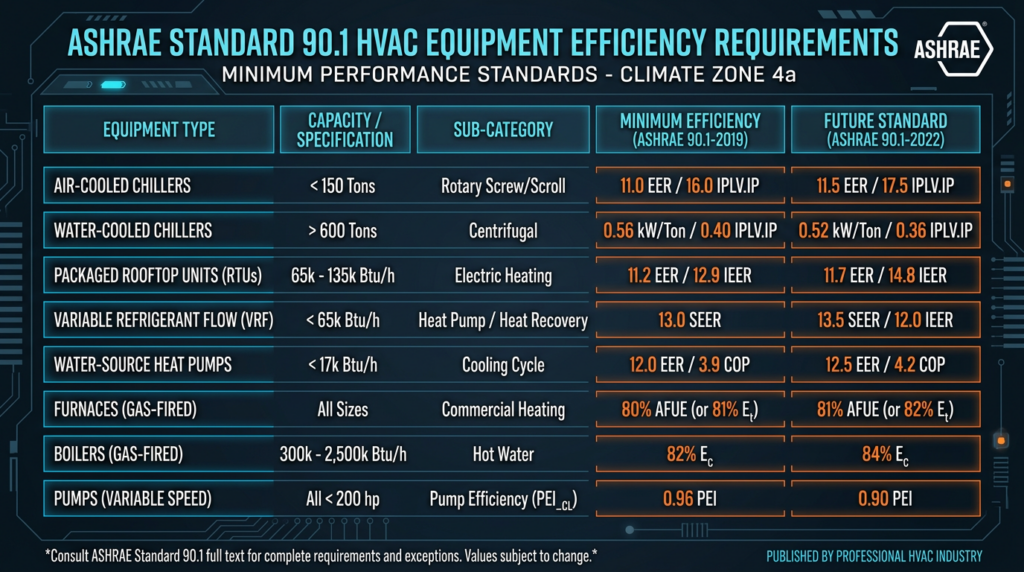
Cooling equipment must meet minimum efficiency thresholds based on equipment type, capacity, and application. The following are representative minimums from the 2022 edition for common equipment categories:
- Unitary air conditioners under 65,000 Btu/h: minimum 14.3 SEER2 (split systems) or 13.4 SEER2 (single package)
- Unitary air conditioners 65,000 to 135,000 Btu/h: minimum 11.0 EER and varying IEER requirements depending on heating section type
- Air-cooled chillers under 150 tons: minimum COP and IPLV values that have increased substantially from prior editions
- Water-cooled centrifugal chillers: minimum COP of 6.0 or higher depending on condenser type and capacity, with IPLV requirements above 10.0 for many configurations
- VRF systems: rated under IEER and EER criteria that are now significantly more stringent than previous editions
Heating equipment requirements include:
- Gas-fired warm air furnaces (commercial): minimum 80% AFUE for units under 225,000 Btu/h input, with higher thermal efficiency requirements for larger units
- Hot water boilers: minimum 84% combustion efficiency for gas-fired units under 300,000 Btu/h, scaling upward with capacity
- Air-source heat pumps under 65,000 Btu/h: minimum 7.5 HSPF2 (split) and COP requirements at 47°F and 17°F rating conditions
- Water-source and ground-source heat pumps: minimum COP of 4.3 to 4.6 for cooling and 3.0 to 3.6 for heating depending on entering water temperature
Note: These values are representative summaries. Always consult the current edition of ASHRAE 90.1 and the corresponding AHRI certification directories for definitive, legally binding requirements.
Fan Efficiency and Power Limits
Fan power limitations in ASHRAE 90.1-2022 restrict total fan system power based on supply airflow. For systems with total fan system power greater than 1 HP, the standard sets maximum allowable fan system power. Credits are available for components that increase pressure drop, such as MERV 13+ filters, energy recovery devices, and sound attenuation. The standard also requires Fan Efficiency Grade (FEG) 67 or higher for fans over 5 HP and mandates variable speed drives on fans serving VAV systems.
Control Requirements
Controls represent one of the most impactful sections of ASHRAE 90.1:
- Thermostatic controls: All HVAC zones must have individual temperature controls with deadband settings of at least 5°F between heating and cooling setpoints. Automatic setback and setup capability is required, reducing heating to 55°F and raising cooling to 90°F during unoccupied periods.
- Demand-controlled ventilation (DCV): Required for spaces larger than 500 square feet with a design occupant density exceeding 25 people per 1,000 square feet. DCV uses occupancy sensors or CO2 sensors to reduce outdoor air intake when spaces are partially occupied.
- Economizer controls: Airside economizers are required for most cooling systems above 54,000 Btu/h in climate zones 1 through 8, with specific exceptions. High-limit shutoff control must use either differential enthalpy, fixed enthalpy, or fixed dry-bulb control depending on climate zone.
- Demand response: The 2022 edition strengthened demand response provisions, requiring buildings to shed cooling loads by raising zone setpoints and reducing fan speeds upon receiving an automated demand response signal.
Duct and Piping Insulation
ASHRAE 90.1 specifies minimum duct insulation R-values based on duct location. Supply ducts in unconditioned spaces typically require R-6 to R-8 insulation. Return ducts in unconditioned spaces require R-3.5 to R-6. Ducts located within conditioned spaces may have reduced or no insulation requirements.
Piping insulation requirements depend on the fluid temperature and pipe diameter. Chilled water piping generally requires 1 to 1.5 inches of insulation for pipes up to 4 inches in diameter, with increased thickness for larger pipes. Heating hot water piping above 200°F requires up to 3 inches for large-diameter pipes.
Duct Sealing and Air Leakage
All ductwork must be sealed in accordance with the standard. Duct systems operating at 3 inches of water gauge or higher static pressure must be leak-tested, with maximum allowable leakage rates of 4 cfm per 100 square feet of duct surface area for Class A sealing (required for high-pressure systems).
Updates and Changes in Recent Editions
The ASHRAE 90.1-2022 edition, along with addenda approved through 2023 and into 2024, introduced several significant changes affecting HVAC design.
Transition to SEER2 and HSPF2
The mandatory shift to SEER2 and HSPF2 testing procedures for equipment under 65,000 Btu/h aligns the standard with the DOE’s updated test procedures. Because SEER2 values are numerically lower than equivalent SEER values for the same equipment (due to higher test static pressures), practitioners must use the correct metric when verifying compliance. A unit rated at 14 SEER may only achieve approximately 13.4 SEER2.
Increased Heat Pump Adoption Provisions
Reflecting the industry push toward electrification and decarbonization, the 2022 edition and subsequent addenda expanded requirements and incentives for heat pump systems. Performance path credits now favor all-electric heat pump designs, and several addenda have proposed tightening fossil-fuel heating efficiency requirements to encourage the transition.
Enhanced Fan and Motor Efficiency
Fan power limitations were tightened, and the standard now requires higher motor efficiency levels consistent with the DOE’s updated motor efficiency regulations. Electronically commutated motors (ECMs) are increasingly necessary to meet the requirements for smaller fan applications.
Expanded Energy Recovery Requirements
Energy recovery ventilation (ERV) requirements were broadened, lowering the outdoor airflow thresholds at which energy recovery becomes mandatory. In many climate zones, systems with as little as 500 cfm of outdoor air now require energy recovery with a minimum 50% recovery effectiveness.
Future Direction
ASHRAE’s long-range goal targets net-zero energy buildings. Future editions are expected to further tighten equipment efficiency floors, expand renewable energy integration requirements, mandate more aggressive heat pump deployment, and incorporate grid-interactive building controls as standard practice.
Common Misconceptions About ASHRAE 90.1 and HVAC Efficiency
- “ASHRAE 90.1 is just about equipment efficiency.” Equipment ratings are only one component. System-level controls, duct insulation, piping insulation, air sealing, and energy recovery all contribute significantly to overall HVAC energy performance. A high-efficiency chiller installed with poorly insulated piping and leaky ductwork will underperform.
- “Complying with ASHRAE 90.1 is too expensive.” While efficient equipment may carry higher upfront costs, lifecycle cost analyses consistently show that the energy savings over a building’s operational life far exceed the initial investment. Payback periods of 3 to 7 years are common for major HVAC upgrades.
- “ASHRAE 90.1 is a code.” It becomes enforceable only when adopted by a local jurisdiction. Until then, it serves as a voluntary standard or a reference for voluntary programs such as LEED.
- “The prescriptive path is always easier.” For buildings with unusual geometry, mixed uses, or innovative systems, the performance path often provides more flexibility and can demonstrate compliance even when individual components do not meet prescriptive thresholds.
- “High-efficiency equipment guarantees high performance.” Without proper sizing, installation, commissioning, and ongoing maintenance, even the most efficient equipment will underperform. Commissioning is essential to verifying that systems operate as designed.
Practical Applications and Compliance Strategies
Designing for Compliance
Successful compliance starts in the schematic design phase. Key strategies include:
- Right-sizing equipment using accurate load calculations per ASHRAE guidelines rather than rules of thumb
- Selecting equipment that exceeds minimum efficiency thresholds by a comfortable margin to account for field conditions
- Zoning HVAC systems to match occupancy patterns, solar exposure, and internal load profiles
- Specifying DDC controls with occupancy-based scheduling, optimal start, and demand-controlled ventilation from the outset
- Running energy models early in design to identify the most cost-effective efficiency measures
Commissioning and Verification
ASHRAE 90.1 requires functional testing of HVAC controls and systems to verify proper operation. A comprehensive commissioning process should verify setpoints, sequences of operation, economizer functionality, and fan power at design conditions. Post-occupancy monitoring can identify drift from design intent and catch control failures before they waste significant energy.
Retrofit Applications
While ASHRAE 90.1 primarily applies to new construction and major renovations, it serves as an excellent benchmark for retrofit projects. Common retrofit strategies guided by the standard include replacing atmospheric boilers with condensing units, upgrading to variable-speed drives on pumps and fans, adding airside economizers to existing rooftop units, and improving duct sealing in existing plenums. Many utility incentive programs reference ASHRAE 90.1 baseline efficiencies when calculating rebates for equipment upgrades.
Related Standards and Resources
- ASHRAE Standard 62.1: Governs ventilation rates for acceptable indoor air quality and directly interacts with 90.1’s DCV and energy recovery provisions
- IECC (International Energy Conservation Code): References ASHRAE 90.1 as an alternative commercial compliance path
- ASHRAE Standard 189.1: The Standard for the Design of High-Performance Green Buildings, which builds on 90.1 with more aggressive efficiency targets
- Energy modeling software: EnergyPlus, Trane TRACE 3D Plus, IES Virtual Environment (VE), Carrier HAP, and eQUEST are widely used for performance path compliance
- ASHRAE 90.1 User’s Manual: Published by ASHRAE with detailed guidance, examples, and illustrations for each section of the standard
Building owners should also investigate federal tax deductions under Section 179D, which rewards energy-efficient commercial building design that meets or exceeds ASHRAE 90.1 reference standards, along with local utility rebate programs.
Key Takeaways
ASHRAE 90.1 is the foundation of commercial building energy efficiency in the United States and beyond. Its HVAC provisions address equipment efficiency, system controls, insulation, duct sealing, and energy recovery as an integrated package. The transition to SEER2 and HSPF2 metrics, tightened fan power limits, expanded energy recovery mandates, and growing emphasis on electrification through heat pumps define the current direction of the standard. Compliance requires attention not only to selecting efficient equipment but also to proper system design, controls integration, commissioning, and ongoing maintenance. Whether you are designing a new building, planning a major renovation, or benchmarking an existing facility, ASHRAE 90.1 provides the roadmap for reducing energy consumption, lowering operating costs, and meeting the evolving expectations of energy codes and sustainability goals.