A homeowner calls you for a refrigerant top-up on their R-410A system. You quote the price, and they gasp. The cost of R-410A has already started climbing, and it will only go higher. This scenario is playing out in service calls across the country as the HVAC industry undergoes its most significant refrigerant transition since the R-22 phase-out. The shift away from R-410A is not a distant possibility; it is happening now. For HVAC contractors, understanding the regulatory timeline, the alternative refrigerants entering the market, and the practical steps required to stay compliant and competitive is essential. This article covers the full scope of the R-410A phase-out, including key regulations, replacement refrigerants, equipment considerations, business strategies, and common misconceptions that could cost you time and money.
The R-410A Phase-Out: Regulatory Overview
The AIM Act and EPA Authority
The American Innovation and Manufacturing (AIM) Act, signed into law in December 2020, gives the Environmental Protection Agency the authority to phase down the production and consumption of hydrofluorocarbons (HFCs) in the United States. R-410A, classified as an HFC with a high global warming potential, falls squarely under this regulation. The AIM Act aligns with the goals of the Kigali Amendment to the Montreal Protocol, which calls for a global HFC phase-down. Although the United States has not formally ratified the Kigali Amendment, the AIM Act effectively achieves similar reduction targets domestically.
The EPA is responsible for implementing the AIM Act through a series of rulemakings that establish production quotas, consumption allowances, and sector-specific restrictions on the use of high-GWP refrigerants in new equipment.
The Timeline: Key Dates for Contractors
Understanding the phase-down schedule is critical for planning your business operations and advising customers accurately.
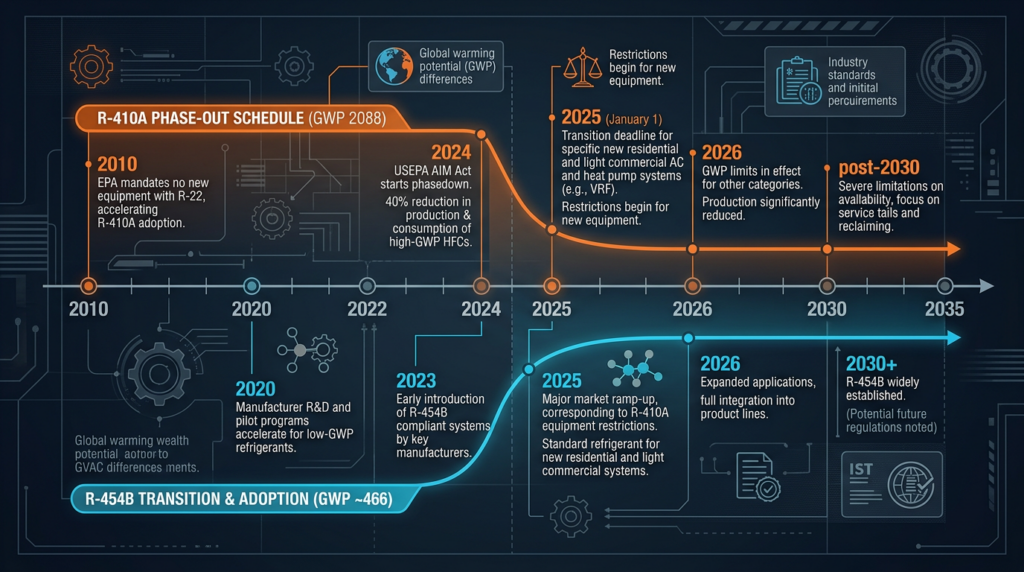
- January 1, 2022: A 10% reduction from the U.S. baseline for HFC production and consumption took effect, representing the first step in reducing overall HFC availability.
- January 1, 2024: The EPA implemented a 40% cumulative reduction from baseline levels, significantly tightening the supply of HFCs including R-410A.
- January 1, 2025: The EPA’s Technology Transitions Rule prohibits the manufacture and import of new residential and light commercial air conditioning and heat pump systems that use refrigerants with a GWP of 700 or higher. This effectively bans R-410A (GWP of 2088) from new equipment in these sectors. This is a system-level ban, not a ban on the refrigerant itself.
R-410A will remain available for servicing existing equipment after 2025. However, as production quotas continue to decline and demand persists from the large installed base of R-410A systems, prices will almost certainly rise. Contractors should also check state-level regulations, as states like California, Washington, and others in the U.S. Climate Alliance may enforce stricter timelines or additional requirements beyond federal rules. Penalties for violating AIM Act provisions can include fines of up to $44,539 per day per violation, making compliance a serious financial concern.
Understanding R-410A and Its Replacements
R-410A Properties
R-410A is a near-azeotropic blend of two HFCs: 50% difluoromethane (R-32) and 50% pentafluoroethane (R-125). It has a Global Warming Potential (GWP) of 2088, meaning that one kilogram of R-410A released into the atmosphere traps 2,088 times more heat than one kilogram of carbon dioxide over a 100-year period. R-410A operates at significantly higher pressures than its predecessor R-22, which drove changes in compressor design, coil construction, and system components when the industry transitioned in the early 2000s. Its Ozone Depletion Potential (ODP) is zero, which was the primary reason it replaced R-22. Now, its high GWP is the reason it is being replaced.
Alternative Refrigerants
Several refrigerants are positioned to replace R-410A. Each has distinct properties that contractors must understand before working with them.
R-32 (Difluoromethane) is a single-component refrigerant with a GWP of 675. It is classified as A2L, meaning it has lower toxicity and mild flammability. R-32 operates at similar pressures to R-410A but offers higher volumetric cooling capacity, which can translate to smaller refrigerant charges and improved energy efficiency. R-32 has been widely adopted in Asia and parts of Europe for years, with manufacturers like Daikin leading its use globally. It is gaining traction in the U.S. market, particularly for ductless mini-split systems. Because R-32 is mildly flammable, contractors must follow specific safety protocols for leak detection, ventilation, and handling during installation and service.
R-454B (marketed as Opteon XL41 by Chemours) is a blend of 68.9% R-32 and 31.1% R-1234yf (2,3,3,3-tetrafluoropropene). It has a GWP of 466 and is also classified as A2L. R-454B is being adopted by several major equipment manufacturers, including Carrier, Trane, and Lennox, for residential and light commercial air conditioning and heat pump systems. Its pressure and capacity characteristics are reasonably close to R-410A, which simplifies some aspects of equipment redesign. Like R-32, it requires A2L-specific safety training and compatible tools.
R-454C (marketed as Opteon XL20) is another R-32/R-1234yf blend with a significantly lower GWP of approximately 148. It is classified as A2L and is finding applications in chillers and certain heat pump configurations where ultra-low GWP is a priority. Its lower GWP makes it particularly attractive for jurisdictions with aggressive climate targets.
R-290 (Propane) is a natural refrigerant with a GWP of only 3. It is classified as A3, meaning it is highly flammable. Due to its flammability, R-290 is primarily used in smaller, self-contained units such as window air conditioners, portable units, and commercial refrigeration display cases where charge limits can be kept very low. The EPA has expanded allowable uses and charge sizes for R-290, but its application in larger split systems remains limited by safety codes. Working with R-290 requires specialized training, explosion-proof tools, and strict adherence to safety standards.
Oil Compatibility
Contractors should be aware that alternative refrigerants may require different lubricant oils. Most R-410A systems use polyolester (POE) oil, and many of the new A2L alternatives are also compatible with POE oils. However, specific formulations may differ between systems. Never assume that simply swapping refrigerant in an existing system without verifying oil compatibility is acceptable. Mismatched lubricants will cause compressor wear, reduced heat transfer, and eventual system failure. Always follow the equipment manufacturer’s specifications.
Practical Implications for HVAC Contractors
Equipment Changes
Systems designed for alternative refrigerants incorporate different engineering compared to R-410A units. A2L refrigerants require built-in safety features such as refrigerant leak detection sensors, modified electrical components to reduce ignition risk, and adjusted system charge limits based on room volume and installation location. Coil designs, metering devices, and control boards are all calibrated specifically for the thermodynamic properties of the new refrigerant.
This brings up a crucial point: R-32 and R-454B are not drop-in replacements for R-410A. You cannot retrofit an existing R-410A system to use these refrigerants. The components, safety systems, and design parameters are fundamentally different. Attempting a retrofit creates serious safety hazards and will void manufacturer warranties. Existing R-410A systems must continue to be serviced with R-410A.
Training and Certification
Working with A2L refrigerants introduces new safety considerations that differ from the non-flammable A1 classification of R-410A. Contractors and technicians need hands-on training covering proper brazing techniques in the presence of mildly flammable refrigerants, leak detection methods specific to A2L compounds, appropriate ventilation procedures, and emergency response protocols.
Several organizations offer relevant certification and training programs:
- ESCO Group: Offers A2L safety training and certification programs.
- AHRI (Air-Conditioning, Heating, and Refrigeration Institute): Provides resources and industry standards related to alternative refrigerants.
- Trade schools and community colleges: Many are updating curricula to include A2L refrigerant handling.
- Equipment manufacturers: Companies like Carrier, Trane, and Daikin offer product-specific training on their new A2L systems.
Existing EPA Section 608 certification remains a baseline requirement for handling refrigerants. Contractors should also invest in updated tools compatible with A2L refrigerants, including electronic leak detectors calibrated for the specific refrigerant, recovery machines rated for A2L use, and potentially intrinsically safe equipment that minimizes ignition risk.
Servicing Existing R-410A Equipment
Millions of R-410A systems are currently installed across the country, and many will remain in operation for 15 to 20 years. Servicing these units will be a significant part of contractor workloads for the foreseeable future. However, the economics of servicing will shift as R-410A becomes scarcer and more expensive.
Contractors should prioritize leak detection and repair on every service call. Minimizing refrigerant loss reduces costs for customers and lessens environmental impact. Using quality fittings, proper brazing techniques, and appropriate leak sealants compatible with R-410A and POE oil can extend the time between service calls.
Reclaimed R-410A offers a more sustainable and potentially cost-effective alternative to virgin refrigerant. Reclaimed refrigerant has been recovered from existing systems, reprocessed to meet AHRI 700 purity standards, and repackaged for reuse. Contractors should establish relationships with certified reclaimers to secure supply as virgin production declines.
Some contractors are considering stockpiling R-410A. While having adequate inventory ensures you can service customers, large-scale stockpiling carries risks including storage costs, capital tied up in inventory, and the possibility that prices stabilize or reclaimed refrigerant becomes more accessible than anticipated. A moderate, well-managed inventory is generally the smarter approach.
Customer Communication
Proactive communication builds trust and drives business. Educate your customers about the phase-out before they hear about it from less reliable sources. Explain that their R-410A system will not become illegal to operate, but that servicing costs will likely increase over time. Present the option of upgrading to a new system using a lower-GWP refrigerant, especially when their current equipment is more than 10 years old or requires a costly repair. Transparency about pricing and the reasons behind rising refrigerant costs will differentiate your business from competitors who leave customers in the dark.
Business Strategies and Opportunities
The refrigerant transition creates real business opportunities for contractors who prepare early. Demand for new equipment installations using R-454B, R-32, and other alternatives will accelerate through 2025 and beyond. Contractors who are already trained and equipped to install these systems will have a competitive advantage over those who delay.
Consider offering proactive service agreements for customers with R-410A systems. These agreements can include annual leak checks, refrigerant management plans, and scheduled maintenance that extends equipment life while managing refrigerant consumption. This creates recurring revenue and strengthens customer relationships.
Promote equipment upgrades tied to energy efficiency gains. Many new A2L systems offer superior SEER2 and HSPF2 ratings compared to older R-410A units. Federal tax credits under the Inflation Reduction Act, as well as state and utility rebate programs, can offset the upfront cost for homeowners. A system that saves money on energy bills and uses a more environmentally responsible refrigerant is an easy sell when framed correctly.
Build partnerships with equipment manufacturers and distributors to stay current on product launches, training opportunities, and promotional programs. Manufacturers are investing heavily in supporting the contractor channel through the transition, and early adopters often receive preferential pricing, co-marketing support, and priority access to new product lines.
Common Misconceptions
Misinformation about the R-410A phase-out is widespread. Clearing up these misconceptions protects your business and your customers.
- “R-410A will be banned entirely in 2025.” Incorrect. The 2025 rule prohibits the manufacture and import of new systems using R-410A. The refrigerant itself will still be produced and sold for servicing existing equipment, though in declining quantities.
- “I can retrofit my R-410A system with R-32 or R-454B.” This is false and dangerous. These refrigerants require purpose-built equipment with specific safety features, charge limits, and component designs. Retrofitting is not an option.
- “All alternative refrigerants are highly flammable.” Most R-410A replacements are classified as A2L, which means mildly flammable with a low burning velocity. This is a fundamentally different risk profile than A3 refrigerants like propane. Proper training and procedures make A2L refrigerants safe to handle.
- “I do not need special training for A2L refrigerants.” A2L handling introduces safety procedures that did not apply to non-flammable R-410A. Brazing, leak detection, system charging, and storage all require updated knowledge and techniques. Skipping training creates liability and safety risks.
- “Reclaimed R-410A is inferior to virgin refrigerant.” When properly processed to AHRI 700 standards, reclaimed R-410A meets the same purity specifications as virgin product. It is a legitimate and increasingly important supply source.
Related Topics and Further Resources
The refrigerant transition is closely linked to evolving energy efficiency standards for HVAC equipment, including updated SEER2, EER2, and HSPF2 metrics that took effect in 2023. The growing adoption of heat pump technology for both heating and cooling applications is accelerating alongside the refrigerant shift, creating additional installation and service opportunities for contractors.
Contractors should familiarize themselves with resources from key organizations:
- EPA: Official AIM Act information, refrigerant regulations, and Section 608 certification details at epa.gov.
- AHRI: Industry standards, refrigerant safety classifications, and equipment certification data.
- ACCA (Air Conditioning Contractors of America): Business resources and advocacy for HVAC contractors.
- RSES (Refrigeration Service Engineers Society): Technical training and continuing education.
- Equipment manufacturer websites: Specific transition plans, product availability timelines, and contractor training schedules.
Key Takeaways
The R-410A phase-out is the defining industry shift for this generation of HVAC professionals. New R-410A systems can no longer be manufactured or imported as of January 2025, but the refrigerant remains available for servicing the massive installed base of existing equipment. Prices will rise as supply tightens. The leading replacement refrigerants, R-454B and R-32, are A2L mildly flammable compounds that require new equipment designs, updated safety training, and compatible tools. Retrofitting existing R-410A systems with these alternatives is not possible. Contractors who invest now in training, manufacturer partnerships, and customer education will be positioned to capture growing demand for new installations while profitably servicing the existing R-410A fleet for years to come. The transition is not a threat to your business. It is the next chapter of it.