Heating and cooling account for nearly half of the average home’s total energy consumption, making it the single largest energy expense most homeowners face. Geothermal heat pumps offer a proven alternative that can slash those costs by 40% to 70% while dramatically reducing carbon emissions. A geothermal heat pump (GHP), also called a ground source heat pump, does not generate heat through combustion or electric resistance. Instead, it transfers heat between a building and the earth, exploiting the ground’s remarkably stable temperature to deliver efficient heating, cooling, and even hot water. This article provides a thorough guide to GHP technology, covering how these systems work, what installation involves, how much they cost, and what kind of return on investment homeowners and building managers can realistically expect.
How Geothermal Heat Pumps Work
The operating principle behind every geothermal heat pump is simple: the earth below the frost line maintains a nearly constant temperature year-round, typically between 45°F and 75°F depending on latitude and depth. In Minnesota, ground temperatures at six feet deep hover around 50°F. In Georgia, they sit closer to 65°F. This stability gives GHPs a reliable heat source in winter and a heat sink in summer, unlike air-source systems that must battle extreme outdoor air temperatures.
The Heat Transfer Cycle
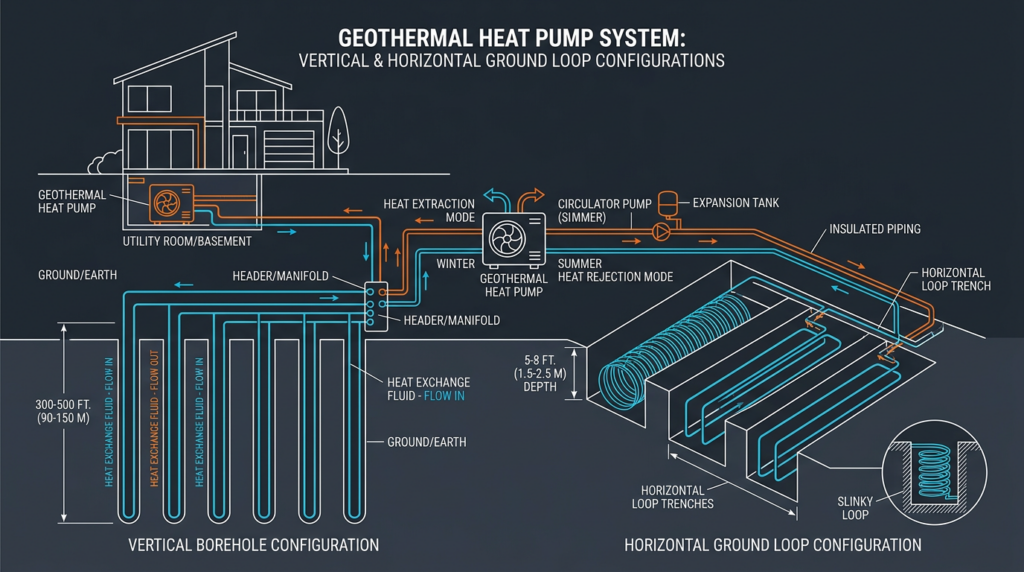
A GHP uses a refrigeration cycle identical in concept to a standard air conditioner or refrigerator, but exchanges heat with the ground rather than the outdoor air. In heating mode, a water-antifreeze solution circulating through buried ground loops absorbs heat from the earth and carries it to the heat pump’s evaporator. The refrigerant inside the evaporator absorbs that heat and vaporizes. A compressor then raises the temperature and pressure of the refrigerant vapor. The hot refrigerant passes through a condenser, releasing its heat into the building’s distribution system. Finally, an expansion valve drops the refrigerant’s pressure, restarting the cycle. In cooling mode, the process reverses: heat is extracted from the building and deposited into the ground.
Measuring Efficiency: COP and EER
Two metrics define GHP performance. The Coefficient of Performance (COP) measures heating efficiency by dividing heat output by electrical energy input. A GHP with a COP of 4.0 delivers four units of heating energy for every one unit of electricity consumed. Most quality GHP systems achieve COPs between 3.0 and 5.0, compared to 1.0 for electric resistance heating and roughly 0.95 for a high-efficiency gas furnace. The Energy Efficiency Ratio (EER) measures cooling efficiency. GHPs commonly reach EERs of 15 to 25, outperforming conventional central air conditioners that typically rate between 13 and 16 EER.
Types of Ground Loop Systems
The ground loop is the heart of any geothermal installation. It determines cost, performance, and site compatibility.
- Horizontal Loop: Pipes are laid in trenches four to six feet deep, requiring significant yard space. This is generally the least expensive option when adequate land is available. Directional boring can reduce surface disruption. Best suited for properties with ample open ground and favorable soil conditions such as moist clay or loam.
- Vertical Loop: Boreholes are drilled 150 to 400 feet deep, with U-shaped pipe loops inserted and sealed with thermally enhanced bentonite-based grout. Vertical systems work well on smaller lots and in areas with rocky or shallow soil. Drilling costs are higher, but efficiency can be excellent due to more stable temperatures at depth.
- Pond or Lake Loop: Coils of pipe are submerged and anchored in a body of water at least eight feet deep with sufficient volume. This approach can be the most cost-effective where suitable water is available, though environmental permitting and water quality considerations (scaling, corrosion) apply.
- Direct Exchange (DX) System: Refrigerant circulates directly through copper tubing buried in the ground, eliminating the intermediate water loop. DX systems offer higher heat transfer efficiency, but the risk of refrigerant leaks into the soil and associated environmental concerns have led to reduced popularity and regulatory restrictions in many jurisdictions.
Heat Pump Unit Types
Water-to-air units are the most common residential type, transferring heat from the ground loop into a forced-air duct system. Water-to-water units transfer heat into a hydronic distribution system, making them ideal for radiant floor heating, baseboard radiators, or domestic hot water production. Some systems combine both capabilities.
The Installation Process
Site Assessment
A proper installation begins with a thorough site evaluation. Qualified installers assess soil composition, thermal conductivity, available land area, existing HVAC infrastructure, and local geology. For vertical systems, a thermal conductivity test (also called an in-situ thermal response test) may be performed by drilling a test borehole and measuring the soil’s ability to transfer heat. Heating and cooling load calculations, following guidelines such as ACCA Manual J and Manual S, determine the correct system size. Oversizing or undersizing a geothermal system significantly degrades performance and ROI.
Loop Installation
Each loop type follows a distinct installation process:
- Horizontal: Trenches are excavated using backhoes or chain trenchers. High-density polyethylene (HDPE) pipe is laid in the trenches, often in slinky or spiral configurations to maximize pipe length per trench foot. Trenches are backfilled, and the loop is pressure tested for leaks.
- Vertical: A drilling rig bores holes to the required depth, typically spaced 15 to 20 feet apart. HDPE U-tubes are inserted into each borehole. The annular space is filled with thermally enhanced grout to ensure efficient heat transfer and protect groundwater from cross-contamination. Each borehole is pressure tested before connection to the header system.
- Pond/Lake: Coiled or plate-style heat exchangers are assembled on shore, transported to the water body, and sunk to the appropriate depth using anchoring weights. Environmental permits are typically required, and local regulations vary widely.
Indoor Equipment and Commissioning
The indoor heat pump unit connects to existing or new ductwork (for water-to-air systems) or hydronic piping (for water-to-water systems). Electrical connections, condensate drainage, and control wiring are completed. System commissioning includes verifying refrigerant charge, adjusting loop flow rates, testing all safety controls, and confirming that heating and cooling output matches design specifications. Common refrigerants include R-410A, though the industry is shifting toward lower Global Warming Potential (GWP) alternatives like R-32 and R-454B in response to regulatory changes under the AIM Act and EPA phasedown schedules.
Permitting and Regulations
Most jurisdictions require permits for drilling, trenching, and mechanical installation. Well drilling regulations, groundwater protection rules, and refrigerant handling certifications (EPA Section 608) all apply. The International Ground Source Heat Pump Association (IGSHPA) publishes design and installation standards that many states have adopted or reference. Working with an IGSHPA-accredited installer helps ensure compliance and system quality.
Costs Associated with Geothermal Heat Pump Systems
Initial Investment Breakdown
Geothermal systems carry higher upfront costs than conventional HVAC equipment, but understanding where those dollars go helps put the investment in perspective.
- Equipment costs: The heat pump unit, circulating pumps, controls, piping, and fittings typically run $3,000 to $8,000 for residential systems ranging from 2 to 5 tons of capacity.
- Loop installation costs: Horizontal loops generally cost $1,500 to $3,000 per ton. Vertical loops cost $3,000 to $5,000 per ton due to drilling expenses. Pond loops fall between these ranges depending on site conditions and permitting requirements.
- Interior installation and ductwork: Labor for connecting the heat pump, any ductwork modifications, electrical work, and plumbing typically adds $3,000 to $7,000.
- Site preparation and restoration: Clearing, grading, and landscaping repair can add $500 to $3,000.
All-in, a typical residential geothermal installation costs between $18,000 and $45,000 before incentives, with system size, loop type, and ground conditions being the primary cost drivers. A 3-ton system with a vertical loop in average soil conditions commonly lands in the $25,000 to $35,000 range.
Government Incentives and Rebates
The Inflation Reduction Act (IRA) of 2022 established a 30% federal tax credit for geothermal heat pump installations through 2032, stepping down to 26% in 2033 and 22% in 2034. There is no maximum dollar cap for residential systems. This credit applies to equipment, installation labor, and loop costs. Tax-exempt entities such as municipalities and nonprofits may qualify for direct pay provisions. Many states and utilities offer additional rebates, often ranging from $500 to $3,000 or more. The Database of State Incentives for Renewables and Efficiency (DSIRE) at dsireusa.org is the most comprehensive resource for locating local programs.
Financing Options
Several financing mechanisms help offset the initial cost. Energy-efficient mortgages (EEMs) allow borrowers to finance energy upgrades into their home loan. PACE (Property Assessed Clean Energy) programs allow property owners to repay geothermal installation costs through their property tax bill. Many HVAC contractors also offer or facilitate conventional home improvement loans with competitive rates for qualified GHP projects.
Return on Investment and Long-Term Savings
Operating Cost Savings
A household spending $2,400 per year on heating and cooling with a conventional system can reasonably expect to reduce that figure to $700 to $1,200 per year with a properly sized geothermal system. The exact savings depend on local energy prices, the system’s COP and EER, climate zone, and building envelope efficiency. Homes that rely on propane, oil, or electric resistance heating see the largest percentage savings.
Maintenance and Lifespan
GHP systems have fewer mechanical components exposed to weather and no outdoor condenser unit to maintain. The indoor heat pump unit typically lasts 20 to 25 years, comparable to or exceeding conventional equipment. The buried ground loop, made of HDPE pipe with a 50-year or longer expected life, essentially becomes a permanent infrastructure improvement. Annual maintenance involves checking refrigerant levels, cleaning filters, inspecting electrical connections, and verifying loop pressure, generally costing $100 to $200 per year.
Calculating Payback Period
Consider a simplified example. A homeowner installs a geothermal system for $30,000. After applying the 30% federal tax credit ($9,000) and a $2,000 state rebate, the net cost is $19,000. If the system saves $1,500 per year in energy costs and $200 per year in reduced maintenance compared to the previous system, the annual net benefit is $1,700. The simple payback period is approximately 11 years. Over the 25-year life of the heat pump, total net savings would exceed $23,500, and the ground loop continues to function if a replacement heat pump unit is installed. Online calculators from the Department of Energy and IGSHPA can provide personalized estimates based on local conditions.
Factors That Influence ROI
- Energy price trends: Rising fuel and electricity costs accelerate payback and increase lifetime savings.
- System efficiency: Higher COP and EER ratings directly translate to lower operating costs.
- Climate: GHPs maintain consistent efficiency regardless of outdoor air temperature, giving them a distinct advantage over air-source heat pumps in extreme cold.
- Home value: Studies indicate that energy-efficient upgrades, including geothermal systems, can increase property values and appeal to environmentally conscious buyers.
Common Misconceptions
- “Geothermal only works in warm climates.” False. Because ground temperatures remain stable, GHPs perform effectively in every U.S. climate zone, from Alaska to Florida. They are especially advantageous in cold climates where air-source heat pumps lose efficiency.
- “You need a huge property.” Vertical loop systems require minimal surface area. A typical residential vertical installation fits within a standard suburban lot.
- “Geothermal heat pumps are the same as geothermal power plants.” GHPs use shallow ground temperatures (within a few hundred feet of the surface). Geothermal power plants tap into superheated water or steam miles underground. The two technologies share a name but differ fundamentally.
- “The upfront cost makes it impractical.” Federal tax credits, state rebates, and financing options can reduce the net cost by 30% to 50%. When viewed over the system’s full lifespan, total cost of ownership is typically lower than conventional alternatives.
- “Installation is environmentally destructive.” Properly installed systems produce minimal lasting environmental impact. Certified installers follow grouting and drilling standards that protect groundwater, and the long-term emissions reduction far outweighs the short-term construction disturbance.
Practical Applications
GHP technology scales effectively from single-family homes to large commercial buildings. Schools, hospitals, office complexes, and military bases across the country rely on geothermal systems. Hybrid systems that pair GHPs with solar photovoltaic panels can approach net-zero energy performance, using solar electricity to power the heat pump’s compressor and circulation pumps. Water-to-water GHP configurations pair naturally with radiant floor heating, providing exceptionally comfortable and efficient space conditioning. Organizations such as IGSHPA and the Geothermal Exchange Organization (GEO) provide resources for both residential and commercial project planning.
Key Takeaways
- Geothermal heat pumps transfer heat between a building and the earth, achieving COPs of 3.0 to 5.0 and EERs of 15 to 25, far exceeding conventional systems.
- Four loop configurations (horizontal, vertical, pond, and direct exchange) accommodate different site conditions and budgets.
- Total installed costs typically range from $18,000 to $45,000, but the 30% federal tax credit under the Inflation Reduction Act, plus state and local incentives, significantly reduces net investment.
- Annual energy savings of 40% to 70% over conventional systems create payback periods commonly between 7 and 15 years, with the ground loop lasting 50 years or more.
- Accurate system sizing, certified installation, and proper commissioning are essential to achieving projected performance and savings.
- Consult an IGSHPA-accredited installer, perform a professional load calculation, and research all available incentives before committing to a project.
Geothermal heat pumps represent one of the most efficient and durable HVAC technologies available today. While the initial investment is higher than conventional systems, the combination of dramatic energy savings, minimal maintenance, long equipment life, and generous federal incentives makes GHP systems a financially sound and environmentally responsible choice for both new construction and retrofit projects. As energy costs continue to rise and decarbonization goals intensify, geothermal heat pump adoption is positioned to grow substantially in the years ahead.