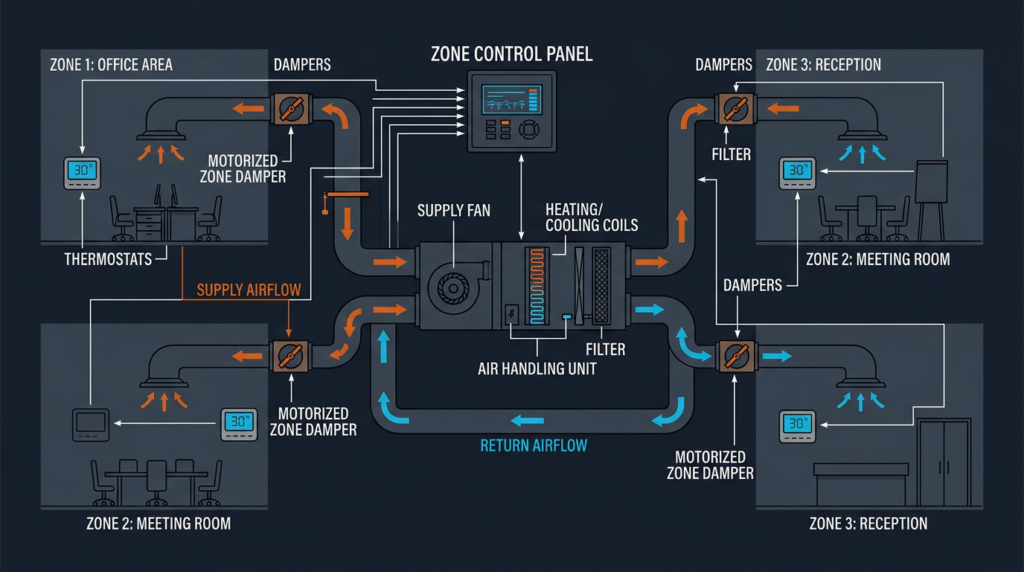
Every homeowner knows the frustration: the upstairs bedrooms feel like a sauna in July while the basement stays frigid, or the kitchen overheats from cooking while the living room remains uncomfortably cool. Traditional single-zone HVAC systems treat an entire home as one uniform space, forcing every room to receive the same amount of conditioned air regardless of actual need. Zoning systems solve this problem by dividing a building into independent temperature control areas, each with its own thermostat and airflow regulation. The result is precise comfort in every room, significant energy savings typically ranging from 15% to 30%, and reduced strain on HVAC equipment. This article explains exactly how multi-zone HVAC works, what components make it possible, and what homeowners and professionals need to know to implement these systems effectively.
What Is a Zone?
A zone is any distinct area within a building that can be independently heated or cooled. Zones are not arbitrary divisions. They are determined by specific factors that cause different parts of a building to have different heating and cooling demands.
Factors That Define Zones
- Building layout: Upper floors naturally accumulate more heat than lower floors due to the physics of warm air rising. A two-story home almost always benefits from at least two zones.
- Sun exposure: East-facing rooms absorb morning solar heat, while west-facing rooms peak in the afternoon. South-facing rooms in the Northern Hemisphere receive the most consistent solar gain year-round.
- Room usage: Bedrooms occupied only at night, home offices used during business hours, and guest rooms used occasionally all have different conditioning needs.
- Heat-generating sources: Kitchens with commercial-grade appliances, server rooms, and rooms with large south-facing windows generate internal heat loads that differ sharply from other spaces.
- Occupancy patterns: Areas with high foot traffic or consistent occupancy need more conditioning than seldom-used spaces.
Common residential zone configurations include separating upstairs from downstairs, isolating a finished basement, creating a dedicated zone for a master suite, or giving a home office independent temperature control.
Core Components of a Multi-Zone System
A zoning system relies on four primary components working in concert: thermostats, zone dampers, a zone control panel, and compatible HVAC equipment. Each plays a critical role in delivering independent temperature control.
Thermostats
Each zone requires its own thermostat to monitor ambient temperature and communicate demand to the system. Standard thermostats use a thermistor (a temperature-sensitive resistor) to measure room temperature and compare it against the user-defined setpoint. When the measured temperature deviates from the setpoint by more than the thermostat’s differential (typically 1 to 2 degrees Fahrenheit), the thermostat sends a call for heating or cooling.
Smart thermostats have significantly enhanced zoning capabilities. Models from manufacturers like Ecobee, Google Nest, and Honeywell Home offer features that directly improve zoning performance:
- Occupancy detection: Built-in sensors or remote room sensors detect whether a zone is occupied and adjust conditioning accordingly.
- Geofencing: The system detects when occupants leave or approach the home and adjusts zone temperatures automatically.
- Learning algorithms: Some thermostats learn daily patterns and pre-condition zones before occupants arrive.
- Remote access: Wi-Fi connectivity allows zone temperature adjustment from anywhere via smartphone apps.
- Energy monitoring: Usage reports help identify which zones consume the most energy and where adjustments will yield savings.
- Smart home integration: Compatibility with Apple HomeKit, Google Assistant, and Amazon Alexa enables voice control and automation routines. Some models offer open APIs for custom integrations.
A critical wiring consideration for multi-zone systems is the common wire (C-wire), which provides continuous 24 VAC power to the thermostat. Many smart thermostats require a C-wire for reliable operation. In older homes where a C-wire is absent, a C-wire adapter can be installed, though these adapters have limitations in systems with complex wiring configurations and should be verified for compatibility with the specific zone control panel in use.
Zone Dampers
Zone dampers are electrically actuated valves installed inside the ductwork that open and close to regulate airflow to each zone. They are the physical mechanism that makes independent zone control possible.
The most common types include:
- Motorized butterfly dampers: A round or rectangular blade rotates on a central axis to open or close the duct. These are the most widely used in residential applications.
- Blade dampers: Multiple parallel blades rotate simultaneously, similar to a louver. These provide finer airflow adjustment and are common in larger duct sizes.
- Inflatable dampers: A bladder inflates to block airflow and deflates to allow it. These are less common but offer very low leakage rates.
Damper actuation typically uses small electric motors operating at 24 VAC, though some commercial systems use 120 VAC or 230 VAC. Motor types include synchronous motors, which rotate to a fixed open or closed position, and stepper motors, which allow proportional positioning for partial opening. Stepper motor dampers enable more precise airflow modulation rather than simple open/closed operation.
Advanced dampers include position feedback mechanisms that report their exact state back to the control panel. This feedback enables diagnostics, confirms that dampers are responding correctly, and allows for proportional control strategies.
Proper damper sizing is essential. An undersized damper restricts airflow even when fully open, while an oversized damper may not seal properly. Damper sizing must match the duct dimensions and the airflow requirements of each zone, typically calculated in cubic feet per minute (CFM). Even when fully closed, most dampers have a leakage rate of 3% to 5% of rated airflow, which designers must account for when calculating zone performance.
Zone Control Panel
The zone control panel is the central brain of the system. This device receives signals from all zone thermostats, determines which dampers to open or close, and sends commands to the HVAC equipment to start or stop operation.
Key functions of the zone control panel include:
- Call management: When multiple zones call simultaneously, the panel prioritizes and coordinates damper positions and equipment operation.
- Proportional control algorithms: Advanced panels modulate damper positions based on how far each zone’s temperature deviates from its setpoint, providing smoother temperature regulation instead of simple on/off cycling.
- System protection: Built-in safety features include high and low temperature limits, freeze protection for cold climates, and over-pressurization protection that opens a bypass damper or additional zones if too many dampers close simultaneously.
- Diagnostics: Modern panels display error codes, monitor damper status, and in some cases measure airflow to help technicians identify problems quickly.
Zone control panels range in capacity from 2-zone to 8-zone configurations or more, depending on the manufacturer. Communication between the panel, thermostats, and dampers traditionally uses hardwired 24 VAC connections. Newer systems increasingly support wireless protocols such as Zigbee, Z-Wave, or proprietary RF communication, which simplify retrofit installations by eliminating the need to run new control wiring through walls and ceilings.
HVAC Equipment Compatibility
The HVAC equipment itself must be compatible with zoned operation. When dampers close to zones not calling for conditioning, the total airflow demand on the system drops. Equipment that cannot adjust its output to match this reduced demand will experience problems.
- Variable-speed blower motors in furnaces and air handlers adjust fan speed to maintain proper static pressure as dampers open and close. This is the single most important equipment feature for zoned systems.
- Variable-speed compressors in air conditioners and heat pumps modulate cooling or heating capacity to match the actual load. This prevents the short cycling that occurs when a full-capacity system conditions a single small zone.
- Two-stage or modulating furnaces can reduce output when fewer zones call for heat, maintaining efficiency and comfort.
- Hydronic systems achieve zoning through zone valves and dedicated circulator pumps rather than dampers, controlling hot water flow to radiant floors or baseboard heaters in each zone independently.
How the System Works: Step by Step
Understanding the operational sequence clarifies how all components interact:
- The thermostat in Zone A detects that the temperature has fallen below its heating setpoint and sends a call for heat to the zone control panel.
- The zone control panel receives the signal and commands the damper serving Zone A to open.
- Once the damper confirms it is in the open position (or after a timed delay), the control panel signals the furnace or heat pump to start.
- Conditioned air flows through the open ductwork into Zone A. Dampers serving zones not calling for heat remain closed.
- The thermostat in Zone A senses that the room has reached the setpoint and ends the call for heat.
- The control panel checks whether any other zones are still calling. If Zone B is now calling, the panel opens Zone B’s damper and keeps the equipment running. If no zones are calling, the panel shuts down the HVAC equipment and closes all dampers.
This process repeats continuously, with the control panel orchestrating dampers and equipment to serve whichever zones need conditioning at any given moment.
Advantages of Multi-Zone HVAC
Precise Comfort Control
Zoning eliminates the hot and cold spots that plague single-zone systems. Each occupant can set their preferred temperature independently. Bedrooms can be kept cooler for sleeping while living areas remain warm, or vice versa.
Energy Savings
By conditioning only occupied zones, zoning systems avoid wasting energy on empty rooms. Research and field data consistently show energy savings between 15% and 30% compared to single-zone operation. For a household spending $2,400 annually on heating and cooling, that translates to $360 to $720 in yearly savings.
Extended Equipment Lifespan
When paired with variable-speed equipment, zoning reduces the frequency of full-capacity on/off cycles. Equipment runs longer at lower capacity, which produces less mechanical stress and extends the operational life of compressors, blower motors, and heat exchangers.
Noise Reduction
Variable-speed equipment operating at partial capacity produces noticeably less noise than a system running at full blast. Zones receiving conditioning experience gentler, quieter airflow.
Disadvantages and Considerations
- Higher upfront cost: A typical residential zoning installation costs between $2,000 and $5,000 or more, depending on the number of zones, equipment modifications required, and local labor rates. This is in addition to the cost of the base HVAC system.
- System complexity: More components mean more potential failure points. Troubleshooting requires understanding the interaction between thermostats, dampers, the control panel, and the HVAC equipment.
- Static pressure risks: When most dampers are closed, the ductwork must handle the resulting increase in static pressure. Poorly designed systems develop excessive pressure that causes noise, reduced airflow, and premature equipment failure. A bypass damper or properly sized dump zone is often necessary.
- Professional installation required: Incorrect damper sizing, improper wiring, or misconfigured control panels can make zoning counterproductive. Professional design and commissioning are essential.
- Regular maintenance: Dampers require periodic inspection and calibration. Thermostat batteries need replacement. Control panels should be checked for error codes. Neglected systems degrade in performance over time.
- Over-zoning: Creating too many zones in a small space leads to very low airflow per zone, causing rapid equipment cycling and reduced efficiency. A general guideline is that each zone should require at least 25% to 30% of the system’s total airflow capacity.
Common Misconceptions
“Zoning is only for large houses.” Even a modest 1,500-square-foot home with two floors or rooms that face different directions benefits from zoning. The size of the home matters less than the variation in heating and cooling loads between different areas.
“Zoning will solve all comfort problems.” Zoning controls where conditioned air goes, but it cannot compensate for poor insulation, leaky ductwork, or inadequate air sealing. These fundamentals must be addressed first for any HVAC system to perform well.
“I can install a zoning system myself.” While the individual components may appear straightforward, the system design requires load calculations, static pressure analysis, and proper equipment configuration. Incorrect installation causes more problems than it solves.
“Once installed, the system needs no maintenance.” Damper motors wear out, calibrations drift, and thermostats lose battery power. Annual professional inspection keeps zoning systems performing at their best.
Practical Applications
Residential Scenarios
A family in a two-story colonial home installed a two-zone system separating the upstairs bedrooms from the downstairs living areas. The upstairs zone is set 3 degrees cooler at night for sleeping comfort, while the downstairs zone reduces its setpoint since no one occupies it. Their annual energy bills dropped by approximately 22%, and the ongoing thermostat disputes between family members ended.
Commercial Scenarios
A small office with a conference room, individual offices, and a server closet used a four-zone system to maintain 68°F in the conference room (occupied intermittently), 72°F in the offices, and 65°F in the server area with continuous cooling. Employee comfort complaints decreased significantly, and the business saw measurable energy savings during evenings and weekends when most zones were set back.
Commercial buildings with larger and more complex requirements often consider Variable Refrigerant Flow (VRF) systems, which use refrigerant piping rather than ductwork to provide simultaneous heating and cooling across many zones with high efficiency.
Emerging Trends
The zoning landscape continues to evolve. Variable-speed HVAC equipment is becoming standard rather than premium, making zoning systems more effective and easier to design. AI-powered zoning controls are entering the market, using machine learning to predict occupancy patterns and pre-condition zones automatically. Wireless damper technology is removing one of the biggest barriers to retrofit installation by eliminating the need for new control wiring. And increasingly, zoning is being integrated with indoor air quality solutions, allowing homeowners to target air purification and ventilation to specific zones based on pollutant levels or occupancy.
Key Takeaways
- Zoning divides a building into independently controlled temperature areas, each with its own thermostat and damper.
- The four essential components are zone thermostats, motorized dampers, a zone control panel, and compatible HVAC equipment (ideally with variable-speed capability).
- Properly installed systems deliver 15% to 30% energy savings while eliminating hot and cold spots.
- Installation costs typically range from $2,000 to $5,000 for residential systems.
- Professional design and installation are critical to avoid static pressure problems, equipment damage, and poor performance.
- Zoning works best when combined with proper insulation, air sealing, and well-designed ductwork.
- Regular maintenance, including damper inspection and thermostat calibration, ensures long-term system reliability.
For homeowners struggling with uneven temperatures or high energy bills, a properly designed multi-zone system is one of the most effective upgrades available. Consult a qualified HVAC contractor with specific zoning experience to evaluate your home’s layout, ductwork, and equipment compatibility before proceeding with installation.