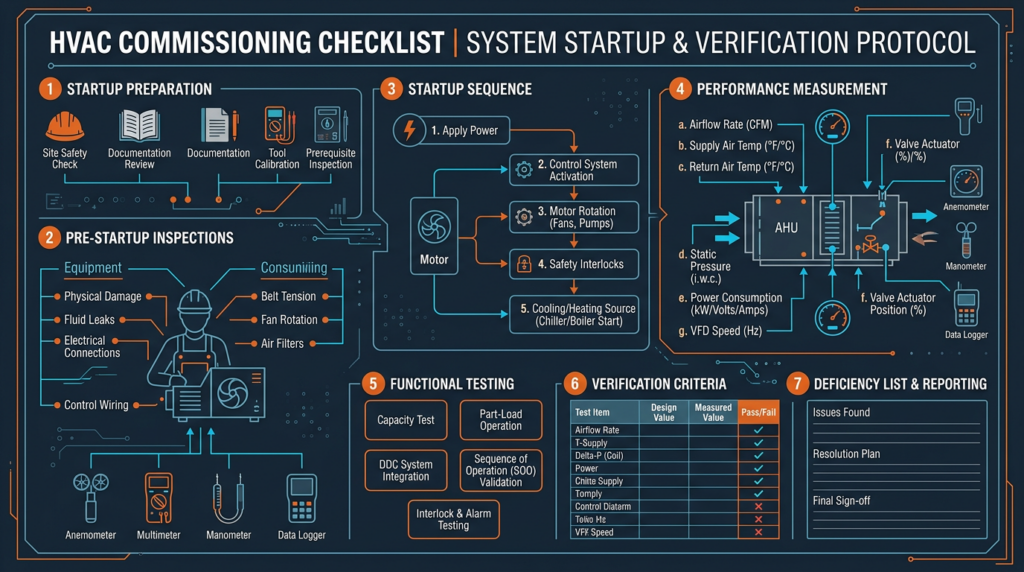
HVAC commissioning is a systematic, quality-driven process that verifies and documents whether heating, ventilation, and air conditioning systems perform according to the owner’s requirements and the engineer’s design intent. The startup and verification phases sit at the heart of this process, bridging the gap between installation and reliable long-term operation. When done correctly, commissioning reduces energy consumption by 10% to 30% in commercial buildings, extends equipment life, improves occupant comfort, and prevents costly callbacks. When skipped or rushed, the consequences range from chronic comfort complaints to premature equipment failure and wasted energy dollars. This article covers every critical step of HVAC startup and verification, from pre-functional checks through functional performance testing and beyond.
Defining HVAC Commissioning and Its Phases
HVAC commissioning (Cx) is a quality assurance process that spans the entire life of a building project. As defined by ASHRAE Guideline 0, it encompasses planning, design review, installation verification, startup, testing and balancing, functional performance testing, documentation, training, and ongoing commissioning. The Commissioning Authority (CxA), an independent professional or firm, leads and coordinates the process to ensure objectivity.
Startup and verification procedures occupy the critical transition zone where a system moves from static hardware to active operation. They depend on everything that came before (proper design, correct installation) and set the stage for everything that follows (balanced airflows, optimized controls, trained operators). Skipping or compressing these phases is the single most common reason new HVAC systems underperform.
The Foundation: Owner’s Project Requirements and Basis of Design
Every commissioning activity traces back to two cornerstone documents. The Owner’s Project Requirements (OPR) defines the building owner’s goals, expectations, and performance criteria. Examples include maintaining occupied spaces at 72°F ±2°F, achieving a minimum ventilation rate of 15 CFM per person, limiting background noise to NC-35 in office areas, and meeting an Energy Use Intensity target below 50 kBtu per square foot per year.
The Basis of Design (BOD) explains how the design team intends to meet the OPR. It documents equipment selections, engineering calculations, control sequences, and design assumptions. Together, the OPR and BOD serve as the benchmarks against which all startup readings and verification test results are measured. Without these documents, commissioning has no objective standard of success.
Pre-Startup Activities: Setting the Stage
Documentation Review
Before any equipment is energized, the CxA confirms that all relevant documents are current and accessible. This includes the OPR, BOD, approved submittals, as-built drawings, control wiring diagrams, equipment operation and maintenance manuals, and warranty information. Missing or outdated documents create gaps that can derail startup.
Installation Verification
Installation verification is a physical inspection confirming that equipment and systems have been installed according to the design documents. The CxA and commissioning team use detailed checklists organized by trade:
- Mechanical: Verify correct piping connections, ductwork routing, insulation type and thickness, damper placement and orientation, access panel locations, and equipment mounting.
- Electrical: Confirm proper wire sizing, grounding, overcurrent protection, disconnect switches, and control panel terminations. Verify voltage at each piece of equipment matches the nameplate.
- Controls: Inspect sensor placement (temperature, humidity, pressure, CO2), actuator linkages, controller mounting, and network wiring. Confirm that controller firmware versions match the approved submittal.
Safety Checks and Pre-Functional Checklists
All safety devices must be verified before startup. This includes high-pressure cutouts on compressors, low-water cutoffs on boilers, pressure relief valves, smoke detector interlocks, fire and smoke damper operation, and emergency shut-off switches. Pre-functional checklists (PFCs) document the completion of every pre-startup task for each piece of equipment. A typical air handling unit PFC covers more than 60 individual items, from filter installation to belt tension to VFD parameter settings.
HVAC Startup Procedures: Bringing Systems to Life
General Startup Sequence
Startup follows a deliberate, safety-first sequence regardless of equipment type:
- Preparation: Confirm power availability, check fluid levels (refrigerant charge, oil levels, hydronic water), verify lubrication on bearings and couplings, inspect belts and sheaves for alignment and tension, and ensure all isolation valves are in the correct position.
- Initial power-up: Energize the equipment and verify correct voltage (within ±10% of nameplate), proper phase rotation on three-phase motors, and absence of unusual noises, vibrations, or odors.
- Gradual activation: Start equipment at minimum or reduced capacity. Monitor motor amperage, bearing temperatures, discharge and suction pressures (for refrigeration equipment), and fluid flow rates. Increase load incrementally while observing system response.
- Safety monitoring: Continuously verify that safety controls remain armed and responsive throughout startup. Document any alarms, trips, or anomalies immediately.
Equipment-Specific Startup Considerations
Different equipment types demand focused attention on different parameters:
- Chillers: Verify oil pressure differential (typically 15 to 25 psi above crankcase pressure for reciprocating units), confirm refrigerant charge using superheat and subcooling measurements, check evaporator and condenser water flow rates against design (usually 2.4 GPM per ton for the evaporator and 3.0 GPM per ton for the condenser), and test the purge unit on low-pressure machines.
- Boilers: Confirm proper water level, test low-water cutoff operation, verify burner ignition sequence, measure flue gas composition (target O2 between 3% and 5% for natural gas), and check safety valve settings against the rated working pressure.
- Air Handling Units: Confirm correct fan rotation direction, measure motor amperage against the nameplate full-load amps, verify damper stroke and actuator operation (0% to 100% travel), check coil entering and leaving temperatures, and confirm filter installation with no bypass gaps.
- Pumps: Verify impeller rotation direction, check for cavitation (listen for gravel-like noise and verify adequate NPSH), measure flow rate and compare to design, and record motor amperage at design flow.
- VRF Systems: Perform electronic leak detection on all refrigerant joints, verify communication between outdoor and indoor units via the system controller, confirm refrigerant charge using manufacturer-specified subcooling or superheat targets, and test each indoor unit individually.
Troubleshooting During Startup
Common startup issues include motors drawing excessive amperage (often caused by incorrect voltage, misaligned couplings, or locked rotor conditions), low refrigerant charge (indicating a leak that must be found and repaired before adding refrigerant), incorrect fan or pump rotation (swap any two of the three phases), and control system communication failures (typically caused by incorrect addressing, wiring polarity errors, or baud rate mismatches). Every issue must be resolved and documented before proceeding to verification.
Verification: Functional Performance Testing
What Functional Performance Testing Covers
Functional Performance Testing (FPT) goes beyond confirming that equipment runs. It systematically verifies that the HVAC system operates correctly under a range of conditions and meets the performance criteria established in the OPR and BOD. FPT is distinct from startup and distinct from testing, adjusting, and balancing (TAB), though it relies on completed TAB data.
Levels of Testing
- Equipment-level tests: Verify individual component operation, such as confirming a VFD ramps a fan from minimum to maximum speed, a valve actuator modulates through full stroke in the correct direction, or a sensor reads within its specified accuracy (for example, ±0.5°F for a space temperature sensor).
- System-level tests: Verify interactions among components. Examples include testing an AHU’s response to rising zone temperatures, confirming chiller staging sequences as cooling load increases from 25% to 100%, and verifying economizer switchover at the correct outdoor air enthalpy setpoint.
- Integrated system tests: Verify HVAC interaction with other building systems, such as confirming that AHUs shut down on fire alarm activation, that smoke dampers close and the smoke control sequence activates correctly, and that the building automation system (BAS) accurately reports energy consumption to the building energy management platform.
Developing Effective Test Procedures
Each FPT procedure should include five elements:
- A clear test objective tied to a specific OPR or BOD requirement.
- A list of required instruments, their calibration status, and acceptable accuracy.
- A step-by-step procedure written so that any qualified technician can repeat the test independently.
- Defined acceptance criteria with specific numerical thresholds (for example, supply air temperature must reset from 55°F at full cooling to 65°F at minimum cooling within 3 minutes of setpoint change).
- Data logging and reporting requirements, including sample interval, duration, and format.
Data Logging, Analysis, and Corrective Actions
All test data must be recorded accurately using calibrated instruments. Trend logs from the BAS, spot measurements from handheld instruments, and visual observations all form part of the verification record. When test results fall outside acceptance criteria, the CxA documents the deficiency, the responsible party implements a corrective action, and the test is repeated until the system passes. A formal issues log tracks every deficiency from discovery through resolution.
Documentation and Reporting
Comprehensive documentation creates a traceable history of the commissioning process. The final commissioning report typically includes the OPR and BOD, design review comments, all pre-functional checklists, startup reports with recorded data, TAB reports, functional performance test procedures and results, the complete issues log with resolution status, training records, and updated operations and maintenance manuals. This package becomes an invaluable reference for facility managers and future retro-commissioning efforts.
Training Building Operators
Even a perfectly commissioned system will degrade without properly trained operators. Commissioning includes structured training that covers system overview and design intent, BAS interface navigation, normal operating parameters and alarm response, preventive maintenance schedules and procedures, emergency shutdown and recovery steps, and seasonal changeover procedures. Training should combine classroom instruction with hands-on sessions at the actual equipment. All training must be documented, and operators should receive reference manuals they can use after the commissioning team departs.
Ongoing Commissioning: Sustaining Performance
Ongoing commissioning (OCx) extends the benefits of initial commissioning throughout the building’s operational life. It uses continuous BAS data monitoring, trend analysis, and periodic functional testing to detect performance degradation before it becomes a costly problem. Studies by Lawrence Berkeley National Laboratory have shown that OCx programs can maintain energy savings of 10% to 20% year after year. Key OCx activities include monitoring key performance indicators (kW per ton for chillers, CFM per watt for fans), analyzing utility bills for unexpected consumption spikes, and scheduling periodic re-testing of critical control sequences.
Post-2023 Changes and Emerging Trends
Several developments are reshaping commissioning practice:
- Refrigerant transition: The AIM Act in the United States and the updated EU F-gas Regulation are accelerating the phase-down of high-GWP refrigerants. New systems increasingly use A2L refrigerants such as R-454B and R-32, which require updated leak detection, ventilation requirements per ASHRAE Standard 15-2024, and revised startup charging procedures.
- Enhanced IAQ verification: Post-pandemic awareness has driven stricter verification of outdoor air delivery rates per ASHRAE Standard 62.1-2022, filtration efficiency (MERV 13 minimum in many jurisdictions), and demand-controlled ventilation using CO2 sensors verified to ±75 ppm accuracy.
- Digital and remote commissioning: Cloud-connected BAS platforms now allow commissioning agents to review trend data, verify control sequences, and witness functional tests remotely, reducing travel costs and accelerating issue resolution.
- AI-powered optimization: Machine learning algorithms integrated into modern BEMS can continuously adjust setpoints, staging, and schedules. Commissioning teams must now verify that AI recommendations align with the OPR and that override protocols are in place.
- BAS cybersecurity: With BAS systems increasingly networked, commissioning now includes verifying firewall configurations, access controls, encrypted communications, and compliance with guidelines such as NIST SP 800-82.
Common Misconceptions About Commissioning
- Commissioning is only for new construction. Existing buildings benefit greatly from retro-commissioning, which routinely uncovers 15% to 30% energy waste in older systems.
- Commissioning and TAB are the same thing. TAB focuses on measuring and adjusting airflows and water flows. Commissioning encompasses TAB but also verifies control sequences, safety interlocks, and overall system integration.
- Commissioning costs too much. The typical cost of commissioning ranges from $1.00 to $3.50 per square foot for new commercial buildings, while documented energy savings alone often produce payback within two to four years.
- The installing contractor handles commissioning. An independent CxA provides objectivity that a contractor self-checking its own work cannot match.
- Commissioning is a one-time event. Without ongoing monitoring, system performance drifts. OCx ensures sustained results.
Real-World Impact
A 2019 study published by Pacific Northwest National Laboratory analyzed 643 commercial buildings that underwent commissioning and found median energy savings of 16%, with healthcare facilities and office buildings seeing the highest returns. A 350,000-square-foot hospital in the southeastern United States documented $280,000 in annual energy savings following retro-commissioning, with the entire project cost recovered in 1.8 years. Data centers, where even small efficiency gains translate to significant cost reductions, routinely report PUE improvements of 0.1 to 0.3 after comprehensive commissioning of their cooling infrastructure.
Key Takeaways
- Ground every commissioning activity in the OPR and BOD so that performance criteria are objective and measurable.
- Complete all pre-functional checklists and safety checks before energizing any equipment.
- Follow a deliberate, gradual startup sequence and document every reading.
- Use structured functional performance testing at the equipment, system, and integrated levels to verify true operational performance, not just basic operation.
- Maintain a rigorous issues log and confirm resolution of every deficiency before project closeout.
- Train operators thoroughly and provide reference documentation they will actually use.
- Implement ongoing commissioning to protect the investment and sustain savings over the building’s lifetime.
- Stay current with refrigerant regulations, IAQ standards, cybersecurity requirements, and digital commissioning tools that continue to reshape best practices.
HVAC commissioning is not an optional add-on or a luxury reserved for high-profile projects. It is the most reliable method available to confirm that complex HVAC systems deliver the comfort, efficiency, and reliability that owners pay for and occupants depend on. By investing in thorough startup and verification procedures, building stakeholders protect equipment, reduce operating costs, and create indoor environments that perform as intended from day one and for years to come.