Chilled Water Systems: Commercial HVAC Fundamentals
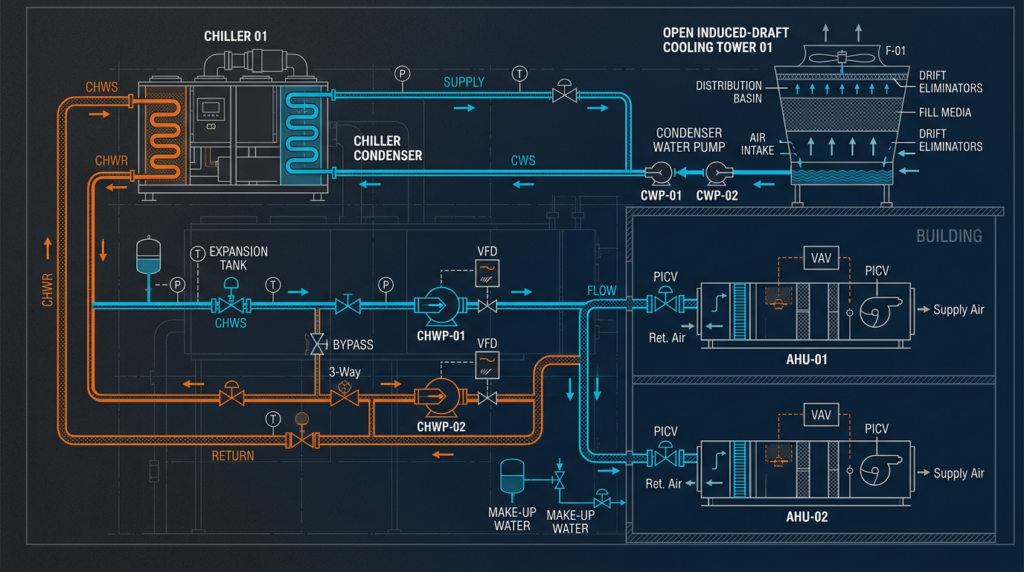
In modern commercial buildings, chilled water systems serve as the backbone of large-scale cooling operations, delivering precise temperature control across hundreds of thousands of square feet with remarkable efficiency. From towering office complexes and sprawling hospital campuses to data centers demanding constant thermal management, these systems move cooling energy through water rather than refrigerant, enabling centralized production and distributed delivery of conditioned air. A typical chilled water system consists of chillers, pumps, cooling towers, air handling units, piping networks, and sophisticated controls working in concert. This article covers the fundamental principles, core components, design considerations, and maintenance practices that HVAC professionals need to optimize chilled water system performance and ensure reliable, energy-efficient operation.
Core Components and Their Functions
Chillers: The Heart of the System
A chiller removes heat from water (typically cooling it to 40 to 45°F or 4 to 7°C) and rejects that heat to another medium, either air or condenser water. Chillers fall into two primary categories: vapor-compression and absorption.
Vapor-compression chillers use a mechanical compressor to drive the refrigeration cycle through four stages: evaporation (where refrigerant absorbs heat from chilled water), compression (where refrigerant vapor is pressurized, raising its temperature), condensation (where heat is rejected to condenser water or ambient air), and expansion (where refrigerant pressure drops before returning to the evaporator). The compressor type largely determines the chiller’s capacity range, efficiency, and application suitability:
- Scroll compressors: Best suited for smaller commercial applications (10 to 60 tons). They offer quiet operation, reliability, and moderate efficiency with COP values typically ranging from 3.0 to 4.0.
- Screw compressors: Cover mid-range capacities (70 to 500 tons) and handle variable loads well. They deliver COP values of 4.0 to 5.5 and tolerate a wide range of operating conditions.
- Centrifugal compressors: Dominate large-capacity applications (200 to 10,000+ tons). These machines achieve the highest efficiencies, with COP values reaching 6.0 to 7.0 at full load, and excel at part-load performance when equipped with variable-speed drives.
- Reciprocating compressors: Less common in new installations but still found in existing systems. They cover capacities from 2 to 200 tons with moderate efficiency.
Refrigerant selection has become a critical design factor. Traditional HFCs such as R-134a (GWP of 1,430) and R-410A (GWP of 2,088) face accelerated phase-down under the Kigali Amendment to the Montreal Protocol and the U.S. EPA’s AIM Act, which mandates an 85% reduction in HFC production and consumption by 2036. Lower-GWP alternatives now gaining market share include HFO refrigerants like R-1234ze(E) (GWP of 7) for medium-pressure centrifugal and screw chillers, and R-1233zd(E) (GWP of 4.5) for low-pressure centrifugal chillers. Natural refrigerants including ammonia (R-717, GWP of 0), carbon dioxide (R-744, GWP of 1), and propane (R-290, GWP of 3) offer extremely low environmental impact but present challenges related to toxicity, flammability, or high operating pressures that require careful engineering and compliance with safety standards.
Chiller efficiency metrics include COP (Coefficient of Performance, the ratio of cooling output to energy input), EER (Energy Efficiency Ratio, measured in BTU/hr per watt), and most importantly, IPLV (Integrated Part Load Value), which reflects real-world performance by weighting efficiency at 25%, 50%, 75%, and 100% load conditions. Since commercial chillers typically operate at 40% to 70% of full capacity for most of the year, IPLV provides a far more accurate efficiency indicator than full-load ratings alone.
Absorption chillers use thermal energy rather than mechanical compression to drive the refrigeration cycle. The most common configuration uses a lithium bromide and water solution, where water serves as the refrigerant. Heat from sources such as natural gas, steam, waste heat from industrial processes, or solar thermal collectors drives the cycle by boiling the refrigerant out of the absorbent solution. Ammonia-water absorption systems handle applications requiring temperatures below 32°F (0°C). While absorption chillers consume significantly less electricity than vapor-compression units, they operate at lower COPs (typically 0.7 to 1.4 for single- and double-effect units) and require larger footprints. Their primary advantage lies in leveraging waste heat or inexpensive thermal energy sources, making them economically attractive in combined heat and power (CHP) installations and facilities with abundant process heat.
Pumps: Moving the Chilled Water
Centrifugal pumps are the standard choice for chilled water distribution due to their smooth, continuous flow delivery and wide range of available capacities. Inline pumps offer compact installation where space is limited, while vertical turbine pumps suit applications with deep sumps or open tanks.
Pumping arrangements significantly affect system efficiency and controllability:
- Primary/secondary pumping: Uses a dedicated set of constant-flow primary pumps to circulate water through the chillers and a separate set of variable-flow secondary pumps to serve the building loads. A bypass line (decoupler) hydraulically separates the two loops, allowing independent flow control.
- Variable primary flow (VPF): Eliminates the secondary loop by varying flow directly through the chillers using variable frequency drives (VFDs). VPF systems reduce pump energy by 30% to 50% compared to constant-flow designs, though they require careful minimum-flow management to protect chiller evaporators. Most modern chiller manufacturers now support VPF operation with minimum flow ratios as low as 30% of design.
VFDs adjust pump motor speed in response to differential pressure setpoints, following the affinity laws where power consumption drops proportionally to the cube of speed reduction. Proper selection of pump head (the pressure the pump must overcome) and flow rate ensures the system delivers adequate cooling without wasting energy on excessive pressure drop.
Cooling Towers: Rejecting Condenser Heat
Cooling towers reject heat from condenser water through evaporative cooling. Open cooling towers expose condenser water directly to airflow, available in counterflow (air moves upward against falling water) and crossflow (air moves horizontally across falling water) configurations. Closed-loop cooling towers (also called fluid coolers) keep the condenser water inside a coil, reducing scaling and contamination risks. Adiabatic cooling towers pre-cool intake air using wetted media, reducing water consumption while maintaining strong performance.
Key performance parameters include approach temperature (the difference between the leaving water temperature and the ambient wet-bulb temperature, typically 7 to 10°F or 4 to 6°C), range (the temperature difference between entering and leaving water), and the wet-bulb temperature of the ambient air, which sets the theoretical minimum achievable water temperature.
Water treatment is essential to prevent scaling, corrosion, and biological growth, particularly Legionella pneumophila. ASHRAE Standard 188 establishes minimum requirements for Legionellosis risk management in building water systems, requiring facility managers to develop water management plans that include monitoring, treatment, and documentation. Treatment methods include chemical programs (biocides, scale inhibitors, corrosion inhibitors), filtration, UV sterilization, and copper-silver ionization. Non-chemical treatment technologies such as advanced oxidation and real-time monitoring systems that adjust treatment in response to live water quality data are gaining significant traction in post-2023 installations.
Air Handling Units: Distributing Cooled Air
Air handling units (AHUs) contain cooling coils, fans, filters, and dampers. Chilled water flows through the cooling coil, where it absorbs heat from the air stream passing over the coil’s finned tubes. The cooled and often dehumidified air is then distributed to occupied spaces through ductwork. Constant air volume (CAV) systems deliver a fixed airflow rate with variable supply temperature, while variable air volume (VAV) systems modulate airflow to match zone demands, offering superior energy performance in most commercial applications.
Piping and Valves
Common piping materials include carbon steel (most prevalent for larger mains due to strength and cost), copper (used for smaller branch lines), and CPVC or PVC (used in specific applications where chemical resistance or cost savings justify their limitations). Proper pipe insulation with vapor barriers is critical to prevent heat gain into the chilled water and condensation on pipe surfaces, which can cause structural damage and mold growth.
Valve types serve distinct functions: ball valves for isolation, butterfly valves for larger-diameter shutoff, globe valves for throttling, and modulating control valves (two-way and three-way) for regulating flow through coils in response to temperature control signals.
System Design Considerations
Accurate load calculation forms the foundation of every chilled water system design. Building size, occupancy patterns, envelope characteristics, internal heat gains from equipment and lighting, and local climate data all factor into determining the required chiller capacity and system flow rates. ASHRAE load calculation methods (such as the Radiant Time Series method) provide standardized approaches to this process.
Temperature differential (Delta T) between supply and return water directly impacts system efficiency. A standard design uses 44°F (6.7°C) supply and 56°F (13.3°C) return, yielding a 12°F (6.7°C) Delta T. Higher Delta T values (14 to 16°F or 7.8 to 8.9°C) reduce required flow rates, allowing smaller pumps and piping while lowering pump energy consumption. Maintaining design Delta T during operation is one of the most important and most commonly overlooked performance factors in existing systems.
Pipe sizing balances first cost against operating cost. Smaller pipes cost less to install but create higher friction losses that increase pump energy. Industry practice targets water velocities of 4 to 10 feet per second and friction losses of 1 to 4 feet of head per 100 feet of pipe, applying principles from the Darcy-Weisbach equation to optimize the balance.
Effective control strategies include chiller sequencing (staging chillers on and off based on load to keep each unit operating near its peak efficiency point), demand limiting (reducing peak electrical demand through load shedding or shifting), and optimal start/stop algorithms that use building thermal mass and weather forecasts to minimize runtime.
Energy efficiency measures that deliver significant savings include:
- Free cooling (economizer mode): Using cooling towers or dry coolers to produce chilled water directly when outdoor wet-bulb temperatures drop below the required supply water temperature, bypassing the chiller entirely.
- Thermal energy storage (TES): Producing and storing chilled water or ice during off-peak electrical periods and discharging it during peak demand hours, reducing demand charges and allowing chillers to operate at optimal loading.
- Heat recovery: Capturing condenser heat for domestic hot water preheating, reheat coils, or other building heating needs, effectively turning waste heat into useful energy.
Sustainability certifications such as LEED, WELL, and Green Globes reward efficient chilled water system design through credits for energy performance, refrigerant management, and water conservation. Life-cycle cost analysis that accounts for energy, maintenance, refrigerant replacement, and equipment longevity consistently favors well-designed chilled water systems over simpler alternatives in buildings exceeding 50,000 square feet.
Operation and Maintenance
Consistent maintenance preserves system efficiency and extends equipment life. Essential routine tasks include:
- Water treatment monitoring: Test condenser and chilled water chemistry weekly or more frequently, adjusting treatment programs to maintain target pH, conductivity, and biocide levels.
- Filter replacement: Change AHU and strainer filters on schedule to maintain airflow and water flow while preventing fouling.
- Coil cleaning: Clean evaporator and condenser tubes annually. Fouled tubes degrade heat transfer, increasing energy consumption by 10% to 30%.
- Pump and motor inspections: Check bearings, seals, alignment, and vibration levels quarterly. Replace worn components before catastrophic failure occurs.
- Refrigerant leak detection: Conduct regular inspections using electronic leak detectors or automated monitoring systems. Even small leaks reduce capacity and contribute to environmental harm.
Common troubleshooting scenarios include high chilled water supply temperature (caused by fouled evaporator tubes, low refrigerant charge, or excessive load), low Delta T syndrome (caused by malfunctioning control valves, improper coil selection, or valve bypass), reduced cooling capacity (caused by dirty coils, air in the piping system, or degraded chiller performance), and cooling tower problems (including scale buildup, fan motor failure, or drift eliminator damage).
Building Automation Systems (BAS) provide continuous monitoring of temperatures, pressures, flow rates, and energy consumption across the entire chilled water plant. Trend logging and fault detection and diagnostics (FDD) software identify performance degradation before it results in comfort complaints or equipment failure, enabling predictive maintenance and ongoing commissioning.
Common Misconceptions
- “Bigger is always better”: Oversized chillers cycle frequently and operate at inefficient load points. Right-sizing equipment to match actual (not theoretical maximum) loads saves 15% to 25% in annual energy costs.
- “Chilled water systems are inherently inefficient”: Properly designed and maintained systems with VFDs, high Delta T, and intelligent controls consistently outperform distributed DX systems in buildings over 50,000 square feet.
- “Water treatment is optional”: Neglecting treatment leads to tube fouling, corrosion failures, biological hazards, and premature equipment replacement costing hundreds of thousands of dollars.
- “All refrigerants perform the same”: Refrigerant choice affects efficiency, environmental impact, regulatory compliance, and long-term operating costs. Selecting low-GWP options now avoids costly retrofits later.
Practical Applications
Chilled water systems serve a broad range of commercial and institutional facilities. Office buildings benefit from centralized plant efficiency and zone-level comfort control. Hospitals rely on the redundancy and precise temperature management that chilled water provides. Data centers depend on the high cooling densities and reliability these systems deliver. Industrial facilities use process chilled water for manufacturing and clean room environments.
Real-world results demonstrate the value of system optimization. Converting a constant-flow primary/secondary system to variable primary flow in a 500,000-square-foot office campus can reduce annual pump energy by 40% to 60%. Adding a waterside economizer (free cooling) in a northern climate data center can eliminate chiller operation for 3,000 to 5,000 hours per year, cutting cooling plant energy costs by 30% or more.
Related Topics
Direct expansion (DX) systems circulate refrigerant directly to the point of cooling and suit smaller buildings, while chilled water systems excel in larger facilities where centralized production and distributed delivery offer better efficiency and flexibility. District cooling extends the chilled water concept to serve multiple buildings from a single central plant, achieving economies of scale in urban environments. Combined heat and power (CHP) systems pair well with absorption chillers, using waste heat from on-site power generation to drive cooling and dramatically improve overall fuel utilization rates.
Key Takeaways
Chilled water systems remain the most effective cooling solution for large commercial buildings when properly designed, operated, and maintained. Success depends on selecting the right chiller type and refrigerant for the application, implementing variable flow strategies with VFDs, maintaining design Delta T throughout the system, rigorously treating condenser and chilled water, and leveraging building automation for continuous performance optimization. As refrigerant regulations tighten and energy costs rise, HVAC professionals who master these fundamentals will be best positioned to deliver reliable, efficient, and sustainable cooling for the buildings they serve.