What Gas Burner Operation Involves and Why It Matters
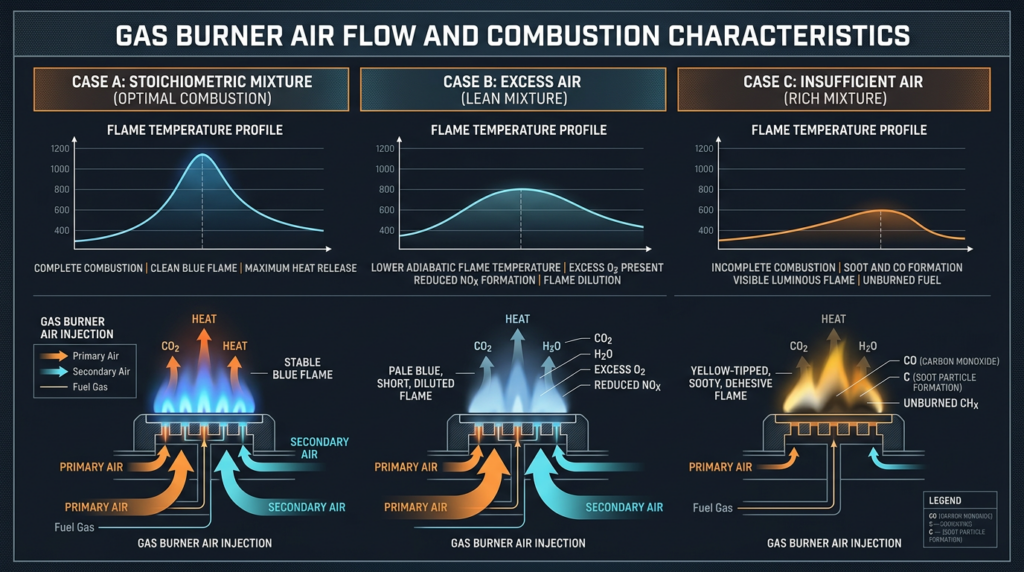
Every gas-fired heating appliance, from a residential furnace to a commercial boiler, depends on a carefully controlled mixture of fuel and air to produce heat safely and efficiently. The air supplied to a gas burner is divided into two categories: primary air, which mixes with fuel before ignition, and secondary air, which reaches the flame after ignition to complete combustion. Getting this balance right determines whether a system runs cleanly and efficiently or produces dangerous carbon monoxide, wastes fuel, and shortens equipment life. Understanding how primary and secondary air work is essential for anyone who installs, maintains, or simply owns gas heating equipment.
The Chemistry of Gas Combustion
Combustion is a rapid chemical reaction between a fuel and an oxidizer (oxygen) that produces heat and light. In HVAC systems, the fuel is typically natural gas (mostly methane, CH4) or liquefied petroleum gas (LPG, primarily propane or butane). Natural gas has a heating value of approximately 1,000 BTU per cubic foot. Propane delivers roughly 2,500 BTU per cubic foot, or about 91,500 BTU per gallon.
The idealized combustion of methane follows this equation:
CH4 + 2O2 → CO2 + 2H2O + Heat
For this reaction to occur completely, the right amount of oxygen must be present. The theoretical perfect ratio is called the stoichiometric ratio. For natural gas, the stoichiometric air-to-fuel ratio is approximately 10:1 by volume. In practice, burners are tuned to supply slightly more air than stoichiometric, typically 10% to 50% excess air, to ensure complete combustion under real-world conditions. This excess is critical because perfect mixing of air and fuel never occurs inside a burner.
Rich vs. Lean Mixtures
A rich mixture contains more fuel than the available air can fully combust. This produces carbon monoxide (CO), soot, and aldehyde compounds. A rich condition wastes fuel and poses serious health and safety risks.
A lean mixture contains more air than needed. Moderate excess air is intentional and beneficial. However, too much excess air cools the flame, reduces efficiency by sending heated air up the flue, and can increase nitrogen oxide (NOx) formation in high-temperature combustion zones. The goal is to find the narrow band where combustion is complete, CO production is minimal, and efficiency is maximized.
Primary Air: The First Stage of Combustion
Primary air is the air that mixes with fuel gas before the mixture reaches the burner port and ignites. It typically accounts for 30% to 50% of the total air required for complete combustion. Primary air serves several functions:
- It initiates the combustion process by providing oxygen at the point of ignition.
- It creates a stable, well-defined flame that sits properly on the burner ports.
- It determines the initial flame temperature and combustion velocity.
The Air Shutter
On atmospheric burners, primary air enters through an adjustable opening called an air shutter. Gas flows from the orifice into a venturi-shaped mixing tube. The velocity of the gas stream creates a low-pressure zone that draws ambient air into the tube through the shutter opening. This is known as the venturi effect or entrainment.
Adjusting the air shutter changes the amount of primary air. The technician opens or closes the shutter while observing the flame to achieve optimal combustion characteristics:
- Too little primary air: The flame turns yellow and lazy, lifts off the burner ports, and produces soot and carbon monoxide. A yellow flame indicates incomplete combustion of carbon particles.
- Too much primary air: The flame becomes hard, noisy, and may lift off or flash back into the mixing tube. The high air velocity can cool the flame below its ignition temperature, causing instability.
- Correct primary air: The flame is blue with a small, well-defined inner cone. It sits firmly on the burner ports without lifting, floating, or producing yellow tips.
Secondary Air: Completing the Reaction
Secondary air is the air that surrounds the flame after the primary air-fuel mixture has ignited. It supplies the remaining 50% to 70% of the oxygen needed for complete combustion. Secondary air reaches the flame by natural convection (in atmospheric systems) or by forced or induced draft (in powered systems).
Without adequate secondary air, combustion cannot finish. The result is elevated carbon monoxide in the flue gases, reduced heat output, and potentially lethal CO levels in occupied spaces. Conversely, excessive secondary air dilutes and cools the flue gases. This lowers the temperature differential across the heat exchanger and sends usable heat up the chimney, reducing overall efficiency.
Secondary air supply depends on the combustion chamber design, the venting configuration, and the availability of combustion air to the appliance room. The National Fuel Gas Code (NFPA 54/ANSI Z223.1) specifies minimum combustion air requirements based on the total BTU input of all gas appliances in a given space. Failure to provide adequate combustion air is one of the most common causes of poor burner performance and CO production in residential systems.
Types of Gas Burners
Atmospheric Burners
Atmospheric burners are the simplest and most common design in older residential furnaces. They rely on the gas pressure from the orifice to entrain primary air through the venturi. Secondary air is drawn into the combustion chamber by natural draft created by the buoyancy of hot flue gases rising through the chimney. Atmospheric burners are inexpensive and reliable but offer limited control over the air-fuel ratio. They are found in Category I appliances with AFUE ratings typically between 78% and 82%.
Power Burners (Forced Draft)
Power burners use a blower to force air into the burner assembly. This allows precise control of both primary and secondary air, resulting in better mixing, more complete combustion, and higher efficiency. Power burners are common in commercial boilers and high-output residential equipment. They operate under positive pressure in the combustion chamber.
Induced Draft Burners
Induced draft systems place a fan downstream of the heat exchanger, pulling combustion gases through the system. This creates a slight negative pressure in the combustion chamber that helps draw in both primary and secondary air. Most modern 80% AFUE residential furnaces use induced draft. The draft inducer motor starts before the gas valve opens, ensuring proper airflow before ignition.
Modulating Burners
Modulating burners can vary their firing rate continuously across a range, typically from 40% to 100% of rated capacity. Both fuel flow and airflow are adjusted proportionally to maintain the correct air-fuel ratio at every firing rate. Modulating burners deliver the most consistent comfort, the lowest temperature swings, and the highest seasonal efficiency. They are standard in condensing furnaces with AFUE ratings of 95% to 98.5% and in high-efficiency commercial boilers.
Orifice Size and Manifold Pressure
The orifice is a precisely drilled opening that meters the flow of gas into the burner. Orifice size is matched to the gas type, altitude, and desired BTU input. Natural gas orifices are larger than propane orifices because propane has a higher energy density and requires less volume to produce the same heat output.
Manifold pressure is the gas pressure measured at the burner manifold downstream of the gas valve. Typical values are:
- Natural gas: 3.5 inches of water column (WC)
- Propane (LP): 10 to 11 inches WC
These values can vary by manufacturer. Always consult the appliance rating plate and installation manual for the specified manifold pressure. Incorrect manifold pressure leads to over-firing or under-firing, both of which compromise safety and efficiency.
Altitude Adjustment
At higher altitudes, air is less dense and contains less oxygen per unit volume. For every 1,000 feet above sea level, the input rating of a gas appliance is typically derated by approximately 4%. This means smaller orifices or reduced manifold pressure may be required. Some jurisdictions require altitude derating above 2,000 feet. Manufacturers provide altitude conversion kits and specific instructions for their equipment.
Combustion Analysis and Tuning
While flame appearance provides a useful visual check, it is not sufficient for precise tuning. A combustion analyzer (flue gas analyzer) measures the actual composition of flue gases, including oxygen (O2), carbon monoxide (CO), carbon dioxide (CO2), and stack temperature. From these measurements, a technician can calculate combustion efficiency and determine whether the air-fuel ratio is correct.
Target readings for a properly tuned natural gas appliance typically include:
- CO in flue gases: below 100 ppm (air-free), ideally below 50 ppm
- O2 in flue gases: 4% to 9% for atmospheric burners, 3% to 5% for power burners
- CO2 in flue gases: 7% to 9% for atmospheric burners, 8% to 10% for power burners
- Stack temperature: varies by equipment type and efficiency rating
Combustion analysis should be performed at installation and during annual maintenance. It is the single most reliable method for verifying safe and efficient burner operation.
Safety Devices
Modern gas appliances incorporate multiple safety devices to prevent hazardous conditions:
- Flame sensors: Thermocouples (millivolt systems) or flame rectification sensors (electronic ignition systems) verify that the burner flame is established. If no flame is detected, the gas valve closes within seconds.
- High-limit switches: These temperature-activated switches shut off the burner if the heat exchanger or plenum temperature exceeds a safe threshold, preventing overheating and potential fire.
- Pressure switches: In induced draft and forced draft systems, pressure switches confirm that the draft motor is operating and adequate airflow exists before allowing ignition.
- Gas valves and regulators: These control fuel flow and maintain the correct manifold pressure. Modern gas valves include redundant shutoff mechanisms. Refer to UL 353 (for gas furnaces) and UL 795 (for gas boilers) for applicable safety standards.
Emissions and Regulatory Considerations
Gas combustion produces two pollutants of primary concern: carbon monoxide (CO) and nitrogen oxides (NOx). CO forms when combustion is incomplete due to insufficient air or poor mixing. NOx forms at high flame temperatures when nitrogen in the air reacts with oxygen.
The EPA regulates emissions from gas-fired equipment, and several states impose stricter limits. California’s South Coast Air Quality Management District (SCAQMD) has led the push for low-NOx burner technology, requiring residential furnaces to emit no more than 14 ng/J of NOx. Other states and air quality districts are adopting similar standards.
Low-NOx burners achieve reduced emissions through techniques such as premixing fuel and air before combustion, using cooler flame temperatures, and recirculating flue gases into the combustion zone. These designs have become standard in condensing furnaces and are increasingly available in conventional efficiency equipment.
Efficiency Ratings and Incentives
Gas furnace efficiency is measured by AFUE (Annual Fuel Utilization Efficiency). The current federal minimum for residential gas furnaces is 80% AFUE for non-weatherized units in the northern United States and 80% AFUE for units in the southern region, though the DOE has proposed raising the minimum to 95% AFUE for the northern region. The highest-efficiency condensing furnaces reach 98.5% AFUE.
The Inflation Reduction Act (IRA) of 2022 provides tax credits and rebates for high-efficiency heating equipment. As of 2024, homeowners may be eligible for a tax credit of up to 30% of the cost (up to $600) for an ENERGY STAR-rated gas furnace meeting specific efficiency criteria. Check the ENERGY STAR and IRS databases for the most current eligibility requirements, as these provisions are subject to change.
Troubleshooting Air Supply Problems
Many common gas burner issues trace back to air supply problems. Technicians should investigate the following when diagnosing poor combustion:
- Blocked combustion air inlets: Obstructed vents, sealed utility rooms, or negative building pressure can starve the burner of air. Check that combustion air openings comply with NFPA 54 requirements.
- Dirty burners: Dust, rust, or debris on burner ports restricts gas flow and disrupts the primary air-fuel mixture, leading to uneven flames and hot spots.
- Improper air shutter adjustment: Shutters that have shifted or been incorrectly set produce yellow flames, delayed ignition, or flame rollout.
- Failed combustion air blower: In forced draft or induced draft systems, a failing blower motor reduces airflow. The pressure switch should prevent ignition, but a weak motor may produce marginal airflow that allows ignition while delivering poor combustion.
- Cracked heat exchanger: A crack can allow secondary air to enter the combustion chamber in uncontrolled ways, disrupting flame patterns and potentially allowing flue gases to enter the supply air stream.
Common Misconceptions
Several widespread misunderstandings about gas burner operation persist among homeowners and even some technicians:
- “More air is always better.” Excess air beyond what is needed for complete combustion reduces efficiency and can increase NOx formation. The goal is the right amount of air, not the most air.
- “Flame color tells you everything.” A blue flame is a good sign, but flame color alone cannot confirm safe CO levels or optimal efficiency. Combustion analysis with calibrated instruments is the only reliable method.
- “Modern furnaces never need adjustment.” Even high-efficiency modulating furnaces benefit from annual combustion analysis. Gas composition can vary, components wear over time, and installation errors may not be apparent without measurement.
- “All gas furnaces work the same way.” The differences between atmospheric, induced draft, forced draft, and modulating condensing systems are significant. Each type has distinct air supply requirements, maintenance procedures, and performance characteristics.
Key Takeaways
Proper gas burner operation depends on delivering the right amount of air at the right time. Primary air mixes with fuel before ignition and typically provides 30% to 50% of the total combustion air. Secondary air surrounds the flame to complete combustion and makes up the remaining 50% to 70%. Together, they must satisfy the stoichiometric requirement plus a controlled amount of excess air.
Technicians should always verify burner performance with combustion analysis rather than relying solely on visual inspection. Manifold pressure, orifice sizing, air shutter settings, and draft conditions all affect the air-fuel balance. Regular maintenance and proper combustion air supply to the appliance space are essential for safe, efficient, and low-emission operation. Whether the system is a simple atmospheric burner in a residential furnace or a modulating power burner in a commercial boiler, the fundamental principles of primary and secondary air remain the same.