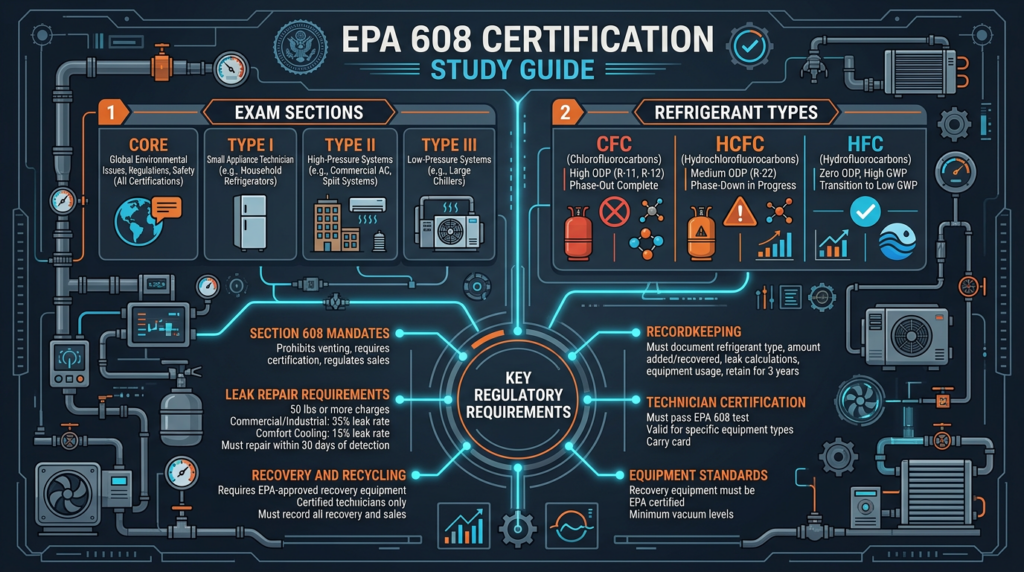
What EPA 608 Certification Is and Why It Matters
EPA Section 608 certification is a federal requirement for any technician who maintains, services, repairs, or disposes of equipment containing regulated refrigerants. Established under Section 608 of the Clean Air Act and codified in 40 CFR Part 82, Subpart F, this certification program exists to prevent the release of ozone-depleting substances and high-GWP (global warming potential) greenhouse gases into the atmosphere. Without it, a technician cannot legally purchase or handle refrigerants in the United States. Violations carry civil penalties of up to $44,539 per day per violation, and criminal penalties can include fines and imprisonment. Whether you are a homeowner trying to understand what your HVAC contractor should hold, or a technician preparing for the exam, this guide covers the regulatory framework, exam structure, and practical knowledge required to earn and use EPA 608 certification responsibly.
Why Certification Is Required
Refrigerants released into the atmosphere cause measurable environmental harm. Chlorofluorocarbons (CFCs) like R-12 and hydrochlorofluorocarbons (HCFCs) like R-22 destroy stratospheric ozone, which protects life on Earth from ultraviolet radiation. Hydrofluorocarbons (HFCs) like R-410A do not deplete ozone but carry extremely high global warming potential, often hundreds to thousands of times greater than carbon dioxide. R-410A, for example, has a GWP of 2,088.
The Montreal Protocol (1987) committed nations to phasing out ozone-depleting substances. The United States implemented those commitments through the Clean Air Act Amendments of 1990, which created the Section 608 certification program. More recently, the AIM Act (American Innovation and Manufacturing Act of 2020) authorized the EPA to phase down HFC production and consumption by 85% from baseline levels by 2036. Together, these laws make proper refrigerant handling a legal obligation, not just a best practice.
Penalties for non-compliance are severe. Beyond fines, technicians can lose their certification, and companies can face enforcement actions. The EPA actively pursues violations and offers bounties of up to $10,000 for tips leading to successful enforcement.
The Four Types of EPA 608 Certification
Type I: Small Appliances
Type I certification covers the servicing and disposal of small appliances containing 5 pounds or less of refrigerant. This includes household refrigerators, window air conditioners, dehumidifiers, water coolers, and vending machines. Technicians must recover 80% of the refrigerant when using self-contained recovery equipment, or 90% when the compressor is operational and system-dependent equipment is used. If the compressor is not operational and system-dependent equipment is used, the requirement is 80% or a vacuum of 4 inches of mercury (in. Hg).
A growing consideration for Type I work is the increasing use of hydrocarbon refrigerants like R-290 (propane) and R-600a (isobutane) in domestic refrigerators and commercial display cases. These refrigerants have very low GWP (3 for R-290) but are flammable, requiring technicians to follow strict safety protocols including eliminating ignition sources and using intrinsically safe recovery equipment.
Type II: High-Pressure Appliances
Type II certification covers servicing and disposal of high-pressure appliances, excluding motor vehicle air conditioners (MVACs) and small appliances. High-pressure appliances use refrigerants with boiling points between -50°C and 10°C at atmospheric pressure. Common examples include residential and commercial air conditioning systems, heat pumps, and commercial refrigeration using R-22, R-134a, R-404A, or R-410A.
Required evacuation levels for high-pressure appliances depend on the refrigerant type and charge size:
- R-22 and other HCFCs with charges under 200 lbs: 0 inches Hg vacuum (0 psig)
- R-22 and other HCFCs with charges of 200 lbs or more: 0 inches Hg vacuum (0 psig)
- R-410A and other HFCs with charges under 200 lbs: 0 inches Hg vacuum (0 psig)
- R-410A and other HFCs with charges of 200 lbs or more: 0 inches Hg vacuum (0 psig)
- R-12 and other CFCs with charges under 200 lbs: 4 inches Hg vacuum
- R-12 and other CFCs with charges of 200 lbs or more: 4 inches Hg vacuum
Note that if the recovery or recycling equipment was manufactured or imported before November 15, 1993, the required levels may differ. Technicians must use equipment certified to meet ARI 740 (now AHRI 740) standards.
Type III: Low-Pressure Appliances
Type III certification covers servicing and disposal of low-pressure appliances, which use refrigerants with boiling points above 10°C at atmospheric pressure. The primary refrigerants in this category are R-11 (CFC, boiling point 74.9°F) and R-123 (HCFC, boiling point 82.2°F). These refrigerants are used almost exclusively in large centrifugal chillers found in commercial and institutional buildings.
Because low-pressure systems operate below atmospheric pressure during normal operation, they are particularly susceptible to air and moisture infiltration. Required evacuation levels are:
- R-11 (CFC): 25 inches Hg vacuum
- R-123 (HCFC): 15 inches Hg vacuum
Low-pressure systems require special purging procedures to remove non-condensables (air) that enter the system. A purge unit is standard equipment on these chillers and must be maintained in good working order to minimize refrigerant loss.
Universal Certification
Universal certification authorizes a technician to work on all appliance types. It is obtained by passing the Core section exam plus all three equipment-specific sections (Type I, Type II, and Type III). Most working HVAC technicians pursue Universal certification because it provides maximum flexibility. There is no additional fee beyond the cost of the full exam.
Obtaining EPA 608 Certification
There are no formal prerequisites for taking the EPA 608 exam. Any person can sit for the test regardless of age, education, or work experience. The exam is administered by EPA-approved testing organizations such as the ESCO Institute, HVAC Excellence, and others. Testing is available in person through proctored exams and, since regulatory updates, through online proctored formats.
The exam structure consists of a Core section (25 questions) and individual sections for each certification type (25 questions each). All sections are closed-book and multiple-choice. The passing score is 70% (18 out of 25 correct) on each section. A technician must pass the Core section and at least one equipment-specific section to receive any certification.
Exam costs typically range from $20 to $40 for a proctored test, depending on the testing organization. Many employers cover this cost. Study materials are widely available from testing organizations, trade schools, and industry publishers.
EPA 608 certification does not expire and has no formal renewal requirement. However, technicians bear a professional and legal responsibility to stay current with regulatory changes, particularly given the ongoing HFC phasedown under the AIM Act.
Core Exam Content
The Core section covers foundational knowledge that applies to all certification types:
- Ozone depletion: How chlorine and bromine atoms from CFCs and HCFCs catalytically destroy stratospheric ozone. One chlorine atom can destroy approximately 100,000 ozone molecules.
- Global warming potential: The relative heat-trapping ability of refrigerants compared to CO2 over a 100-year period.
- The Montreal Protocol: International treaty phasing out ozone-depleting substances and its subsequent amendments.
- Clean Air Act provisions: Prohibition of venting, recovery requirements, sales restrictions, and enforcement mechanisms.
- Recovery, recycling, and reclamation: The distinction between these three processes is critical exam content.
- Safe handling practices: Refrigerants can cause frostbite on skin contact, displace oxygen in enclosed spaces, and decompose into toxic compounds (such as phosgene gas) when exposed to open flames.
- Record keeping: Documentation requirements for refrigerant purchases, sales, recovery, and disposal.
Refrigerant Recovery, Recycling, and Reclamation
These three terms have specific regulatory definitions that technicians must understand:
- Recovery: Removing refrigerant from a system and storing it in an external container without necessarily testing or processing it.
- Recycling: Cleaning recovered refrigerant for reuse by removing moisture, oil, and other contaminants using oil separators, filter-driers, and similar equipment. Recycling is typically performed on-site or at a local service facility.
- Reclamation: Processing used refrigerant to return it to virgin-grade purity as defined by AHRI Standard 700. Reclamation can only be performed by EPA-certified reclaimers and requires chemical analysis to verify compliance.
Recovery equipment must be certified to meet AHRI 740 standards. There are two categories: self-contained recovery equipment, which has its own compressor and condenser, and system-dependent recovery equipment, which relies on the appliance’s compressor or pressure differential to move refrigerant into the recovery container. System-dependent equipment is generally limited to small appliances.
Refrigerant Types and Phase-Out Schedules
Understanding the regulatory status of different refrigerant classes is essential:
- CFCs (R-12, R-11, R-502): Production and import banned since January 1, 1996. These carry both high ODP and high GWP. Only reclaimed or recycled supplies remain available for servicing legacy equipment.
- HCFCs (R-22, R-123, R-142b): Production and import of R-22 for servicing existing equipment ended January 1, 2020. Only reclaimed or recycled R-22 may be used. R-123 production ended January 1, 2030 per the phaseout schedule.
- HFCs (R-410A, R-134a, R-404A, R-407C): Zero ODP but high GWP. Subject to phasedown under the AIM Act. The EPA has mandated a 40% reduction from baseline by 2024 and 85% by 2036.
- HFOs (R-1234yf, R-1234ze): Hydrofluoroolefins with very low GWP (typically under 10). Increasingly adopted in automotive and commercial applications.
- Hydrocarbons (R-290, R-600a): Extremely low GWP (under 5) but flammable (ASHRAE A3 safety classification). Growing in popularity for self-contained commercial refrigeration and domestic appliances.
- Natural refrigerants (R-744/CO2, R-717/ammonia): Zero or near-zero GWP. CO2 is used in transcritical commercial refrigeration systems. Ammonia is standard in industrial refrigeration.
Leak Detection and Repair Requirements
The EPA mandates that equipment owners repair refrigerant leaks within 30 days of discovery for appliances containing 50 pounds or more of refrigerant. The allowable annual leak rates are:
- Commercial refrigeration: 20%
- Industrial process refrigeration: 30%
- Comfort cooling and heating: 10%
If an appliance exceeds its applicable leak rate, the owner must repair the leak or retire the equipment. Extensions may be available under specific conditions, but documentation is required.
Common leak detection methods include electronic leak detectors (which can sense halogenated compounds at levels as low as 0.1 oz/year), bubble solution (soap and water applied to suspected leak points), UV fluorescent dye injected into the system, and ultrasonic leak detectors for pressurized systems. Standing pressure or vacuum tests are also used to verify system integrity.
Oil Management
Refrigerant oil is essential for compressor lubrication but must be carefully managed during service. Different refrigerants require compatible oils:
- Mineral oil: Used with CFC and some HCFC refrigerants (R-12, R-22).
- Alkylbenzene (AB) oil: Compatible with CFC and HCFC systems; sometimes used as a retrofit oil.
- Polyolester (POE) oil: Required for HFC refrigerants (R-410A, R-134a). POE oil is hygroscopic and absorbs moisture rapidly when exposed to air.
- Polyalkylene glycol (PAG) oil: Primarily used in automotive MVAC systems with R-134a.
Oil contamination, including acid formation from moisture, reduces system efficiency and can damage compressors. During recovery, oil removed with the refrigerant should be measured and replaced with the correct type and quantity.
Record Keeping Requirements
Facilities with appliances containing 50 pounds or more of refrigerant must maintain records of all refrigerant additions, recoveries, and leak repairs. Records must be retained for a minimum of three years. Documentation should include the date of service, type and quantity of refrigerant added or recovered, leak rate calculations, and verification of repair.
Technicians selling or distributing refrigerant must verify that buyers hold valid EPA 608 certification. Sales records must be maintained.
The AIM Act and the Future of Refrigerants
The AIM Act, signed into law in December 2020, directs the EPA to reduce HFC production and consumption according to a stepdown schedule: 10% reduction by 2024, 40% by 2028, 70% by 2032, and 85% by 2036, measured against a 2011-2013 baseline. This is driving a rapid transition in the HVAC industry.
The most significant near-term change is the shift from R-410A (GWP 2,088) to R-454B (GWP 466) in residential and light commercial air conditioning. R-454B is an A2L refrigerant, meaning it has mild flammability, which requires updated safety standards, equipment design, and technician training. New residential and commercial air conditioning equipment manufactured after January 1, 2025, will increasingly use R-454B or similar lower-GWP alternatives.
The SNAP (Significant New Alternatives Policy) program continues to update its lists of acceptable and unacceptable substitutes. Technicians should check the EPA SNAP website regularly for changes affecting the refrigerants they handle.
The Inflation Reduction Act (IRA) of 2022 includes provisions supporting this transition. Tax credits under Section 25C provide homeowners up to $2,000 for qualifying heat pump installations, and the High-Efficiency Electric Home Rebate Act offers additional incentives. These provisions accelerate adoption of equipment using lower-GWP refrigerants and increase demand for technicians trained on new systems.
Common Misconceptions
- “Certification never needs updating.” While the certificate itself does not expire, regulations change frequently. Technicians who do not stay informed risk non-compliance. The AIM Act alone has introduced substantial new requirements since 2021.
- “All refrigerants are basically the same.” Different refrigerants have vastly different pressures, toxicity levels, flammability ratings, oil compatibility, and environmental impacts. Mixing refrigerants is illegal and dangerous.
- “Old equipment doesn’t need leak repair.” EPA leak repair requirements apply regardless of equipment age. An older system leaking R-22 still must meet the applicable leak rate threshold or be retired.
- “EPA 608 covers everything I need for HVAC work.” EPA 608 specifically addresses refrigerant handling. Installation, electrical work, and system design may require separate state or local licenses.
- “Recovery equipment is only needed for large systems.” Certified recovery equipment must be used for any appliance containing regulated refrigerant, including household refrigerators and window units.
Practical Scenarios
Scenario 1: Commercial Refrigerant Leak
A technician discovers that a supermarket rack system with 500 lbs of R-404A has lost 120 lbs of refrigerant over the past year, representing a 24% leak rate. Since this exceeds the 20% commercial refrigeration threshold, the owner must have the leak repaired within 30 days. The technician must document the leak rate calculation, repair actions, and a follow-up verification test. Failure to repair can result in daily fines.
Scenario 2: R-22 System Replacement
A homeowner with a 20-year-old R-22 air conditioner faces a compressor failure. Since R-22 is no longer manufactured and reclaimed supplies are expensive (often $50-$100+ per pound), replacement with a new system using R-410A or R-454B is typically more cost-effective. The technician must recover all remaining R-22 from the old system before decommissioning it.
Scenario 3: Disposing of a Household Refrigerator
A contractor removing an old refrigerator must recover the refrigerant (typically R-134a or R-600a) before disposal. This requires Type I certification and appropriate recovery equipment. Releasing the refrigerant by cutting refrigerant lines is a federal violation regardless of the small charge size.
Exam Preparation and Costs
- Exam fee: $20 to $40 depending on the proctor organization.
- Study time: Most candidates spend 20 to 40 hours preparing, depending on prior experience.
- Recovery equipment: Certified machines range from $500 to $3,000+ depending on capacity and features.
- Leak detection equipment: Electronic detectors range from $100 to $800.
Candidates should focus their study on the specific evacuation requirements, refrigerant properties, safety procedures, and regulatory definitions that appear most frequently on the exam. Practice tests from ESCO Institute and similar organizations closely mirror actual exam content.
Key Takeaways
- EPA 608 certification is legally required for anyone who services, maintains, repairs, or disposes of equipment containing regulated refrigerants.
- Four certification levels exist: Type I (small appliances), Type II (high-pressure), Type III (low-pressure), and Universal (all types).
- The exam is closed-book, multiple-choice, with a 70% passing threshold on each section.
- Recovery equipment must be certified to AHRI 740 standards, and specific evacuation levels apply based on refrigerant type and system charge size.
- The AIM Act is driving a phasedown of HFCs, with R-454B replacing R-410A as the primary residential AC refrigerant starting in 2025.
- Leak detection and repair are mandatory for systems with 50 lbs or more of refrigerant, with annual leak rate thresholds of 10% to 30% depending on application type.
- Certification does not expire, but staying current with evolving regulations is a professional and legal necessity.
- Proper refrigerant management protects the environment, ensures regulatory compliance, and is fundamental to responsible HVAC practice.