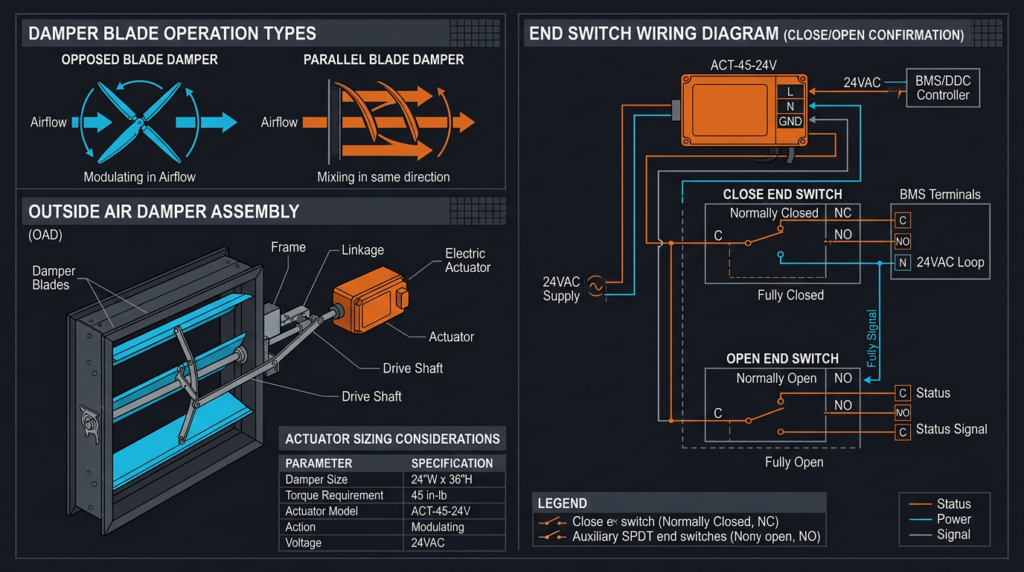
Outside air dampers are mechanical devices installed in HVAC ductwork or air handling units to regulate the volume of fresh outdoor air entering a building. They serve three critical functions: maintaining acceptable indoor air quality (IAQ), controlling building pressurization, and enabling economizer operation for energy-efficient cooling. A malfunctioning outside air damper can spike energy costs, degrade air quality, or cause uncomfortable pressure imbalances. Understanding how these dampers work, how they are controlled, and how they fail is essential for both building owners seeking efficient operation and technicians tasked with installation, commissioning, and repair.
Types of Outside Air Dampers
Outside air dampers come in several configurations, each suited to different control requirements and system designs. Selecting the right type affects airflow uniformity, energy efficiency, and long-term reliability.
Parallel Blade Dampers
Parallel blade dampers feature blades that all rotate in the same direction. They are commonly used for two-position (open/closed) applications because their airflow characteristic is nonlinear. As the damper opens from closed, airflow increases rapidly at first, then levels off. This makes them poor candidates for precise modulating control but acceptable for simple on/off ventilation scenarios. They also tend to exhibit higher leakage when fully closed compared to opposed blade designs.
Opposed Blade Dampers
Opposed blade dampers have adjacent blades that rotate in opposite directions. This produces a more linear airflow characteristic and better air mixing downstream. They are the preferred choice for variable air volume (VAV) systems and any application requiring proportional airflow modulation. The opposed blade configuration also creates more uniform velocity distribution across the damper face, reducing turbulence and noise.
Low-Leakage Dampers
Low-leakage dampers incorporate tighter blade-edge seals, jamb seals, and sometimes inflatable gaskets to minimize air infiltration when the damper is fully closed. AMCA Standard 500 defines leakage classes for dampers. Class 1A represents the tightest rating at 3 CFM per square foot at 1 inch of water gauge (in. w.g.) differential pressure. Specifying a low-leakage damper is critical in climates with extreme heating or cooling loads, where uncontrolled air infiltration during unoccupied hours can waste significant energy.
Round (Butterfly) Dampers
Round dampers, also called butterfly dampers, consist of a single disc that pivots on a central axis inside a round duct. They are commonly used where space is limited or in smaller branch ducts. Airflow control precision is lower than with multi-blade rectangular dampers, but they are adequate for basic balancing and two-position control in many residential and light commercial systems.
Damper Leakage Ratings
Damper leakage directly affects energy consumption. AMCA Standard 500 establishes standardized leakage classifications that allow engineers to compare products consistently.
- Class 1A: Maximum 3 CFM/ft² at 1 in. w.g. (lowest leakage)
- Class 1: Maximum 4 CFM/ft² at 1 in. w.g.
- Class 2: Maximum 10 CFM/ft² at 1 in. w.g.
- Class 3: Maximum 40 CFM/ft² at 1 in. w.g.
- Class 4: Leakage exceeding Class 3 limits
ASHRAE Standard 90.1 requires that outside air dampers on systems larger than a specified capacity meet specific leakage class requirements, typically Class 1A or Class 1. Ignoring leakage specifications is one of the most common and costly mistakes in damper selection.
Damper Materials
Material choice depends on the operating environment. Aluminum is lightweight and corrosion-resistant, making it the default for most commercial HVAC applications. Galvanized steel offers higher strength at lower cost but is susceptible to corrosion in humid or chemically aggressive environments. Stainless steel is specified for coastal installations, swimming pool facilities, laboratories, and industrial plants where corrosive chemicals are present. Plastic dampers are available for smaller duct sizes and specialized corrosive environments but are limited in structural capacity and temperature range.
Actuator Types
The actuator is the device that physically moves the damper blades to the commanded position. Actuator selection must match the control strategy, available power, response time requirements, and damper torque demand. Actuator torque is measured in inch-pounds (in-lbs) or Newton-meters (Nm), and undersizing an actuator is a frequent cause of premature failure and unreliable damper positioning.
Electric Actuators
Electric actuators are the most widely used type in modern HVAC systems. They use an electric motor, often with a gear train, to rotate or push the damper linkage. Electric actuators come in two primary configurations:
- Two-position (on/off): The actuator drives the damper fully open or fully closed based on a binary control signal (24V AC is common). Used where precise modulation is unnecessary.
- Modulating: The actuator positions the damper proportionally based on a continuous signal, typically 0 to 10V DC or 4 to 20 mA. This provides variable airflow control and is required for economizer operation and demand-controlled ventilation.
Many electric actuators include a spring return feature. If power is lost, an internal spring drives the damper to a predetermined fail-safe position, either fully open or fully closed depending on the application. For outside air dampers, a spring-return-to-closed configuration is common to prevent uncontrolled outdoor air entry during heating mode power failures.
Pneumatic Actuators
Pneumatic actuators use compressed air, typically at 15 to 20 psi, supplied through a building’s pneumatic control air system. They offer fast response times and high force output relative to their size. Pneumatic actuators remain common in older buildings with existing pneumatic control infrastructure, and they are well suited to environments where electrical components pose safety concerns (such as certain hazardous or explosive atmospheres). However, they require a clean, dry compressed air supply, and maintaining the air compressor and tubing adds to system complexity and cost.
Manual Actuators
Manual actuators are hand levers, locking quadrants, or crank mechanisms that allow a technician to set the damper position by hand. They are appropriate only for fixed minimum outside air settings or seasonal adjustments where automatic control is not required. Manual actuators have no moving mechanical or electrical components to fail, but they depend entirely on human intervention to respond to changing conditions.
Control Methods
Outside air damper control ranges from simple standalone setups to fully integrated building automation strategies. The control method directly determines IAQ performance, energy efficiency, and occupant comfort.
Standalone Control
In a standalone control arrangement, a single sensor or controller governs damper position. A common example is a CO2 sensor mounted in the return air duct that sends a 0 to 10V signal to a modulating actuator. As CO2 levels rise above a setpoint (often 800 to 1000 ppm), the controller opens the outside air damper to increase ventilation. This approach is cost-effective for single-zone systems but lacks the sophistication to optimize across multiple variables simultaneously.
Building Automation System (BAS) Integration
BAS integration connects the outside air damper to a centralized control platform that processes inputs from multiple sensors: space temperature, outdoor temperature, humidity, CO2 concentration, occupancy sensors, and scheduling data. The BAS can execute complex control sequences such as demand-controlled ventilation (DCV), enthalpy-based economizer switching, and morning pre-conditioning routines. BAS integration is standard in commercial buildings and is increasingly common in high-performance residential construction.
Economizer Control Strategies
Economizer cycles use the outside air damper to provide free cooling when outdoor conditions are favorable. Two primary strategies exist:
- Dry-bulb temperature economizer: The damper opens when outdoor dry-bulb temperature falls below a changeover setpoint (commonly 55 to 75°F depending on climate zone). This is simpler to implement and maintain.
- Enthalpy economizer: The damper opens when outdoor air enthalpy (total heat content) is lower than return air enthalpy. This method is more accurate in humid climates because it accounts for moisture, but it requires enthalpy sensors or comparative humidity and temperature sensors, which demand more frequent calibration.
Minimum Outside Air Settings
ASHRAE Standard 62.1 establishes minimum outdoor air ventilation rates based on building type, occupancy, and floor area. For example, an office space requires 5 CFM per person plus 0.06 CFM per square foot of floor area. The outside air damper must be configured, either through a minimum position stop on the actuator or a BAS software minimum, to never close below the level needed to meet these requirements during occupied hours.
Common Failure Modes
Outside air dampers fail more frequently than many building operators realize. Failures often go undetected for months because damper position is not always visible or monitored. The consequences include wasted energy, poor IAQ, frozen coils, and comfort complaints.
Actuator Failure
Electric actuators can fail due to motor burnout, gear train wear, capacitor degradation, or circuit board malfunction. Pneumatic actuators fail from diaphragm rupture, air leaks in tubing, or clogged orifices. A seized actuator leaves the damper stuck in whatever position it last achieved. If that position is fully open during winter, the heating coil may not be able to keep up, or worse, a hot water coil can freeze and rupture.
Linkage Problems
The mechanical linkage connecting the actuator to the damper blade shaft can loosen, disconnect, or bind over time. Vibration, thermal cycling, and corrosion all contribute. A disconnected linkage means the actuator runs but the damper blades do not move. This is one of the most common and easily overlooked failure modes. A quick visual inspection during routine maintenance catches it immediately.
Blade Damage and Corrosion
Damper blades can bend from debris impact, ice buildup, or improper handling during installation. Bent blades prevent full closure and increase leakage dramatically. In coastal or industrial environments, corrosion can weaken blade structure and degrade seal contact surfaces.
Seal Degradation
Blade-edge seals and jamb seals deteriorate over time due to UV exposure, temperature extremes, and repeated mechanical cycling. As seals degrade, damper leakage increases, sometimes moving a damper from Class 1 performance to effectively Class 3 or worse. Seal replacement is a routine maintenance item that is frequently neglected.
Control System Issues
Sensor drift, wiring faults, programming errors, and communication failures between the BAS and actuator can all cause the damper to operate incorrectly. A CO2 sensor reading low due to calibration drift will cause the system to under-ventilate the space. A reversed control signal can drive the damper open when it should be closed. Systematic commissioning and periodic re-commissioning catch these issues.
Maintenance and Troubleshooting
Regular maintenance extends damper life and prevents costly failures. A practical maintenance schedule includes the following tasks:
- Visual inspection (quarterly): Check for blade damage, corrosion, debris obstruction, and linkage integrity.
- Actuator stroke test (semi-annually): Command the actuator through its full range and verify that blades move from fully closed to fully open smoothly.
- Lubrication (annually): Lubricate blade bearings and linkage pivot points with manufacturer-recommended lubricant.
- Seal inspection and replacement (annually or as needed): Inspect blade-edge and jamb seals for cracking, compression set, or deterioration. Replace when leakage increases noticeably.
- Control calibration (annually): Verify sensor accuracy (CO2, temperature, humidity), confirm actuator feedback signal matches actual blade position, and check BAS programming for correct setpoints and sequences.
Always follow lockout/tagout (LOTO) procedures before performing any maintenance on dampers or actuators. De-energize electrical circuits and depressurize pneumatic lines before working on components.
Commissioning and Testing
Proper commissioning verifies that the outside air damper performs as designed. Commissioning activities should include measurement of actual airflow at minimum and maximum damper positions using a flow measuring station or traverse, verification that the damper achieves the minimum outside air rate required by ASHRAE 62.1, leakage testing at rated pressure differential, and end-to-end testing of the control sequence from sensor input through BAS logic to actuator response. Re-commissioning every three to five years, or after any significant system modification, helps maintain performance over the life of the building.
Practical Applications and Cost Considerations
Damper costs vary significantly by application complexity, size, and required performance level:
- Small office space: A basic outside air damper with actuator typically costs $500 to $2,000 installed.
- School classrooms: Installations meeting ASHRAE 62.1 run $1,000 to $5,000 per classroom, depending on existing infrastructure.
- Hospital operating rooms: High-precision, low-leakage dampers with dedicated controllers cost $2,000 to $10,000 installed per room.
- Data centers: Economizer damper systems with redundant actuators represent a higher investment but can reduce cooling energy by 30% or more during favorable outdoor conditions.
- Residential (ERV/HRV integration): Smaller outside air dampers for high-performance homes typically cost $200 to $800 installed.
Budget approximately $300 to $500 for a basic commercial damper and $200 to $800 or more for the actuator alone. Installation labor and BAS programming add to the total. Low-leakage dampers and modulating actuators cost more upfront but deliver measurable energy savings that often justify the premium within one to three heating or cooling seasons.
Relevant Standards and Regulations
- ASHRAE Standard 62.1: Defines minimum outdoor air ventilation rates for acceptable IAQ in commercial buildings.
- ASHRAE Standard 90.1: Sets energy efficiency requirements, including damper leakage limits and economizer mandates by climate zone.
- IECC (International Energy Conservation Code): References ASHRAE 90.1 and may impose additional requirements depending on local adoption.
- AMCA Standard 500: Provides standardized testing and rating procedures for damper leakage and pressure drop performance.
- Local building codes: May impose additional or more stringent requirements. Always verify local amendments.
The Inflation Reduction Act (IRA) of 2022 provides tax credits and rebates for energy-efficient building upgrades, which may indirectly incentivize the installation of advanced damper control systems as part of broader HVAC efficiency improvements.
Key Takeaways
- Outside air dampers are critical for IAQ, energy efficiency, and building pressurization. They are not optional accessories.
- Opposed blade dampers provide better modulating control; parallel blade dampers suit on/off applications.
- Specify damper leakage class per AMCA 500. Class 1A (3 CFM/ft² at 1 in. w.g.) is required by most energy codes for outside air applications.
- Size actuators with adequate torque for the damper. Undersized actuators are a leading cause of premature failure.
- Spring-return actuators provide fail-safe positioning during power loss, which is critical for outside air dampers.
- BAS integration with multiple sensor inputs (CO2, temperature, occupancy) delivers the best balance of IAQ and energy performance.
- Regular maintenance, including linkage checks, seal inspection, and actuator stroke testing, prevents the most common failures.
- Commission damper systems at installation and re-commission every three to five years to maintain performance.
- A stuck or leaking outside air damper can waste thousands of dollars in energy annually. Detection and correction should be a maintenance priority.