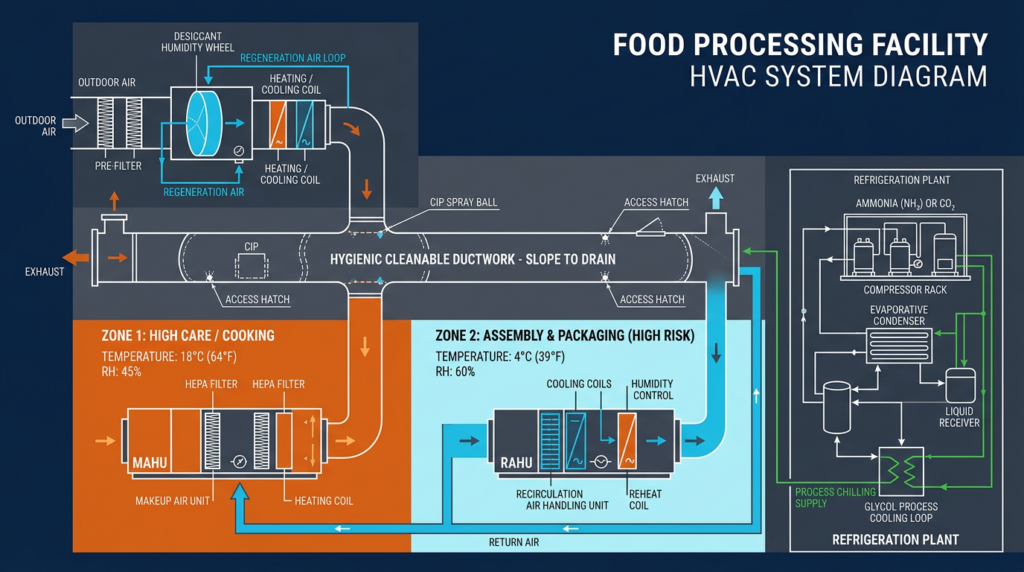
Why HVAC Matters in Food Processing
Food processing facilities operate under some of the most demanding environmental conditions in any industry. The HVAC systems serving these spaces do far more than provide comfort. They maintain precise temperatures that prevent bacterial growth, control humidity to avoid condensation and spoilage, filter airborne contaminants that could compromise product safety, and support regulatory compliance with federal food safety laws. A failure in any one of these functions can result in contaminated product, costly recalls, regulatory shutdowns, or serious public health consequences. Designing, installing, and maintaining HVAC systems for food processing requires specialized knowledge that goes well beyond standard commercial practice.
Regulatory Landscape
Food processing HVAC systems must comply with an overlapping framework of federal regulations and industry standards. Understanding these requirements is the starting point for any system design.
FDA and FSMA
The Food Safety Modernization Act (FSMA), signed into law in 2011 and continually updated since, shifted the FDA’s approach from responding to contamination events to preventing them. FSMA’s Preventive Controls rules require food processors to identify and control hazards, including environmental hazards like airborne contaminants, temperature abuse, and condensation. HVAC systems play a direct role in meeting these preventive control requirements. Facilities must demonstrate that their environmental controls are adequate and consistently maintained.
USDA Requirements
Meat and poultry processing facilities fall under USDA Food Safety and Inspection Service (FSIS) oversight. USDA regulations impose strict requirements on facility temperatures, sanitation, and air quality. Inspectors routinely verify that HVAC systems maintain proper conditions in slaughter, processing, and storage areas.
ASHRAE Standards
ASHRAE Standard 15 governs the safe design and operation of refrigeration systems, covering equipment rooms, ventilation, and leak detection. ASHRAE Standard 62.1 establishes ventilation requirements for acceptable indoor air quality. Both are foundational references for food processing HVAC design.
NSF International and AHRI
NSF International standards address sanitation and cleanability for food equipment. HVAC components located within food processing zones should meet applicable NSF standards to ensure they do not become contamination sources. AHRI standards establish performance testing and rating criteria for HVAC and refrigeration equipment, helping engineers verify that specified equipment will perform as needed.
Refrigerant Regulations
The AIM Act (American Innovation and Manufacturing Act) mandates an 85% reduction in hydrofluorocarbon (HFC) production and consumption by 2036. The EPA’s SNAP program (Significant New Alternatives Policy) continues to designate acceptable and unacceptable refrigerants for specific end uses. High-GWP refrigerants like R-404A and R-507A, long standard in food processing refrigeration, are being phased down. Facilities must plan for this transition now.
Temperature and Humidity Control
Temperature control is the single most critical HVAC function in food processing. Different stages of production demand different conditions, and even small deviations can compromise food safety or product quality.
Temperature Requirements by Application
- Refrigerated storage: 40°F (4.4°C) or below. Dairy and fresh meat often require 34°F to 38°F (1°C to 3°C).
- Frozen storage: 0°F (-17.8°C) or below. Blast freezers used for rapid freezing can reach -40°F (-40°C).
- Processing areas: Typically maintained between 50°F and 55°F (10°C to 13°C) for many chilled product lines.
- Pasteurization: Milk pasteurization requires 161°F (72°C) for 15 seconds (HTST method). Other thermal processes have their own time-temperature profiles.
- Packaging zones: Often held at 40°F to 50°F (4.4°C to 10°C) depending on the product.
Temperature fluctuations of even a few degrees can accelerate bacterial growth. For example, the danger zone for bacterial proliferation in perishable foods is 40°F to 140°F (4.4°C to 60°C). Holding products in this range for extended periods creates serious safety risks.
Humidity Control
Relative humidity (RH) must be controlled to prevent condensation, mold growth, and product degradation. Target RH levels typically range from 30% to 60%, depending on the product and process stage. Excessive humidity promotes mold and bacterial growth on surfaces and products. Insufficient humidity can dry out products, reduce weight, and damage packaging. Condensation on ceilings, walls, and equipment is a common contamination pathway and a frequent finding during regulatory inspections.
Control Strategies
Effective temperature and humidity control relies on several strategies working together:
- Zoning: Dividing the facility into distinct thermal zones with independent controls prevents cross-contamination and allows each area to maintain its required conditions.
- Automated controls: Modern building automation systems (BAS) use networked sensors and programmable logic controllers to maintain setpoints, respond to load changes, and generate alarms when conditions drift.
- Continuous monitoring: Data loggers and real-time monitoring systems track temperature and humidity 24/7. Many regulatory frameworks require documented temperature records.
- Positive pressure: Maintaining positive air pressure in clean zones relative to less-clean areas prevents contaminated air from migrating into sensitive production spaces.
Air Quality and Filtration
Airborne contaminants in food processing facilities include dust, flour particles, bacteria, mold spores, and chemical vapors. The HVAC system is the primary defense against these hazards.
Filtration Levels
A layered filtration approach is standard in food processing HVAC design:
- Pre-filters (MERV 7 to 10): Capture large particles and extend the life of downstream filters.
- Secondary filters (MERV 13 to 16): Remove finer particles including most bacteria and mold spores. MERV 13 or higher is typical for food processing areas.
- HEPA filters (MERV 17 and above): Capture 99.97% of particles at 0.3 microns. Used in high-hygiene zones, clean rooms, and areas producing ready-to-eat products.
Filter selection must balance air quality requirements with pressure drop and energy cost. Higher-efficiency filters create more resistance to airflow, requiring larger fans and more energy. Proper sizing of air handling units accounts for this added resistance.
Air Changes Per Hour
Air changes per hour (ACH) measures how many times the total air volume in a space is replaced each hour. In food processing, ACH requirements typically range from 6 to 25, with some critical clean room environments requiring even higher rates. Higher ACH removes contaminants faster but increases energy consumption and can dry out products if humidity is not properly managed. The optimal ACH for a given space depends on the contaminant load, room volume, and product sensitivity.
Air Curtains and Physical Barriers
Air curtains installed at doorways between zones with different temperature or cleanliness requirements help maintain separation without physical doors that impede traffic flow. Strip curtains and rapid-roll doors serve similar functions. These barriers reduce thermal load on the HVAC system and limit cross-contamination between zones.
Sanitation and Cleanability
HVAC equipment itself can become a contamination source if not designed and maintained with sanitation in mind. Ductwork, coils, drain pans, and diffusers can harbor bacteria, mold, and biofilm if they are difficult to access and clean.
Materials and Construction
Stainless steel is the standard material for HVAC components in food processing zones. It resists corrosion from washdown chemicals, is easy to clean, and does not support microbial growth. Ductwork should feature smooth interior surfaces with welded seams rather than screwed joints that can trap debris. Insulation must be closed-cell and vapor-sealed to prevent moisture absorption and mold growth. Drain pans must slope properly and drain completely to avoid standing water.
Cleaning and Disinfection
Regular cleaning of HVAC components is essential. Coils, drain pans, and ductwork should be included in the facility’s master sanitation schedule. Cleaning methods include:
- Chemical washdown of accessible components using food-safe sanitizers
- Steam cleaning for coils and heat exchangers
- Mechanical cleaning of ductwork using brushes and vacuum systems
UV-C Disinfection
UV-C lighting installed in air handling units and ductwork provides continuous disinfection of air and surfaces. UV-C energy at 254 nanometers effectively inactivates bacteria, viruses, and mold spores. It also prevents biofilm formation on coils and drain pans, maintaining heat transfer efficiency and reducing cleaning frequency. UV-C systems are a supplement to, not a replacement for, proper filtration and cleaning.
Refrigeration Systems
Refrigeration is the backbone of food processing HVAC. Most facilities rely on mechanical vapor-compression systems, though system size and refrigerant selection vary widely.
System Types
- Central plant systems: Large compressor racks or chillers serving multiple zones through a piped distribution network. Common in large processing plants.
- Packaged rooftop units: Self-contained systems suitable for smaller facilities or supplementary cooling.
- Industrial ammonia systems: Large-scale systems using ammonia (NH3, R-717) as the refrigerant. Common in meat, dairy, and frozen food plants.
- Transcritical CO2 systems: Increasingly popular, especially in cold storage and supermarket applications, using carbon dioxide (R-744) as the refrigerant.
Refrigerant Selection
The refrigerant transition is reshaping food processing refrigeration. Key options include:
- Ammonia (R-717): Zero ODP, zero GWP, excellent thermodynamic properties. Toxic and mildly flammable, requiring compliance with ASHRAE Standard 15, IIAR standards, and EPA Risk Management Program rules. Commonly used in large industrial systems.
- Carbon dioxide (R-744): GWP of 1. Works well in low-temperature applications. Transcritical CO2 systems operate at high pressures (up to 1,400 psi on the high side), requiring specialized components and training.
- Hydrocarbons (R-290 propane, R-600a isobutane): Very low GWP (3 and 3, respectively). Flammable, so charge limits restrict their use to smaller self-contained units.
- HFOs (R-1234ze(E), R-1234yf): Low GWP (less than 1 for some), non-toxic, low flammability. Used as direct replacements for some HFCs in medium-temperature applications.
Facilities still operating R-404A or R-507A systems should begin transition planning. Equipment costs, refrigerant availability, and regulatory timelines all factor into the decision.
HVAC System Design Considerations
Designing HVAC for food processing requires close collaboration between mechanical engineers, food safety professionals, and operations managers. Key considerations include:
- Process heat loads: Cooking, pasteurization, and other thermal processes generate significant heat that must be removed.
- Moisture loads: Washdown operations, steam, and product moisture all add humidity that the HVAC system must manage.
- Airflow patterns: Supply air should flow from clean areas toward less-clean areas. Diffuser placement must avoid blowing air directly onto exposed product or food contact surfaces.
- Redundancy: Critical refrigeration and air handling systems often require backup capacity. A compressor failure in a meat processing cold storage room is not just an equipment problem; it is a food safety emergency.
- Energy efficiency: Food processing facilities are energy-intensive. Variable-frequency drives (VFDs) on fans and compressors, heat recovery from refrigeration systems, and efficient lighting can significantly reduce operating costs. The Inflation Reduction Act (IRA) provides tax credits for qualifying energy efficiency upgrades and renewable energy installations that may benefit food processors.
Practical Applications
Dairy Processing Plant
A typical dairy plant requires pasteurization at 161°F (72°C), rapid cooling to 38°F (3.3°C), and cold storage at 34°F to 38°F (1°C to 3°C). Humidity must stay below 55% RH to prevent condensation on packaging equipment. HEPA filtration is common in filling rooms. A mid-size dairy plant retrofit including new air handling units, HEPA filtration, and updated controls can cost $500,000 to $1.5 million depending on scope.
Meat Processing Facility
Meat plants must maintain processing areas at or below 50°F (10°C) with 15 to 20 ACH. Ammonia refrigeration systems are standard in large facilities. Condensation control is a constant challenge due to the temperature differential between processing and outdoor environments. Ammonia system installations for a medium-sized meat plant typically range from $1 million to $5 million, including safety systems, ventilation, and leak detection.
Produce Storage Facility
Controlled atmosphere (CA) storage extends produce shelf life by maintaining specific oxygen, carbon dioxide, and nitrogen concentrations alongside precise temperature (32°F to 34°F / 0°C to 1°C for apples, for example) and humidity (90% to 95% RH for many fruits). The HVAC system must integrate with gas control equipment. A CA storage room buildout runs approximately $15 to $30 per cubic foot, including refrigeration and atmosphere control systems.
Maintenance and Monitoring
Preventive maintenance is not optional in food processing HVAC. Deferred maintenance leads to equipment failure, contamination events, and regulatory violations.
- Filter replacement: Pre-filters monthly to quarterly; secondary filters quarterly to semi-annually; HEPA filters annually or as indicated by differential pressure monitoring.
- Coil cleaning: Evaporator and condenser coils should be cleaned at least quarterly. Fouled coils reduce efficiency and can harbor bacteria.
- Drain pan inspection: Monthly checks to ensure proper drainage and absence of biofilm or standing water.
- Refrigerant leak detection: Continuous monitoring for ammonia systems is required by OSHA and EPA. All systems should be checked at least annually for leaks.
- Calibration: Temperature, humidity, and pressure sensors must be calibrated on a regular schedule, typically semi-annually or annually, to ensure accurate readings.
- Documentation: All maintenance activities, sensor readings, and corrective actions must be documented. Regulatory auditors and third-party food safety auditors (SQF, BRC, FSSC 22000) will review these records.
Emerging Technologies
Several technologies are gaining traction in food processing HVAC:
- Advanced BAS integration: Cloud-based monitoring platforms with predictive analytics can identify equipment degradation before failures occur, reducing downtime and food safety risk.
- Photocatalytic oxidation (PCO): PCO systems use UV light and a catalyst to break down volatile organic compounds (VOCs), odors, and some microbial contaminants in the airstream.
- Heat recovery: Capturing waste heat from refrigeration compressors to preheat water for sanitation or space heating can reduce natural gas consumption by 20% to 40% in some facilities.
- Solar and geothermal energy: IRA incentives make renewable energy installations more financially viable for food processors with high energy demand.
- Low-charge ammonia systems: Packaged ammonia refrigeration units with reduced refrigerant charges (under 500 pounds) fall below EPA Risk Management Program thresholds, simplifying compliance while retaining ammonia’s efficiency and zero GWP.
Key Takeaways
- Food processing HVAC is a specialized discipline governed by FDA, USDA, EPA, ASHRAE, and NSF requirements. Generic commercial HVAC systems are not adequate.
- Temperature control must be precise and continuously monitored. The bacterial danger zone of 40°F to 140°F demands reliable refrigeration and alarm systems.
- Humidity control prevents condensation, mold, and product degradation. Target RH varies by product and process stage.
- Filtration should follow a layered approach: pre-filters, MERV 13 or higher secondary filters, and HEPA filters in critical zones.
- Air changes per hour must be optimized for the specific application, balancing contamination control against energy cost and product impact.
- HVAC materials in food zones should be stainless steel with smooth, cleanable surfaces.
- The refrigerant transition from high-GWP HFCs to ammonia, CO2, hydrocarbons, and HFOs is accelerating under the AIM Act. Plan now.
- Preventive maintenance and thorough documentation are not just best practices; they are regulatory requirements.
- Energy efficiency upgrades, supported by IRA tax credits, can deliver meaningful operating cost reductions while meeting sustainability goals.