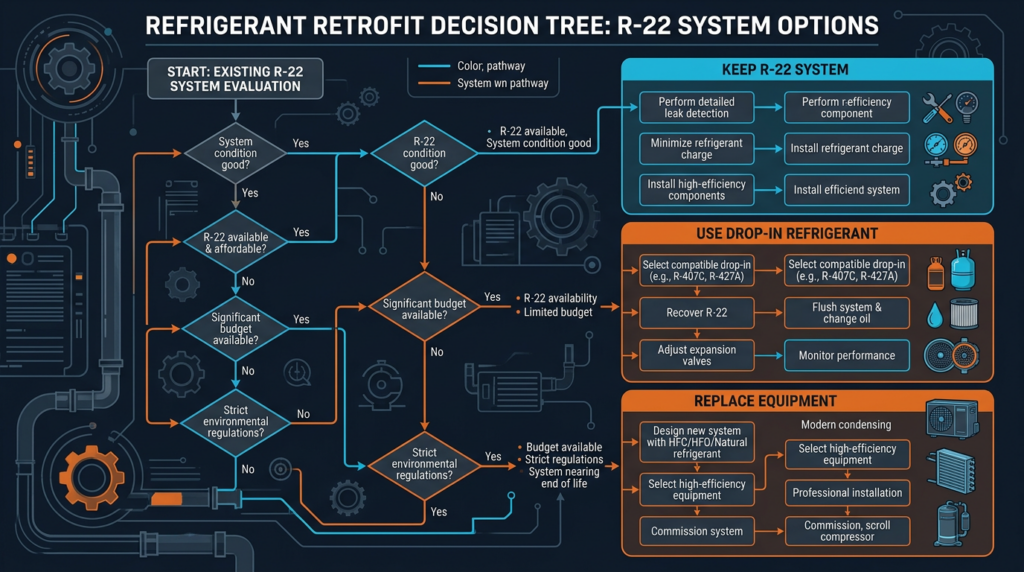
Why R-22 Retrofit Matters
R-22 (ASHRAE designation for chlorodifluoromethane, CHClF2) served as the dominant refrigerant in residential and commercial air conditioning for decades. With an ozone depletion potential (ODP) of 0.055 and a global warming potential (GWP) of 1,810 (IPCC AR4), its environmental impact led to a complete ban on production and import in the United States effective January 1, 2020. Existing R-22 equipment can still be serviced with recycled or reclaimed refrigerant, but supplies are finite and prices have risen sharply. Technicians and building owners now face a critical decision: retrofit the existing system with an alternative refrigerant, or replace the equipment entirely. Making the right choice requires a clear understanding of drop-in replacements, required system changes, performance trade-offs, and the evolving regulatory landscape.
R-22 Properties and Baseline Performance
Understanding R-22’s characteristics is essential for evaluating any alternative. R-22 is classified A1 under ASHRAE Standard 34, meaning it is non-toxic and non-flammable. It operates at moderate pressures: roughly 68 psig on the low (evaporator) side and 260 psig on the high (condenser) side at standard air conditioning conditions (45°F evaporator, 120°F condenser). R-22 systems traditionally use mineral oil (MO) or alkylbenzene (AB) oil as the compressor lubricant. These oil types are incompatible with many newer refrigerants, a fact that drives much of the complexity in retrofit projects.
Reasons to Retrofit
- Cost and availability: Reclaimed R-22 can exceed $50 per pound in some markets, and supply will only decrease over time.
- Environmental compliance: The EPA’s phase-out under the Clean Air Act eliminated virgin R-22 production. Continued use of existing stock remains legal, but future servicing is uncertain.
- Regulatory pressure: The AIM Act (American Innovation and Manufacturing Act of 2020) authorizes a phased 85% reduction in HFC production and consumption over 15 years. Many R-22 alternatives are themselves HFCs subject to this phase-down, making the transition a moving target.
- Energy efficiency: Older R-22 systems often operate at SEER ratings of 10 or lower. Modern equipment using R-410A, R-454B, or R-32 routinely achieves SEER2 ratings above 15, offering substantial utility savings.
Types of Retrofit Options
Drop-In Replacements
A drop-in replacement is a refrigerant designed to work in an existing R-22 system with minimal modifications. The term is somewhat misleading. No retrofit refrigerant requires zero changes. At minimum, the filter drier must be replaced and the system must be properly evacuated and recharged. Many so-called drop-ins also require metering device adjustments and careful evaluation of oil compatibility. The term “near drop-in” is more accurate for most alternatives.
System Conversions
A system conversion involves more extensive modifications such as compressor replacement, metering device changes, oil changes, and potentially new pressure relief valves. Converting an R-22 system to R-410A is the most common example. R-410A operates at pressures roughly 50% higher than R-22 (around 400 psig on the high side), which typically demands a new compressor, new metering devices, and verification that all existing components are rated for the higher pressures.
Full Equipment Replacement
Replacing the entire HVAC system with new equipment using a modern refrigerant is often the most practical long-term solution, especially for equipment that is more than 15 years old or in poor condition. New systems using R-454B (a low-GWP A2L refrigerant with a GWP of 466) or R-32 (GWP of 675) are increasingly available and offer significantly better efficiency and a more favorable regulatory outlook.
Common Drop-In and Near Drop-In Alternatives
The following refrigerants are the most widely used R-22 replacements. Performance data is drawn from manufacturer literature by Chemours, Honeywell, and Arkema, as well as AHRI test procedures.
R-407C
- Composition: R-32 (23%), R-125 (25%), R-134a (52%)
- GWP: 1,774 (AR4) / 1,624 (AR5)
- Safety classification: A1
- ODP: 0
- Oil requirement: Polyolester (POE) oil. Mineral oil must be removed.
- Capacity vs. R-22: Approximately 5% to 10% lower cooling capacity
- Operating pressures: Similar to R-22 on the high side; slightly lower on the low side
- Temperature glide: Approximately 7°F to 9°F. This is a zeotropic blend, and the significant glide affects evaporator and condenser performance. Charging must be done as a liquid to maintain composition accuracy.
- Notes: Requires TXV adjustment or replacement. Oil change to POE is mandatory, including a thorough flush of existing mineral oil.
R-422D
- Composition: R-125 (65.1%), R-134a (31.5%), R-600a (3.4%)
- GWP: 2,729 (AR4)
- Safety classification: A1
- ODP: 0
- Oil requirement: Compatible with existing mineral oil and AB oil in many applications.
- Capacity vs. R-22: Typically 5% to 15% lower cooling capacity
- Notes: Higher GWP than R-22 makes this a poor long-term choice given the AIM Act phase-down. The mineral oil compatibility is its primary advantage, reducing retrofit labor.
R-438A (MO99)
- Composition: R-32 (8.5%), R-125 (45%), R-134a (44.2%), R-600 (1.7%), R-601a (0.6%)
- GWP: 2,265 (AR4)
- Safety classification: A1
- ODP: 0
- Oil requirement: Compatible with mineral oil, AB, and POE oil.
- Capacity vs. R-22: Approximately 5% to 10% lower
- Operating pressures: Close to R-22, making it one of the more straightforward retrofits
- Notes: Widely used due to broad oil compatibility. Still requires filter drier replacement and typically TXV adjustment. High GWP remains a concern.
R-427A
- Composition: R-32 (15%), R-125 (25%), R-143a (10%), R-134a (50%)
- GWP: 2,138 (AR4)
- Safety classification: A1
- ODP: 0
- Oil requirement: POE oil required.
- Capacity vs. R-22: Approximately 5% to 10% lower
- Notes: Good pressure match with R-22. Oil change to POE is mandatory.
R-453A (RS-70)
- Composition: R-32 (20%), R-125 (20%), R-134a (53.8%), R-227ea (5%), R-600 (0.6%), R-601a (0.6%)
- GWP: 1,765 (AR4)
- Safety classification: A1
- ODP: 0
- Oil requirement: Compatible with mineral oil, AB, and POE oil.
- Capacity vs. R-22: Claimed to be within 5% by the manufacturer
- Notes: One of the closest performance matches to R-22 among available alternatives. Oil compatibility reduces retrofit complexity. GWP is roughly equivalent to R-22’s GWP.
R-458A
- Composition: R-32 (30.4%), R-125 (21%), R-134a (6.8%), R-1234ze(E) (41.2%), R-227ea (0.6%)
- GWP: 1,650 (AR4)
- Safety classification: A1
- ODP: 0
- Oil requirement: POE oil required.
- Notes: Contains HFO component (R-1234ze(E)), resulting in one of the lowest GWPs among current R-22 drop-in alternatives. Relatively new to market.
Required System Changes
Filter Drier Replacement
Filter drier replacement is mandatory for every R-22 retrofit, regardless of the replacement refrigerant. Use driers with XH-9 or XH-11 desiccant cores, which are compatible with HFC refrigerants and POE oils. Standard XH-7 driers designed for CFC/HCFC systems may not adequately remove acids in an HFC system.
Oil Changes and Flushing
Oil compatibility is one of the most critical factors in a successful retrofit. Refrigerants like R-407C and R-427A require POE oil. The existing mineral oil must be removed to the greatest extent possible. A residual mineral oil concentration above 5% can cause lubrication failure, oil logging in the evaporator, and reduced heat transfer. The recommended flushing procedure involves multiple oil changes: drain the mineral oil, charge with POE oil and run the system briefly, then drain and recharge with fresh POE oil. Some technicians perform three flushes to reduce residual mineral oil below 1%.
Refrigerants compatible with mineral oil (R-438A, R-422D, R-453A) simplify the process significantly but do not eliminate the need to verify oil charge level and condition.
Metering Device Adjustments
Systems using a thermostatic expansion valve (TXV) may require a new valve or at minimum a superheat adjustment to match the pressure-temperature characteristics of the new refrigerant. Systems with fixed-orifice metering devices often need a different orifice size. Consult the refrigerant manufacturer’s retrofit guide for specific orifice sizing charts. Incorrect metering leads to poor superheat and subcooling control, reduced capacity, and potential compressor damage.
Pressure Relief Valves
For any refrigerant with higher operating pressures than R-22, verify that existing pressure relief valves (PRVs) are rated appropriately. This is especially critical for R-410A conversions, where high-side pressures can exceed 400 psig. ASHRAE Standard 15 governs pressure relief requirements for refrigeration systems.
Compressor Considerations
Most true drop-in replacements work with the existing compressor, provided it is in good condition. However, R-410A conversions almost always require a new compressor designed for higher-pressure operation. Running an R-22 compressor with R-410A risks catastrophic failure due to excessive discharge pressures and temperatures. Even with compatible refrigerants, a compressor showing signs of wear (high amp draw, excessive noise, oil contamination) should be replaced during the retrofit.
Refrigerant Line Cleaning
Flush refrigerant lines to remove old oil residue, contaminants, and moisture before introducing the new refrigerant and oil. Use an approved flushing solvent and follow the manufacturer’s procedure. Residual contaminants react with POE oil to form acids that damage compressor bearings and valve plates.
Understanding Temperature Glide
Temperature glide is the difference between the dew point and bubble point of a zeotropic refrigerant blend at a given pressure. R-22 is a pure compound with zero glide. Many replacement blends are zeotropic and exhibit significant glide. R-407C, for example, has a glide of approximately 7°F to 9°F. This means the refrigerant evaporates and condenses over a range of temperatures rather than at a single saturation temperature. Glide affects superheat and subcooling measurements, heat exchanger performance, and system capacity. Technicians must use the midpoint temperature (or the dew/bubble point as specified by the manufacturer) when reading pressure-temperature charts for these blends. Zeotropic blends must always be charged as a liquid from the cylinder to prevent fractionation.
Regulatory Framework and Future Outlook
Federal Regulations
The EPA’s SNAP program (Significant New Alternatives Policy) lists acceptable and unacceptable substitutes for R-22 across various end-uses. Technicians should verify that any chosen replacement is SNAP-approved for the specific application. The AIM Act of 2020 phases down HFC production by 85% through a stepped schedule ending in 2036. This phase-down directly affects the long-term availability and cost of high-GWP alternatives like R-422D (GWP 2,729) and R-438A (GWP 2,265). Choosing a lower-GWP replacement today provides better insulation against future supply constraints and price increases.
State Regulations
California and several other states have adopted more aggressive timelines for restricting high-GWP HFCs. California’s regulations under CARB (California Air Resources Board) prohibit certain HFCs in new equipment and may restrict servicing with high-GWP refrigerants sooner than federal law requires. Technicians operating in these states must verify local compliance requirements before selecting a retrofit refrigerant.
SEER2 Standards and the Case for Replacement
The Department of Energy’s transition to SEER2 testing standards (effective January 1, 2023) raised the minimum efficiency bar for new equipment. While SEER2 does not directly govern retrofit procedures, it highlights the growing efficiency gap between older R-22 systems (often SEER 10 or below) and new equipment (minimum SEER2 of 13.4 in the northern U.S. and 14.3 in the southern U.S.). This gap affects the economic calculation of retrofit versus replacement.
Incentives for Replacement
The Inflation Reduction Act (IRA) of 2022 provides tax credits of up to $2,000 for qualifying high-efficiency heat pumps and up to $600 for qualifying central air conditioners. Additional rebates may be available through state-level programs under the Home Efficiency Rebates and Home Electrification and Appliance Rebates provisions. These incentives can significantly offset the cost of full system replacement, tilting the economics away from retrofit in many cases.
Step-by-Step Retrofit Procedure
- Preliminary assessment: Evaluate system condition, check for leaks, verify the existing refrigerant charge, and assess compressor health. Document baseline performance (superheat, subcooling, amp draw, airflow).
- Select replacement refrigerant: Based on system design, oil compatibility, metering device type, operating pressure match, and regulatory requirements.
- Recover existing R-22: Use EPA-certified recovery equipment. Do not vent refrigerant. Recovered R-22 may be sent for reclamation.
- Replace filter drier: Install an XH-9 or XH-11 type drier sized for the system.
- Change oil if required: Drain mineral oil, flush system, and charge with the correct POE oil. Perform multiple flushes if needed to reduce residual MO below 5% (below 1% preferred).
- Adjust or replace metering device: Install correct TXV or orifice per the refrigerant manufacturer’s guidelines.
- Flush refrigerant lines: Remove contaminants and residual oil using approved flushing solvents.
- Evacuate system: Pull vacuum to at least 500 microns (preferably below 300 microns) and hold for a minimum of 30 minutes to verify system integrity and remove moisture.
- Charge with new refrigerant: Charge as liquid for zeotropic blends. Weigh in the correct charge amount per manufacturer specifications. Verify superheat and subcooling after the system stabilizes.
- Test and commission: Perform a thorough leak test using electronic leak detectors or nitrogen pressure testing. Measure and document superheat, subcooling, discharge pressure, suction pressure, amp draw, and supply air temperature. Label the system with the new refrigerant type per EPA requirements.
Practical Decision-Making Scenarios
Scenario 1: Residential Split System, 12 Years Old
A 3-ton residential split system in good condition with no leaks and a functioning scroll compressor is a reasonable candidate for retrofit. R-438A or R-453A would offer the simplest conversion due to mineral oil compatibility. Expected cost: $800 to $1,500 including refrigerant, filter drier, labor, and minor adjustments. Compare this to full replacement with an R-454B system at $6,000 to $10,000 installed, minus potential IRA tax credits of up to $2,000. If the homeowner plans to stay in the home for more than five years, replacement often wins on lifecycle cost and efficiency gains.
Scenario 2: Commercial Rooftop Unit, 20 Years Old
A 15-ton commercial rooftop unit with a reciprocating compressor showing elevated amp draw and a history of refrigerant leaks is a poor candidate for retrofit. The cost of retrofit refrigerant, oil change, compressor repair, and leak repair could easily reach $5,000 to $8,000 with no guarantee of long-term reliability. Replacement with a high-efficiency unit using a modern refrigerant provides better energy savings, lower maintenance costs, and regulatory security. Downtime for replacement is typically comparable to a major retrofit.
Common Misconceptions
- “Drop-in” means no changes are needed. Every retrofit requires at minimum a filter drier change, proper evacuation, and careful recharging. Most require additional modifications.
- Any R-22 substitute performs identically. Capacity typically varies by 5% to 15%, and efficiency changes are common. Operating pressures differ. System performance must be verified after every retrofit.
- Oil changes are optional with compatible refrigerants. Even mineral-oil-compatible blends require verification of oil charge level and condition. For refrigerants requiring POE, skipping the oil change will cause compressor failure.
- Recycled R-22 is a permanent solution. The supply of reclaimed R-22 is finite. Prices will continue to rise as equipment ages out and supply diminishes.
- Retrofitting is always cheaper than replacing. For systems older than 15 years or in poor condition, the combined cost of retrofit plus future repairs often exceeds the cost of new equipment, especially when factoring in efficiency gains and available incentives.
Key Takeaways
- R-22 production ended in 2020. Servicing costs will only increase as reclaimed supplies shrink.
- No retrofit refrigerant is a true “drop-in.” All require filter drier replacement, proper evacuation, and system verification. Many require oil changes, metering device adjustments, or both.
- Choose a replacement refrigerant based on oil compatibility, pressure-temperature match, GWP, capacity retention, and SNAP approval for the specific end-use.
- R-453A and R-458A offer the best combination of R-22 performance match and lower GWP among currently available A1 alternatives.
- The AIM Act phase-down of HFCs means high-GWP alternatives like R-422D may themselves become scarce and expensive within the next decade.
- For systems older than 15 years or in marginal condition, full equipment replacement with a modern low-GWP refrigerant is often the better economic and environmental choice.
- Follow AHRI Guideline K procedures for all retrofit work. Document the refrigerant type on the equipment nameplate. Comply with EPA Section 608 requirements for refrigerant recovery and record-keeping.
- Always perform a comprehensive leak test after retrofit. High-GWP replacement refrigerants amplify the environmental impact of even small leaks.