What Is an Evaporative Cooler?
An evaporative cooler, commonly called a swamp cooler, is a cooling device that lowers air temperature by harnessing the natural process of water evaporation. When water changes from liquid to vapor, it absorbs heat energy from the surrounding air. This principle, rooted in the latent heat of vaporization, allows evaporative coolers to deliver meaningful temperature drops of 15 to 30 degrees Fahrenheit under ideal conditions while consuming a fraction of the electricity required by conventional vapor-compression air conditioning. Evaporative coolers are most effective in hot, arid climates where relative humidity stays below 30 to 40 percent. They remain a popular and cost-effective cooling solution across the American Southwest, parts of the Mountain West, and similar dry regions worldwide. Understanding how they work, where they work, and what they require is essential for homeowners and technicians making informed cooling decisions.
How Evaporative Cooling Works
Evaporative cooling exploits a simple thermodynamic fact: converting liquid water into water vapor requires energy. That energy comes from the heat in the surrounding air. As air passes over or through a wet surface, water molecules escape into the airstream, pulling thermal energy with them. The result is cooler, more humid air on the other side.
Two temperatures govern the process. The dry-bulb temperature is the standard ambient air temperature read by a thermometer. The wet-bulb temperature is the lowest temperature air can reach through evaporative cooling alone, measured by wrapping a wet wick around a thermometer bulb and allowing airflow across it. The gap between these two values is called the wet-bulb depression. A larger depression means more cooling potential. In Phoenix on a dry summer afternoon, the dry-bulb temperature might be 110°F while the wet-bulb sits at 66°F, yielding a wet-bulb depression of 44°F. In Houston, the dry-bulb might be 95°F with a wet-bulb of 80°F, leaving only a 15°F depression and far less cooling capability.
The science of measuring and predicting these relationships falls under psychrometrics, the study of thermodynamic properties of moist air. Psychrometric charts plot dry-bulb temperature, wet-bulb temperature, relative humidity, dew point, and enthalpy, giving engineers precise tools to predict evaporative cooler performance in any climate.
Types of Evaporative Coolers
Direct Evaporative Coolers
Direct evaporative coolers are the most common type. Outside air is drawn directly through a water-saturated cooling medium by a fan or blower. The air absorbs moisture, its temperature drops, and the now-cooler, more humid air is delivered into the living or working space. Direct units are simple, affordable, and effective in dry climates. Their main limitation is that they add moisture to the supply air, which can become uncomfortable if outdoor humidity is already moderate.
Indirect Evaporative Coolers
Indirect evaporative coolers use a heat exchanger to cool the primary airstream without adding moisture to it. A secondary airstream passes through the wet media and absorbs heat from the primary air through the exchanger walls. The secondary air, now warm and humid, is exhausted outdoors. The primary airstream enters the building cooler and at its original humidity level. Indirect systems are more complex and expensive, but they extend the useful range of evaporative cooling into slightly more humid climates.
Two-Stage Evaporative Coolers
Two-stage evaporative coolers combine indirect and direct cooling in sequence. The first stage cools air indirectly without adding moisture. The second stage passes that pre-cooled air through a direct evaporative section for additional temperature reduction. Because the air entering the direct stage is already cooler, the two-stage approach can achieve supply air temperatures 5 to 7 degrees lower than a direct-only unit. Two-stage systems work in a wider range of climates and deliver air that feels less humid than single-stage direct units.
Portable Evaporative Coolers
Portable evaporative coolers are smaller, self-contained units designed for individual rooms or spot cooling. They typically range from $100 to $500 and include a built-in water reservoir, pump, pad, and fan. They require no permanent installation. While convenient, portable units lack the airflow capacity for whole-house cooling and still require adequate ventilation to exhaust humid air.
Key Components
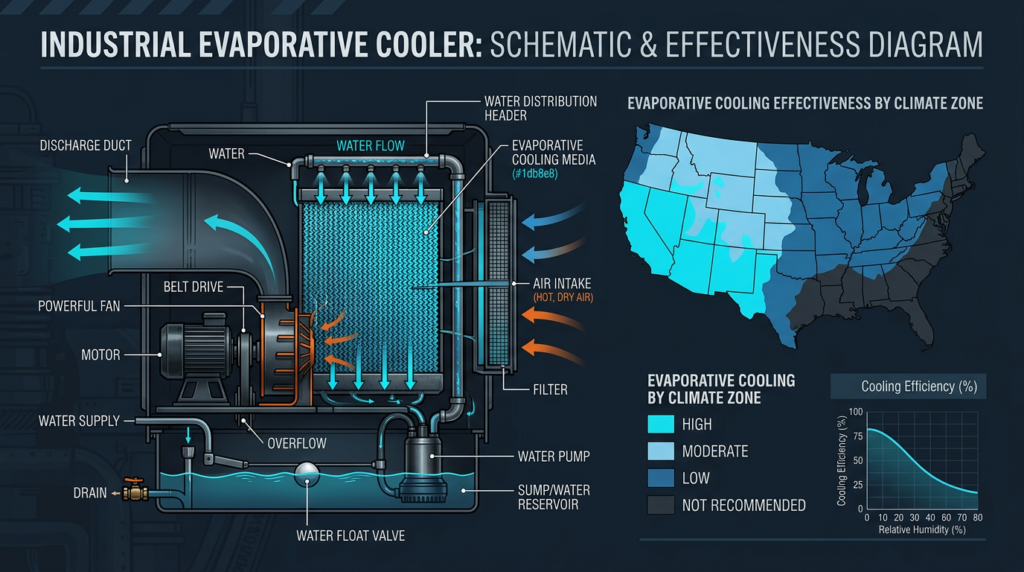
Every evaporative cooler, regardless of size, relies on the same core components working together:
- Water Reservoir: A tank or sump that holds the water supply. Size varies from a few gallons in portable units to 15 gallons or more in whole-house systems.
- Water Pump: A small submersible pump circulates water from the reservoir to distribution troughs at the top of the cooling pads, keeping them consistently saturated.
- Cooling Medium (Pads or Media): The surface where evaporation occurs. Common materials include cellulose paper, aspen wood shavings (excelsior), and synthetic fiber. Cellulose pads offer higher saturation efficiency (up to 90%) and longer life. Aspen pads are cheaper but less efficient (50 to 70%) and require more frequent replacement.
- Fan or Blower: Moves air through the wet media and into the building. Centrifugal blowers are used in ducted whole-house systems, while axial fans are common in window and portable units.
- Float Valve and Water Level Control: Maintains proper water level in the reservoir, similar to a toilet float valve. It opens to admit fresh water as the level drops from evaporation and bleed-off.
- Distribution System: In whole-house installations, ductwork and ceiling or wall grilles deliver cooled air throughout the building. Roof-mounted and side-mounted units connect to a short duct run or a central plenum.
Performance Metrics
Several measurements define how well an evaporative cooler performs:
- Airflow (CFM): Cubic feet per minute of air moved through the system. Whole-house units typically deliver 5,000 to 8,000 CFM. Proper sizing requires calculating the volume of the space and targeting 20 to 40 air changes per hour.
- Saturation Efficiency: The ratio of actual temperature drop to the maximum possible temperature drop. It is calculated as: (Dry Bulb Temp minus Outlet Temp) divided by (Dry Bulb Temp minus Wet Bulb Temp). High-quality cellulose media achieves 85 to 90% saturation efficiency. Aspen pads typically reach 50 to 70%.
- Cooling Capacity (BTU/hr): The amount of heat removed from the air. This varies widely based on climate conditions and unit size.
- Water Consumption: Whole-house units typically consume 5 to 15 gallons per hour, depending on climate severity and cooler efficiency. Water consumption is a meaningful operating cost and an environmental consideration in drought-prone regions.
- Electrical Consumption: Motors range from 1/2 HP to 1 HP for whole-house units. Total electrical draw is a fraction of what a comparable vapor-compression air conditioner requires, often 75% less.
Where Evaporative Coolers Work Best
Climate is the single most important factor in evaporative cooler performance. These systems excel in regions with hot, dry summers where afternoon relative humidity regularly stays below 30%. The American Southwest, including Arizona, New Mexico, Nevada, Utah, and parts of Colorado and West Texas, represents the ideal operating environment. In these areas, a well-maintained direct evaporative cooler can lower air temperature by 20 to 30°F.
Performance declines as humidity rises. At 50% relative humidity, a direct cooler may only achieve a 10 to 15°F temperature drop. Above 60% relative humidity, the cooling effect becomes marginal, and the added moisture can make indoor conditions feel worse. Coastal areas, the Southeast, and the upper Midwest during summer are generally poor candidates for direct evaporative cooling.
Indirect and two-stage systems push the useful boundary somewhat further. A two-stage cooler can still deliver adequate comfort in areas where humidity occasionally reaches 40 to 50%, but it cannot match the performance of refrigerated air conditioning in consistently humid environments.
Installation Considerations
Evaporative coolers are available in several mounting configurations. Roof-mounted units (downdraft) sit on the roof and deliver air downward through a ceiling plenum. Side-mounted units attach to an exterior wall. Window-mounted units fit into a window opening, similar to a window air conditioner. Each configuration requires:
- Water supply connection: A dedicated water line from a potable source with adequate pressure, typically 20 to 80 psi.
- Electrical connection: A properly sized circuit matching the unit’s voltage, amperage, and wattage requirements. Most residential units run on 120V or 240V single-phase power.
- Drainage: An overflow drain and bleed-off line to prevent mineral concentration in the reservoir. Bleed-off systems continuously drain a small amount of water to reduce scale buildup.
- Exhaust path: This is critical and often overlooked. Evaporative coolers push large volumes of air into a building. That air must have an exit path, typically through open windows or dedicated exhaust vents on the opposite side of the house. Without adequate exhaust, the system builds back-pressure, airflow drops, humidity climbs, and cooling suffers. A general guideline is 1 to 2 square feet of open exhaust area per 1,000 CFM of airflow.
Local plumbing and electrical codes govern installation requirements. Always verify compliance before beginning work.
Maintenance and Seasonal Care
Evaporative coolers demand regular maintenance to perform well and avoid health hazards. Standing water and damp pads can harbor mold, bacteria, and mineral deposits if neglected.
Routine Maintenance
- Pad inspection and replacement: Inspect pads monthly during the cooling season. Cellulose pads typically last 3 to 5 years with proper water treatment. Aspen pads should be replaced every season or sooner if they become clogged with mineral deposits.
- Water treatment: Use a bleed-off valve or water treatment tablets to slow mineral scaling. In areas with hard water, a water softener on the supply line can extend pad life and improve efficiency.
- Reservoir cleaning: Drain and clean the water reservoir at least once per month to remove sediment and algae.
- Pump inspection: Check the water pump for proper operation. Clear any debris from the pump intake screen.
- Belt and motor check: On belt-driven units, inspect the belt for tension and wear. Lubricate motor bearings if the manufacturer specifies it.
Winterization
In climates with freezing winters, proper winterization prevents costly damage:
- Disconnect the water supply line and drain it completely.
- Drain the reservoir and pump housing.
- Remove and clean or replace the cooling pads.
- Cover the exterior unit with a breathable, weatherproof cover to prevent moisture accumulation.
- Close any interior dampers to prevent cold air from entering the building through the ductwork.
Evaporative Coolers vs. Air Conditioning
Evaporative coolers and vapor-compression air conditioners serve the same goal but differ in almost every other respect:
- Energy use: Evaporative coolers consume roughly 25% of the electricity of a comparably sized air conditioner. A whole-house swamp cooler might draw 500 to 1,000 watts, while a central AC system draws 3,000 to 5,000 watts.
- Refrigerants: Evaporative coolers use no refrigerants. Air conditioners rely on refrigerants (R-410A, R-32, R-454B) that carry environmental and regulatory implications.
- Humidity control: Air conditioners remove moisture from indoor air. Evaporative coolers add moisture. In dry climates, the added humidity can be a comfort benefit. In humid climates, it is a serious drawback.
- Fresh air: Evaporative coolers continuously supply 100% outdoor air, providing excellent ventilation. Air conditioners recirculate indoor air in a closed system.
- Water use: Evaporative coolers consume 5 to 15 gallons per hour of water. Air conditioners use no water (though cooling towers in large commercial systems do).
- Installation cost: Whole-house evaporative coolers typically cost $2,000 to $5,000 installed. Central air conditioning systems generally cost $4,000 to $12,000 or more.
- Temperature control: Air conditioners can maintain a precise setpoint regardless of outdoor conditions. Evaporative coolers deliver a temperature reduction relative to outdoor conditions, meaning indoor temperature rises on hotter days.
Hybrid Systems and Pre-Cooling
Some installations combine evaporative cooling with conventional air conditioning in a hybrid system. The evaporative cooler handles the load during dry periods, and the air conditioner takes over when humidity rises or when temperatures exceed the swamp cooler’s capability. This approach can reduce annual cooling energy costs by 50% or more in transitional climates.
Another strategy is evaporative pre-cooling, where evaporatively cooled air is used to lower the temperature of the condenser coil intake on an air conditioning unit. By reducing the air temperature entering the condenser, the refrigeration cycle operates more efficiently, lowering energy consumption by 10 to 20% without adding any moisture to the indoor air.
Standards, Regulations, and Incentives
Unlike vapor-compression air conditioners, evaporative coolers have no federal efficiency standards comparable to SEER2. The AHRI (Air-Conditioning, Heating, and Refrigeration Institute) does not maintain a dedicated certification program for evaporative coolers, though some manufacturers voluntarily test and publish performance data.
ASHRAE provides design guidance for evaporative cooling systems in the ASHRAE Handbook, HVAC Systems and Equipment volume. ASHRAE Standard 90.1, which sets energy performance requirements for commercial buildings, can indirectly encourage evaporative cooling as a strategy for meeting whole-building energy targets.
The Inflation Reduction Act (IRA) does not include direct tax credits or rebates specifically for evaporative coolers. The IRA’s incentive structure focuses on heat pumps, high-efficiency furnaces, and building envelope improvements. However, some state and local utility programs in the Southwest offer rebates for evaporative cooler purchases or upgrades. Consumers should check with their local utility and state energy office for available programs.
Water restrictions are an increasingly important regulatory factor. Many municipalities in drought-affected areas have implemented tiered water pricing, outdoor use restrictions, and conservation mandates. While evaporative coolers are typically classified as indoor use, their water consumption can push households into higher pricing tiers. The EPA’s WaterSense program promotes conservation practices that may influence future regulation of evaporative cooler water use.
Common Misconceptions
- “Swamp coolers work everywhere.” They do not. Performance depends directly on the wet-bulb depression, which is small in humid climates. A swamp cooler in Atlanta or Miami will produce warm, damp air.
- “They are maintenance-free.” Neglected coolers develop mineral scaling, mold growth, and reduced airflow. Annual pad replacement or cleaning, monthly reservoir cleaning, and seasonal winterization are all required.
- “You keep the house sealed up like with AC.” The opposite is true. Evaporative coolers require open windows or exhaust vents to allow the continuous flow of air through and out of the building. A sealed house will see rapidly rising humidity and poor cooling.
- “They cool just as well as air conditioning.” Under ideal dry conditions, a well-sized evaporative cooler can keep a home comfortable. But it cannot achieve the same precise, low temperatures as a refrigerated system, especially as outdoor temperatures and humidity climb.
Practical Applications
Residential Use
Evaporative coolers are a strong choice for homeowners in arid regions seeking lower energy bills and fresh air ventilation. Whole-house rooftop units are the most common residential configuration in the Southwest. Window units offer a lower-cost entry point. Homeowners should verify that their local humidity conditions support effective operation for the majority of the cooling season.
Commercial and Industrial Use
Large warehouses, manufacturing facilities, and agricultural buildings benefit significantly from evaporative cooling. These spaces are often partially open, making sealed vapor-compression systems impractical. Evaporative coolers can move massive volumes of air at low cost. Agricultural operations, including greenhouses and poultry houses, rely on evaporative cooling to manage heat stress in livestock and protect crops.
Outdoor and Event Cooling
Portable and high-capacity evaporative coolers are used at outdoor events, construction sites, and athletic facilities to reduce ambient temperatures in open or semi-enclosed areas where air conditioning is not feasible.
Key Takeaways
- Evaporative coolers work by converting water to vapor, absorbing heat from the air in the process. Their effectiveness is governed by the difference between dry-bulb and wet-bulb temperatures.
- They are best suited to hot, dry climates with relative humidity consistently below 30 to 40%. Performance drops sharply as humidity rises.
- Direct, indirect, and two-stage configurations offer different balances of cost, complexity, and humidity control.
- Whole-house units typically deliver 5,000 to 8,000 CFM, consume 5 to 15 gallons of water per hour, and use 75% less electricity than comparable air conditioning systems.
- Open windows or exhaust vents are mandatory for proper operation. A sealed house will not cool effectively.
- Regular maintenance, including pad care, reservoir cleaning, water treatment, and winterization, is essential for performance, efficiency, and indoor air quality.
- No federal tax credits currently target evaporative coolers, but local utility rebates may be available. Water restrictions in drought-prone areas may affect long-term viability.
- Hybrid systems that pair evaporative pre-cooling with conventional air conditioning can reduce cooling energy costs by 10 to 20% or more while maintaining comfort across a wider range of conditions.