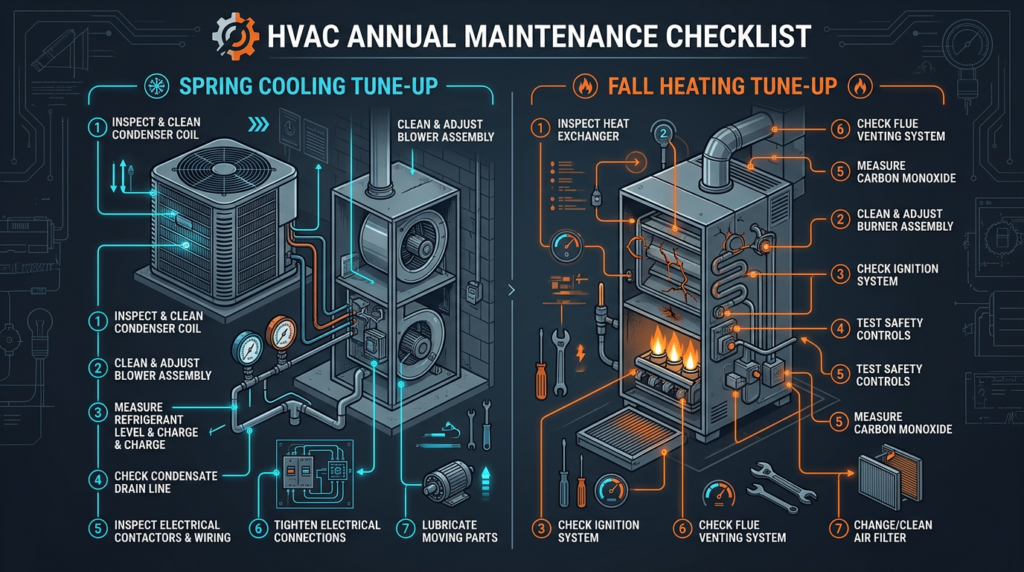
HVAC preventive maintenance is the systematic inspection, cleaning, and servicing of heating, ventilation, and air conditioning equipment to keep it running efficiently and prevent unexpected failures. A well-maintained system uses 15% to 25% less energy than a neglected one, lasts 15 to 20 years instead of 10 to 12, and delivers cleaner, more comfortable air year-round. Skipping routine maintenance is the single most common reason HVAC systems fail prematurely, and the cost of prevention is a fraction of the cost of emergency repair or early replacement.
Why Preventive Maintenance Matters
Every HVAC system degrades over time. Dust accumulates on coils, electrical connections loosen, moving parts wear, and refrigerant can slowly leak. Left unchecked, these small problems compound into major failures. Regular preventive maintenance delivers measurable benefits:
- Lower energy bills. A clean system with proper airflow and correct refrigerant charge operates at peak efficiency. The U.S. Department of Energy estimates that replacing a dirty filter alone can reduce energy consumption by 5% to 15%.
- Extended equipment lifespan. Properly maintained central air conditioners, furnaces, and heat pumps routinely last 15 to 20 years.
- Fewer breakdowns. Most emergency HVAC calls stem from issues that a routine inspection would have caught early.
- Better indoor air quality. Clean filters, clear drain lines, and sealed ductwork reduce dust, mold, and allergens circulating through a building.
- Warranty compliance. Most manufacturers require proof of annual professional maintenance to honor equipment warranties.
Safety First
Before touching any HVAC component, turn off all power to the system at the electrical disconnect and the circuit breaker panel. Gas furnaces also require shutting off the gas supply valve before performing any inspection near the burners or heat exchanger.
Never attempt to handle refrigerants without EPA Section 608 certification. Federal law under 40 CFR Part 82 prohibits venting refrigerants into the atmosphere, and improper handling can cause frostbite, chemical burns, or environmental harm. Wear safety glasses and work gloves for any cleaning task, and never bypass safety switches or controls.
How Often to Schedule Maintenance
The standard recommendation is straightforward:
- Central air conditioners: Once per year, ideally in spring before cooling season.
- Furnaces: Once per year, ideally in fall before heating season.
- Heat pumps: Twice per year (spring and fall), because heat pumps run in both heating and cooling modes and accumulate wear faster.
- Air filters: Check monthly. Replace every one to three months depending on filter type, household dust levels, pet ownership, and occupancy.
Homes in dusty environments, homes with pets, and buildings with high occupancy should lean toward the more frequent end of every maintenance interval.
The Complete Annual Checklist
This checklist covers the full scope of HVAC preventive maintenance. Tasks labeled “DIY” are safe for most homeowners. Tasks labeled “Professional” require a licensed HVAC technician.
Outdoor Unit: Condenser or Heat Pump
- Clear debris (DIY). Remove leaves, grass clippings, branches, and any objects within two feet of the unit. Trim vegetation to maintain at least 24 inches of clearance on all sides for proper airflow.
- Clean condenser coils (DIY with caution). Spray coils gently with a garden hose from the inside out to flush dirt. Use a fin comb to straighten bent aluminum fins. Avoid pressure washers, which crush fins and damage coils. A mild commercial coil cleaner can help with heavy buildup.
- Inspect fan blades (DIY). Look for cracks, chips, or visible damage. A damaged fan blade creates vibration that accelerates bearing wear.
- Check the base pan (DIY). Ensure the drain holes in the base pan are clear so water can drain freely.
- Inspect refrigerant lines (Professional). A technician checks line insulation, looks for oil stains that indicate leaks, and verifies proper refrigerant charge using manifold gauges. DIY leak detection is unreliable and potentially dangerous.
- Test electrical connections (Professional). A technician tightens connections, measures voltage and amperage on motors and compressors, and checks contactor condition.
Indoor Unit: Evaporator Coil and Blower
- Replace or clean the air filter (DIY). This is the single most important maintenance task. A clogged filter restricts airflow, forces the blower motor to work harder, reduces efficiency, and can cause the evaporator coil to freeze. Check the filter monthly. Replace disposable filters or wash reusable filters every one to three months. Choose a filter with the correct MERV rating for your system (see the air filtration section below).
- Clear the condensate drain line (DIY). Pour a cup of distilled white vinegar or a diluted bleach solution through the drain line to prevent algae and slime buildup. Use a wet/dry vacuum on the outdoor drain termination to clear stubborn clogs. Place condensate pan tablets in the drain pan to inhibit microbial growth between cleanings.
- Inspect the drain pan (DIY). Check for cracks, rust, or standing water. A cracked drain pan can cause significant water damage to ceilings and walls.
- Clean evaporator coils (Professional). Evaporator coils sit inside the air handler and typically require partial disassembly to access. A technician uses a no-rinse foaming coil cleaner and inspects for corrosion.
- Inspect and lubricate the blower motor (Professional). Older motors have oil ports that need a few drops of SAE 20 oil annually. Newer ECM (electronically commutated motor) blowers are sealed and require no lubrication, but a technician should still verify proper amperage draw and operation.
- Check electrical connections (Professional). Loose wires cause arcing, which generates heat and creates fire risk. A technician inspects all connections and tests capacitors and relays.
Furnace-Specific Tasks
- Inspect burners (Professional). A properly functioning gas burner produces a steady blue flame. Yellow or flickering flames indicate incomplete combustion, which can produce carbon monoxide.
- Inspect the heat exchanger (Professional). Cracks in the heat exchanger allow combustion gases, including carbon monoxide, to enter the living space. This is a critical safety inspection that requires specialized tools, including visual cameras and combustion analyzers.
- Check the flue pipe (DIY visual check). Look for disconnected joints, rust, corrosion, or obstructions. Ensure the flue pipe slopes upward toward the chimney or exterior vent to maintain proper draft.
- Test for gas leaks (Professional). A technician uses combustible gas detectors to check all gas connections and the gas valve.
- Inspect the ignition system (Professional). Modern furnaces use hot surface igniters or spark ignition. A technician checks igniter resistance and verifies reliable ignition and flame sensing.
Ductwork
The duct system distributes conditioned air throughout the building. According to Energy Star, typical homes lose 20% to 30% of conditioned air through duct leaks, holes, and poorly connected joints.
- Visual inspection (DIY). Check accessible ductwork in attics, basements, and crawl spaces for disconnected sections, visible holes, crushed flex duct, and deteriorating insulation.
- Seal leaks (DIY for accessible areas). Use duct mastic (a water-based sealant) or UL 181-rated foil tape to seal joints and small holes. Do not use standard cloth duct tape. Despite its name, duct tape degrades rapidly in HVAC applications and fails within months. SMACNA (Sheet Metal and Air Conditioning Contractors’ National Association) guidelines specify mastic or approved tapes for all duct sealing.
- Professional duct leakage testing. For suspected major leakage, a technician performs a duct blaster test to measure total duct leakage in cubic feet per minute (CFM) at 25 pascals of pressure. Acceptable leakage rates vary by code, but a common target is less than 4% of total system airflow.
Thermostat
- Verify settings (DIY). Confirm that heating and cooling setpoints are correct and that the system switches properly between modes.
- Replace batteries (DIY). Programmable and smart thermostats with battery backup should get fresh batteries annually. A dead battery can cause the system to stop responding.
- Calibrate if needed (DIY or Professional). Place an accurate thermometer near the thermostat. If readings differ by more than 1 to 2 degrees Fahrenheit, recalibrate or replace the thermostat.
- Upgrade consideration. A programmable or smart thermostat can save 8% to 10% on heating and cooling costs by automatically adjusting temperatures when occupants are asleep or away.
System Performance Checks
- Airflow (DIY). Walk through the building and check each supply register for adequate airflow. Weak airflow from one register may indicate a duct problem. Weak airflow everywhere points to a filter, blower, or coil issue.
- Temperature differential (DIY or Professional). In cooling mode, measure the air temperature at a supply register and at the return grille. The supply air should be 15 to 20 degrees Fahrenheit cooler than the return air. A smaller difference may indicate low refrigerant, a dirty coil, or restricted airflow.
- Listen for unusual noises (DIY). Grinding, squealing, banging, or clicking during operation can signal failing bearings, loose components, or ignition problems.
Air Filtration: Understanding MERV Ratings
The Minimum Efficiency Reporting Value (MERV) scale, defined by ASHRAE Standard 52.2, rates a filter’s ability to capture particles. Common residential ratings include:
- MERV 8: Captures dust, pollen, and mold spores. Suitable for most residential systems.
- MERV 11: Also captures pet dander, fine dust, and some smoke particles. Good for homes with pets or mild allergy concerns.
- MERV 13: Captures bacteria and some virus carriers. Recommended by ASHRAE for improved indoor air quality. Common in commercial buildings.
Higher MERV ratings trap smaller particles but also restrict airflow more. Installing a MERV 13 filter in a system designed for MERV 8 can starve the blower of air, reduce efficiency, and damage the compressor. Always verify that your system can handle the filter you choose. Check the equipment manual or consult a technician.
Refrigerant Considerations for 2024 and Beyond
R-22 was fully phased out of production and import on January 1, 2020. Systems still running on R-22 can only be serviced with reclaimed or recycled refrigerant, which is increasingly expensive and scarce. Retrofitting an R-22 system to an alternative refrigerant is sometimes possible, but replacement is often more cost-effective.
R-410A has been the dominant residential refrigerant since the mid-2000s but is now being phased down under the AIM Act due to its high global warming potential (GWP of 2,088). Starting in 2025, new residential and commercial air conditioning equipment is transitioning to lower-GWP alternatives. R-454B, with a GWP of 466, is the leading replacement for R-410A in new equipment. R-454B is classified as an A2L (mildly flammable) refrigerant, which means new safety standards apply to equipment design and installation.
Existing R-410A systems can continue to be serviced with R-410A. The refrigerant itself is not banned for use in existing equipment, only in new equipment manufacturing.
Current Efficiency Standards
As of January 1, 2023, new residential HVAC equipment must meet updated efficiency minimums tested under the SEER2, EER2, and HSPF2 protocols. These updated metrics use a higher external static pressure during testing (0.5 inches of water column instead of 0.1 to 0.3), producing ratings that more closely reflect real-world installed performance.
- SEER2 (Seasonal Energy Efficiency Ratio 2): Minimum 13.4 nationally; 14.3 in the Southwest region.
- HSPF2 (Heating Seasonal Performance Factor 2): Minimum 7.5 for heat pumps.
- EER2 (Energy Efficiency Ratio 2): New EER2 requirements apply to equipment manufactured on or after January 1, 2025.
These standards do not make older systems illegal to operate. They apply only to new equipment installations. Equipment performance is certified through AHRI (Air-Conditioning, Heating, and Refrigeration Institute) under standards such as AHRI 210/240 for unitary equipment. When selecting new equipment, look for the AHRI certification and Energy Star label, which identifies units exceeding minimum efficiency requirements.
The Inflation Reduction Act (IRA) provides federal tax credits of up to $2,000 for qualifying heat pumps and up to $600 for qualifying central air conditioners or furnaces. Additional state and utility rebates may also apply. Visit energystar.gov or the DSIRE database for current incentives in your area.
When to Call a Professional
Some situations require a licensed HVAC technician immediately:
- Refrigerant leaks or low charge (requires EPA 608 certification to handle)
- Cracked heat exchanger or carbon monoxide detector alarm
- Electrical failures, tripped breakers, or burning smells
- Compressor not starting or short-cycling
- No heating or cooling output despite the system running
- Unusual or persistent noises, vibrations, or odors
- Gas leaks (leave the building and call your gas company first, then an HVAC technician)
Choosing an HVAC Contractor
Not all technicians are equally qualified. Look for these credentials:
- State licensing and insurance. Verify that the contractor holds a current HVAC license for your state and carries liability insurance and workers’ compensation.
- NATE certification. The North American Technician Excellence program is the leading third-party certification for HVAC technicians.
- Experience with your equipment type. A technician experienced with your brand and system type will be more efficient and thorough.
- Written estimates and warranties. Get a written scope of work and pricing before service begins. Reputable companies guarantee their work.
- Reputation. Check online reviews and ask for references.
Cost Considerations
- DIY filter replacement: $5 to $50 per filter, depending on size and MERV rating.
- Professional annual tune-up: $100 to $300 per visit. Many contractors offer service agreements at a discount.
- Professional duct sealing: $500 to $2,000 depending on system size and leakage severity.
- Cost of neglect: Emergency repairs average $300 to $1,500. Premature system replacement costs $5,000 to $15,000 or more. Annual maintenance pays for itself many times over.
Common Misconceptions
- “I don’t need to change my filter that often.” A dirty filter is the number one cause of HVAC service calls. In homes with pets, a filter can clog in as little as 30 days.
- “If it’s not broken, don’t fix it.” HVAC systems degrade gradually. By the time something breaks, the accumulated inefficiency and secondary damage have already cost you far more than maintenance would have.
- “Duct tape works fine for duct sealing.” Standard cloth duct tape fails within weeks to months in HVAC applications. Only duct mastic or UL 181-rated foil tape should be used.
- “My new system doesn’t need maintenance.” New equipment benefits from maintenance just as much as old equipment. Skipping maintenance on a new system can void the manufacturer warranty.
- “Any handyman can handle HVAC work.” Refrigerant handling, gas work, and electrical diagnostics require specific licenses and certifications. Improper work creates safety hazards and code violations.
Key Takeaways
- Check and replace air filters every one to three months. This single task has the greatest impact on system performance and longevity.
- Schedule professional maintenance once per year for air conditioners and furnaces, twice per year for heat pumps.
- Clear the condensate drain line seasonally to prevent water damage and microbial growth.
- Seal duct leaks with mastic or foil tape to recover up to 30% of lost conditioned air.
- Never handle refrigerants without EPA Section 608 certification.
- Leave heat exchanger inspection, electrical diagnostics, gas leak testing, and refrigerant work to licensed professionals.
- Keep records of all maintenance performed. Documentation supports warranty claims and adds value when selling a home.
- Take advantage of IRA tax credits when upgrading to high-efficiency equipment rated under the current SEER2/HSPF2 standards.
Preventive maintenance is the most cost-effective investment you can make in your HVAC system. A few hours of attention each year protects thousands of dollars in equipment, keeps energy bills in check, and ensures reliable comfort through every season.