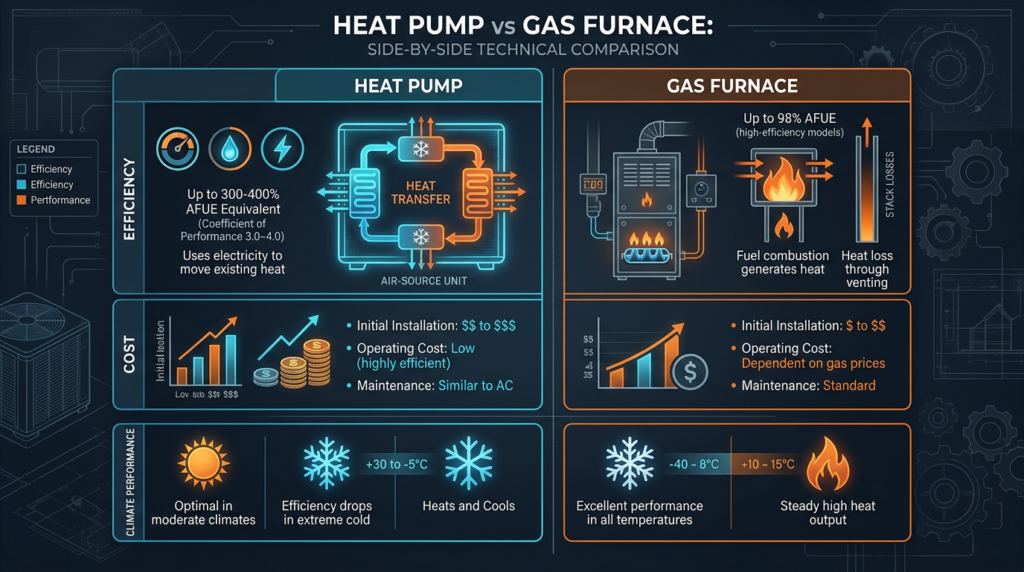
Choosing between a heat pump and a furnace is one of the most consequential decisions a homeowner can make. The right system affects monthly energy bills, long-term maintenance costs, indoor comfort, and environmental impact for 15 to 20 years. Heat pumps have surged in popularity since 2022, driven by federal incentives, improved cold-climate technology, and growing interest in electrification. Yet gas furnaces remain the dominant heating system in much of the United States, and for good reason in certain climates and cost scenarios. This comparison lays out the technical facts, real-world costs, and climate considerations so readers can make a well-informed choice.
How Heat Pumps Work
A heat pump does not generate heat. It moves heat from one place to another using a refrigeration cycle. In winter, it extracts thermal energy from outdoor air (or the ground) and transfers it indoors. In summer, it reverses the process and functions as an air conditioner. This principle of heat transfer rather than heat generation is what gives heat pumps their efficiency advantage.
Key Components
Every heat pump relies on five core components: a compressor that pressurizes refrigerant, a condenser coil that releases heat, an evaporator coil that absorbs heat, a reversing valve that switches the direction of refrigerant flow between heating and cooling modes, and the refrigerant itself, which serves as the heat-transfer medium.
Types of Heat Pumps
- Air-source heat pumps (ASHP): The most common type. These extract heat from outdoor air and are available as ducted split systems or packaged units. Modern inverter-driven ASHPs can operate efficiently at outdoor temperatures as low as -15°F.
- Ground-source (geothermal) heat pumps (GSHP): These extract heat from the earth via buried loop systems. Ground temperatures remain relatively stable year-round (45°F to 75°F depending on region), which gives GSHPs consistently high efficiency. Initial costs are substantially higher due to ground loop installation.
- Mini-split heat pumps: Ductless systems with one or more indoor heads connected to an outdoor unit. Ideal for homes without existing ductwork, room additions, or targeted zone heating and cooling.
Defrost Cycle
When outdoor temperatures drop near or below freezing, moisture in the air can form ice on the outdoor coil. Heat pumps handle this with a defrost cycle, temporarily reversing to cooling mode to melt the ice. During defrost, the system relies on auxiliary or backup heat to maintain indoor comfort. This cycle typically lasts a few minutes and occurs automatically.
How Furnaces Work
A furnace generates heat through combustion (or electric resistance) and distributes it through ductwork via a blower fan. The process is straightforward: fuel burns inside a burner, the resulting hot gases pass through a heat exchanger, a blower pushes household air over the heat exchanger to warm it, and combustion byproducts exit through a flue or vent to the outdoors.
Types of Furnaces
- Natural gas furnaces: The most common type in the U.S., connected to municipal gas lines.
- Propane furnaces: Used in areas without natural gas infrastructure. Propane is stored in on-site tanks.
- Oil furnaces: Common in the Northeast. Oil is delivered and stored in a tank, typically in a basement or outdoors.
- Electric furnaces: Use electric resistance heating elements. Simple and inexpensive to install but costly to operate, as they convert electricity to heat at a 1:1 ratio.
Safety Considerations
Any combustion-based furnace produces carbon monoxide (CO) as a byproduct. A cracked heat exchanger can leak CO into the living space. Every home with a gas, propane, or oil furnace should have CO detectors on every level. Annual professional inspections of the heat exchanger and flue are essential for safe operation.
Efficiency Metrics Explained
Heat Pump Efficiency: SEER2 and HSPF2
Since January 1, 2023, all new heat pumps must be rated under the updated SEER2 (Seasonal Energy Efficiency Ratio 2) and HSPF2 (Heating Seasonal Performance Factor 2) testing procedures mandated by the U.S. Department of Energy. These updated metrics use more realistic testing conditions, including higher external static pressure, which produces slightly lower numbers than legacy SEER and HSPF ratings.
- Current federal minimums (2024): SEER2 13.4 (Northern region) or 14.3 (Southeast and Southwest regions); HSPF2 7.5 nationwide.
- High-efficiency models: Inverter-driven (variable-speed) heat pumps routinely achieve SEER2 ratings of 18 to 22 and HSPF2 ratings of 10 to 13.
The COP (Coefficient of Performance) measures efficiency at a single operating point. A COP of 3.0 means the heat pump delivers 3 units of heat for every 1 unit of electricity consumed. At 47°F outdoor temperature, a quality ASHP may achieve a COP of 3.5 to 4.0. At 17°F, that same unit might drop to a COP of 2.0 to 2.5. At -5°F, cold-climate models can still maintain a COP of 1.5 to 2.0, still outperforming electric resistance heating.
Furnace Efficiency: AFUE
AFUE (Annual Fuel Utilization Efficiency) measures the percentage of fuel a furnace converts into usable heat over a season. An 80% AFUE furnace sends 80 cents of every fuel dollar into your home as heat and loses 20 cents up the flue.
- Non-condensing furnaces: Minimum AFUE of 80% (current DOE standard). These vent through metal flues and do not recover latent heat from exhaust gases.
- Condensing furnaces: Achieve 90% to 98.5% AFUE by extracting additional heat from exhaust gases, condensing the water vapor in the process. They vent through PVC pipe rather than metal flue.
- Energy Star threshold: 97% AFUE for gas furnaces (as of the most recent Energy Star specification update).
- Modulating furnaces: Adjust flame output in small increments (sometimes as low as 40% of capacity) for more consistent temperatures and higher seasonal efficiency.
All performance data should be verified through the AHRI (Air-Conditioning, Heating, and Refrigeration Institute) directory, which certifies equipment ratings based on standardized testing.
Climate Suitability
Where Heat Pumps Excel
Heat pumps perform best in climates with mild to moderate winters. In ASHRAE Climate Zones 1 through 4 (roughly the southern two-thirds of the United States), an air-source heat pump can serve as the sole heating and cooling system with high seasonal efficiency. In these regions, the COP stays above 2.5 for most of the heating season, making heat pumps substantially cheaper to run than furnaces.
A common misconception holds that heat pumps cannot work in cold climates. This was true of older single-speed units, but modern cold-climate heat pumps (ccASHP) with variable-speed inverter compressors and enhanced vapor injection (EVI) technology maintain rated heating capacity at 5°F and continue operating down to -15°F or lower. The Northeast Energy Efficiency Partnerships (NEEP) maintains a cold-climate heat pump product list with verified low-temperature performance data.
Where Furnaces Excel
In Climate Zones 5 through 7 with sustained sub-zero temperatures, furnaces deliver consistent heat output regardless of outdoor conditions. A 96% AFUE gas furnace produces the same Btu output whether it is 30°F or -20°F outside. In regions where natural gas is inexpensive (below $1.00 per therm) and electricity is expensive (above $0.15/kWh), a high-efficiency gas furnace can be the more economical choice.
Dual-Fuel Systems
A dual-fuel system pairs a heat pump with a gas furnace. The heat pump handles heating when outdoor temperatures are above a set balance point (often 25°F to 35°F), and the furnace takes over below that threshold. This approach captures the heat pump’s efficiency in moderate weather and the furnace’s reliability in extreme cold.
Cost Comparison
Initial Cost
- Air-source heat pump (3-ton, installed): $5,000 to $12,000 depending on efficiency level and regional labor costs.
- Ground-source heat pump (installed): $15,000 to $35,000, with ground loop installation accounting for a significant portion.
- Gas furnace, 80% AFUE (installed): $3,000 to $7,000.
- Gas furnace, 95%+ AFUE (installed): $4,000 to $9,000.
- Mini-split heat pump (single-zone, installed): $3,000 to $6,000. Multi-zone systems range from $6,000 to $15,000 or more.
Installation costs vary significantly based on whether existing ductwork can be reused, whether electrical service needs upgrading (heat pumps may require a 200-amp panel), and local permit requirements. Proper sizing per ACCA Manual J (load calculation), Manual S (equipment selection), and Manual D (duct design) is critical. Oversized systems lead to short cycling, poor humidity control, and premature wear.
Operational Cost
Annual heating costs depend on climate, fuel prices, home size, insulation quality, and system efficiency. The following estimates assume a 2,000-square-foot home with moderate insulation:
- Heat pump in a mild climate (Charlotte, NC): $600 to $900 per year for heating.
- Heat pump in a cold climate (Chicago, IL): $1,000 to $1,400 per year for heating, depending on the balance point and backup heat source.
- 95% AFUE gas furnace (Chicago, IL): $800 to $1,200 per year, assuming natural gas at $1.00 to $1.20 per therm.
- Electric resistance furnace (Chicago, IL): $1,800 to $2,400 per year at $0.14/kWh.
Electricity and natural gas prices vary widely by state. In the Pacific Northwest, where electricity is cheap ($0.08 to $0.10/kWh) and largely hydroelectric, heat pumps are overwhelmingly cost-effective. In New England, where electricity can exceed $0.25/kWh, the calculus shifts toward gas or dual-fuel systems.
Maintenance and Lifespan
- Heat pumps: Typical lifespan of 15 to 20 years. Annual maintenance includes filter changes, coil cleaning, refrigerant charge checks, and inspection of electrical connections. Because heat pumps run year-round (heating and cooling), they accumulate more operating hours than a furnace.
- Furnaces: Typical lifespan of 15 to 25 years. Annual maintenance includes burner cleaning, heat exchanger inspection, flue and venting checks, and filter replacement.
Incentives and Rebates
The Inflation Reduction Act (IRA), signed in 2022, provides significant financial incentives for heat pump adoption:
- Section 25C (Energy Efficient Home Improvement Credit): Up to $2,000 per year for qualified heat pumps meeting the highest efficiency tier (CEE Tier 1 or above). This is a 30% credit with a $2,000 annual cap for heat pumps specifically. An additional $150 credit is available for a home energy audit.
- Section 25D (Residential Clean Energy Credit): Covers 30% of geothermal heat pump installation costs with no annual dollar cap through 2032.
- State and utility rebates: Many states and utility companies offer additional rebates of $500 to $5,000 or more for heat pump installations. The DSIRE database (dsireusa.org) tracks available incentives by state.
Refrigerant Transition
Heat pumps rely on refrigerants, and the industry is in the midst of a major transition. R-410A, the dominant refrigerant in residential heat pumps since the early 2000s, has a Global Warming Potential (GWP) of 2,088. Under the AIM (American Innovation and Manufacturing) Act, the EPA is phasing down production and import of high-GWP HFCs. Starting January 1, 2025, new residential and light commercial air conditioning and heat pump equipment must use refrigerants with a GWP of 700 or less.
The leading replacement refrigerants are:
- R-454B (marketed as Opteon XL41): GWP of 466. Classified as A2L (mildly flammable). Currently adopted by several major manufacturers for ducted split systems.
- R-32: GWP of 675. Also A2L classified. Widely used internationally and favored for its thermodynamic efficiency and lower charge requirements.
Both refrigerants require updated safety standards, equipment design, and technician training. The EPA’s SNAP (Significant New Alternatives Policy) program maintains a list of acceptable refrigerant substitutes. Existing R-410A equipment can continue to be serviced with R-410A refrigerant; the ban applies to new equipment manufacturing.
Environmental Impact
The environmental comparison between heat pumps and furnaces depends heavily on the local electricity grid. A heat pump running on electricity generated by coal produces more CO2 per Btu of delivered heat than a 95% AFUE gas furnace. However, as the U.S. grid continues to decarbonize, heat pumps become progressively cleaner over their lifespan without any equipment changes.
On the natural gas side, methane leakage from extraction, distribution, and building-level piping adds significantly to the greenhouse gas impact of gas furnaces. Methane has roughly 80 times the warming potential of CO2 over a 20-year period. Studies suggest that total supply-chain methane leakage may be 2% to 3% of total gas production, which materially worsens the climate footprint of gas heating.
For most of the U.S. grid today, a heat pump with a seasonal COP above 2.0 produces fewer greenhouse gas emissions than a gas furnace, and the margin widens as renewable energy penetration increases.
Practical Scenarios
Scenario 1: New Construction in a Mild Climate
A homeowner building in Climate Zone 3 (e.g., Atlanta, GA) should strongly consider an inverter-driven heat pump rated at SEER2 17+ and HSPF2 9+. Pairing the heat pump with rooftop solar and a heat pump water heater can dramatically reduce total energy costs. In this climate, no backup fossil fuel heating is needed.
Scenario 2: Furnace Replacement in a Cold Climate
A homeowner in Minneapolis replacing a 20-year-old 80% AFUE gas furnace has several options. A cold-climate heat pump with a gas furnace backup (dual-fuel configuration) captures the best of both technologies. If the electrical panel is only 100 amps, upgrading to 200 amps may cost $1,500 to $4,000 but is often necessary for reliable heat pump operation. Federal tax credits can offset a significant portion of the heat pump cost.
Scenario 3: Older Home Without Ductwork
For a 1920s home with radiator heating and no duct system, a multi-zone mini-split heat pump avoids the expense and disruption of installing ductwork. A three-zone mini-split system can heat and cool the entire home while allowing independent temperature control in each zone.
Decision Checklist
Before committing to a system, evaluate the following:
- Climate zone: How many heating degree days does your location experience? How frequently do temperatures drop below 10°F?
- Fuel costs: Compare the local cost per kWh of electricity against the cost per therm of natural gas or per gallon of propane/oil.
- Existing infrastructure: Is ductwork present and in good condition? Is the electrical panel sufficient for a heat pump?
- Home envelope: Is the home well-insulated and air-sealed? A heat pump performs best in a tight, well-insulated structure.
- Budget: Can you absorb a higher upfront cost for lower operating costs, especially with available tax credits and rebates?
- Environmental priorities: Is reducing fossil fuel consumption a goal? What is your local grid’s energy mix?
- Cooling needs: If you also need air conditioning, a heat pump provides both functions in one system, potentially eliminating the need for a separate AC unit.
Key Takeaways
- Heat pumps move heat rather than generating it, delivering 2 to 4 times more energy than they consume in electricity. This fundamental advantage makes them the more efficient option in most climates.
- Modern cold-climate heat pumps operate reliably at -15°F and below, making the “heat pumps don’t work in cold weather” claim outdated for current equipment.
- High-efficiency condensing furnaces (95%+ AFUE) remain competitive in very cold regions where natural gas is inexpensive and electricity is costly.
- Dual-fuel systems offer the best of both worlds: heat pump efficiency in moderate weather and furnace reliability in extreme cold.
- Federal tax credits under the IRA (up to $2,000 for ASHPs, 30% uncapped for GSHPs) significantly reduce the upfront cost premium of heat pumps.
- The refrigerant transition from R-410A to lower-GWP alternatives (R-454B, R-32) is underway, with new equipment requirements effective January 2025.
- Proper system sizing using ACCA Manual J load calculations is essential regardless of system type. Oversizing causes short cycling, poor dehumidification, and wasted energy.
- Consult a qualified HVAC professional who can assess your specific home, climate, and energy costs before making a final decision.