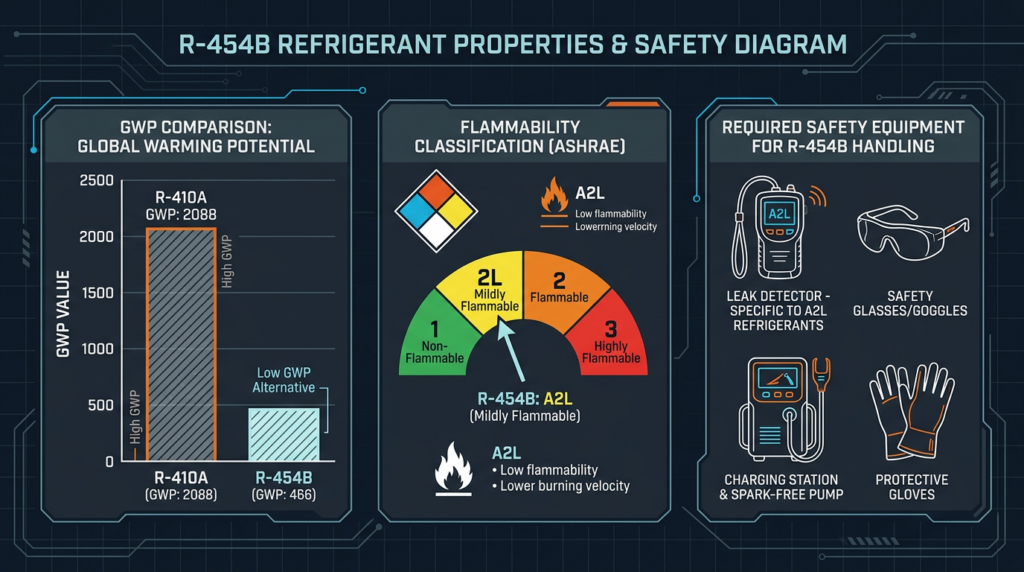
R-454B is a hydrofluoroolefin (HFO) blend refrigerant composed of 68.9% difluoromethane (R-32) and 31.1% 2,3,3,3-tetrafluoropropene (R-1234yf) by weight. Designated by ASHRAE as R-454B and classified under safety group A2L (lower toxicity, slightly flammable), it serves as the primary replacement for R-410A in residential and light commercial air conditioning and heat pump systems. With a global warming potential (GWP) of 466 under IPCC AR5 methodology, R-454B represents a roughly 76% reduction in GWP compared to R-410A’s 2,088. This dramatic reduction is the central reason the HVAC industry has converged on R-454B as the next-generation refrigerant for unitary equipment, driven by federal regulations under the AIM Act and global commitments under the Kigali Amendment to the Montreal Protocol.
Chemical Composition and Thermodynamic Properties
R-454B is a zeotropic blend, meaning its two components evaporate and condense at slightly different temperatures. This results in a temperature glide of approximately 1.5°F (0.8°C), which is small enough that it behaves similarly to a near-azeotropic mixture in most practical applications. Its ozone depletion potential (ODP) is zero, making it fully compliant with Montreal Protocol requirements.
Key Thermodynamic Data
- Boiling point: Approximately -50.9°F (-46.1°C) at atmospheric pressure
- Critical temperature: Approximately 161.8°F (72.1°C)
- Critical pressure: Approximately 735 psia (5,068 kPa)
- Operating pressures: Slightly lower than R-410A at equivalent saturation temperatures, typically 5% to 10% lower on both the high and low sides
- GWP (IPCC AR5): 466 (some manufacturer datasheets may cite values between 465 and 467 depending on rounding)
- GWP (IPCC AR6): Approximately 434, reflecting updated atmospheric lifetime calculations
- ODP: 0
- Temperature glide: Approximately 1.5°F (0.8°C)
Because R-454B operates at slightly lower pressures than R-410A, system components experience marginally less mechanical stress. However, the differences are not large enough to permit the use of lower-rated components. Equipment must still meet the pressure ratings specified by the original equipment manufacturer (OEM).
Pressure-Temperature Relationship
Accurate pressure-temperature (P-T) charts are essential for charging and troubleshooting R-454B systems. Because R-454B is a zeotropic blend, technicians must distinguish between bubble point and dew point temperatures when reading saturation pressures. At a common suction condition of 45°F (7.2°C), R-454B has a saturation pressure of approximately 130 psig at the bubble point. At a typical condensing temperature of 120°F (48.9°C), high-side pressure is approximately 440 psig. Technicians should always reference the P-T chart supplied by the equipment manufacturer or refrigerant producer, as slight compositional variations can affect readings.
Performance Comparison with R-410A and Alternatives
R-454B delivers comparable energy efficiency to R-410A in systems designed for it. Laboratory and field testing by major manufacturers has shown that the coefficient of performance (COP) of R-454B systems matches or slightly exceeds that of equivalent R-410A systems at standard AHRI rating conditions (95°F outdoor, 80°F/67°F indoor dry bulb/wet bulb). At extreme ambient temperatures above 115°F, R-454B may experience modest capacity reductions relative to R-410A due to its lower critical temperature, though system design optimizations largely mitigate this effect.
- R-454B vs. R-410A: GWP reduced by 76%. Operating pressures 5% to 10% lower. Comparable COP at standard conditions. Slightly lower volumetric capacity, requiring optimized compressor and heat exchanger sizing.
- R-454B vs. R-32: R-32 has a GWP of 675 and higher flammability (also A2L but with a lower minimum ignition energy threshold in some contexts). R-454B’s lower GWP gives it a regulatory advantage in markets with strict GWP caps.
- R-454B vs. R-290 (propane): R-290 has a GWP of 3, far lower than R-454B. However, R-290 is classified A3 (highly flammable), severely limiting charge sizes and application scope. R-454B’s A2L classification allows much larger charge quantities and broader application in ducted residential and commercial systems.
Safety: Understanding the A2L Classification
The A2L safety classification under ASHRAE Standard 34 indicates that R-454B has lower toxicity (the “A”) and slight flammability (the “2L”). The “L” suffix denotes a burning velocity of less than 10 cm/s, which is significantly slower than conventional flammable gases. R-454B will not ignite under most conditions encountered during normal HVAC operation. However, the classification carries meaningful implications for system design, installation, and service.
Flammability Characteristics
- Lower Flammability Limit (LFL): Approximately 0.30 kg/m³, or roughly 12% by volume in air
- Upper Flammability Limit (UFL): Not consistently measurable in standard testing due to the self-extinguishing nature of A2L refrigerants at higher concentrations
- Minimum Ignition Energy (MIE): Higher than A2 and A3 refrigerants but still capable of ignition from high-energy electrical arcs or open flames in the presence of a sufficient concentration
- Burning velocity: Less than 10 cm/s, meaning flame propagation is slow and typically non-sustaining under turbulent conditions
Safe Handling Practices
Technicians must follow specific protocols when working with A2L refrigerants. Adequate ventilation is critical during any procedure that could release refrigerant, including brazing, charging, and leak repair. Refrigerant leak detectors rated for A2L refrigerants are required. Standard electronic detectors designed for R-410A may not reliably detect R-454B at concentrations below the LFL. Recovery machines, vacuum pumps, and manifold gauges should be rated for A2L service or confirmed compatible by the manufacturer.
Open flames, including brazing torches, should not be used in enclosed spaces where a refrigerant leak is suspected. If brazing is necessary during installation, the work area must be ventilated and confirmed free of refrigerant accumulation. Nitrogen purging during brazing remains standard practice and also helps prevent interior oxidation of copper tubing.
Applicable Safety Standards
- ASHRAE Standard 15: Safety Standard for Refrigeration Systems, governing system design, installation, and operation
- ASHRAE Standard 34: Designation and Safety Classification of Refrigerants
- UL 60335-2-40: Updated to include requirements for A2L refrigerant equipment, including built-in leak detection systems, charge size limits based on room volume, and electrical component specifications that minimize ignition risk
- AHRI Standard 700: Specifies purity requirements for refrigerants, including R-454B
Under UL 60335-2-40 (fourth edition), equipment using A2L refrigerants must incorporate a refrigerant detection system (RDS) in the indoor unit or occupied space. If the sensor detects refrigerant at a concentration exceeding 25% of the LFL, the system must activate mitigation measures such as shutting off the refrigerant circuit and activating ventilation.
Regulatory Landscape and Transition Timeline
The AIM Act and EPA Regulations
The American Innovation and Manufacturing (AIM) Act, signed into law in December 2020, directs the EPA to phase down HFC production and consumption by 85% from baseline levels by 2036. Under the AIM Act’s Technology Transitions Rule, the EPA established maximum GWP limits for refrigerants used in specific applications. For residential and light commercial air conditioning and heat pumps, the GWP limit of 700 takes effect on January 1, 2025, for new equipment. R-410A, with a GWP of 2,088, cannot be used in newly manufactured equipment after this date. R-454B, at GWP 466, falls well under this threshold.
The EPA’s SNAP (Significant New Alternatives Policy) program has listed R-454B as acceptable for use in new residential and light commercial air conditioning and heat pump equipment, subject to use conditions including adherence to applicable safety standards.
State and International Regulations
Several states, including California, New York, Washington, and Colorado, have adopted or proposed their own HFC phasedown rules, some of which are more aggressive than federal timelines. California’s refrigerant management program, for instance, includes leak detection and reporting requirements for commercial systems that apply regardless of refrigerant type. The Kigali Amendment to the Montreal Protocol provides the international framework, committing developed nations to reducing HFC consumption by 85% by 2036, with developing nations following on a delayed schedule.
Building Code Updates
The International Mechanical Code (IMC) and Uniform Mechanical Code (UMC) have been updated to accommodate A2L refrigerants. These updates include revised charge size limits, ventilation requirements, and provisions for refrigerant detection systems. Jurisdictions that have adopted the 2021 or later editions of these codes generally permit A2L refrigerant use with appropriate safeguards. Contractors should verify local code adoption before installing R-454B equipment, as some jurisdictions lag behind in code adoption.
Installation and Service Considerations
Charging Procedures
R-454B must be charged as a liquid to maintain proper blend composition. Vapor-phase charging will cause fractionation, altering the ratio of R-32 to R-1234yf and degrading system performance. Most manufacturers specify charging by subcooling method, with target subcooling values typically between 8°F and 12°F depending on the system design. Some systems may use superheat charging, particularly in capillary-tube or fixed-orifice applications. Always follow the OEM’s specified procedure.
Lubricant Requirements
R-454B systems use polyolester (POE) oil, the same general lubricant category as R-410A systems. However, specific viscosity grades may differ. Using the wrong POE oil viscosity can result in inadequate compressor lubrication or oil return problems. Technicians must use the lubricant specified by the equipment manufacturer.
Material Compatibility
R-454B is compatible with copper, aluminum, steel, and brass commonly used in HVAC systems. Elastomeric seals and gaskets must be verified for compatibility with R-1234yf, which can degrade certain materials that performed adequately with R-410A. Only OEM-approved replacement parts should be used.
Retrofitting Existing R-410A Systems
R-454B is not a drop-in replacement for R-410A. The two refrigerants have different pressure-temperature characteristics, flammability profiles, and material compatibility requirements. Existing R-410A systems lack the required refrigerant detection systems, may use incompatible elastomers, and were not designed or tested for A2L service. Attempting to retrofit an R-410A system with R-454B violates UL listings, voids warranties, and creates potential safety and liability issues. Replacement with purpose-built R-454B equipment is the correct path.
Applications and Equipment Availability
Major HVAC manufacturers have developed R-454B product lines spanning residential and light commercial applications. Carrier, Lennox, Trane, Daikin, Rheem, and others have announced or released R-454B equipment including split-system air conditioners, heat pumps, packaged units, and ductless mini-splits. System capacities typically range from 1.5 to 20 tons for the residential and light commercial market.
- Residential split-system air conditioners and heat pumps: The primary application, with SEER2 ratings commonly ranging from 14.3 to over 22
- Light commercial packaged and split systems: Rooftop units and split systems up to approximately 20 tons
- Ductless mini-split and multi-split systems: Available from several manufacturers for both residential and light commercial use
- Small-capacity chillers: Emerging applications in scroll-compressor chillers
Training and Certification Requirements
Technicians must hold a valid EPA Section 608 certification to purchase and handle R-454B. Beyond this baseline requirement, manufacturers and industry organizations strongly recommend additional training on A2L refrigerant safety, including proper leak detection procedures, ventilation protocols, and emergency response. Several manufacturers require completion of their own training programs before technicians can install or service their R-454B equipment under warranty. HVAC trade organizations, including ACCA, NATE, and RSES, offer A2L-specific training modules.
Costs, Incentives, and Market Trends
R-454B equipment carries a modest price premium over equivalent R-410A equipment, typically in the range of 5% to 15% at the system level. This premium reflects the cost of integrated refrigerant detection systems, updated component specifications, and the current state of manufacturing scale-up. As production volumes increase and R-410A equipment exits the market, this premium is expected to narrow.
The Inflation Reduction Act (IRA) provides tax credits and rebates for high-efficiency HVAC equipment, including heat pumps. While the IRA does not specifically mandate low-GWP refrigerants, its efficiency thresholds align with the performance capabilities of R-454B systems. Homeowners may qualify for federal tax credits of up to $2,000 for qualifying heat pump installations, and state-administered rebate programs under the IRA’s Home Energy Rebates provisions may offer additional incentives.
As of 2024 and into 2025, R-454B refrigerant is available through major distributors, though pricing has experienced some volatility during the transition period. Supply chain stability is expected to improve as manufacturers and distributors complete the shift from R-410A production.
Future Outlook
R-454B is widely understood to be a transitional refrigerant rather than a permanent endpoint. While its GWP of 466 satisfies current regulatory thresholds, future regulations may push GWP limits below 150 or even lower for certain applications. Research continues into natural refrigerants (CO2, propane, ammonia), advanced HFO blends, and novel working fluids. System miniaturization, reduced charge designs, and improved heat exchanger technology will further reduce the climate impact of whatever refrigerant is used. For the foreseeable future, however, R-454B will be the workhorse refrigerant for residential and light commercial comfort cooling and heating in North America.
Key Takeaways
- R-454B is a 68.9% R-32 / 31.1% R-1234yf blend with a GWP of 466 and an A2L (slightly flammable) safety classification.
- It replaces R-410A in residential and light commercial air conditioning and heat pump systems starting January 1, 2025, under EPA rules.
- R-454B is not a drop-in replacement for R-410A. Systems must be purpose-built for R-454B, with integrated refrigerant detection and A2L-compliant components.
- Technicians need EPA Section 608 certification and should pursue A2L-specific safety training before working with R-454B.
- Equipment must comply with UL 60335-2-40 (fourth edition), ASHRAE 15, and applicable building codes that permit A2L refrigerant use.
- Charge R-454B in liquid phase only, using manufacturer-specified subcooling or superheat targets and POE oil.
- Federal tax credits and state rebate programs may offset the modest cost premium of R-454B high-efficiency equipment.
- R-454B is a transitional solution. Future regulations and technological advances will likely push the industry toward even lower-GWP options over the coming decades.