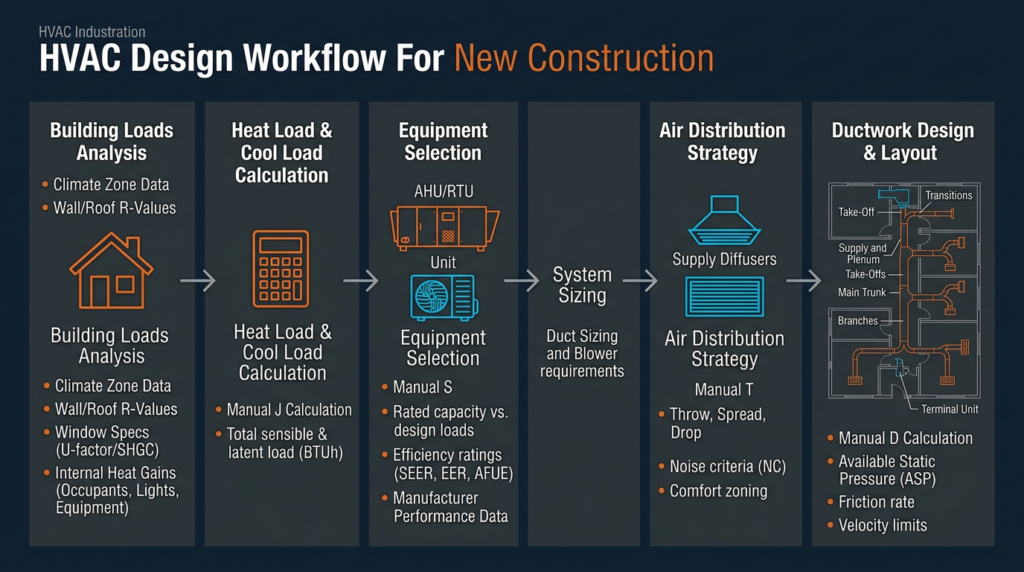
Designing an HVAC system for new construction is fundamentally different from retrofitting an existing building. In new construction, every decision about the building envelope, mechanical systems, and controls can be coordinated from the start. This creates an opportunity to optimize energy efficiency, indoor air quality (IAQ), and occupant comfort in ways that are difficult or impossible to achieve in renovations. Getting the HVAC design right during the planning phase avoids costly change orders, prevents comfort complaints, and ensures compliance with increasingly stringent building codes. A poorly designed system, by contrast, will underperform for the entire life of the building.
Early Design Collaboration
The single most important factor in successful HVAC design for new construction is early collaboration between the HVAC designer, architect, structural engineer, and builder. HVAC systems interact with every aspect of a building: wall assemblies, roof structure, window placement, electrical loads, and plumbing. When the HVAC engineer is brought in after the architectural design is finalized, compromises are inevitable. Duct runs may not fit in available ceiling cavities. Equipment may end up in suboptimal locations. Mechanical rooms may be undersized.
An integrated design approach allows the team to align building orientation, window sizing, insulation levels, and HVAC system selection as a coordinated package. For example, upgrading window specifications from a solar heat gain coefficient (SHGC) of 0.40 to 0.25 on west-facing glass can meaningfully reduce cooling loads and allow a smaller, less expensive air conditioning system. These trade-offs are only possible when all disciplines work together from the start.
Building Codes and Standards
New construction must comply with applicable building codes, which set minimum requirements for energy efficiency, ventilation, and equipment performance.
International Energy Conservation Code (IECC)
The International Energy Conservation Code (IECC) is the primary energy code for residential and commercial buildings in most U.S. jurisdictions. The 2021 IECC requires minimum insulation R-values ranging from R-13 for walls in Climate Zone 1 to R-20+5ci (continuous insulation) in Climate Zones 6 through 8. Ceiling insulation requirements range from R-30 to R-60. Maximum fenestration U-factors range from 0.40 in the warmest zones to 0.28 in the coldest. The code also mandates air leakage testing, with a maximum of 3 ACH50 (air changes per hour at 50 Pascals) for residential buildings in most climate zones. Duct leakage testing is required, with a maximum total leakage rate of 4 CFM per 100 square feet of conditioned floor area. The IECC also mandates mechanical ventilation in accordance with ASHRAE 62.2 for residential buildings.
ASHRAE Standards
Several ASHRAE standards directly govern HVAC design:
- ASHRAE 90.1 (“Energy Standard for Buildings Except Low-Rise Residential Buildings”) sets minimum equipment efficiencies, envelope requirements, and lighting power densities for commercial buildings. It dictates minimum efficiency levels for chillers, boilers, heat pumps, and unitary equipment, and requires economizer cycles in many climate zones.
- ASHRAE 62.1 (“Ventilation for Acceptable Indoor Air Quality”) specifies ventilation rates for commercial buildings using either the Ventilation Rate Procedure (VRP), which prescribes specific outdoor air rates per person and per unit floor area, or the Indoor Air Quality Procedure (IAQP), which targets specific contaminant concentrations.
- ASHRAE 62.2 governs residential ventilation, requiring continuous whole-building ventilation calculated as 0.03 CFM per square foot of floor area plus 7.5 CFM per bedroom plus one. Local exhaust requirements apply to kitchens (100 CFM intermittent or 25 CFM continuous) and bathrooms (50 CFM intermittent or 20 CFM continuous).
- ASHRAE 55 (“Thermal Environmental Conditions for Human Occupancy”) defines acceptable ranges of temperature, humidity, air speed, and radiant temperature for comfort. It informs system design by establishing the performance targets the HVAC system must meet.
Local Codes
Local building codes may exceed national model codes. California’s Title 24, for example, imposes stricter equipment efficiency requirements and mandatory solar-ready provisions. Washington State and several Northeast states have adopted stretch codes that push beyond the 2021 IECC. Always verify local requirements before finalizing any design.
Equipment Standards and Ratings
Efficiency Metrics
As of January 1, 2023, the U.S. Department of Energy transitioned to new testing procedures based on the M1 standard, which uses a higher external static pressure to more accurately reflect real-world duct conditions. This change introduced new efficiency metrics:
- SEER2 (Seasonal Energy Efficiency Ratio 2) replaced SEER for cooling efficiency. Minimum SEER2 is 13.4 in the Northern region and 14.3 in the Southeastern and Southwestern regions for split-system air conditioners.
- EER2 (Energy Efficiency Ratio 2) replaced EER for steady-state cooling performance.
- HSPF2 (Heating Seasonal Performance Factor 2) replaced HSPF for heat pump heating efficiency. Minimum HSPF2 is 7.5 for split-system heat pumps.
- AFUE (Annual Fuel Utilization Efficiency) remains unchanged. Minimum AFUE for non-weatherized gas furnaces is 80% nationally, though many jurisdictions and programs require 90% or higher. High-efficiency condensing furnaces achieve 95% to 98% AFUE.
The Air-Conditioning, Heating, and Refrigeration Institute (AHRI) certifies equipment performance through its directory program. AHRI Standard 210/240 governs performance ratings for unitary air conditioners and heat pumps. Specifying AHRI-certified equipment ensures verified performance data. The ENERGY STAR program sets criteria above the federal minimums; for example, ENERGY STAR-certified central air conditioners must meet SEER2 15.2 or higher in the South.
Refrigerant Regulations
The American Innovation and Manufacturing (AIM) Act, aligned with the Kigali Amendment to the Montreal Protocol, mandates an 85% phasedown of high-GWP hydrofluorocarbon (HFC) production and consumption by 2036. R-410A, the dominant residential refrigerant with a GWP of 2,088, faces significant restrictions. Beginning January 1, 2025, new residential and commercial AC and heat pump equipment must use refrigerants with a GWP of 700 or less.
Leading alternatives include:
- R-454B (GWP 466): A mildly flammable (A2L classification) blend positioned as the primary R-410A replacement in ducted residential systems.
- R-32 (GWP 675): An A2L refrigerant common in ductless systems, widely used internationally.
- R-290 (propane, GWP 3): An A3 (highly flammable) refrigerant used in small self-contained systems with strict charge limits.
For new construction projects, specifying equipment designed for next-generation refrigerants avoids the risk of purchasing systems that will face supply constraints as HFC allocations decrease.
Load Calculation and Analysis
Accurate heating and cooling load calculations are the foundation of proper HVAC design. An undersized system cannot maintain comfort on design days. An oversized system short-cycles, leading to poor humidity control, increased wear, higher energy consumption, and reduced equipment life.
Factors affecting loads include:
- Building orientation: South-facing glass gains significant solar heat in winter; west-facing glass creates peak cooling loads in summer.
- Climate: ASHRAE design conditions vary dramatically. Heating design temperatures range from +30°F in mild climates to -20°F or lower in northern zones. Cooling design conditions may exceed 100°F dry bulb in desert climates.
- Insulation levels: Wall, roof, and foundation insulation directly reduce conductive heat transfer.
- Air infiltration: Tighter construction reduces heating and cooling loads but increases the need for mechanical ventilation.
- Internal heat gains: Occupants generate approximately 250 BTU/h sensible and 200 BTU/h latent heat per person. Lighting, computers, and appliances contribute additional sensible loads.
- Window specifications: U-factor, SHGC, and shading conditions significantly affect both heating and cooling loads.
For residential projects, ACCA Manual J is the industry-standard load calculation methodology. Software tools such as Wrightsoft and CoolCalc automate Manual J calculations. For commercial buildings, detailed energy modeling software such as eQUEST, Trane TRACE, or Carrier HAP provides hour-by-hour analysis. The key principle: never size equipment based on square footage rules of thumb. Every building is unique.
System Selection
System selection depends on building type, climate, efficiency goals, budget, and space constraints.
Centralized Systems
Forced-air systems using furnaces and air conditioners or heat pumps remain the most common residential choice. Split systems separate the indoor and outdoor components. Packaged units combine all components in a single outdoor cabinet, common in commercial rooftop applications. Chilled water systems using chillers, cooling towers, and air handling units serve larger commercial buildings where centralized plant efficiency and long distribution distances justify the added complexity and cost.
Decentralized Systems
Ductless mini-split systems provide zoned heating and cooling without ductwork and are increasingly popular in additions, high-performance homes, and buildings where duct routing is impractical. PTAC units (packaged terminal air conditioners) are standard in hotels and motels, providing individual room control.
Heat Pumps and Geothermal
Air-source heat pumps have improved dramatically, with cold-climate models now delivering rated heating capacity at 5°F outdoor temperature. Geothermal (ground-source) heat pumps use the earth’s stable subsurface temperature (typically 45°F to 75°F depending on latitude) to achieve heating COPs of 3.5 to 5.0 and cooling EERs above 20. Installation costs for geothermal systems typically range from $18,000 to $45,000 for a residential system including the ground loop, but operating costs are 30% to 60% lower than conventional systems.
VRF and DOAS
Variable Refrigerant Flow (VRF) systems circulate refrigerant directly to multiple indoor units from a single outdoor unit, offering precise zone control and heat recovery between zones. They are well suited to commercial buildings with diverse simultaneous heating and cooling needs. Dedicated Outdoor Air Systems (DOAS) decouple ventilation from space conditioning, allowing the DOAS unit to handle outdoor air tempering and humidity control while a separate system (VRF, radiant, or fan coils) handles sensible loads. This approach optimizes both IAQ and energy performance.
Ductwork Design and Installation
Poorly designed ductwork can waste 25% to 40% of heating and cooling energy. ACCA Manual D is the standard methodology for residential duct sizing. Proper design ensures adequate airflow to each room while maintaining static pressures within equipment specifications (typically 0.5 inches of water column or less for residential systems).
Sheet metal ducts are the most durable option, with lowest friction losses and longest service life. Fiberglass duct board provides built-in insulation but requires careful sealing at joints. Flexible duct is cost-effective but must be pulled taut and supported properly; sagging or excessive length dramatically increases friction and reduces airflow.
All ductwork must be sealed with mastic or UL-181 listed tape (not standard cloth duct tape, which degrades over time). Insulation requirements per the IECC range from R-6 to R-8 for ducts in unconditioned spaces. Upgrading from R-8 to R-13 duct insulation adds roughly $0.50 to $1.00 per linear foot but can reduce duct-related energy losses by 20% to 30% in extreme climates. Duct construction should follow SMACNA standards for material gauge, joint construction, and support spacing.
Ventilation and Indoor Air Quality
Modern tight construction virtually eliminates natural infiltration as a ventilation source. Mechanical ventilation is not optional; it is required by code.
Ventilation System Types
- Exhaust-only: Simple and inexpensive. A continuously running bathroom fan depressurizes the house, drawing outdoor air through the envelope. Limited control over incoming air quality and path.
- Supply-only: Introduces filtered outdoor air through the HVAC system or a dedicated fan. Pressurizes the building slightly, reducing uncontrolled infiltration of pollutants.
- Balanced ventilation: Provides both supply and exhaust. Heat Recovery Ventilators (HRVs) transfer sensible heat between exhaust and supply streams, recovering 70% to 85% of the energy. Energy Recovery Ventilators (ERVs) transfer both sensible heat and moisture. HRVs are preferred in cold, dry climates where winter indoor humidity needs to be preserved. ERVs are better suited to hot, humid climates where reducing incoming moisture load is beneficial.
An HRV typically costs $1,500 to $3,500 installed for residential applications. An ERV costs $1,800 to $4,000. The energy savings from heat recovery can reduce ventilation-related heating and cooling costs by 50% to 70%.
Filtration and Humidity Control
Air filters are rated by MERV (Minimum Efficiency Reporting Value). MERV 8 filters capture particles 3 microns and larger (dust, pollen). MERV 13 filters capture particles down to 0.3 microns, including bacteria and some virus carriers, and are recommended by ASHRAE for improved IAQ. Higher MERV ratings increase static pressure; the HVAC system must be designed to accommodate the filter resistance.
Humidity control is critical. Indoor relative humidity should be maintained between 30% and 60%. In humid climates, dedicated whole-house dehumidifiers (70 to 130 pints per day capacity) prevent mold growth. In dry climates, whole-house humidifiers can be integrated with forced-air systems.
Controls and Automation
Programmable thermostats allow scheduled temperature setbacks, reducing energy use by 5% to 15%. Smart thermostats (such as Ecobee or Google Nest) use occupancy sensing, weather data, and learning algorithms to optimize schedules automatically. For residential systems with multiple zones, zoning systems using motorized dampers and multiple thermostats allow independent temperature control, eliminating the common complaint of one zone being too hot while another is too cold.
In commercial buildings, Building Automation Systems (BAS) provide centralized monitoring and control of HVAC equipment, lighting, and other building systems. BAS platforms enable demand-based ventilation, optimal start/stop, economizer control, fault detection, and energy use tracking. The investment in a BAS typically pays for itself within 3 to 5 years through reduced energy and maintenance costs.
Commissioning
Commissioning is the process of verifying that all HVAC systems are installed correctly, calibrated, and performing according to design intent. It includes verifying airflows at each register, confirming refrigerant charge, testing controls sequences, calibrating sensors, and measuring total system performance. ASHRAE Guideline 0 outlines the commissioning process. For commercial buildings, commissioning is often required by code or green building certifications (LEED). For residential projects, a thorough startup and testing protocol should be specified even when not mandated. Skipping commissioning means accepting that the system may never perform as designed.
Energy Efficiency, Incentives, and Sustainability
The Inflation Reduction Act (IRA) of 2022 provides significant incentives for high-efficiency HVAC equipment. The Section 25C tax credit offers homeowners up to $2,000 per year for qualifying heat pumps (including geothermal) and $600 for other efficient HVAC components such as furnaces and central air conditioners. Equipment must meet specific efficiency thresholds determined by ENERGY STAR Most Efficient or CEE (Consortium for Energy Efficiency) criteria. The Section 179D tax deduction allows commercial building owners to deduct up to $5.00 per square foot for energy-efficient building design meeting ASHRAE 90.1 efficiency targets.
A comparison of system costs illustrates the value of efficiency investments:
- SEER2 16 vs. SEER2 20 air conditioner: A SEER2 20 unit may cost $1,500 to $3,000 more than a SEER2 16 unit. For a home with $1,200 annual cooling costs at SEER2 16, the SEER2 20 unit saves roughly $240 per year, yielding a payback period of approximately 6 to 12 years before accounting for tax credits and utility rebates.
- High-efficiency furnace (96% AFUE) vs. standard (80% AFUE): The high-efficiency unit costs $800 to $1,500 more but reduces fuel consumption by 20%.
For net-zero energy buildings, HVAC systems must be paired with on-site renewable energy generation (typically rooftop solar PV) and a highly efficient building envelope to achieve annual energy balance.
Climate-Specific Design
A common mistake is applying generic HVAC advice regardless of location. Climate zone fundamentally changes design priorities:
- Heating-dominated climates (Zones 5-8): Prioritize high-efficiency heating, robust insulation, HRVs for ventilation, and air sealing. Cold-climate heat pumps with supplemental resistance or gas backup may be appropriate.
- Cooling-dominated climates (Zones 1-2): Prioritize high SEER2 equipment, low-SHGC windows, dehumidification, and ERVs. Moisture management is critical.
- Mixed climates (Zones 3-4): Require balanced attention to both heating and cooling performance. Heat pumps are particularly efficient in these zones because neither extreme dominates.
Common Misconceptions
- Bigger is better: Oversized equipment short-cycles, fails to dehumidify, and wastes energy. Proper sizing through Manual J or engineering analysis is essential.
- Ductwork does not matter: Duct leakage and poor design can waste more energy than an inefficient furnace. Ductwork is the circulatory system of forced-air HVAC; it deserves the same attention as equipment selection.
- Efficiency is everything: A highly efficient system that provides poor IAQ or comfort has failed its purpose. Ventilation, filtration, and humidity control are equally important design objectives.
- Initial cost is the real cost: Lifecycle cost analysis, including energy, maintenance, and expected equipment life, almost always favors higher-efficiency equipment. A system that costs $3,000 more upfront but saves $500 per year in operating costs is the better investment.
Future Trends
The HVAC industry is moving toward electrification of heating, driven by decarbonization goals and increasingly efficient heat pump technology. Several jurisdictions have enacted policies favoring or requiring all-electric new construction. Smart HVAC systems with IoT connectivity enable remote monitoring, predictive maintenance, and grid-interactive demand response. AI-powered controls are beginning to optimize system operation based on weather forecasts, occupancy patterns, utility rate structures, and equipment degradation data. As the grid becomes cleaner and heat pump performance continues to improve, all-electric HVAC systems will become the default choice for most new construction applications.
Key Takeaways
- Involve the HVAC designer at the earliest stage of the project, before the building envelope and floor plans are finalized.
- Perform accurate load calculations using Manual J (residential) or detailed energy modeling (commercial). Never size equipment based on rules of thumb.
- Select equipment that meets or exceeds current SEER2, HSPF2, and AFUE minimums, and specify next-generation refrigerants (R-454B, R-32) to future-proof the installation.
- Design and install ductwork to ACCA Manual D and SMACNA standards. Seal all joints with mastic and insulate to code requirements or better.
- Provide code-required mechanical ventilation using HRVs or ERVs appropriate to the climate.
- Commission the completed system to verify that it operates as designed.
- Take advantage of IRA tax credits and utility rebates to offset the cost of high-efficiency equipment.
- Design for the specific climate zone. Heating-dominated, cooling-dominated, and mixed climates require fundamentally different design priorities.