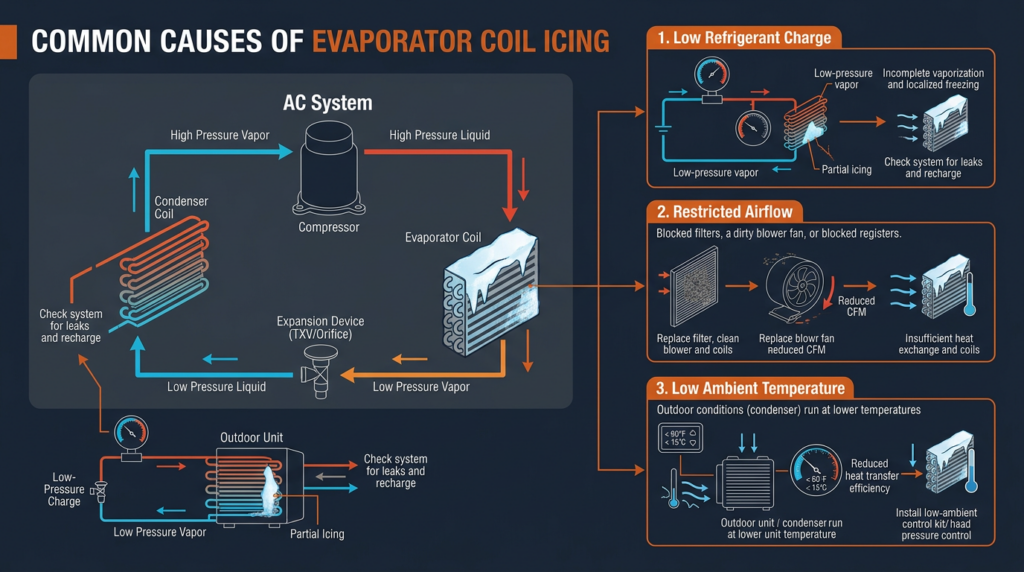
Indoor coil icing occurs when the evaporator coil inside an air conditioning system drops below 32°F (0°C) and moisture from indoor air freezes on its surface. What starts as a thin layer of frost can quickly escalate into a solid block of ice that chokes airflow, starves the system of heat absorption, and sends liquid refrigerant back toward the compressor. Left unchecked, a frozen coil can cause water damage, mold growth, and catastrophic compressor failure. Understanding the causes, consequences, and corrective steps is essential for homeowners who want to protect their investment and for HVAC technicians who need to diagnose the root problem quickly and accurately.
How the Cooling Cycle Creates the Conditions for Icing
Every air conditioner relies on the refrigeration cycle to move heat from inside a building to the outdoors. Low-pressure liquid refrigerant enters the evaporator coil, absorbs heat from the indoor air stream, and evaporates into a gas. Under normal operating conditions, the coil surface temperature sits between 35°F and 45°F (1.7°C to 7.2°C), well above freezing but cold enough to pull moisture out of the air as condensation. That condensation drains into a pan and exits through the condensate line.
Problems arise when any factor drives the coil surface temperature below 32°F. Moisture that would normally drip away as liquid water instead crystallizes on the fins. Ice insulates the coil, further reducing heat transfer and driving the temperature even lower. The result is a self-reinforcing cycle: more ice means less heat absorption, which means colder coil temperatures, which means still more ice.
Causes of Indoor Coil Icing
Restricted Airflow
Restricted airflow is the single most common cause of evaporator coil icing. Residential systems are typically designed to deliver 350 to 450 CFM (cubic feet per minute) of air per ton of cooling capacity. When airflow drops significantly below that range, the coil cannot absorb enough heat to keep its surface temperature above freezing.
- Dirty air filters: A clogged filter is the easiest problem to diagnose and the most frequently encountered. Filters are rated on the Minimum Efficiency Reporting Value (MERV) scale, defined by ASHRAE Standard 52.2. Residential systems usually perform best with filters in the MERV 8 to MERV 13 range. Higher MERV filters (MERV 14 and above) trap finer particles but can restrict airflow in systems not designed to handle the added static pressure.
- Blocked return air vents or supply registers: Furniture, curtains, or closed registers restrict the volume of air reaching the coil.
- Dirty evaporator coil: Dust and debris accumulate on coil fins over time. Fin density, measured in fins per inch (FPI), affects susceptibility. Coils with higher FPI counts (14 to 20 FPI is common in modern high-efficiency systems) are more prone to blockage because the gaps between fins are narrower.
- Improper ductwork design: Undersized ducts, excessive length, sharp bends, or collapsed flex duct sections increase static pressure and reduce airflow. ACCA Manual D provides the standard procedures for duct design and airflow calculations.
- Blower motor issues: A failing run capacitor, a worn-out blower motor, or a damaged blower wheel can reduce air volume. Variable-speed ECM motors can sometimes mask the problem by ramping up to compensate, but PSC (permanent split capacitor) motors have no such flexibility.
Low Refrigerant Charge
A system with a low refrigerant charge has less heat-absorbing capacity in the evaporator. The reduced mass of refrigerant expands more than intended, dropping the coil temperature below freezing. Low charge is almost always caused by a leak, not by refrigerant being “used up.” Refrigerant circulates in a sealed loop and does not deplete under normal operation.
Technicians verify charge using superheat and subcooling measurements. For systems with a thermostatic expansion valve (TXV), subcooling at the condenser is the primary indicator, with targets typically between 8°F and 14°F depending on manufacturer specifications. For fixed-orifice (piston) systems, superheat at the evaporator is measured instead, with targets commonly between 10°F and 20°F. Deviations from these ranges indicate undercharge or overcharge conditions.
Refrigerant handling is regulated under EPA Section 608. Only technicians holding a valid EPA 608 certification may purchase, recover, or charge refrigerants. Homeowners cannot legally recharge their own central air conditioning systems.
Low Ambient Temperature
Running an air conditioner when outdoor temperatures fall below approximately 60°F (15.5°C) can cause the evaporator coil to freeze. The condenser rejects less heat when the outdoor air is cool, lowering head pressure and reducing the flow of refrigerant through the metering device. This starves the evaporator of adequate refrigerant pressure and drives coil temperatures below freezing.
Some systems include a freezestat (also called a low-limit thermostat) that shuts down the compressor if coil temperature drops below a set point, typically around 35°F. Commercial systems may use head pressure controls or condenser fan cycling to maintain adequate pressures during low-ambient operation.
Mechanical Failures
- Failed thermostatic expansion valve (TXV): A TXV regulates the flow of refrigerant into the evaporator based on superheat. If the sensing bulb loses its charge, the valve can close too far, underfeeding the coil and causing localized freezing at the inlet. Conversely, if the valve sticks open, it can overfeed the coil and flood liquid refrigerant back to the compressor.
- Stuck or damaged piston/orifice: Fixed-orifice metering devices can become partially blocked by debris or moisture contamination. A restricted orifice underfeeds the evaporator in the same way as a failed TXV.
- Compressor issues: A compressor with worn valves or reduced capacity may not circulate enough refrigerant to maintain proper pressures, leading to abnormally low evaporator temperatures.
High Indoor Humidity
When indoor relative humidity is high, the air carries more moisture. As this moisture-laden air passes over a cold coil, condensation is heavier. If the coil temperature is at or near freezing, the abundant moisture accelerates ice formation. Homes in humid climates or buildings with poor ventilation and vapor barriers are particularly susceptible.
Consequences of a Frozen Coil
- Reduced cooling capacity: Ice acts as an insulator, blocking heat transfer between the air and the refrigerant. A partially iced coil can lose 30% to 50% of its effective surface area.
- Increased energy consumption: The system runs longer to meet thermostat demand, driving up electricity costs without delivering adequate comfort.
- Compressor damage: When the evaporator cannot boil off all the refrigerant, liquid slugs travel through the suction line to the compressor. Liquid slugging can damage scroll plates, reed valves, and bearings, often resulting in compressor failure.
- Water damage: When the ice finally melts, the volume of water may overwhelm the drain pan and condensate line, causing leaks onto ceilings, walls, and floors.
- Mold growth: Persistent moisture around the air handler creates a breeding ground for mold and bacteria, degrading indoor air quality.
Troubleshooting Indoor Coil Icing
Steps for Homeowners
- Turn off the air conditioner at the thermostat. Switch the fan setting to “ON” (not “AUTO”) to circulate warm air over the coil and speed thawing. Never use a heat gun, hair dryer, or any direct heat source on the coil. Rapid, uneven heating can damage copper tubing and solder joints.
- Check the air filter. If it is visibly dirty or has been in place for more than 90 days (30 days for fiberglass filters or homes with pets), replace it.
- Inspect all return and supply vents. Ensure they are open and unobstructed.
- Look at the coil if accessible. Heavy dust or matted debris on the fin surface is a sign that professional cleaning is needed.
- Place a drip tray or towels beneath the air handler to catch meltwater.
- If the coil freezes again after thawing and restarting with a clean filter and open vents, call a licensed HVAC technician.
Diagnostic Steps for Technicians
- Measure external static pressure (ESP) across the air handler. Total ESP should typically fall between 0.20 and 0.50 inches of water column (in. w.c.) for most residential systems, though manufacturer specifications vary. High static pressure confirms restricted airflow.
- Verify airflow volume. Use the temperature rise method, a duct traverse with a hot-wire anemometer, or a flow capture hood. Compare measured CFM against the 350 to 450 CFM per ton target and the equipment manufacturer’s rating. ACCA Manual T provides procedures for air distribution verification.
- Check superheat and subcooling. Attach gauges and temperature clamps. Compare readings against the manufacturer’s charging chart. Low superheat on a fixed-orifice system suggests overcharge or excessive airflow restriction. High subcooling on a TXV system may indicate a restricted metering device or overcharge.
- Inspect the metering device. A partially closed TXV or blocked piston restricts refrigerant flow. Measure the temperature drop across the device; an abnormally large drop signals a restriction.
- Perform a leak search if the charge is low. Use an electronic refrigerant leak detector, ultrasonic detector, or nitrogen pressurization with soap bubbles. Common leak points include the evaporator coil U-bends, Schrader valve cores, and flare connections.
- Test the blower motor and capacitor. Measure amperage draw against the motor nameplate rating. Test the run capacitor with a multimeter set to microfarads. A capacitor reading more than 10% below its rated value should be replaced.
- Evaluate ductwork. Inspect accessible sections for kinks, disconnections, or collapsed flex duct. Perform a duct leakage test if conditions warrant.
Cost Considerations
Repair costs vary widely by region and complexity. The following ranges represent typical 2024 pricing for residential systems in the United States:
- Air filter replacement: $5 to $15 for disposable fiberglass; $15 to $40 for pleated MERV 8 to MERV 13; $40 to $100 or more for HEPA-style media filters.
- Professional duct cleaning: $300 to $600 for a whole-house cleaning.
- Refrigerant recharge (R-410A): $50 to $150 per pound of refrigerant, plus $100 to $200 in labor. A typical residential system holds 6 to 16 pounds of R-410A. Note that R-410A prices have risen as the HFC phase-down under the AIM Act takes effect.
- TXV replacement: $400 to $1,000, including parts, refrigerant recovery, evacuation, and recharge.
- Blower motor replacement: $300 to $800 for a PSC motor; $500 to $1,500 for an ECM motor, including labor.
Repair vs. Replacement
When coil icing points to a major component failure, homeowners face the classic repair-or-replace decision. Key factors include:
- System age: The average residential central air conditioner lasts 15 to 20 years. If the system is beyond 12 to 15 years and facing an expensive repair, replacement often makes more financial sense over the remaining equipment life.
- Refrigerant type: Systems still running R-22 (HCFC-22) use a refrigerant that was fully phased out of production in the United States in 2020. Remaining supplies are limited and expensive, often exceeding $100 per pound. Replacement with a system using R-410A or the newer, lower-GWP R-32 is typically advisable.
- Efficiency gains: Current DOE minimum efficiency standards require a SEER2 of 13.4 in the northern United States and 14.3 in the Southeast and Southwest (as of January 1, 2023, per AHRI 210/240 testing procedures). Older systems may operate at SEER 10 or below. Upgrading can reduce cooling energy use by 25% to 40%.
- Available incentives: The Inflation Reduction Act (IRA) provides a federal tax credit of up to 30% of the cost (capped at $2,000 per year) for qualifying high-efficiency heat pumps and central air conditioners. Additional state and utility rebates may apply. Details are available at energystar.gov and the IRS Energy Efficient Home Improvement Credit page.
- Lifecycle cost analysis: Compare the total cost of repair plus projected energy bills over the remaining life of the existing system against the cost of a new system with lower operating costs. A qualified contractor can run this calculation using equipment performance data and local utility rates.
Refrigerant Transition and Regulatory Context
The refrigerant landscape is shifting. R-410A, the dominant residential refrigerant since the early 2000s, has a global warming potential (GWP) of 2,088. Under the American Innovation and Manufacturing (AIM) Act, the EPA is phasing down HFC production and consumption by 85% by 2036. R-32, with a GWP of 675 and zero ozone depletion potential (ODP), is gaining adoption as a replacement. R-22, the legacy refrigerant, has an ODP of 0.055 and a GWP of 1,810 and is no longer manufactured in or imported to the United States.
For technicians, proper refrigerant identification is critical before any charging or recovery work. Mixing refrigerants contaminates systems and can void warranties. EPA Section 608 requires that technicians use certified recovery equipment and maintain records of refrigerant purchases and disposals.
Preventative Measures
- Replace filters on schedule. Check monthly during peak cooling season. Replace standard 1-inch pleated filters every 30 to 90 days. Media filters (4 to 5 inches deep) may last 6 to 12 months.
- Schedule annual professional maintenance. A pre-season tune-up should include coil cleaning, refrigerant charge verification, blower inspection, and condensate drain clearing.
- Keep return and supply vents open. Closing vents in unused rooms increases static pressure and reduces total system airflow.
- Ensure proper duct design and sealing. Leaky or undersized ducts can reduce delivered airflow by 20% to 30%. Duct sealing with mastic or approved tape and proper insulation (R-6 to R-8 for ducts in unconditioned spaces) are cost-effective improvements.
- Avoid running the AC below 60°F outdoor temperature. Use ventilation or economizer modes if available.
- Control indoor humidity. Maintain relative humidity between 30% and 50%. Use a standalone dehumidifier in basements or in climates where latent loads are high.
Common Misconceptions
- “A frozen coil always means low refrigerant.” Restricted airflow causes coil icing just as often, sometimes more frequently. Always check the filter and airflow before assuming a refrigerant issue.
- “Running the fan on low saves energy.” Low fan speed can reduce airflow below the threshold needed to prevent icing. Follow manufacturer speed settings or use the “AUTO” fan mode at the thermostat for normal operation.
- “Higher MERV is always better.” A MERV 16 filter installed in a system designed for MERV 8 can create a severe airflow restriction. Match the filter to the system’s rated static pressure capability.
- “A frozen coil means the AC is dying.” While icing can signal a serious issue, it is often resolved with a $10 filter change. Do not panic; diagnose methodically.
- “I can buy refrigerant online and recharge it myself.” Federal law under EPA Section 608 prohibits anyone without proper certification from purchasing or handling regulated refrigerants. Improper charging also risks overcharge, undercharge, and personal injury from high-pressure refrigerant lines.
Key Takeaways
- Indoor coil icing is a symptom, not a diagnosis. The root cause is always either insufficient airflow, insufficient refrigerant, low ambient conditions, or a mechanical failure.
- The first step for any homeowner is to turn off the system, let the ice thaw, and check the air filter. This single action resolves a large percentage of icing events.
- Technicians should measure external static pressure and airflow before connecting refrigerant gauges. Airflow problems are more common than charge problems and easier to confirm.
- Proper superheat and subcooling measurements, referenced against the manufacturer’s charging chart, are the only reliable way to verify refrigerant charge.
- Preventative maintenance, including regular filter changes, annual professional inspections, and proper duct design, is the most cost-effective strategy for avoiding frozen coils and the expensive damage they can cause.
- When repair costs approach 50% of the replacement cost on an aging system, a lifecycle cost analysis almost always favors upgrading to a new, higher-efficiency unit, especially with current IRA tax credits available.