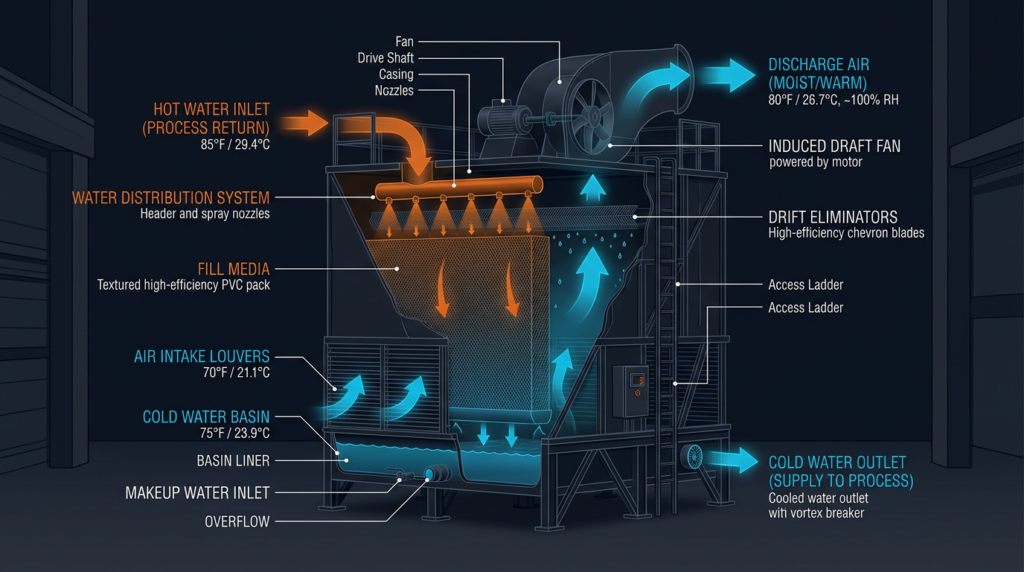
What Is a Cooling Tower?
A cooling tower is a heat rejection device that transfers waste heat from a building or industrial process to the atmosphere through the evaporation of water. Cooling towers serve as the critical final link in the heat rejection chain for large HVAC systems, power plants, data centers, and manufacturing facilities. Without properly functioning cooling towers, chillers cannot efficiently reject condenser heat, and entire cooling systems fail. Understanding how to operate and maintain these systems directly affects energy consumption, water usage, equipment lifespan, and occupant safety. Legionella bacteria, which thrive in poorly maintained cooling tower water, cause Legionnaires’ disease and represent a serious public health risk governed by ASHRAE Standard 188.
Types of Cooling Towers
Mechanical Draft Towers
Most commercial and industrial cooling towers use fans to move air through the tower. These mechanical draft towers fall into two categories based on fan placement:
- Forced draft: Fans located at the air inlet push air through the tower. These towers handle dirty or corrosive environments well but can suffer from recirculation of warm, moist discharge air.
- Induced draft: Fans located at the top of the tower pull air through the fill media. This design is the most common in HVAC applications because it reduces recirculation and provides more uniform airflow.
Mechanical draft towers are further classified by airflow pattern:
- Counterflow: Air moves vertically upward while water falls downward. This configuration achieves the closest approach temperatures but requires higher pump head due to pressurized spray nozzles.
- Crossflow: Air moves horizontally across the falling water. Crossflow towers use gravity-fed distribution basins, which simplifies maintenance and reduces pump energy but typically requires a larger footprint.
Natural Draft Towers
Natural draft towers rely on the buoyancy of warm, moist air to create airflow without fans. The iconic hyperbolic cooling towers found at power plants are the most recognizable example, often exceeding 500 feet in height. Smaller atmospheric towers rely on wind and natural convection. Natural draft towers have minimal operating costs but require enormous capital investment and are rarely used in commercial HVAC.
Open Circuit vs. Closed Circuit
Open circuit (direct contact) towers expose the process water directly to the air stream, maximizing heat transfer efficiency. Closed circuit towers (also called fluid coolers) circulate the process fluid through a coil inside the tower while a separate spray water stream evaporates over the coil exterior. Closed circuit systems protect the process fluid from contamination but are less thermally efficient and more expensive.
Package vs. Field-Erected
Package towers arrive factory-assembled and are common for loads under 1,000 tons. Field-erected towers are built on-site for larger applications, often exceeding 5,000 tons, and allow customization for specific site conditions.
Key Components
Every cooling tower shares a set of core components that determine its performance and maintenance requirements:
- Fill (packing): The heat transfer media that increases the contact area between air and water. Film fill uses thin, closely spaced sheets to spread water into a thin film, offering high thermal efficiency but requiring clean water. Splash fill uses horizontal bars or grids to break water into droplets and tolerates dirtier water.
- Drift eliminators: Baffles near the air discharge that capture water droplets entrained in the leaving air stream. Modern drift eliminators limit drift losses to 0.001% to 0.005% of circulating water flow.
- Water distribution system: Spray nozzles (counterflow) or gravity basins (crossflow) that distribute water uniformly across the fill. Uneven distribution reduces effective tower capacity.
- Fans and motors: Typically propeller-type (axial) fans for induced draft towers and centrifugal fans for forced draft towers. Fan diameter, blade pitch, and motor horsepower directly control airflow volume.
- Cold water basin: The collection sump at the tower base. Basin design must prevent sediment accumulation and allow access for cleaning.
- Air inlet louvers: Prevent sunlight penetration (which promotes algae growth) and reduce splash-out water losses.
- Structure: Materials include galvanized steel, stainless steel, fiberglass-reinforced polyester (FRP), and treated wood. FRP offers superior corrosion resistance and is increasingly standard for HVAC applications.
How Cooling Towers Work
Cooling towers exploit the principle of evaporative cooling. When water evaporates, it absorbs approximately 1,000 BTU per pound of water evaporated (the latent heat of vaporization). Warm condenser water enters the tower and is distributed over the fill media. Ambient air contacts this water, and a small percentage evaporates, absorbing heat from the remaining water. The cooled water collects in the basin and returns to the chiller condenser or process equipment.
Three performance metrics define cooling tower operation:
- Range: The temperature difference between the hot water entering the tower and the cold water leaving. A tower cooling water from 95°F to 85°F has a 10°F range.
- Approach temperature: The difference between the cold water temperature leaving the tower and the ambient wet-bulb temperature. A tower producing 85°F water at a 78°F wet-bulb has a 7°F approach. Lower approach temperatures indicate better performance but require larger, more expensive towers.
- Capacity: The rate of heat rejection, measured in BTU/hr or tons of refrigeration. One cooling ton equals 15,000 BTU/hr of heat rejected at the condenser (accounting for compressor heat added to the refrigeration ton of 12,000 BTU/hr).
The wet-bulb temperature is the single most important ambient condition affecting cooling tower performance. A cooling tower cannot cool water below the wet-bulb temperature. As relative humidity increases, the wet-bulb temperature rises, and the tower’s ability to reject heat decreases.
Water Treatment
Cooling tower water treatment is not optional. Open recirculating systems continuously concentrate dissolved minerals as pure water evaporates. Without treatment, three problems develop rapidly: scaling, corrosion, and biological growth.
Scaling
As water evaporates, calcium carbonate and silica concentrations increase. Scale deposits on fill and heat exchange surfaces act as insulation, reducing heat transfer. Even a 1/32-inch layer of scale can reduce heat transfer efficiency by 10% to 15%. Scale inhibitors (phosphonates, polymers) and proper blowdown control prevent mineral buildup. Cycles of concentration (the ratio of dissolved solids in the tower water to the makeup water) typically run between 3 and 6 cycles, depending on makeup water quality.
Corrosion
Dissolved oxygen, low pH, chlorides, and sulfates attack metal components. Corrosion inhibitors such as molybdates, phosphates, and azoles (for copper protection) are standard treatments. Maintaining pH between 7.0 and 9.0 is generally recommended.
Biological Growth and Legionella
Warm, aerated cooling tower water provides an ideal environment for bacteria, algae, and biofilm. Legionella pneumophila grows in water between 77°F and 113°F and can be aerosolized by drift, posing a serious inhalation risk. ASHRAE Standard 188 requires building owners to develop and implement a water management program that includes risk assessment, control measures, monitoring, and corrective actions. ASHRAE Guideline 12 provides practical implementation guidance.
Common biocides include oxidizing chemicals (chlorine, bromine, chlorine dioxide) and non-oxidizing chemicals (isothiazolinones, glutaraldehyde). UV treatment and ozone offer chemical-free supplemental disinfection. Heterotrophic plate counts (HPC) should be maintained below 10,000 CFU/mL, and Legionella testing should follow the schedule established in the water management program.
Blowdown and Filtration
Blowdown is the intentional discharge of concentrated tower water, replaced by fresh makeup water, to control total dissolved solids (TDS). Automated conductivity controllers are standard for managing blowdown. Sidestream filtration, typically filtering 5% to 15% of the recirculating flow through sand or bag filters, removes suspended solids and reduces biological nutrient loads.
Maintenance Practices
Routine Inspections
Cooling towers require inspection on a weekly to monthly basis, depending on operating conditions. Key inspection items include:
- Water levels in the basin and makeup valve operation
- Fan and motor operation (unusual vibration, noise, or amperage draw)
- Water treatment chemical levels and controller calibration
- Fill condition (clogging, damage, or biological growth)
- Drift eliminator integrity
- Spray nozzle coverage and clogging
- Structural integrity and fastener tightness
- Basin cleanliness and sediment accumulation
Cleaning
The basin should be cleaned at least twice per year and whenever visible sediment exceeds 1/4 inch. Fill media should be inspected annually and cleaned or replaced when airflow restriction exceeds 15% to 20%. Pressure washing and chemical cleaning with approved biocides are standard procedures. All cleaning must follow ASHRAE Standard 188 requirements.
Mechanical Maintenance
Fan motor bearings require lubrication per manufacturer schedules, typically every 3 to 6 months. Belt-driven systems need belt tension checks monthly. Gearbox oil levels and condition should be checked quarterly, with oil changes annually or per manufacturer recommendation. Fan blades must be inspected for cracks, erosion, and pitch accuracy.
Winterization
In freezing climates, cooling towers require winterization to prevent ice damage. Options include basin heaters (typically maintaining water above 40°F), indoor sump systems that drain the tower basin, and reduced-flow operation with ice prevention controls. Towers not operating during winter should be fully drained, cleaned, and covered.
Record Keeping
Maintaining detailed logs of inspections, water treatment results, maintenance activities, and any corrective actions is required by ASHRAE Standard 188 and is essential for regulatory compliance and troubleshooting.
Troubleshooting Common Problems
- Reduced cooling capacity: Check for airflow restrictions (dirty fill, damaged drift eliminators), inadequate water flow, scaling on fill surfaces, or recirculation of warm discharge air. Verify that actual wet-bulb conditions match design assumptions.
- Excessive water loss: Distinguish between evaporation (normal, approximately 1% of flow per 10°F range), drift (should be under 0.005%), blowdown (controlled), and leaks (abnormal). Inspect drift eliminators and basin for cracks.
- High energy consumption: Check fan belt slippage, motor degradation, fouled fill restricting airflow (forcing fans to work harder), and whether VFDs are operating correctly.
- Legionella detection: Immediately implement the corrective actions defined in the water management program. This typically includes hyperchlorination (raising free chlorine to 10 ppm or higher for 6 to 24 hours), followed by draining, cleaning, and refilling the system.
Energy Efficiency and Optimization
Variable frequency drives (VFDs) on cooling tower fans are one of the most effective energy-saving measures available. Fan power varies with the cube of speed, meaning reducing fan speed by 50% reduces energy consumption by approximately 87.5%. VFDs allow fan speed to match actual cooling load rather than running at full speed continuously. Payback periods typically range from 1 to 3 years.
Additional optimization strategies include:
- Tower staging: Operating multiple tower cells at reduced fan speed rather than fewer cells at full speed reduces total fan energy.
- Waterside economizer (free cooling): When ambient wet-bulb temperatures drop below approximately 55°F, cooling towers can provide chilled water directly through a heat exchanger, allowing chillers to shut down entirely. ASHRAE Standard 90.1 requires waterside economizers on many systems above 20 tons in applicable climate zones.
- Flow rate optimization: Excessive water flow over the fill can reduce contact time and degrade thermal performance. Balancing flow rates to design specifications is essential.
The Inflation Reduction Act (IRA) provides tax incentives under Section 179D for energy-efficient commercial building improvements. Cooling tower upgrades incorporating VFDs, high-efficiency motors, and optimized controls may qualify for deductions when they contribute to whole-building energy savings meeting specified thresholds.
Environmental and Regulatory Considerations
Cooling towers consume significant amounts of water. A 1,000-ton cooling tower evaporates approximately 30 gallons per minute under full load. In water-stressed regions such as California and the arid Southwest, jurisdictions increasingly restrict cooling tower water use and mandate higher cycles of concentration or alternative cooling technologies.
Blowdown discharge must comply with the Clean Water Act and local wastewater regulations. Chemical treatment programs must account for discharge limits on chromates (largely discontinued), zinc, phosphorus, and total dissolved solids. Many municipalities require discharge permits for cooling tower blowdown.
Plume abatement towers use coil sections to preheat incoming air, reducing the visible condensation plume that forms in cold weather. These are often required near airports, highways, or in dense urban areas. Noise from cooling tower fans can exceed 85 dBA at close range. Attenuation measures include low-speed fan operation, sound barriers, and inlet/discharge silencers.
The AIM Act is phasing down high-GWP HFC refrigerants used in chillers paired with cooling towers. Replacement refrigerants such as R-514A, R-1233zd, and R-515B may operate at different condenser pressures and temperatures, affecting the required cooling tower approach temperature and capacity. Facility managers should coordinate chiller refrigerant transitions with cooling tower performance evaluations.
Safety
Working on cooling towers involves multiple hazards. Required safety practices include:
- Personal protective equipment (PPE): Safety glasses, chemical-resistant gloves, respiratory protection when handling biocides, and fall protection when working at height.
- Lockout/tagout (LOTO): All fans, pumps, and chemical feed systems must be de-energized and locked out before maintenance per OSHA 29 CFR 1910.147.
- Confined space entry: Cooling tower basins and plenums may qualify as confined spaces under OSHA 29 CFR 1910.146, requiring atmospheric monitoring, a rescue plan, and an entry permit.
- Chemical handling: Water treatment chemicals, especially concentrated biocides and acids, must be stored and handled according to Safety Data Sheet (SDS) requirements.
Practical Application Examples
Typical cooling tower specifications vary widely by application:
- Small commercial HVAC (100 tons): 300 GPM condenser water flow, 95°F entering/85°F leaving water temperature, 78°F design wet-bulb, 7°F approach. Installed cost: $15,000 to $40,000.
- Large commercial HVAC (500 tons): 1,500 GPM, similar temperatures, multiple cells with VFDs. Installed cost: $75,000 to $200,000.
- Industrial process cooling (1,000 tons): 3,000 GPM, 120°F entering/90°F leaving water (30°F range), splash fill for dirty water applications. Installed cost: $200,000 to $500,000 or more.
- Data centers: Require N+1 redundancy, close approach temperatures (5°F to 7°F), and premium water treatment programs. Closed circuit towers or hybrid systems are common to protect critical infrastructure.
Key Takeaways
Cooling towers are essential heat rejection equipment for large HVAC and industrial systems, and their performance depends on proper selection, operation, and maintenance. Wet-bulb temperature is the primary driver of cooling tower capacity. Water treatment is not optional and must include programs for scale, corrosion, and biological control in compliance with ASHRAE Standard 188. Preventive maintenance on a regular schedule prevents costly failures and protects public health. VFDs on tower fans offer substantial energy savings with short payback periods. Environmental regulations governing water use, chemical discharge, and refrigerant transitions continue to tighten, requiring facility managers to stay informed and plan ahead. Proper record keeping supports both regulatory compliance and long-term operational reliability.