If you run a business, your commercial air conditioning system is not a luxury; it is critical infrastructure. Unlike a residential system that might run four to six hours a day during peak heat, a commercial unit often runs 12 to 20 hours daily, demanding specialized equipment, knowledge, and service protocols. I’ve been dealing with these large systems for decades, and the one thing I know for sure is that ignoring maintenance on a commercial unit guarantees costly downtime.
I remember a job we handled in downtown Denver back in the winter of 2018. It was a three-story data center that used commercial rooftop units not just for comfort cooling but specifically to manage the heat load from their servers. When one of their units failed due to a lack of routine compressor lubrication, the localized heat spike put their entire network at risk. That failure wasn’t just about an expensive repair; it threatened their core business operations. That’s the high-stakes reality of commercial HVAC—it protects your assets and keeps the lights on.
Key Highlights
- Commercial systems require specialized maintenance schedules due to high runtime hours and the complexity of components like Variable Frequency Drives (VFDs) and economizers.
- Rooftop Units (RTUs) are the backbone of light and medium commercial cooling, prized for accessibility and space efficiency.
- Preventative maintenance, specifically coil cleaning and inspecting blower belts, prevents approximately 80% of all emergency compressor failures.
- Sizing a commercial unit must follow strict engineering standards (like ASHRAE guidelines) to avoid energy waste caused by oversizing or system strain from undersizing.
- Commercial units typically use 3-phase power, which requires certified, specialized electrical knowledge during installation and repair.
Understanding Commercial AC Systems: Rooftop Units, Chillers, and More
The first step in managing your commercial cooling is knowing what equipment you have. Commercial HVAC systems are fundamentally different from residential models, not just in size, but in design, voltage requirements, and complexity.
Rooftop Units (RTUs) / Package Units
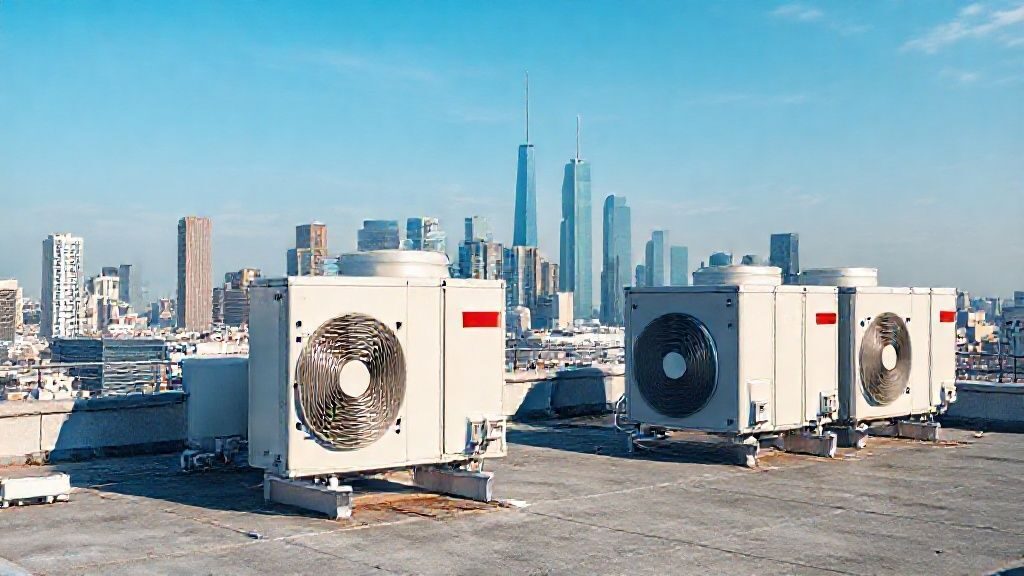
These are the most common systems you will encounter in retail spaces, offices, and small manufacturing facilities. The entire mechanical system—condenser, compressor, evaporator, and blower—is contained within a single large box located on the roof. This design saves valuable interior space and makes service access easier, provided the weather cooperates.
Commercial Split Systems
Similar to their residential counterparts, commercial split systems have an outdoor condensing unit and an indoor air handler. However, commercial systems operate at much higher tonnages and often utilize zoning technology to manage comfort across many distinct areas of a building. If you are unfamiliar with the terminology, you can reference this clear split ac description, but understand that the commercial application demands industrial-grade components.
Chillers
Chillers are used for large facilities—hospitals, universities, large manufacturing plants, and high-rise office towers. They work by cooling water, which is then circulated through the building to cool the air handlers. Chillers are complex mechanical beasts requiring specialized training to maintain. They offer extremely high capacity and energy efficiency when properly managed.
Variable Refrigerant Flow (VRF) Systems
VRF systems are growing in popularity, especially in buildings requiring simultaneous heating and cooling in different zones. They use refrigerant as the cooling and heating medium and allow fine-tuned control over dozens of individual indoor units connected to a single outdoor condenser. This offers significant energy savings and superior occupant comfort control.
For certain specialized needs, particularly temporary setups or industrial use, highly scalable and rugged equipment is needed. I often recommend exploring modular hvac systems, as they offer flexibility in scaling capacity up or down depending on the current load requirements of the business space.
Essential Commercial AC Services We Offer (Installation and Replacement)
When it’s time to install a new system or replace an aging unit, the complexity multiplies. This is not a weekend project; it requires licensed professionals, crane operators, and detailed load calculations.
Load Calculation and Sizing
The single biggest mistake I see in commercial installations is improper sizing. We use Manual N calculations, which account for occupancy, lighting, equipment heat load, window exposure, insulation, and regional climate data. An oversized commercial unit short-cycles, leading to poor humidity control and premature component wear. An undersized unit runs constantly, spiking energy bills and failing to maintain comfort during peak demand.
The Installation Process
For a typical rooftop unit replacement, the process is streamlined but demanding:
- Disconnect and Rigging: Safely shutting down and disconnecting electrical and refrigerant lines.
- Crane Operation: Lifting the old, massive unit off the roof and hoisting the new unit into place. This requires precise timing and coordination with local authorities for street closures, if necessary.
- Welding and Brazing: Making precise, clean connections for refrigerant lines, which must be rated for the high pressures found in commercial systems.
- Electrical Wiring: Connecting high-voltage, 3-phase power and integrating new control wiring for thermostats and building management systems (BMS).
- Commissioning: Testing static pressure, airflow, and refrigerant levels to ensure the unit runs exactly to manufacturer specifications upon startup.
When dealing with the high capital expenditure required for a new commercial HVAC system, cash flow is often a concern. We understand that, and we work hard to provide options for businesses. If upfront costs are challenging, many businesses find options like buy now pay later air conditioner programs helpful to manage these necessary investments. If you are looking to start the planning process for a major overhaul or installation, the next logical step is to contact us for a quote so we can properly assess the unique needs of your facility.
Emergency Commercial Air Conditioning Repair: When Reliability Matters
In the commercial sector, an emergency repair is rarely just an inconvenience; it often means lost productivity, damaged inventory, or even regulatory non-compliance (in laboratories or food service). Our goal in an emergency is immediate, accurate diagnosis and rapid repair.
The Diagnosis Challenge
Commercial systems are complex. When a residential unit fails, it’s usually straightforward—a capacitor or a bad contactor. Commercial failures involve complex control boards, multi-stage compressors, sophisticated economizers, and often proprietary Building Management Systems (BMS). Our technicians carry specialized diagnostic tools (like phase rotation meters and advanced manifold gauges) required to quickly isolate the problem.
Common Emergency Scenarios
- Compressor Failure: The heart of the system. Replacement is time-consuming and expensive. Often caused by neglect (dirty coils leading to overheating) or voltage issues.
- Blower Motor Issues: A failed motor or a thrown/broken belt stops airflow entirely, shutting down the cooling cycle.
- Refrigerant Leaks: Large leaks on high-tonnage systems require specialized recovery and leak detection equipment and often necessitate large volumes of replacement refrigerant.
We staff our emergency service team with technicians who specialize only in commercial equipment. They understand that a quick fix is useless if it doesn’t address the root cause, which is often systemic rather than just a single failed part. Downtime is expensive, and getting it right the first time minimizes future disruption.
The Critical Role of Preventative Commercial AC Maintenance Plans
If you take one piece of advice from me, let it be this: Implement a detailed preventative maintenance (PM) plan for your commercial HVAC units. Maintenance is not a cost; it is insurance against catastrophic failure. Commercial systems typically demand quarterly or semi-annual maintenance due to their high load factors.
What a Comprehensive PM Plan Includes
A good maintenance plan goes far beyond changing filters. It is a detailed inspection of every subsystem:
- Coil Cleaning and Washing: Evaporator and condenser coils must be chemically cleaned. Dirty coils reduce efficiency by 25% or more and dramatically increase head pressure, leading directly to compressor failure.
- Blower Belt Inspection and Replacement: Belts wear out. A loose belt wastes energy; a broken belt shuts the system down. They need to be checked for tension and wear patterns quarterly.
- Lubrication: Motor bearings and sometimes dampers require periodic, specific lubrication to prevent friction and premature wear.
- Electrical Checks: Checking voltage, amperage, and phases on all motors and compressors. Identifying loose wires, scorched contactors, and weak capacitors before they fail under load.
- Drain Pan and Line Clearance: Ensuring condensate drains are free-flowing to prevent water damage inside the building and mold growth in the air handler.
- Economizer Functionality: Testing the economizer dampers to ensure they are opening correctly to utilize free cooling (outside air) when temperatures allow. This is a massive energy saver if functioning properly.
By investing in professional, regular maintenance, you ensure the longevity of your assets and maintain peak system efficiency, which directly impacts your bottom line through reduced energy consumption.
Maximizing Business Efficiency: Tips for Commercial HVAC Systems
Commercial spaces consume vast amounts of energy, and HVAC often accounts for 40% to 60% of that total. Efficiency isn’t just about the unit’s SEER rating; it’s about how the entire system is controlled and managed.
Implementing Zoning and Controls
If your entire building is cooled or heated to one temperature setpoint, you are wasting money. Modern commercial zoning allows you to adjust temperatures based on occupancy, time of day, and specific area needs (e.g., warmer in the warehouse, cooler in the server room). Integrating a modern Building Management System (BMS) provides the necessary data and control to optimize every cycle.
Optimizing Economizers
An economizer uses cool outside air to provide “free cooling” instead of running the compressor. If your unit has one, ensure it is calibrated correctly. A stuck or broken economizer damper can either allow hot air in when it shouldn’t, or prevent cold air from being utilized, costing thousands annually in wasted cooling effort.
Ductwork Integrity
Leakage in commercial ductwork, particularly in older buildings or ceiling plenums, can be significant. We often perform duct leakage tests to ensure that the conditioned air makes it to the occupied space. Fixing duct leaks is often one of the quickest and most cost-effective efficiency improvements a business can make.
Common Commercial Air Conditioning Problems and Troubleshooting
As a business owner, you should know the warning signs that your commercial HVAC system is in distress. Catching these early can prevent a day of lost revenue.
1. High Energy Bills
If your utility costs spike without a corresponding increase in usage hours, the system is likely suffering from inefficiency. The top causes are dirty coils, low refrigerant charge, or a failing blower motor forcing the unit to run longer cycles.
2. Poor Airflow and Hot Spots
If some areas of the building are hot while others are freezing, this points to zoning issues, problems with VAV (Variable Air Volume) boxes, or severely restricted filters. Never underestimate the impact of clogged filters on airflow, especially in environments with high dust or lint.
3. Constant Running (Short Cycling or Long Cycles)
A system that runs constantly may be undersized, or it could be battling excessive heat gain due to poor insulation or a malfunctioning thermostat/sensor. Short cycling (turning off and on rapidly) is highly destructive to the compressor and often indicates an electrical fault or a serious pressure imbalance.
4. Water Leaks
Pooling water around the indoor unit or dripping from the ceiling is usually a blocked condensate drain line. While often a minor fix, if ignored, it leads to expensive ceiling damage, mold growth, and potential system shutdown if the safety float switch is activated.
When you are looking for long-term solutions, remember that the quality of your equipment and the quality of the installation go hand-in-hand. Finding the best hvac providers ensures that you receive durable equipment installed to strict commercial specifications.
Why Choose Our Experts for Your Commercial HVAC Needs
My team doesn’t just hire general technicians; we deploy commercial HVAC specialists. This distinction is crucial. Commercial units operate under different safety protocols, pressures, and control schemes than residential units. When you choose us, you are getting decades of combined experience dedicated solely to the unique challenges of keeping a business climate-controlled.
Specialized Equipment and Certification
We own the rigging equipment, cranes, and specialized recovery tools necessary to handle large commercial systems efficiently and legally. We maintain certifications for large refrigerant handling (EPA 608 Universal) and adhere strictly to OSHA safety standards, which are essential when working on rooftops and high-voltage equipment.
Focus on Business Continuity
We understand the concept of the “critical load.” Our maintenance schedules are designed to minimize disruption, often scheduled after hours or on weekends. Our repair strategy is always focused on restoring full functionality with minimal downtime, ensuring your employees and customers remain comfortable and your operations remain uninterrupted.
We approach every job—from the smallest split system maintenance to a multi-chiller replacement—with the mindset of maximizing your asset lifespan and optimizing your energy consumption. Our reports are transparent, showing you exactly where efficiency losses are occurring and providing clear, actionable steps to remedy them.
FAQ
What is the typical lifespan of a commercial AC unit?
A well-maintained commercial rooftop unit typically lasts between 15 and 20 years. However, high-tonnage chillers, due to their robust construction and comprehensive maintenance, can often exceed 25 years. The key factor is routine, detailed preventative maintenance; neglected systems often fail within 10 to 12 years.
How often should commercial AC filters be replaced?
This depends heavily on the environment. In a standard office environment, quarterly changes (every three months) are sufficient. For high-dust environments (like light manufacturing, food service, or hair salons), monthly filter checks and replacements are often necessary. Neglecting filter changes restricts airflow, increases energy costs, and reduces dehumidification.
Is it better to repair or replace an aging commercial unit?
I typically use the 50% rule. If the repair cost exceeds 50% of the cost of a new replacement unit, replacement is generally the more financially sound decision. Additionally, consider the unit’s age (over 15 years old) and current energy efficiency. Modern high-efficiency units often have such significant energy savings that they can offset the replacement cost within a few years.
What is the difference between tonnage and horsepower in commercial HVAC?
Tonnage measures the cooling capacity (the amount of heat the unit can remove). One ton equals 12,000 BTUs per hour. Horsepower (HP) measures the mechanical power required to drive the fan motors and compressors. While related, when sizing a system, we rely primarily on the tonnage required to meet the calculated cooling load of the building.
What is an energy audit for commercial HVAC?
An energy audit is a detailed inspection of your entire building envelope and HVAC system to identify where energy waste is occurring. We use specialized tools, including thermal cameras and airflow measurement devices, to pinpoint inefficiencies in insulation, ductwork, controls, and system operation. The resulting report provides prioritized steps for guaranteed energy reduction.
Final Thoughts
Managing a commercial air conditioning system is fundamentally about risk management. Every business owner understands that reliable comfort and process cooling directly impact productivity and profitability. Don’t wait for a 90-degree day and a complete shutdown to realize the value of your HVAC system.
By investing in professional installation based on accurate load calculations, securing a robust preventative maintenance plan, and partnering with experienced commercial technicians, you ensure that your equipment delivers its maximum lifespan and peak efficiency. The upfront cost of proper care always pales in comparison to the massive expense of emergency repair and lost business hours. Make the right choice for your operation and treat your commercial HVAC system like the vital asset it is.