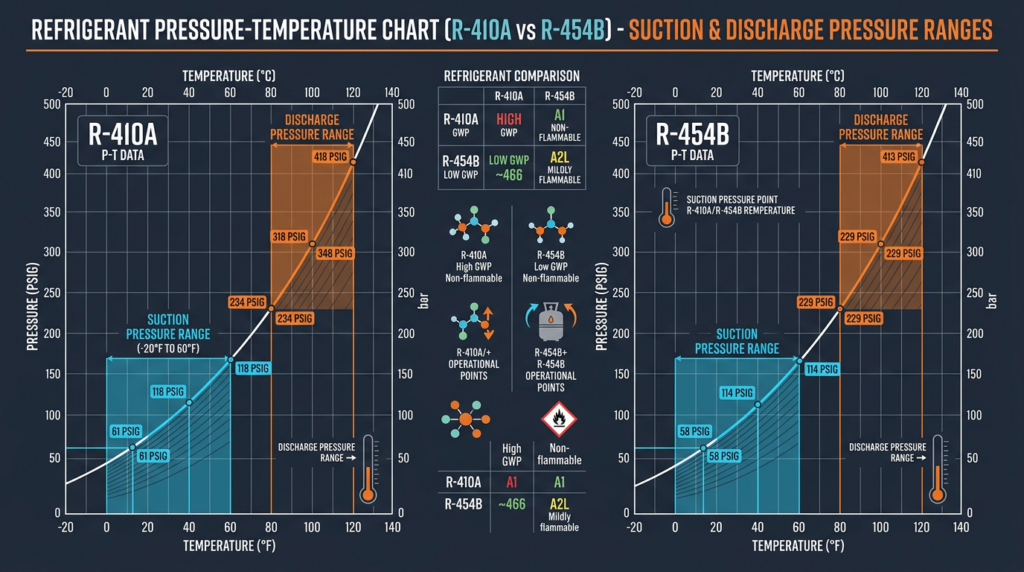
Refrigerant pressure is the single most telling diagnostic measurement in air conditioning service work. Every component in the refrigeration cycle affects pressure, and every pressure reading tells a story about what is happening inside the system. Understanding normal operating ranges allows technicians to pinpoint problems quickly and helps homeowners recognize when something is wrong. However, “normal” is not a fixed number. Operating pressures depend on the refrigerant type, outdoor and indoor temperatures, humidity, airflow, system design, and manufacturer specifications. Treating pressure readings as absolute benchmarks without considering these variables is one of the most common mistakes in HVAC service.
The Refrigeration Cycle and the Role of Refrigerant
Refrigerant is a chemical compound that absorbs heat from indoor air and releases it outdoors. It does this by changing state between liquid and vapor at controlled pressures and temperatures. The basic refrigeration cycle has four stages:
- Evaporation: Low-pressure liquid refrigerant enters the evaporator coil inside the home, absorbs heat from the indoor air, and boils into a vapor.
- Compression: The compressor draws in this low-pressure vapor and compresses it into a high-pressure, high-temperature vapor.
- Condensation: The hot, high-pressure vapor flows to the outdoor condenser coil, where it releases heat to the outside air and condenses into a high-pressure liquid.
- Expansion: The high-pressure liquid passes through a metering device (either a thermostatic expansion valve or a fixed orifice), which rapidly drops the pressure and temperature before the refrigerant returns to the evaporator.
Pressure readings at the suction (low) side and discharge (high) side of this cycle reveal whether each stage is functioning correctly.
Types of Refrigerants in Air Conditioning
R-22 (Legacy Refrigerant)
R-22, also known as HCFC-22, was the dominant residential air conditioning refrigerant for decades. The EPA completed its phase-out on January 1, 2020. R-22 can no longer be produced or imported in the United States. Existing systems may still operate on R-22, but servicing them requires reclaimed or recycled refrigerant, which is increasingly expensive and scarce. R-22 systems are not covered in detail here because no new installations use this refrigerant, and replacement is strongly recommended.
R-410A (Current Standard)
R-410A is the most widely used refrigerant in residential air conditioning systems installed since the mid-2000s. It operates at significantly higher pressures than R-22 and requires equipment rated for those pressures. R-410A is an HFC (hydrofluorocarbon) with zero ozone depletion potential but a global warming potential (GWP) of 2,088, which is driving its phasedown under the American Innovation and Manufacturing (AIM) Act.
R-32 and Emerging Low-GWP Refrigerants
R-32 has a GWP of 675, roughly one-third that of R-410A, and is already used in some ductless mini-split systems. It operates at slightly higher pressures than R-410A at the same temperatures. ASHRAE classifies R-32 as A2L (mildly flammable), which introduces additional safety requirements for equipment design, installation, and servicing.
Other emerging refrigerants include R-454B (GWP of 466) and R-452B (GWP of 698). These A2L blends are being adopted in new equipment to meet GWP limits established by international agreements and the AIM Act. Technicians must use refrigerant-specific tools, follow updated safety protocols, and receive training on flammability hazards before working with A2L refrigerants.
Understanding Refrigerant Pressure
Refrigerant pressure is measured in psig (pounds per square inch gauge), which represents pressure above atmospheric pressure. Every refrigerant has a unique relationship between pressure and temperature, expressed in a pressure-temperature (PT) chart. At a given pressure, a refrigerant in a saturated state (where liquid and vapor coexist) will be at a specific temperature called the saturation temperature.
This relationship is the foundation of all HVAC diagnostics. When a technician reads the suction pressure and converts it to saturation temperature using the correct PT chart, that number can be compared against actual pipe temperatures to calculate superheat and subcooling. Using the wrong PT chart for the refrigerant in the system will produce entirely inaccurate results.
Normal Operating Pressure Ranges
R-410A Typical Ranges
- Suction (low-side) pressure: 110 to 150 psig under typical residential cooling conditions. This corresponds to evaporator saturation temperatures roughly between 38°F and 45°F, depending on indoor conditions.
- Discharge (high-side) pressure: 300 to 400 psig under typical conditions. This corresponds to condensing temperatures that vary with outdoor ambient temperature, typically ranging from about 100°F to 125°F.
R-32 Typical Ranges
R-32 operates at slightly higher pressures than R-410A at equivalent temperatures. Exact ranges depend on the specific equipment. Always consult the manufacturer’s PT chart and installation manual for R-32 systems.
Factors That Affect Operating Pressures
No single pressure reading is universally “correct.” The following factors cause significant variation:
- Outdoor ambient temperature: Higher outdoor temperatures raise discharge (high-side) pressures. A system running on a 95°F day will show substantially higher head pressure than the same system on an 80°F day.
- Indoor temperature and humidity: Warmer, more humid indoor conditions increase the heat load on the evaporator, raising suction pressures.
- Airflow: Restricted airflow across the evaporator (dirty filter, collapsed duct, slow blower) lowers suction pressure. Restricted airflow across the condenser (dirty coils, blocked fins) raises discharge pressure.
- System design and metering device: Systems with a thermostatic expansion valve (TXV) regulate refrigerant flow differently than systems with a fixed orifice. Charging methods and target values differ between these designs.
- Refrigerant charge level: Undercharged systems show low suction and low discharge pressures. Overcharged systems show high suction and high discharge pressures.
- Line set length: Longer refrigerant line sets create additional pressure drop, which must be accounted for during charging.
Manufacturer specifications always take precedence over general guidelines. The nameplate data and installation manual for each specific unit will list expected operating parameters.
Superheat and Subcooling
Superheat is the temperature of the refrigerant vapor above its saturation temperature at the suction side. It confirms that all liquid refrigerant has evaporated before reaching the compressor, preventing liquid slugging and compressor damage. To measure superheat, subtract the saturation temperature (derived from the suction pressure and PT chart) from the actual temperature of the suction line at the evaporator outlet.
Subcooling is the temperature of the liquid refrigerant below its saturation temperature at the discharge (liquid line) side. It confirms that the refrigerant has fully condensed and is in a pure liquid state before entering the metering device. To measure subcooling, subtract the actual liquid line temperature from the saturation temperature (derived from the discharge pressure and PT chart).
Target Values
- Systems with a TXV: Charge using subcooling. Target subcooling is typically 8 to 12°F, though manufacturer specs may differ. The TXV automatically adjusts superheat, typically holding it between 8 and 12°F.
- Systems with a fixed orifice: Charge using superheat. Target superheat is typically 8 to 14°F, depending on indoor and outdoor conditions. Subcooling is still a useful secondary check.
Relying on pressure readings alone without calculating superheat and subcooling is one of the most common diagnostic errors. Two systems can show identical suction pressures yet have very different superheat values, indicating completely different problems. Proper airflow is essential for accurate superheat and subcooling measurements. Ductwork designed to ACCA Manual D standards ensures the evaporator receives the correct volume of air.
Troubleshooting Abnormal Refrigerant Pressures
High Suction Pressure
- Overcharged system
- Compressor not pumping efficiently (valve or mechanical failure)
- Metering device stuck open or oversized
- Excessive heat load (unusually hot indoor conditions, open doors or windows)
Low Suction Pressure
- Refrigerant undercharge or leak
- Restricted airflow across the evaporator (dirty filter, iced coil, blower motor failure)
- Metering device restricted or partially blocked
- Liquid line restriction (kinked line, clogged filter-drier)
High Discharge Pressure
- Dirty or blocked condenser coil
- Condenser fan motor failure or running at reduced speed
- Overcharged system
- Non-condensable gases (air or nitrogen) in the system
- Extremely high outdoor ambient temperature
Low Discharge Pressure
- Refrigerant undercharge or leak
- Compressor not compressing efficiently
- Metering device stuck wide open (bypassing too much refrigerant)
A systematic troubleshooting approach involves recording suction pressure, discharge pressure, suction line temperature, liquid line temperature, outdoor ambient temperature, and indoor return air temperature. These measurements together, combined with superheat and subcooling calculations, allow a technician to accurately diagnose the system.
Charging Procedures
Proper refrigerant charging is critical for system efficiency, performance, and longevity. The preferred method is the weigh-in method, where the system is evacuated and charged with the exact amount of refrigerant specified on the nameplate. This eliminates guesswork.
When a weigh-in charge is not practical (such as field-adjusting after a line set change), technicians use superheat or subcooling methods depending on the metering device type. Charging must always follow the manufacturer’s procedures.
- Overcharging raises suction and discharge pressures, reduces efficiency, can cause liquid slugging to the compressor, and may trigger high-pressure safety switches.
- Undercharging lowers suction and discharge pressures, reduces cooling capacity, can cause the evaporator to starve, and may lead to compressor overheating due to insufficient cooling from the returning refrigerant.
Simply “topping off” refrigerant without identifying and repairing the source of a leak is a violation of EPA regulations and a disservice to the customer. R-410A must be charged as a liquid because it is a zeotropic blend, and vapor-charging can alter its composition.
Tools and Equipment
- Manifold gauge sets: Analog gauges remain common, but digital manifold gauges offer greater accuracy, automatic PT calculations, and data logging. Digital gauges are strongly recommended for modern refrigerants.
- Thermometers: Clamp-on digital thermometers or thermocouple probes measure pipe temperatures for superheat and subcooling. Infrared thermometers can supplement but are less accurate on reflective copper surfaces.
- Electronic leak detectors: Required for locating refrigerant leaks. Heated diode and infrared detectors offer the best sensitivity.
- Vacuum pumps: Used during system evacuation to remove moisture and non-condensables before charging.
- Refrigerant recovery machines: Legally required for recovering refrigerant before repairs. Venting refrigerant is illegal under EPA Section 608.
- Refrigerant scales: Essential for weigh-in charging with accuracy to fractions of an ounce.
Safety Considerations
Working with refrigerants requires proper personal protective equipment, including safety glasses and gloves. Liquid refrigerant causes frostbite on skin contact. All work must be performed in well-ventilated areas because refrigerant vapor displaces oxygen in enclosed spaces.
A2L refrigerants (R-32, R-454B, R-452B) introduce flammability hazards. Technicians must use spark-free tools, avoid open flames near service ports, and follow manufacturer guidelines for charge limits and leak testing. Equipment designed for A2L refrigerants includes additional safety features such as leak detection sensors.
EPA Section 608 certification is legally required for anyone who purchases, handles, or disposes of refrigerants. Technicians must hold the appropriate certification level (Type I, Type II, Type III, or Universal) for the equipment they service.
Regulations and the Future of Refrigerants
AIM Act and HFC Phasedown
The American Innovation and Manufacturing (AIM) Act directs the EPA to phase down HFC production and consumption by 85% by 2036, using a baseline of historical production levels. R-410A falls under this phasedown. Starting in 2025, new residential and light commercial air conditioning equipment is required to use refrigerants with a GWP of 700 or less, effectively ending R-410A in new systems. Existing R-410A systems can continue to operate and be serviced, but refrigerant costs are expected to rise as supply tightens.
Efficiency Standards (Post-2023)
As of January 1, 2023, new federal efficiency standards took effect using updated testing procedures: SEER2, EER2, and HSPF2. These metrics use a higher external static pressure during testing to better reflect real-world duct conditions. Minimum SEER2 ratings are 14.3 in the Northern region and 15.0 in the Southeast and Southwest for split-system air conditioners. These standards interact with refrigerant pressures because higher-efficiency equipment often uses variable-speed compressors and electronic expansion valves, which produce different pressure profiles than single-stage systems.
Inflation Reduction Act Incentives
The Inflation Reduction Act (IRA) provides tax credits of up to $2,000 for qualifying heat pumps and high-efficiency HVAC equipment under Section 25C (now the Energy Efficient Home Improvement Credit). Additional rebates through state-administered Home Efficiency Rebate programs (Section 50121 and 50122) can further offset costs. These incentives encourage adoption of systems using low-GWP refrigerants and meeting current efficiency standards.
Common Misconceptions
- “The pressure should always be X.” There is no single correct pressure. Operating pressures change with ambient conditions, load, and system design. A suction pressure of 118 psig and 145 psig can both be perfectly normal on different days for the same R-410A system.
- “Just add refrigerant if it’s low.” Refrigerant does not get consumed. If levels are low, there is a leak. Adding refrigerant without repairing the leak wastes money, harms the environment, and violates EPA regulations.
- “Pressures alone tell you everything.” Without superheat and subcooling calculations, pressure readings are incomplete. Two identical suction pressures can indicate very different system conditions.
- “R-410A will always be available.” The AIM Act phasedown will progressively limit R-410A supply. Costs will rise, and replacement parts will become harder to source. Planning for the transition is prudent.
- “All PT charts are the same.” Each refrigerant has a unique PT relationship. Using an R-22 chart on an R-410A system will produce dangerously wrong conclusions.
Key Takeaways
- R-410A suction pressures typically range from 110 to 150 psig, and discharge pressures from 300 to 400 psig, but actual values depend on operating conditions and system design.
- Always use the correct PT chart for the specific refrigerant in the system.
- Superheat and subcooling measurements are essential complements to pressure readings. Target values are typically 8 to 12°F for both, but manufacturer specifications always take priority.
- The weigh-in method is the most accurate charging approach. Superheat charging is used for fixed-orifice systems, and subcooling charging is used for TXV systems.
- R-410A is being phased down under the AIM Act. New residential equipment from 2025 onward must use refrigerants with a GWP of 700 or lower, such as R-32 or R-454B.
- EPA Section 608 certification is required for all refrigerant handling. Venting refrigerant is illegal.
- Regular preventive maintenance, including checking refrigerant charge, cleaning coils, replacing filters, and verifying airflow, prevents most pressure-related problems and extends equipment life.
- A2L refrigerants require additional safety training and spark-free tools due to mild flammability. The industry is in an active transition period that demands ongoing education for technicians and informed decision-making by homeowners.