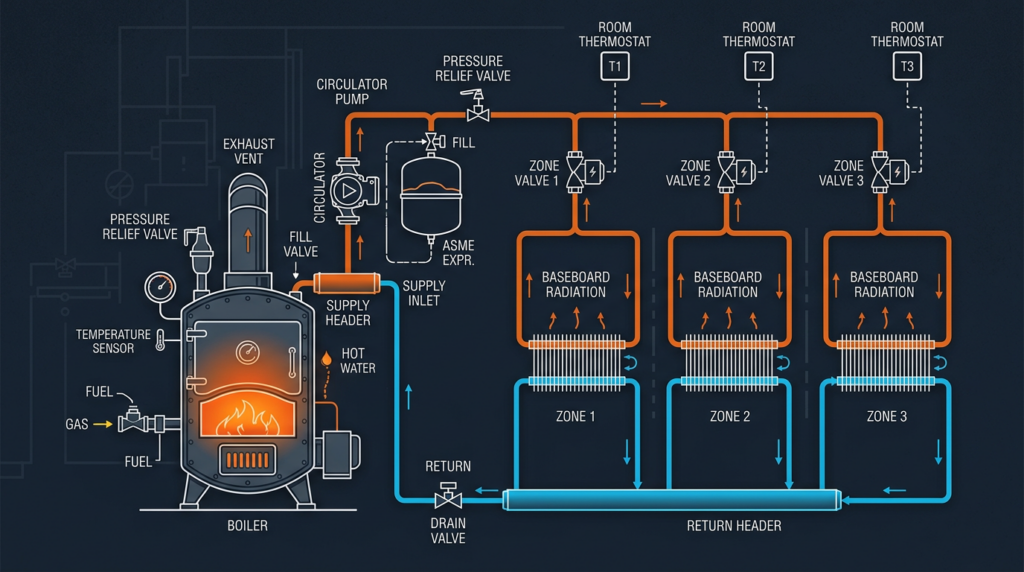
Modern boilers operate at efficiencies exceeding 95%, making them one of the most effective ways to heat buildings in cold climates. Unlike furnaces, which heat air directly, a boiler heats water or produces steam and distributes that thermal energy throughout a building using a network of pipes, radiators, or radiant tubing. This approach, known as hydronic heating, delivers consistent warmth with less noise, fewer airborne allergens, and greater zone control than forced-air alternatives. Whether you are a homeowner evaluating heating options, a technician servicing commercial systems, or a building professional designing new construction, understanding boiler types, components, and hydronic distribution methods is essential for achieving efficient, comfortable, and reliable heating.
Boiler Types
Boilers vary widely in fuel source, efficiency, and construction. Selecting the right type depends on local fuel availability, building size, budget, and performance goals. The four primary categories are condensing, non-condensing, electric, and oil-fired boilers.
Condensing Boilers
A condensing boiler recovers latent heat from exhaust gases by cooling them to the point where water vapor in the flue gas condenses. This heat recovery process pushes efficiency well beyond what conventional boilers can achieve.
- AFUE (Annual Fuel Utilization Efficiency): Condensing boilers typically achieve 90% to 98% AFUE. Optimal condensation occurs when return water temperature stays at or below 130°F (54°C), which is why these boilers pair exceptionally well with radiant floor systems and low-temperature panel radiators.
- Modulating burners: Most condensing units feature modulating burners with high turndown ratios, often 10:1 or greater. A 10:1 turndown ratio means a 100,000 BTU/hr boiler can reduce output to 10,000 BTU/hr, matching the building’s actual heating load rather than cycling on and off. This precise modulation reduces fuel consumption and minimizes temperature swings.
- Heat exchanger materials: Because the condensate produced is mildly acidic (pH around 3.5 to 5), heat exchangers are built from stainless steel or specialized alloys such as titanium-stabilized stainless steel to resist corrosion.
- Venting: Lower flue gas temperatures (typically 100°F to 150°F) allow the use of PVC or CPVC vent piping instead of traditional metal flues. A condensate drain line routed to a floor drain or neutralizer tank is required.
Advantages: Lower operating costs, reduced greenhouse gas emissions, compatibility with smart controls and IoT-based remote monitoring platforms. As of 2024, many utility programs and federal tax credits (under the Inflation Reduction Act) offer rebates for high-efficiency condensing equipment.
Disadvantages: Higher upfront purchase price, more complex installation due to condensate management, and the need for compatible low-temperature distribution systems to realize full efficiency gains.
Non-Condensing Boilers
A non-condensing boiler exhausts combustion gases at temperatures high enough to prevent condensation in the flue, typically above 300°F. These units do not recover latent heat.
- AFUE: Ranges from 80% to 89%.
- Heat exchanger materials: Cast iron, copper, or carbon steel. Cast iron sectional boilers remain common in older installations and offer long service life when properly maintained.
- Venting: Traditional Type B metal flues or masonry chimneys, relying on natural draft or power venting.
Advantages: Lower initial cost and simpler installation, especially in replacement scenarios where existing chimney infrastructure is already in place.
Disadvantages: Higher fuel bills over the boiler’s lifespan and greater carbon emissions. Some jurisdictions, particularly in the Northeast United States and parts of Europe, have begun restricting new installations of non-condensing gas boilers in residential buildings.
Electric Boilers
An electric boiler uses immersion heaters or resistance coils to convert electricity directly into heat. There is no combustion involved.
- Efficiency: Approaches 99% to 100% at the point of use, since virtually all electrical energy converts to heat.
- Power requirements: Residential units typically require 240V service and can draw 40 to 100+ amps depending on capacity, which may range from 15,000 to 100,000 BTU/hr.
- Emissions: Zero on-site combustion emissions, making them attractive in buildings pursuing electrification or in areas where the electrical grid draws heavily from renewable sources.
Advantages: Compact footprint, silent operation, no flue or gas piping required, and straightforward installation. Electric boilers are increasingly paired with rooftop solar arrays and battery storage to offset operating costs.
Disadvantages: Operating costs can be high where electricity prices exceed $0.15/kWh. Capacity is limited compared to large gas-fired or oil-fired equipment, making electric boilers best suited for smaller buildings, supplemental heating, or regions without natural gas infrastructure.
Emerging electrode boilers, which pass current directly through the water rather than through resistance elements, are gaining traction in commercial applications for their rapid response and precise load-following ability.
Oil-Fired Boilers
An oil-fired boiler burns #2 heating oil delivered by truck and stored in an on-site tank, typically 275 gallons for residential use.
- AFUE: 80% to 90%, with newer models equipped with flame-retention burners reaching the upper end of that range.
- Venting: Requires a properly sized flue to handle combustion gases, with regular inspection for soot buildup.
Advantages: Provides high heat output and remains a practical choice in rural areas without natural gas service.
Disadvantages: Volatile fuel prices, on-site storage requirements, higher particulate and CO₂ emissions compared to natural gas, and the need for regular tank maintenance. The market share of oil-fired boilers has declined steadily as heat pump technology improves and biofuel blends (such as B20 biodiesel) gain limited adoption as a transitional measure.
Key Boiler Components
Regardless of fuel type, boilers share a set of critical components that work together to generate, control, and distribute heat safely.
Heat Exchanger
The heat exchanger transfers thermal energy from combustion gases (or electric elements) to the circulating water. Materials include cast iron (durable, heavy, slower to respond), copper (lightweight, fast heat transfer, susceptible to scale), steel (cost-effective, moderate lifespan), and stainless steel (corrosion-resistant, used in condensing units). Designs range from finned-tube and shell-and-tube configurations to cast iron sectional assemblies.
Burner
The burner mixes fuel with air and ignites the mixture. Three main types exist:
- Atmospheric burners: Rely on natural draft; simple but less efficient.
- Power burners: Use a fan to force air into the combustion chamber, improving combustion efficiency and allowing sealed combustion designs.
- Modulating burners: Adjust flame intensity continuously based on demand, delivering the best efficiency and comfort by matching output to load.
Controls and Safety Devices
Modern boiler controls govern ignition sequence, water temperature, system pressure, and fault detection. Key components include:
- Thermostats and outdoor reset controls that adjust water temperature based on outside air conditions
- Pressure gauges and temperature sensors
- Pressure relief valve: Opens automatically if system pressure exceeds safe limits (typically 30 psi in residential hydronic systems), preventing catastrophic failure
- Low water cut-off (LWCO): Shuts down the burner if water level drops below a safe threshold, protecting the heat exchanger from overheating
- Flame sensors and electronic ignition modules
- Smart control boards with Wi-Fi connectivity for remote monitoring, diagnostics, and integration with building automation systems
Circulator Pump
The circulator pump moves heated water through the distribution piping and back to the boiler. Wet-rotor (in-line) circulators are standard in residential systems due to their quiet operation and compact size. Variable-speed circulators, such as ECM (electronically commutated motor) models, automatically adjust flow rate to match demand, reducing electrical consumption by up to 85% compared to fixed-speed pumps.
Expansion Tank
Water expands roughly 4% in volume when heated from 40°F to 200°F. The expansion tank, usually a bladder or diaphragm type, absorbs this expansion and prevents dangerous pressure buildup. Proper sizing is critical; an undersized tank leads to frequent pressure relief valve discharge and potential system damage.
Air Separator
An air separator removes dissolved air and microbubbles from the system water. Trapped air causes gurgling noises, reduces heat transfer efficiency, and accelerates internal corrosion of ferrous components.
Hydronic Heating Systems
A hydronic heating system uses heated water circulated through a closed-loop piping network to deliver warmth to occupied spaces. The boiler serves as the heat source, while the distribution method determines comfort characteristics, response time, and installation cost.
Distribution Methods
- Cast iron radiators: Found in many pre-war buildings, these heavy units store significant thermal mass and provide steady, even heat. They operate well at higher water temperatures (160°F to 180°F) and are slow to respond to thermostat changes.
- Baseboard heaters (finned tube): Copper or steel tubing with aluminum fins, mounted along walls at floor level. They offer lower cost and easier installation than radiators but can collect dust and limit furniture placement.
- In-floor radiant heating: Cross-linked polyethylene (PEX) tubing embedded in a concrete slab or stapled beneath a subfloor. Water temperatures of 85°F to 120°F produce comfortable, uniform floor surface temperatures. This method is highly efficient, especially when paired with a condensing boiler, but carries higher installation costs and longer response times due to the thermal mass of the slab.
- Panel radiators: Popular in European markets and gaining ground in North America, these slim, wall-mounted units respond quickly and operate effectively at moderate water temperatures (110°F to 150°F).
- Fan coil units: Combine a hydronic coil with a small blower to deliver heated (or cooled) air through ductwork or directly into a room. They provide fast response and individual zone control, making them common in hotels, apartments, and office buildings.
System Design Considerations
Proper hydronic system design starts with an accurate heat loss calculation. Industry-standard methods such as ACCA Manual J (residential) or ASHRAE load calculation procedures (commercial) account for insulation levels, window area, infiltration rates, and local design temperatures. Oversizing the boiler wastes fuel through short cycling, while undersizing leaves the building cold on the coldest days.
Piping can be arranged in series (one loop, simple but uneven temperatures), parallel (reverse-return, balanced flow), or home-run configurations. Zoning divides the building into independently controlled areas using zone valves or dedicated circulator pumps, each governed by its own thermostat. Zoning reduces energy waste by heating only occupied spaces.
Water treatment protects the system from scale, corrosion, and biological growth. A proper fill consists of treated water with appropriate inhibitors, and pH should be monitored annually. Glycol antifreeze solutions are used in systems exposed to freezing conditions, such as snow-melt loops or buildings with intermittent occupancy.
Advantages of Hydronic Heating
- Even heat distribution with minimal temperature stratification from floor to ceiling
- Quiet operation with no duct noise or blower hum
- Improved indoor air quality because there is no forced air movement to circulate dust, pollen, and pet dander
- High energy efficiency potential, particularly with condensing boilers and radiant distribution
- Flexible integration with domestic hot water production through indirect-fired water heaters
Disadvantages of Hydronic Heating
- Higher installation cost compared to forced-air systems
- No built-in cooling capability (a separate system is required for air conditioning)
- Slower thermal response in high-mass systems like radiant slabs
- Risk of water leaks requiring careful installation and ongoing inspection
Combination and Specialty Applications
Boilers frequently serve double duty. An indirect water heater connected to the boiler provides domestic hot water with high recovery rates and long tank life. Snow-melt systems circulate boiler-heated glycol solution through tubing beneath driveways and walkways to eliminate ice buildup. Solar thermal collectors and geothermal heat pumps can also feed into hydronic piping networks, with the boiler acting as a backup heat source during peak demand.
Common Misconceptions
- “All boilers are basically the same.” A 98% AFUE condensing boiler and an 80% AFUE cast iron unit differ enormously in fuel consumption, emissions, and operating cost over a 20-year lifespan.
- “Bigger is always better.” An oversized boiler cycles on and off frequently, wasting fuel and increasing wear on components. Sizing must be based on calculated heat loss, not guesswork.
- “Boilers are dangerous.” Modern boilers include multiple redundant safety devices, including pressure relief valves, low water cut-offs, and flame safeguard controls. When professionally installed and annually maintained, they are extremely safe.
- “Hydronic heating is only for old houses.” New construction projects worldwide specify hydronic systems for their comfort, efficiency, and compatibility with renewable heat sources.
- “Hotter water equals better heating.” Condensing boilers achieve peak efficiency with return water below 130°F. Running unnecessarily high temperatures wastes energy and prevents condensation from occurring.
Maintenance and Practical Applications
Boilers serve residential buildings from single-family homes to large apartment complexes, as well as commercial facilities including schools, hospitals, office towers, and industrial plants. Regardless of scale, a consistent maintenance program is the single most important factor in boiler longevity and performance.
- Annual professional inspection: A qualified HVAC technician should check combustion efficiency, inspect the heat exchanger for cracks or fouling, verify safety controls, and test the pressure relief valve.
- Burner and heat exchanger cleaning: Soot and scale buildup reduce heat transfer and increase fuel consumption. Oil-fired units require more frequent cleaning than gas-fired models.
- Venting inspection: Confirm that flue connections are secure, vent piping is free of obstructions, and condensate drains are clear.
- Water chemistry monitoring: Test pH, dissolved oxygen levels, and inhibitor concentrations. Replace or treat system water as needed.
- Pressure and leak testing: Check system pressure (typically 12 to 18 psi cold in residential systems) and inspect all fittings, valves, and piping for signs of leakage.
Preventative maintenance extends equipment life well beyond the typical 15- to 30-year range, maintains peak efficiency, and prevents costly emergency repairs during the heating season.
Key Takeaways
- Condensing boilers offer the highest efficiency (90% to 98% AFUE) but require low return water temperatures and proper condensate management to deliver on that potential.
- Non-condensing, electric, and oil-fired boilers each fill specific niches based on fuel availability, budget, and building constraints.
- Critical components such as the heat exchanger, modulating burner, circulator pump, expansion tank, and safety controls must all be properly selected and maintained.
- Hydronic distribution methods range from cast iron radiators to in-floor radiant tubing, each with distinct comfort, cost, and response-time characteristics.
- Accurate heat loss calculations and proper system sizing prevent the energy waste and equipment damage caused by oversized boilers.
- Annual professional maintenance is essential for safety, efficiency, and long equipment life.
- Consult a qualified HVAC professional for boiler selection, installation, and ongoing service to ensure your system operates at its best for decades.