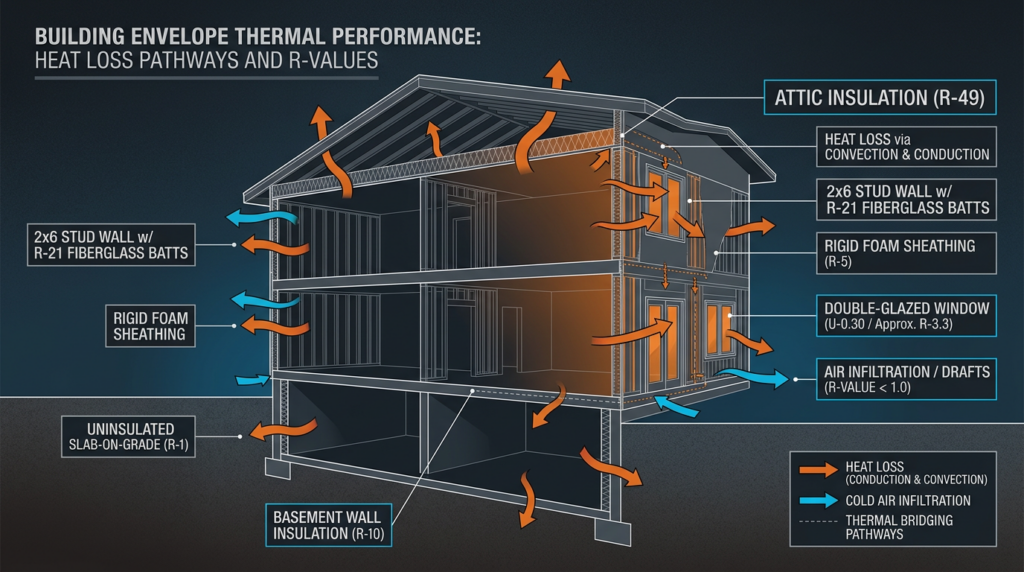
Buildings account for roughly 40% of total energy consumption in the United States, according to the U.S. Department of Energy. A significant portion of that energy goes directly toward heating and cooling. The building envelope, specifically its insulation, stands as the first and most critical line of defense against unwanted heat transfer. Understanding how insulation affects HVAC load is essential for HVAC professionals, building engineers, architects, and homeowners who want to reduce energy costs, right-size mechanical equipment, and maintain consistent indoor comfort. This article covers the fundamentals of the building envelope, heat transfer principles, insulation types and their properties, the direct impact on HVAC load calculations, relevant codes and standards, common misconceptions, practical applications, and emerging technologies shaping the future of building performance.
Defining the Building Envelope
The building envelope is the physical boundary separating the conditioned interior environment from the unconditioned exterior. It includes walls, the roof or ceiling assembly, floors, the foundation, windows, and doors. Every component plays a role in how much energy the HVAC system must expend to maintain comfortable conditions inside.
The building envelope serves four primary functions:
- Thermal resistance: Slowing the transfer of heat between interior and exterior environments.
- Air tightness: Minimizing uncontrolled air leakage into and out of the building.
- Moisture control: Managing water vapor movement to prevent condensation, mold, and structural damage.
- Solar radiation management: Controlling heat gain from direct and indirect sunlight through glazing and opaque surfaces.
A high-performance building envelope minimizes energy transfer across all four of these categories. When the envelope fails in any one area, the HVAC system must compensate, driving up energy consumption and equipment wear.
Key Concepts of Insulation
Heat Transfer Mechanisms
Heat moves through and around building assemblies in three ways:
- Conduction: Heat transfer through solid materials. When a warm interior wall touches a cold exterior sheathing layer, energy flows through the material from hot to cold.
- Convection: Heat transfer through the movement of fluids, primarily air. Warm air rising inside a wall cavity or leaking through gaps carries thermal energy with it.
- Radiation: Heat transfer through electromagnetic waves. The sun radiating heat onto a dark roof surface is a common example. Radiant energy does not require a medium and can cross air spaces.
Effective insulation strategies address all three mechanisms, though most insulation materials primarily resist conductive heat flow.
R-Value
R-value measures a material’s thermal resistance, or its ability to resist heat flow. A higher R-value means greater insulating capability. In U.S. customary units, R-value is expressed as hr·ft²·°F/Btu. In SI units, it is expressed as m²·K/W.
However, R-value alone does not tell the full story. Laboratory R-value ratings assume ideal installation conditions. In practice, gaps in insulation coverage, compressed batts, moisture intrusion, and air movement through or around the insulation can dramatically reduce actual thermal performance. A fiberglass batt rated at R-13 that is poorly fitted into a wall cavity with gaps and voids may perform closer to R-9 or R-10 in the field.
U-Value (U-Factor)
The U-value, or U-factor, is the overall coefficient of heat transfer for an entire building assembly. It represents the rate of heat flow through a composite section, including insulation, framing, sheathing, finishes, and air films. U-value is the mathematical reciprocal of R-value (U = 1/R). In U.S. customary units, it is expressed as Btu/hr·ft²·°F; in SI units, as W/m²·K.
U-value is especially useful for evaluating windows and complete wall assemblies because it accounts for all layers and materials in the system, not just the insulation itself.
Thermal Bridging
Thermal bridging occurs when materials with higher thermal conductivity, such as wood studs or steel framing, create pathways for heat to bypass the insulation layer. In a typical 2×6 wood-framed wall with R-19 fiberglass batts, the framing members (which have an R-value of approximately R-6.9 for 5.5 inches of wood) occupy roughly 25% of the wall area when headers, plates, and corners are included. This reduces the effective whole-wall R-value significantly below R-19. Steel studs are even more conductive and create more severe thermal bridges.
Strategies to mitigate thermal bridging include continuous insulation (CI) applied over the exterior of the framing, thermally broken framing systems, and advanced framing techniques that reduce the amount of structural lumber in the assembly.
Air Infiltration
Air infiltration is the uncontrolled leakage of outdoor air into the building through cracks, gaps, and openings in the envelope. Even a well-insulated building can have excessive HVAC loads if air sealing is neglected. The Department of Energy estimates that air leakage can account for 25% to 40% of heating and cooling energy in a typical home. Blower door testing, measured in air changes per hour at 50 Pascals (ACH50), quantifies the tightness of a building envelope and helps identify areas that need sealing.
Types of Insulation and Their Properties
Choosing the right insulation material depends on climate, application, budget, and performance goals. Below is an overview of the most common types.
Fiberglass
Available as batts, rolls, and loose-fill (blown-in), fiberglass insulation offers R-values of approximately R-2.9 to R-3.8 per inch. It is affordable and widely available. Some products contain up to 50% recycled glass content. Fiberglass does not resist air movement well and must be paired with a separate air barrier for optimal performance.
Cellulose
Cellulose is a loose-fill insulation made from approximately 80% recycled paper treated with fire retardants such as borate. It provides R-values of roughly R-3.2 to R-3.8 per inch. Dense-pack cellulose installed at 3.5 pounds per cubic foot in wall cavities offers good resistance to air movement and is effective in retrofit applications.
Mineral Wool
Available as batts, boards, and loose-fill, mineral wool (including rock wool and slag wool) provides R-values of approximately R-3.0 to R-4.2 per inch. It offers excellent fire resistance with melting points above 2,000°F and superior acoustic performance compared to fiberglass. Its semi-rigid nature allows for friction-fit installation that resists settling and sagging.
Spray Foam
Open-cell spray foam provides approximately R-3.5 to R-3.7 per inch and is vapor permeable. Closed-cell spray foam provides approximately R-6.0 to R-7.0 per inch and doubles as both an air barrier and a vapor retarder. Closed-cell foam also adds structural rigidity. Environmental concerns around blowing agents and off-gassing potential should be considered, though many manufacturers have transitioned to lower global warming potential (GWP) blowing agents.
Rigid Foam Boards
Expanded Polystyrene (EPS) offers approximately R-3.6 to R-4.2 per inch. Extruded Polystyrene (XPS) provides approximately R-5.0 per inch. Polyisocyanurate (polyiso) provides approximately R-5.7 to R-6.5 per inch at a mean temperature of 75°F, though its performance decreases at lower temperatures. Rigid foam boards are commonly used for continuous insulation over exterior sheathing and below-grade foundation applications.
Reflective Insulation
Foil-faced materials reflect radiant heat rather than resist conductive heat flow. They require an adjacent air space of at least 3/4 inch to perform effectively. Reflective insulation is most beneficial in hot climates where reducing radiant heat gain from the roof is a priority.
Vacuum Insulation Panels (VIPs)
Vacuum insulation panels achieve R-values of R-25 to R-50 per inch by encapsulating a microporous core in an airtight envelope under vacuum. They are expensive and fragile but valuable in space-constrained applications where ultra-thin, high-performance insulation is required.
How Insulation Affects HVAC Load Calculations
Sensible Heat Load
Insulation directly reduces the sensible heat load, which is the energy required to change air temperature without changing its moisture content. In summer, insulation slows heat gain from the hot exterior, reducing the cooling load. In winter, it slows heat loss from the warm interior, reducing the heating load.
Consider a simplified example: a 200-square-foot wall section with an outdoor temperature of 95°F and an indoor setpoint of 75°F (a 20°F temperature difference). With a U-value of 0.10 Btu/hr·ft²·°F (poorly insulated), the heat gain through that wall is 200 × 0.10 × 20 = 400 Btu/hr. Upgrading to a U-value of 0.04 (well-insulated) reduces heat gain to 200 × 0.04 × 20 = 160 Btu/hr, a 60% reduction for that wall section alone. Multiply this across the entire envelope, and the cumulative impact on system sizing is substantial.
Latent Heat Load
Insulation also affects the latent heat load, which relates to moisture removal. Proper insulation, especially when combined with appropriate vapor barriers and air sealing, helps keep wall cavity temperatures above the dew point, preventing condensation within the assembly. Reduced moisture intrusion means the HVAC system spends less energy on dehumidification, which is particularly significant in hot and humid climates.
Impact on System Sizing
Accurate load calculations that account for the actual insulation levels and overall envelope performance are critical for selecting properly sized HVAC equipment. ACCA Manual J is the industry standard residential load calculation methodology, and it requires input of R-values and U-values for every envelope component. Oversized equipment resulting from ignored insulation upgrades leads to short cycling, poor humidity control, increased wear, and wasted energy. Undersized equipment cannot maintain comfort during peak conditions.
Climate Zones and Insulation Requirements
Insulation needs vary significantly by climate zone. The International Energy Conservation Code (IECC) defines eight climate zones across the United States. For example, the 2021 IECC requires ceiling insulation of R-30 in Climate Zone 1 (hot and humid, such as southern Florida) and R-49 in Climate Zones 4 through 8 (mixed to very cold). Wall insulation requirements range from R-13 in Zone 1 to R-20 plus R-5 continuous insulation (or R-13 plus R-10 CI) in Zone 5 and above. Climate change projections suggest that cooling loads will increase across many regions, making robust insulation even more critical in traditionally heating-dominated climates.
Building Codes and Standards
The IECC serves as the model energy code adopted in some form by most U.S. states and municipalities. It establishes minimum insulation levels, maximum fenestration U-factors, and air leakage limits by climate zone. The 2021 and subsequent editions have increased stringency, with tighter envelope requirements and lower air leakage thresholds (now as low as 3 ACH50 in many zones for residential construction).
ASHRAE Standard 90.1 governs commercial and high-rise residential buildings, while ASHRAE 90.2 addresses low-rise residential buildings. Both standards provide detailed prescriptive and performance-based compliance paths for envelope insulation. The performance path allows trade-offs, where higher-performing insulation in one area can offset lower performance elsewhere, as long as the total building energy use meets or falls below the target.
Local jurisdictions may adopt more stringent requirements than the base model codes. Always verify requirements with the local authority having jurisdiction (AHJ) before specifying insulation levels.
Common Misconceptions About Insulation
- “More insulation is always better.” There is a point of diminishing returns. Going from R-5 to R-20 in a wall yields dramatic energy savings, but going from R-40 to R-60 in an attic yields a much smaller incremental benefit. At higher insulation levels, air sealing and window performance become the dominant factors in envelope performance.
- “Insulation solves all energy problems.” Insulation is one component of a system. A building with R-60 attic insulation but leaky ductwork in an unconditioned attic or single-pane windows will still waste significant energy.
- “R-value is the only important factor.” Installation quality matters enormously. A study by Oak Ridge National Laboratory demonstrated that gaps covering just 4% of an insulated cavity area can reduce thermal performance by up to 50%. Proper contact with surrounding surfaces, consistent density, and complete coverage are essential.
- “Any insulation is good insulation.” Older insulation materials may have degraded, settled, absorbed moisture, or in some cases may contain hazardous materials such as asbestos or urea-formaldehyde. A professional assessment of existing insulation condition is warranted before assuming it still performs to its original rating.
Practical Applications and Best Practices
Retrofit Insulation
Adding insulation to an existing building is one of the most cost-effective energy improvements available. Priority areas include the attic (often the easiest and most impactful upgrade), exterior walls (via blown-in dense-pack insulation or exterior rigid foam), crawl spaces, and rim joists. Air sealing should always precede or accompany insulation work. Infrared thermography can identify thermal deficiencies and air leakage paths before and after improvements.
New Construction
New buildings should be designed with continuous insulation to minimize thermal bridging, high-performance windows appropriate for the climate zone, and a defined air barrier system. Advanced framing techniques (also called optimum value engineering) reduce lumber use and increase the insulated area of the wall. Integrating the insulation strategy with the mechanical system design from the earliest project phases ensures right-sized equipment and optimized energy performance.
Specific Scenarios
- Basement insulation: Exterior foundation insulation is preferred where practical because it keeps the foundation wall warm and dry. Interior insulation is more common in retrofits but requires careful moisture management with vapor-open materials or properly detailed vapor barriers.
- Attic insulation: Adequate attic ventilation must be maintained when insulating at the ceiling plane. In cold climates, insufficient ventilation combined with air leakage from below can cause ice dams. Insulating at the roofline (creating an unvented attic) is an alternative strategy that brings ductwork and air handlers into the conditioned space.
- Wall insulation: Dense-pack cellulose or injection foam fills existing wall cavities effectively. Adding exterior continuous insulation during re-siding projects provides a thermal break over the framing and significantly improves whole-wall performance.
Emerging Technologies and Trends
Aerogel insulation offers thermal conductivity as low as 0.013 W/m·K, making it one of the most effective insulating materials available. Originally developed for aerospace applications, it is now appearing in building products as thin blankets and board stock for space-constrained retrofits and high-performance assemblies.
Phase change materials (PCMs) absorb and release thermal energy during phase transitions (typically solid to liquid and back). Integrated into wallboard, ceiling tiles, or insulation layers, PCMs can reduce peak cooling loads by storing excess heat during the day and releasing it at night, smoothing temperature swings and reducing HVAC cycling.
Bio-based insulation materials, including hempcrete, sheep’s wool, cork, and straw bales, are gaining market share as sustainability becomes a higher priority. These materials offer competitive thermal performance, low embodied carbon, and favorable moisture-buffering characteristics.
Smart insulation systems with embedded sensors are being developed to monitor temperature, moisture, and thermal performance in real time, enabling predictive maintenance and early detection of envelope failures.
Related Topics
- Ventilation: Tighter, well-insulated buildings require mechanical ventilation to maintain indoor air quality. Energy recovery ventilators (ERVs) and heat recovery ventilators (HRVs) recapture energy from exhaust air.
- Air sealing: Insulation and air sealing work as a team. Neither is fully effective without the other.
- Window and door performance: Glazing often represents the weakest thermal link in the envelope. High-performance windows with low U-factors and appropriate solar heat gain coefficients (SHGC) are essential complements to wall insulation.
- Renewable energy integration: A well-insulated building with low HVAC loads requires a smaller solar array or heat pump system, reducing the capital cost of renewable energy installations.
Key Takeaways
Building envelope insulation is the foundation of energy-efficient HVAC design. It reduces both sensible and latent heat loads, enables smaller and more efficient mechanical systems, and improves occupant comfort year-round. R-value and U-value provide essential metrics for evaluating thermal performance, but real-world results depend equally on installation quality, air sealing, moisture management, and thermal bridge mitigation. Insulation requirements vary by climate zone and are governed by codes such as the IECC and ASHRAE standards, with local jurisdictions sometimes imposing stricter mandates. Whether you are retrofitting an older building or designing new construction, prioritizing the building envelope delivers compounding returns in energy savings, equipment longevity, and occupant satisfaction. Consult with qualified building science and HVAC professionals to evaluate your specific envelope conditions and identify the insulation strategies that will deliver the greatest performance improvements for your project.