The Role of the Compressor in HVAC Systems
The compressor is the mechanical heart of every air conditioning and refrigeration system. It pressurizes refrigerant vapor, driving the thermodynamic cycle that moves heat from one space to another. When a compressor fails, cooling or heating stops entirely. Yet compressor failure is rarely a sudden, mysterious event. In most cases, it results from identifiable and preventable conditions: refrigerant problems, electrical faults, lubrication breakdown, or chronic overheating. Understanding how compressors fail, why they fail, and how to prevent failure saves thousands of dollars in emergency repairs and extends system life by years.
Compressor Types and Their Vulnerabilities
Different compressor designs serve different applications, and each has its own failure patterns.
- Reciprocating compressors use pistons to compress refrigerant. They are simple and robust but generate more noise and vibration. Valve failure and bearing wear are their most common mechanical issues.
- Scroll compressors dominate modern residential air conditioning. Two interlocking spiral elements compress refrigerant with fewer moving parts, resulting in quieter operation and higher efficiency. They are vulnerable to liquid floodback, which can damage the scroll elements.
- Rotary vane compressors are older technology, less common in new installations but still found in legacy equipment.
- Screw compressors serve commercial and industrial chillers, handling high capacities efficiently. Bearing failure and oil system problems are their primary concerns.
- Centrifugal compressors operate at the largest scale, used in chillers for large buildings. Surge conditions and bearing wear are key failure modes.
- Digital scroll compressors modulate capacity by periodically separating the scroll elements. They offer precise temperature control but add mechanical complexity.
- Variable-speed (inverter-driven) compressors adjust motor speed to match the load. They represent the current state of the art for efficiency and comfort, though they require more sophisticated electronic controls that introduce additional potential failure points.
Common Symptoms of Compressor Failure
Recognizing early warning signs can prevent a minor issue from becoming a catastrophic and expensive failure.
- Lack of cooling or heating: The most obvious symptom. Supply air temperatures remain close to return air temperatures.
- Unusual noises: Grinding indicates bearing failure. Clicking suggests electrical relay problems. Hissing points to refrigerant leaks or internal valve bypass. Loud rattling may indicate loose internal hardware or liquid slugging.
- Tripped circuit breakers: A compressor drawing excessive current will repeatedly trip its breaker. This often indicates a grounded winding or locked rotor.
- Overheating: A compressor shell temperature exceeding manufacturer limits (often above 300°F) signals serious internal problems.
- High amperage draw: Current measured with a clamp meter that exceeds the Rated Load Amps (RLA) on the nameplate indicates mechanical or electrical stress.
- Hard starting: The compressor hums but fails to start, or starts only after several attempts. This often points to a failed start capacitor or deteriorating motor windings.
- Short cycling: Rapid on-off cycling stresses mechanical components and signals problems with refrigerant charge, airflow, or control circuits.
- Oil stains at fittings or the compressor body: Refrigerant oil at connection points indicates a refrigerant leak, since oil travels with the refrigerant.
Diagnosing Compressor Failure
Accurate diagnosis prevents unnecessary compressor replacements and identifies root causes that would destroy a new compressor if left unaddressed.
Visual Inspection
Start with the basics. Look for oil residue around the compressor and refrigerant connections. Check for physical damage, corrosion, and discolored or burned wiring. Inspect the contactor for pitting. Verify that the condenser coil is clean and the fan is operational.
Electrical Testing
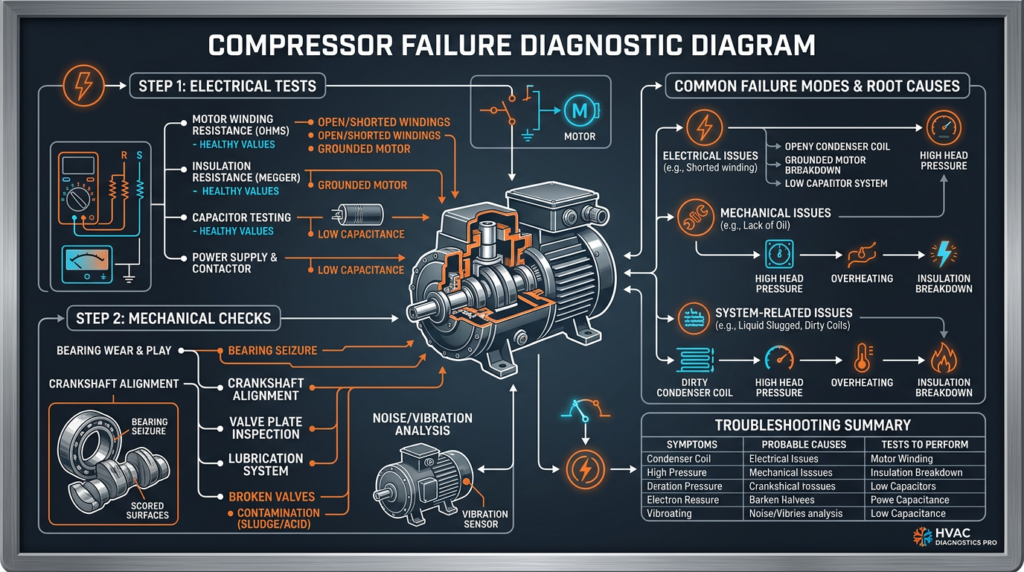
Electrical faults account for a large percentage of compressor failures. Three essential tests apply to hermetic and semi-hermetic compressors:
- Continuity to ground (megger test): Using a megohmmeter, measure resistance between each motor terminal (Common, Start, Run) and the compressor shell. A reading below 1 megohm indicates a grounded winding. This compressor must be replaced.
- Winding resistance: Measure resistance across C-S, C-R, and S-R terminals with a multimeter. The sum of C-S and C-R should approximately equal S-R. Significant deviations indicate an open or shorted winding.
- Voltage measurement: Verify that supply voltage falls within plus or minus 10% of the compressor’s rated voltage. For three-phase systems, measure voltage imbalance. Imbalance exceeding 2% can cause motor overheating and premature failure.
- Capacitor testing: Test both the start capacitor and run capacitor with a capacitance meter. A capacitor that has lost more than 10% of its rated microfarad value should be replaced.
Mechanical and Refrigerant Testing
- Suction and discharge pressure readings: Compare gauge readings to expected values for the refrigerant type and operating conditions. Equal suction and discharge pressures with the compressor running indicate failed internal valves or a seized compressor.
- Pump-down test: Isolate the compressor and measure its ability to pull a vacuum on the low side. Inability to reach expected vacuum levels confirms valve or mechanical failure.
- Acid test: Draw an oil sample and test it with an acid test kit. The presence of acid indicates motor winding decomposition (burnout), which contaminates the entire system and requires thorough cleaning before installing a replacement compressor.
Root Causes of Compressor Failure
This is the most critical section. Most compressor failures trace back to one or more of these categories.
Refrigerant-Related Issues
- Low refrigerant charge from leaks: The most common cause of compressor failure. Low charge reduces suction pressure, increases discharge temperature, and starves the motor of the cooling effect provided by returning suction gas. Prolonged operation at low charge destroys windings.
- Overcharging: Excess refrigerant raises head pressure and can cause liquid refrigerant to reach the compressor (liquid slugging), which damages valves and scroll elements. Overcharging is as harmful as undercharging.
- Contamination: Moisture, air, and non-condensable gases in the system create acids, raise operating pressures, and reduce heat transfer efficiency.
- Incorrect refrigerant type: Mixing refrigerants or using the wrong refrigerant destroys performance and can cause chemical incompatibility with system oils and seals.
Electrical Issues
- Voltage imbalance (three-phase systems): A 2% voltage imbalance causes approximately a 10% increase in current imbalance. This creates uneven heating in motor windings and accelerates insulation breakdown.
- Power surges: Lightning strikes and grid switching events can punch through winding insulation.
- Loose wiring and corroded connections: High-resistance connections cause voltage drops, overheating, and arcing.
- Failed capacitors: A weak or failed run capacitor forces the motor to work harder, increasing current draw and heat. A failed start capacitor prevents the compressor from starting at all.
Lubrication Issues
- Oil dilution: During off-cycles, refrigerant can migrate to the compressor crankcase and dissolve into the oil. On startup, the sudden pressure drop causes the oil-refrigerant mixture to foam, starving bearings of lubrication. Crankcase heaters prevent this.
- Oil starvation: Improper piping, missing oil traps on vertical risers, or sluggish refrigerant velocities prevent oil from returning to the compressor.
- Wrong oil type: Mineral oil was standard with R-22. Polyolester (POE) oil is required for R-410A, R-32, and R-454B systems. POE oil is highly hygroscopic, meaning it absorbs moisture rapidly when exposed to air. Using mineral oil in an HFC or HFO system causes immiscibility and lubrication failure. Polyalkylene glycol (PAG) oil is used in some CO2 (R-744) systems.
- Acid formation: Overheating breaks down oil and winding insulation, creating organic acids that corrode copper components and further degrade the oil.
Overheating
- Restricted airflow: Dirty condenser coils, clogged filters, collapsed ductwork, or failed blower motors reduce heat rejection and raise discharge pressures.
- Condenser fan failure: Without adequate airflow across the condenser coil, head pressure rises rapidly.
- Liquid floodback: Liquid refrigerant returning to the compressor washes oil from bearing surfaces and can hydraulically lock reciprocating compressors.
- Incorrect superheat: Low superheat allows liquid refrigerant to reach the compressor. High superheat means the compressor runs hotter than designed. Target superheat values typically range from 8°F to 15°F at the compressor for most systems, though manufacturer specifications always govern.
Contamination and Mechanical Wear
Moisture entering the system during installation or service creates hydrofluoric and hydrochloric acids that attack copper tubing, valve seats, and motor insulation. Brazing without a nitrogen purge creates copper oxide scale that contaminates the entire system. After a compressor burnout, particulate debris and acidic oil must be flushed from the system before a new compressor is installed. Proper filter driers are essential for removing residual moisture and contaminants. Normal mechanical wear from age and usage also contributes to eventual valve and bearing degradation, though well-maintained systems routinely exceed 15 years of compressor life.
Preventive Measures
Most compressor failures are preventable. The following practices protect the compressor and extend system life:
- Regular maintenance: Clean condenser and evaporator coils at least annually. Change air filters every one to three months. Inspect electrical connections, contactors, and capacitors. Annual maintenance contracts typically cost $150 to $500.
- Correct refrigerant charging: Charge to manufacturer specifications using superheat (for fixed metering devices) and subcooling (for TXVs) measurements. Never simply “top off” without checking for leaks.
- Leak detection and repair: Use electronic leak detectors, ultrasonic detectors, or fluorescent dye to find and repair leaks before recharging. Repeated topping-off without repair guarantees eventual compressor failure.
- Electrical system verification: Tighten all connections. Measure voltage and amperage at each service call. Install surge protectors on outdoor units.
- Oil analysis: For commercial and industrial systems, periodic oil sampling reveals acid formation, moisture contamination, and metal wear particles before they cause catastrophic failure.
- Proper system sizing: An oversized system short-cycles, and an undersized system runs continuously. Both conditions shorten compressor life. Follow ACCA Manual J for load calculations and ACCA Standard 5 for proper system design.
- Nitrogen purge during brazing: Flow dry nitrogen through the tubing during all brazing operations to prevent copper oxide contamination.
- Install and maintain filter driers: Replace filter driers whenever the system is opened for service. Use suction-line filter driers after burnouts.
Repair vs. Replacement
The decision to repair or replace depends on several factors:
- Age of the system: If the system is more than 12 to 15 years old, replacement often makes more financial sense.
- Refrigerant type: Systems using R-22 (production ceased in 2020) face increasingly expensive refrigerant costs, often exceeding $100 per pound. Replacement with a modern system is usually more economical.
- Cost comparison: Compressor replacement typically costs $1,500 to $5,000 or more, including parts and labor. A full system replacement runs $5,000 to $15,000 or more depending on size, efficiency, and features. When repair costs exceed 50% of replacement cost on an aging system, replacement is generally the better investment.
- Efficiency gains: A system manufactured in 2010 at 13 SEER replaced with a 2025 system at 16 SEER2 or higher reduces energy consumption by 20% or more.
- Severity of failure: A failed capacitor is a $150 to $400 repair. A compressor burnout that has contaminated the entire lineset and coils with acid may warrant full system replacement.
New Refrigerants and Evolving Compressor Technology
The HVAC industry is in the midst of a significant refrigerant transition. The AIM Act mandates a phasedown of high-GWP HFC refrigerants. As of January 1, 2025, a 30% reduction in HFC production and consumption took effect, effectively ending manufacture of new R-410A equipment at that threshold.
Replacement refrigerants include:
- R-32: GWP of 675 (compared to 2,088 for R-410A). Classified A2L (mildly flammable). Increasingly used in ductless mini-splits and smaller systems.
- R-454B: GWP of 466. Also A2L. Emerging as the primary R-410A replacement for residential split systems and heat pumps.
- R-290 (propane): GWP of 3. Classified A3 (highly flammable). Used in window air conditioners and some commercial refrigeration under strict charge limits.
- R-744 (CO2): GWP of 1. Used in commercial and industrial refrigeration, particularly transcritical systems.
A2L refrigerants require updated safety standards. UL 60335-2-40 governs equipment design for A2L systems, mandating leak detection, charge limits per room volume, and ignition source controls. Technicians must update their tools and recovery equipment, as existing R-410A recovery machines may not be rated for the operating pressures and flammability characteristics of newer refrigerants.
New efficiency metrics also affect compressor selection. SEER2 and HSPF2 ratings, effective since January 1, 2023, use higher external static pressure in testing to reflect real-world conditions. Minimum efficiencies are now 14.3 SEER2 in the Southeast and Southwest and 13.4 SEER2 in the North. Variable-speed inverter compressors are essential for reaching higher efficiency tiers, as they match output to load far more precisely than single-speed units.
The Inflation Reduction Act (IRA) provides federal tax credits of up to $2,000 for qualifying heat pump installations, incentivizing homeowners to upgrade from aging systems with failing compressors to high-efficiency equipment.
Proper Disposal and Refrigerant Recovery
EPA Section 608 regulations (40 CFR Part 82) require that all refrigerant be recovered before disposing of any HVAC equipment. Venting refrigerant is illegal and carries fines of up to $44,539 per day per violation. Technicians must hold EPA Section 608 certification to purchase and handle regulated refrigerants. Recovered refrigerant must be reclaimed to AHRI 700 purity standards or destroyed.
Key Takeaways
- Compressor failure is usually a symptom of another problem: refrigerant leak, electrical fault, oil breakdown, or chronic overheating. Replacing the compressor without fixing the root cause guarantees repeated failure.
- Proper diagnosis requires both electrical testing (winding resistance, megger, capacitor checks) and mechanical testing (pressure analysis, acid tests).
- Preventive maintenance is the single most effective way to protect compressor longevity. Annual service, correct refrigerant charge, clean coils, and tight electrical connections prevent the majority of failures.
- The refrigerant landscape is changing rapidly. R-410A is being phased down under the AIM Act, and A2L refrigerants like R-32 and R-454B require updated safety practices, tools, and training.
- When a compressor fails in an older system using R-22 or aging R-410A equipment, replacement with a high-efficiency system often provides better long-term value, especially with available IRA tax credits.
- Always use the correct oil type for the refrigerant in use. POE oil for R-410A and its successors. Never mix oil types or skip nitrogen purges during brazing.