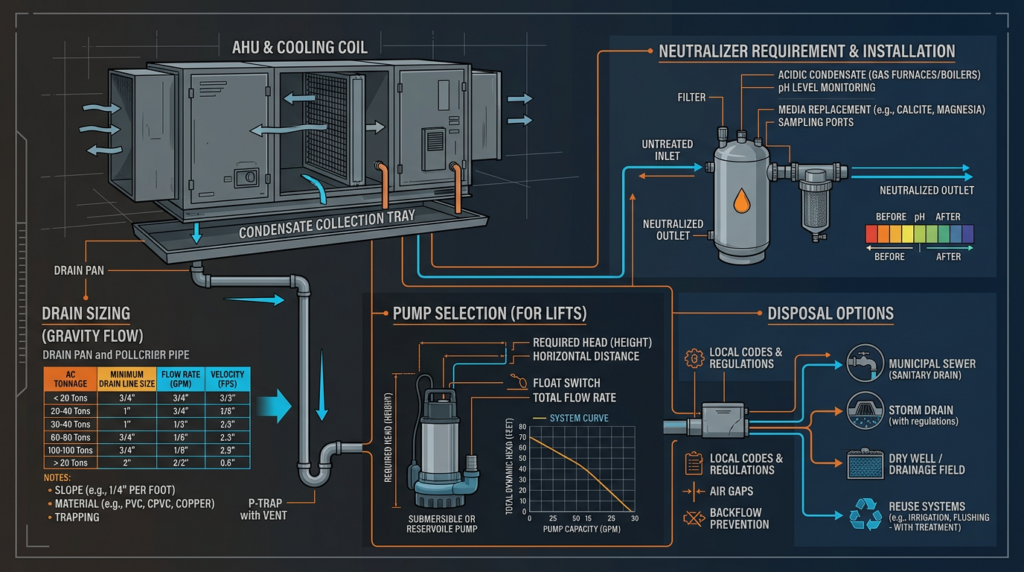
Condensate management encompasses the collection, drainage, pumping, and treatment of water produced by HVAC systems during the cooling process. When warm, humid air passes over cold evaporator coils, water vapor condenses into liquid, much like moisture forming on a glass of ice water. A typical 3-ton air conditioner operating in a humid climate with 70% relative humidity can produce 3 to 5 gallons of condensate per day, and in extreme conditions, output can exceed 20 gallons daily. Left unmanaged, this water causes structural damage, promotes mold growth, corrodes equipment, and degrades indoor air quality. Proper condensate management is not optional. It is a core requirement of every cooling system installation and a routine focus of professional HVAC service.
How and Why HVAC Systems Produce Condensate
Condensate is water vapor that has been cooled below its dew point and returned to a liquid state. In HVAC systems, this occurs as part of latent heat removal. The evaporator coil absorbs both sensible heat (lowering air temperature) and latent heat (removing moisture). The extracted moisture collects on the coil fins and drips into a drain pan below the coil.
Several factors determine how much condensate a system generates:
- Climate and humidity: Higher outdoor dew points mean more moisture in the supply air. A system in Miami will produce far more condensate than one in Phoenix.
- System capacity: Larger systems move more air across the coil. A 5-ton unit generates roughly 60% more condensate than a 3-ton unit under identical conditions.
- Indoor setpoints: Lower thermostat settings increase the temperature differential across the coil, promoting more condensation.
- Runtime: Systems that cycle frequently may produce less total condensate than those running continuously, because coil surfaces dry between cycles.
- Efficiency ratings: Higher-efficiency systems rated under the SEER2 standard (Seasonal Energy Efficiency Ratio 2, introduced January 2023) often feature variable-speed compressors that run longer at lower capacity, which can increase total moisture removal over a 24-hour period.
A rough calculation: each ton of cooling capacity removes approximately 0.5 to 0.8 gallons of condensate per hour at 50% relative humidity. At 70% relative humidity, that figure can approach 1 to 1.5 gallons per ton per hour during peak conditions.
Gravity Drainage Systems
The simplest and most reliable method of condensate removal is gravity drainage, where water flows downhill through a piped drain line to an approved discharge point.
Components
- Drain pan: Positioned directly below the evaporator coil to catch condensate. Common materials include plastic (ABS or polypropylene), stainless steel, and galvanized steel. Stainless steel resists corrosion best but costs more.
- Primary drain line: The main path for condensate to exit the system. Typically ¾-inch PVC for residential systems up to 5 tons.
- Secondary (auxiliary) drain line: A backup drain that activates if the primary line clogs. Often routed to a conspicuous location, such as above a window, so overflow is immediately visible.
- Auxiliary drain pan (safety pan): Installed beneath the air handler to catch overflow from a failed primary pan. Required by code in many jurisdictions when the unit is installed above a finished ceiling or living space.
- P-trap: Prevents conditioned air from being drawn through the drain line, which would create an airlock and stop drainage. Trap depth must exceed the unit’s negative static pressure.
- Cleanout tee: A capped tee fitting that allows access for clearing clogs without disassembling the drain.
- Air vent: Installed after the trap to break vacuum and ensure smooth flow.
Design and Installation Requirements
The International Mechanical Code (IMC), Section 307, and the Uniform Mechanical Code (UMC), Chapter 3, govern condensate drainage. Key requirements include:
- Minimum slope: ¼ inch per foot (approximately 2% grade) for horizontal runs. This ensures consistent flow and reduces the chance of standing water.
- Drain line sizing: ASHRAE and the IMC specify minimum diameters based on equipment capacity. For systems up to 20 tons, ¾-inch pipe is generally acceptable. Systems above 20 tons typically require 1-inch or larger lines. Always consult the manufacturer’s installation instructions, which may exceed code minimums.
- Approved materials: PVC Schedule 40, CPVC, ABS, copper, and polyethylene are standard. PVC is most common in residential work due to cost and ease of installation.
- Discharge locations: Condensate must discharge to an approved location. Most codes permit discharge to the building’s sanitary sewer (with an indirect connection and air gap), a floor drain, a dry well, or to the outdoors. Direct discharge to storm drains or public walkways is typically prohibited.
Undersized drain lines are a frequent source of problems. A ½-inch line on a 3-ton system may handle average loads but overflow during peak humidity. Oversizing by one pipe diameter is inexpensive insurance.
Common Problems and Troubleshooting
- Clogs: The most common issue. Algae, slime (biofilm), dust, and debris accumulate in the drain pan and line. Symptoms include water overflow, musty odors, and elevated humidity indoors.
- Airlocks: Occur when the trap is improperly sized or absent. Negative pressure inside the air handler prevents water from flowing through the drain.
- Cracked or rusted pans: Galvanized steel pans corrode over time. Plastic pans can crack from UV exposure or physical stress. Inspect annually.
- Improper slope: Sagging drain lines create low spots where water pools and biofilm grows. Re-support with hangers at 4-foot intervals maximum.
Condensate Pumps
When gravity drainage is not feasible, such as in basements, interior closets, or installations below the nearest drain, a condensate pump lifts water to an elevated discharge point.
How Condensate Pumps Work
A condensate pump consists of a reservoir (tank), a float switch, and a small electric pump. As the reservoir fills, the float rises and activates the pump, which pushes water through a discharge tube to a drain or exterior location. Most residential pumps operate on 115V AC power, though 230V models exist for commercial applications. Low-voltage 24V pumps, often called mini pumps, are designed for ductless mini-split systems and fan coil units.
Selection Criteria
- Flow rate: Measured in gallons per hour (GPH). Residential pumps typically range from 5 to 65 GPH. A 3-ton system in a humid climate needs a pump rated for at least 10 to 15 GPH to handle peak production with a safety margin.
- Lift (head): The maximum vertical distance the pump can push water. Common residential pumps offer 15 to 20 feet of head. Commercial pumps may exceed 30 feet.
- Tank capacity: Reservoir sizes range from 0.5 to 1.5 gallons in residential models. Larger tanks reduce pump cycling frequency but take up more space.
- Safety features: A high-level safety switch is critical. This switch, wired to the thermostat’s 24V circuit, shuts off the HVAC system if the pump fails and the reservoir overflows. Overload protection prevents motor burnout.
- Noise level: Important for installations near living spaces. Look for pumps rated below 45 dB.
- Materials: Plastic housings (ABS) are standard for residential use. Stainless steel components are preferred in commercial or corrosive environments.
- Certifications: UL and CSA listings confirm the pump meets electrical safety standards.
Installation and Maintenance
Mount the pump on a level, stable surface near the air handler. Route the discharge line with a slight upward slope to prevent backflow. Use flexible vinyl tubing (⅜-inch ID is standard) or rigid PVC for the discharge line. Secure connections with hose clamps to prevent leaks.
Maintenance is straightforward but essential. Clean the reservoir and check the float switch every three months during cooling season. Biofilm and sediment can jam the float in the down position, preventing the pump from activating. Flush the reservoir with a dilute vinegar solution or a commercial pump cleaner. Replace pumps every 3 to 5 years or sooner if they become noisy, cycle excessively, or fail to activate reliably.
Typical Costs
- Residential condensate pump (installed): $150 to $400
- Commercial high-capacity pump system: $1,000 to $5,000 per unit
- Mini-split condensate pump (24V): $80 to $200
Condensate Treatment
Untreated condensate becomes a breeding ground for bacteria, algae, and mold. Condensate treatment prevents microbial growth, controls odors, inhibits scale, and protects drain components from corrosion.
Biocides
Biocide tablets are the most common treatment for residential systems. Placed directly in the drain pan, they dissolve slowly and release antimicrobial agents over 30 to 90 days. Common active ingredients include:
- Slow-release chlorine compounds: Effective against algae and bacteria. Inexpensive and widely available.
- Quaternary ammonium compounds (quats): Broad-spectrum antimicrobials that are less corrosive than chlorine.
- Polymeric biocides: Sustained-release formulations that maintain consistent concentration levels.
Liquid and gel biocides are also available and may be applied to the drain line directly. All biocides used in HVAC systems must be EPA-registered for that specific application. Using unregistered products is a violation of federal law under FIFRA (Federal Insecticide, Fungicide, and Rodenticide Act).
Replace tablets every 1 to 3 months during cooling season. Dosage depends on system size and condensate volume. Follow manufacturer recommendations precisely.
pH Control and Scale Inhibitors
Condensate from standard air conditioning systems is typically slightly acidic (pH 5.5 to 6.5) due to dissolved carbon dioxide and airborne contaminants. Condensate from high-efficiency condensing furnaces (90% AFUE and above) is much more acidic, with pH levels between 2.5 and 4.0. This acidic condensate can damage cast iron drain pipes and corrode metal components.
Condensate neutralizers use calcium carbite or limestone media to raise the pH to 7.0 or above before the condensate enters the drain system. Many jurisdictions require neutralizers for condensing furnaces. The neutralizer media must be replaced or replenished annually.
Scale inhibitors prevent mineral deposits, particularly calcium and magnesium, from building up in drain pans and lines. These are more relevant in commercial systems and areas with hard water.
Alternatives to Chemical Treatment
UV-C germicidal lamps installed near the evaporator coil and drain pan kill microorganisms on contact without chemicals. They are effective at reducing biofilm but do not prevent growth downstream in the drain line. Ozone generators offer another chemical-free option but must be used cautiously due to ozone’s respiratory hazards and EPA indoor air quality guidelines.
Codes, Standards, and Regulatory Considerations
Condensate management is governed by overlapping layers of regulation:
- IMC Section 307: Covers condensate disposal, drain sizing, auxiliary pans, and discharge location requirements.
- UMC Chapter 3: Contains parallel requirements, widely adopted in western states.
- Local building codes: Often more stringent than national codes. Florida, for example, requires secondary drain lines or float switches on all systems installed in attics. California has specific requirements for condensate discharge related to water conservation.
- Manufacturer specifications: Always take precedence when they exceed code requirements. Failure to follow manufacturer instructions can void equipment warranties.
Refrigerant Transition and Its Impact
The AIM Act (American Innovation and Manufacturing Act) mandates an 85% phase-down of HFC production and consumption by 2036. R-410A, the dominant residential refrigerant since the early 2000s, is being replaced by lower-GWP alternatives including R-32 (GWP 675) and R-454B (GWP 466). New equipment using these refrigerants began shipping in 2025.
The direct impact on condensate production is modest. R-454B systems operate at similar evaporator temperatures to R-410A systems, so moisture removal rates remain comparable. However, new systems paired with higher SEER2 ratings (the current federal minimum is 13.4 SEER2 for split systems in northern regions, 14.3 SEER2 in southern regions) tend to run longer cycles at reduced capacity, which can increase total daily condensate output slightly.
Technicians handling any refrigerant must hold EPA Section 608 certification. The new A2L refrigerants (mildly flammable) also require updated safety training and, in some states, additional certifications.
Inflation Reduction Act Incentives
The Inflation Reduction Act (IRA) provides tax credits of up to $2,000 for qualifying high-efficiency heat pumps and up to $600 for qualifying central air conditioners. While these credits do not directly cover condensate management components, homeowners upgrading to high-efficiency condensing equipment should budget for condensate neutralizers, upgraded drain systems, and pumps as part of the total installation cost. The 25C tax credit (now Section 25C of the Internal Revenue Code) covers the full installed cost of qualifying equipment, which can include ancillary components.
Practical Applications by Sector
Residential
Most residential condensate systems use gravity drainage with ¾-inch PVC pipe. A cleanout tee, proper P-trap, and biocide tablets form the baseline. When the air handler is in a basement or closet below the nearest drain, a condensate pump is required. Budget $75 to $200 for professional drain line cleaning and $10 to $20 per year for biocide tablets.
Commercial
Large office buildings with multiple rooftop units may use centralized condensate collection systems with 1-inch or larger drain headers. Automated biocide dosing systems maintain consistent treatment. Legionella prevention is a concern in commercial drain pans, particularly those associated with cooling towers and large air handlers. Professional drain cleaning services typically cost $200 to $500 per unit.
Data Centers
Data center cooling systems demand the highest reliability. Redundant condensate pumps, continuous leak detection sensors, and remote monitoring are standard. Any water intrusion near server racks risks catastrophic equipment loss. Condensate management systems in these facilities are typically integrated with building management systems (BMS) for real-time alerts.
Common Misconceptions
- “Condensate is clean water.” It is not. Condensate contains dust, allergens, dissolved metals, and microbial contaminants. It should never be used for drinking or cooking without treatment. It can, however, be harvested for irrigation or toilet flushing in some jurisdictions with proper filtration.
- “Every drain line needs a trap.” Traps are required when the air handler operates under negative pressure (draw-through configuration) to prevent airlock. Positive-pressure systems (blow-through) may not require a trap, though one is still recommended to prevent sewer gas infiltration.
- “Biocide tablets last all season.” Most tablets dissolve within 30 to 90 days. They must be replaced multiple times during cooling season to remain effective.
- “Any pump will do.” Pumps must be matched to the system’s condensate production rate and required lift height. An undersized pump will cycle excessively and fail prematurely.
- “Condensate problems only happen in humid climates.” Every air conditioning system produces condensate. Drier climates produce less, but even moderate humidity generates enough moisture to cause problems if drainage fails.
Key Takeaways
- Every cooling system produces condensate. Managing it properly prevents water damage, mold, equipment corrosion, and poor indoor air quality.
- Gravity drainage is preferred when possible. Maintain a minimum slope of ¼ inch per foot with properly sized PVC drain lines.
- Condensate pumps are necessary when gravity drainage is not feasible. Size pumps for peak condensate production with adequate lift, and always install a high-level safety switch.
- Treat condensate with EPA-registered biocides. Replace tablets every 1 to 3 months during cooling season.
- High-efficiency condensing furnaces produce acidic condensate that requires a neutralizer before discharge.
- Follow IMC Section 307, UMC Chapter 3, local codes, and manufacturer specifications. Local requirements often exceed national standards.
- Inspect drain pans, lines, and pumps at least twice per year. Most condensate-related failures are preventable with routine maintenance.
- New refrigerants (R-32, R-454B) and higher SEER2 efficiency standards may slightly increase condensate production. Plan drainage capacity accordingly.