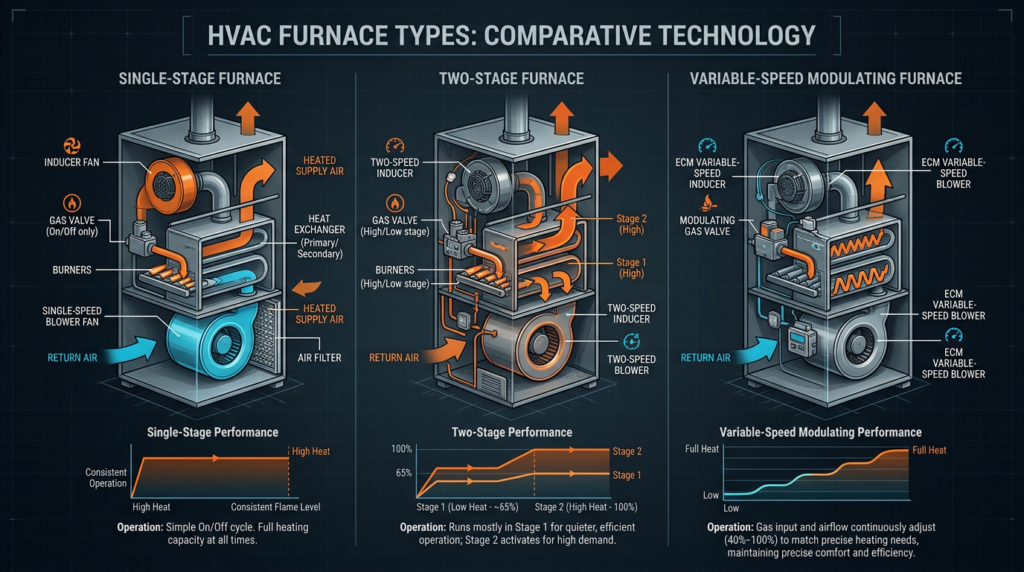
When a gas furnace reaches the end of its lifespan or a homeowner decides to upgrade, one of the most important decisions involves choosing the right furnace type. Gas furnaces fall into three main categories based on how they control heat output: single-stage, two-stage, and variable-speed (modulating). The core difference between these types lies in how their gas valves and blower motors operate. A single-stage furnace runs at full capacity or not at all. A two-stage furnace switches between two output levels. A variable-speed furnace adjusts its output across a wide range to precisely match heating demand. Understanding these distinctions is essential for selecting the right balance of upfront cost, energy efficiency, comfort, and long-term reliability.
Core Concepts and Technical Background
Gas Combustion Basics
Every gas furnace operates on the same fundamental principle: natural gas or propane mixes with air inside a burner, where an ignition system (typically a hot surface igniter or spark igniter) lights the fuel. The resulting combustion produces heat along with byproducts including carbon dioxide, water vapor, and trace amounts of carbon monoxide. These byproducts must be safely vented outside through a flue or vent system. The heat generated during combustion passes through a heat exchanger, which transfers thermal energy to household air without allowing combustion gases to mix with the breathable air supply. A blower motor pushes conditioned air through the ductwork and into living spaces.
AFUE: The Efficiency Standard
Annual Fuel Utilization Efficiency (AFUE) is the standard measure of how efficiently a furnace converts fuel into usable heat over an entire heating season. An AFUE of 95% means that 95 cents of every dollar spent on fuel becomes heat for the home, while 5 cents is lost through exhaust gases. The U.S. Department of Energy (DOE) sets minimum AFUE standards. As of 2023, the DOE requires a minimum AFUE of 80% for non-weatherized gas furnaces in the southern United States and 90% for those installed in northern states (defined by a geographic boundary roughly along the 37th parallel). It is important to note that AFUE measures only fuel-to-heat conversion efficiency. It does not account for the electricity consumed by blower motors, control boards, and other electrical components, which is a separate but meaningful consideration.
Key Furnace Components
Understanding the differences between furnace types requires familiarity with several critical components:
- Gas Valve — Controls the flow of gas to the burner. Its design determines whether the furnace operates at one level, two levels, or across a modulating range.
- Burner — The chamber where gas and air mix and combustion takes place.
- Heat Exchanger — A metal assembly that absorbs heat from combustion gases and transfers it to circulating household air.
- Blower Motor — Moves air through the furnace and into the duct system. Motor type (PSC or ECM) significantly impacts efficiency and comfort.
- Control Board — The electronic brain that interprets thermostat signals and manages the sequence of furnace operations.
- Thermostat — Sends signals to the furnace control board to initiate or terminate heating cycles based on temperature setpoints.
Single-Stage Furnaces
How They Work
A single-stage furnace has one mode of operation: full capacity. When the thermostat detects that the indoor temperature has dropped below the setpoint, it sends a signal to the furnace. The gas valve opens completely, the burner ignites at 100% firing rate, the heat exchanger warms up, and the blower motor engages to distribute heated air. The furnace continues running at full output until the thermostat registers that the setpoint has been reached, at which point everything shuts off. This on/off cycle repeats throughout the heating season.
Advantages
- Lowest initial cost. Single-stage furnaces are the most affordable option to purchase and install, often costing 30% to 50% less than variable-speed models.
- Simple design. Fewer sophisticated components mean potentially lower repair costs and a wider pool of technicians comfortable servicing them.
- Adequate for specific applications. In smaller homes, well-insulated structures, or regions with short and mild heating seasons, a single-stage furnace can meet heating needs without significant drawbacks.
Disadvantages
- Temperature swings. Because the furnace always runs at full blast, it can overshoot the thermostat setpoint before shutting off, then allow the temperature to drop noticeably before firing again. This creates a noticeable wave pattern of warm and cool periods.
- Lower overall efficiency. Running at 100% capacity even when the heating load is light wastes energy. AFUE ratings for single-stage furnaces typically fall between 80% and 92%.
- Noise. Full-capacity operation produces the most noise, particularly from the blower motor and burner.
- Frequent cycling. Repeated on/off cycles increase mechanical wear on the gas valve, igniter, and blower motor, which can shorten component lifespan.
Technical Specifications
- AFUE range: 80% to 92% (most common models)
- Gas valve: Simple on/off design
- Blower motor: Typically a PSC (Permanent Split Capacitor) motor, though some models use a multi-speed ECM motor
Common Problems
Single-stage furnaces are prone to short cycling in oversized installations, which accelerates wear on the heat exchanger and igniter. The constant full-load operation also places greater thermal stress on the heat exchanger over time. Hot surface igniters, subjected to frequent on/off cycles, are among the most commonly replaced parts.
Two-Stage Furnaces
How They Work
A two-stage furnace operates at two distinct firing rates. The low stage typically runs at approximately 60% to 70% of the furnace’s full capacity, while the high stage runs at 100%. Under normal conditions, the furnace starts in low stage when the thermostat calls for heat. If the low stage satisfies the heating demand within a set time period, the furnace remains at that level. If the indoor temperature continues to fall or fails to reach the setpoint, the control board automatically shifts the furnace to high stage for additional heating power.
Advantages
- Better energy efficiency. Because the furnace operates in low stage for the majority of the heating season (often 80% or more of total run time), it consumes significantly less gas than a single-stage unit. AFUE ratings typically range from 90% to 96%.
- Improved comfort. Low-stage operation produces longer, gentler heating cycles that distribute warmth more evenly throughout the home, reducing the temperature swings common with single-stage models.
- Quieter performance. At 60% to 70% capacity, both the burner and blower produce considerably less noise than at full output.
- Reduced component wear. Fewer on/off cycles and less time spent at maximum output decrease mechanical stress on the gas valve, igniter, and heat exchanger.
Disadvantages
- Higher upfront cost. Two-stage furnaces typically cost 15% to 25% more than comparable single-stage models.
- Greater complexity. The two-stage gas valve, multi-speed blower motor, and more advanced control board introduce additional potential failure points.
- Thermostat requirements. While basic thermostats can operate a two-stage furnace (the control board manages staging internally), a two-stage-compatible thermostat allows more precise control over when the furnace shifts between stages.
Technical Specifications
- AFUE range: 90% to 96%
- Gas valve: Two-stage valve with distinct low-fire and high-fire positions
- Blower motor: Typically an ECM (Electronically Commutated Motor) with multiple speed settings to match airflow to the active stage
Common Problems
Two-stage gas valves can occasionally fail to transition between stages, causing the furnace to operate only in low or high mode. Control board malfunctions may prevent proper stage recognition. Blower motor issues at specific speeds can also affect performance, particularly if the ECM motor’s programming becomes corrupted.
Variable-Speed (Modulating) Furnaces
How They Work
A variable-speed furnace, also called a modulating furnace, adjusts its firing rate across a broad range, typically from about 40% to 100% of capacity, in small increments. Some models modulate in defined steps (for example, 1% increments), while others offer near-continuous adjustment. When the thermostat calls for heat, the furnace starts at the lowest necessary firing rate and gradually increases output only as needed. The ECM blower motor simultaneously adjusts its speed to match the airflow requirements of the current firing rate. The result is a furnace that runs almost continuously at a low, efficient output rather than cycling on and off.
Advantages
- Highest energy efficiency. AFUE ratings for modulating furnaces typically start at 96% and can reach 98% or higher. Extended low-fire operation maximizes heat extraction from combustion gases.
- Superior comfort. Temperature fluctuations are virtually eliminated. The furnace maintains indoor temperatures within a fraction of a degree of the setpoint.
- Quietest operation. At low firing rates, many modulating furnaces are barely audible, producing noise levels comparable to a refrigerator hum.
- Improved humidity control. When paired with a compatible air conditioning system, the variable-speed blower runs at lower speeds for longer periods during cooling season, removing more moisture from indoor air and improving summer comfort.
- Extended equipment lifespan. Minimal cycling and reduced thermal stress on components contribute to the longest expected service life among the three furnace types.
- Excellent for zoning. The ability to precisely adjust output makes modulating furnaces ideal for homes with zoned HVAC systems, where different areas may have different heating demands at the same time.
Disadvantages
- Highest initial cost. Variable-speed furnaces can cost 40% to 70% more than single-stage equivalents, making them the most significant upfront investment.
- Complex technology. Modulating gas valves, advanced ECM motors, and sophisticated control boards require specialized diagnostic tools and trained technicians for repair.
- Thermostat compatibility. To unlock the full modulating capability, these furnaces require a communicating thermostat designed for the specific furnace platform. Standard thermostats will typically limit the furnace to basic two-stage operation.
- Higher repair costs. Replacement parts, particularly modulating gas valves and ECM motors, are more expensive than their single-stage or two-stage counterparts.
Technical Specifications
- AFUE range: 96% to 98.5%
- Gas valve: Modulating valve capable of precise, incremental gas flow adjustment
- Blower motor: ECM with variable-speed control, often infinitely adjustable
- Control board: Advanced microprocessor with algorithms that continuously calculate and adjust firing rate based on real-time conditions
Common Problems
Communication errors between the thermostat and control board are the most frequent issue, often resulting in the furnace defaulting to a limited operating mode. Modulating gas valve failures can force the system into a fixed firing rate. ECM motor issues, while less common than PSC motor failures, tend to be more costly to resolve.
Comparing the Three Furnace Types
The following summary highlights how the three types compare across the most important performance categories:
- Initial cost: Single-stage (lowest), two-stage (moderate), variable-speed (highest)
- AFUE efficiency: Single-stage (80% to 92%), two-stage (90% to 96%), variable-speed (96% to 98.5%)
- Comfort level: Single-stage (noticeable temperature swings), two-stage (improved consistency), variable-speed (near-perfect temperature stability)
- Noise: Single-stage (loudest), two-stage (quieter in low stage), variable-speed (quietest)
- Repair complexity and cost: Single-stage (simplest and cheapest), two-stage (moderate), variable-speed (most complex and expensive)
- Best applications: Single-stage (small homes, mild climates, tight budgets), two-stage (mid-size to large homes, moderate climates), variable-speed (large homes, cold climates, zoned systems, comfort-focused homeowners)
Factors to Consider When Choosing a Furnace
Selecting the right furnace type depends on several interrelated factors:
- Home size and insulation quality. Larger homes and those with older or insufficient insulation benefit most from the sustained, even output of two-stage or variable-speed systems.
- Climate. In regions with long, cold winters, the energy savings from a high-efficiency modulating furnace can offset the higher purchase price within several years. In mild climates, a single-stage unit may be perfectly adequate.
- Budget. Consider both upfront cost and projected energy savings over the furnace’s 15- to 20-year lifespan. A higher AFUE furnace does not always pay for itself in warmer regions.
- Comfort priorities. Homeowners sensitive to temperature fluctuations or noise will find significantly better performance from two-stage or variable-speed systems.
- Local fuel costs. Higher natural gas or propane prices strengthen the case for investing in a more efficient system.
- Professional load calculation. A qualified HVAC contractor should perform a Manual J load calculation to determine the correct furnace size. An oversized furnace of any type will short cycle and underperform.
Installation and Maintenance
Gas furnaces must be installed by a licensed HVAC professional. Proper installation involves correct gas line sizing and connections, appropriate venting configuration, electrical wiring, and system commissioning. Improper installation can lead to gas leaks, carbon monoxide exposure, equipment damage, and voided manufacturer warranties. Annual maintenance by a qualified technician should include cleaning or replacing air filters, inspecting the burner assembly and heat exchanger for cracks, verifying gas pressure, testing all safety controls, and cleaning the blower motor and its housing.
Common Misconceptions
- “A higher AFUE furnace always saves money.” Savings depend on climate, usage, fuel prices, and how long you plan to stay in the home. In mild climates, the payback period for a 98% AFUE furnace may exceed the furnace’s lifespan compared to a 92% model.
- “Bigger furnaces heat better.” An oversized furnace cycles on and off more frequently, creating temperature swings, wasting energy, and accelerating component wear. Proper sizing is critical regardless of furnace type.
- “I can install a furnace myself.” Gas furnace installation involves combustible fuel, high-voltage electricity, and exhaust venting. Errors can result in carbon monoxide poisoning, fire, or explosion. Professional installation is not optional for safety.
- “All new furnaces perform the same.” As this article demonstrates, the differences between single-stage, two-stage, and variable-speed furnaces in efficiency, comfort, and operating cost are substantial.
Related Topics
Zoning systems divide a home into independently controlled temperature zones and pair especially well with variable-speed furnaces that can modulate output to serve different zones simultaneously. Smart thermostats can optimize furnace operation through learning algorithms, scheduling, and remote access, though compatibility with modulating furnaces requires verification. Dual-fuel systems combine a gas furnace with an electric heat pump, using the heat pump for moderate weather and switching to gas heat during extreme cold for optimal efficiency across all conditions. Proper air filtration is essential for all furnace types, protecting the heat exchanger and blower motor while maintaining indoor air quality.
Key Takeaways
Single-stage, two-stage, and variable-speed gas furnaces represent a clear spectrum from simplicity and low cost to precision and high efficiency. Single-stage furnaces remain a practical choice for budget-conscious homeowners in mild climates with modest heating demands. Two-stage furnaces offer a meaningful step up in comfort and efficiency at a moderate price increase. Variable-speed modulating furnaces deliver the best possible performance in temperature control, energy savings, and quiet operation, but at the highest cost. The right choice depends on your specific home, climate, budget, and comfort expectations. Consult with a licensed HVAC professional who can perform a proper load calculation and recommend the furnace type that best fits your situation.