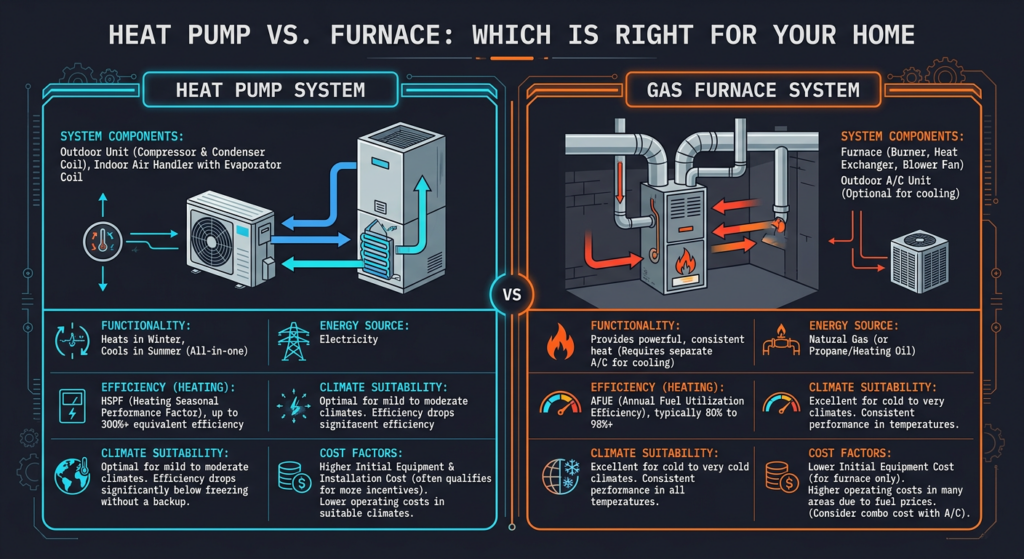
Choosing between a heat pump and a gas furnace is one of the most impactful decisions a homeowner can make. Both heat your home, but they work very differently, cost different amounts to operate, and perform better or worse depending on your climate.
How Each System Works
Gas Furnace
A gas furnace burns natural gas (or propane) to produce heat. A burner ignites the fuel, heats a heat exchanger, and a blower fan pushes air across the exchanger and into your ductwork. Modern high-efficiency furnaces (90%+ AFUE) condense the combustion gases to recover additional heat. Output temperatures are typically 120-140 degrees F, making them excellent for very cold climates.
Heat Pump
A heat pump does not generate heat — it moves heat. In heating mode, it extracts heat energy from outdoor air (even cold air contains heat energy) and pumps it inside. In cooling mode, it reverses the process, moving heat from inside to outside. A standard air-source heat pump becomes less efficient as outdoor temperatures drop, with significant capacity loss below 30 degrees F. Cold-climate heat pumps (variable-speed inverter-driven) now maintain good efficiency down to -13 degrees F or lower.
Climate Considerations
In mild climates (most of the southern US, Pacific Northwest), a heat pump alone is an excellent choice. It handles both heating and cooling efficiently, and the climate rarely demands more than it can deliver.
In cold climates (upper Midwest, New England, Mountain West), the choice is more complex. A standard heat pump may need a backup electric resistance strip for the coldest days — expensive to operate. A cold-climate heat pump (Mitsubishi Hyper Heat, Bosch IDS, Carrier Infinity) can often handle 100% of heating loads even in harsh winters. A dual-fuel system pairs a heat pump with a gas furnace: the heat pump handles moderate weather (when it is most efficient) and the furnace handles extreme cold (when gas is cheaper than electricity per BTU).
Operating Costs
The comparison depends entirely on local electricity and gas rates:
- Heat pump at COP 3.0 = 1 unit electricity delivers 3 units heat
- Gas furnace at 96% AFUE = 0.96 units heat per unit of gas
- If gas costs $1.20/therm and electricity costs $0.12/kWh, the heat pump is cheaper to operate
- If electricity is $0.20/kWh and gas is $0.80/therm, run the numbers for your region
Installation Cost
A gas furnace installation (furnace only, no cooling) typically costs $2,500–$5,000. A heat pump system (with air handler for heating and cooling) runs $4,000–$8,000 for standard efficiency, $7,000–$15,000 for a cold-climate inverter system. The heat pump advantage: it replaces both your furnace and AC, so compare it to the cost of replacing both.
Incentives
Under the Inflation Reduction Act (IRA), qualifying heat pumps are eligible for a 30% federal tax credit (up to $2,000/year) plus additional rebates through the High-Efficiency Electric Home Rebate Act (HEEHRA) for lower-income households. Gas furnaces do not qualify for these incentives.
The Bottom Line
- Mild climate, replace AC + heat: Heat pump wins
- Cold climate, existing gas service: Dual-fuel or cold-climate heat pump — do the math for your utility rates
- Replace furnace only, keeping old AC: High-efficiency gas furnace is simpler and cheaper
- New construction or full replacement: A cold-climate heat pump is increasingly the smart long-term choice in most US climates