HVAC controls and Building Automation Systems (BAS) represent the central nervous system of modern buildings, governing everything from temperature and humidity to air quality and energy consumption. According to the U.S. Department of Energy, buildings with well-implemented automation systems can reduce energy costs by 10% to 30% compared to those relying on manual or outdated controls. Beyond energy savings, these systems directly influence occupant comfort, equipment longevity, and operational efficiency. This article provides a thorough examination of HVAC control systems and BAS, covering foundational control theory, system architecture, communication protocols, advanced optimization strategies, and emerging trends shaping the future of building management.
Foundational Concepts: Understanding HVAC Control Systems
Open Loop vs. Closed Loop Control
Every HVAC control system falls into one of two fundamental categories. An open-loop control system executes a predetermined action without measuring the result. A bathroom exhaust fan on a timer is a classic example: it runs for a set duration regardless of actual humidity levels. Open-loop systems are simple and inexpensive but cannot compensate for changing conditions.
A closed-loop control system continuously measures the controlled variable and adjusts its output to maintain a desired setpoint. A thermostat controlling a furnace exemplifies this approach: the sensor measures room temperature, compares it to the setpoint, and signals the furnace to cycle on or off. Closed-loop systems deliver superior accuracy and responsiveness, making them the standard for nearly all modern HVAC applications.
Control Variables and Sensors
Control variables are the measurable parameters that an HVAC system regulates. The most common include supply air temperature, return air temperature, zone temperature, relative humidity, duct static pressure, chilled and hot water flow rates, and carbon dioxide (CO2) concentration.
Sensors serve as the eyes and ears of any control system. Temperature sensors include resistance temperature detectors (RTDs), thermistors, and thermocouples, each with different accuracy ranges. Humidity sensors typically use capacitive sensing elements. Pressure transducers measure duct static pressure with accuracies of plus or minus 0.25% of full scale. CO2 sensors, critical for ventilation control, use non-dispersive infrared (NDIR) technology with typical accuracy of plus or minus 50 ppm. Regular calibration is essential because sensor drift directly degrades control performance. A temperature sensor drifting by just 2°F can increase energy consumption by 5% to 10% in a typical commercial building.
Control Devices and Actuators
Actuators are the devices that physically manipulate HVAC equipment based on controller commands. Three primary types dominate the industry:
- Damper actuators control airflow by positioning damper blades. Parallel blade dampers provide roughly equal percentage flow characteristics, while opposed blade dampers offer more linear control. Actuators can be two-position (open/closed) or modulating (0-10V or 4-20mA signal for precise positioning).
- Control valves regulate fluid flow in hydronic systems. Globe valves offer the best throttling control and are preferred for modulating applications. Ball valves and butterfly valves are common for two-position or isolation duty. Valve sizing, expressed as the Cv coefficient, must be calculated carefully to avoid hunting or poor control authority.
- Variable Frequency Drives (VFDs) control the speed of fan and pump motors by adjusting electrical frequency. Because power consumption follows the affinity laws (power varies with the cube of speed), reducing a fan to 80% speed cuts energy use by nearly 50%. VFDs are among the most cost-effective energy conservation measures in HVAC systems.
Control Strategies
Control strategies define how a system responds to deviations from setpoint:
- On/Off control is the simplest strategy, cycling equipment fully on or fully off. It works for basic applications but produces temperature swings around the setpoint.
- Proportional (P) control adjusts output in proportion to the error between the measured value and setpoint. While smoother than on/off, it inherently produces a steady-state offset that prevents the system from reaching the exact setpoint.
- Proportional-Integral (PI) control adds an integral term that accumulates error over time, eliminating the offset inherent in proportional-only control. PI control is the most widely used strategy in HVAC applications. Proper tuning of the proportional gain and integral time constants is critical to achieving stable, responsive performance.
- Proportional-Integral-Derivative (PID) control adds a derivative term that responds to the rate of change of error, improving response to rapid disturbances. PID is common in applications like discharge air temperature control, though the derivative term requires careful tuning to avoid amplifying sensor noise.
- Adaptive control strategies automatically adjust tuning parameters based on changing conditions, reducing the need for manual retuning as building loads and conditions shift seasonally.
Building Automation Systems: The Integrated Approach
Definition and Purpose
A Building Automation System (BAS) is an integrated platform that monitors, controls, and manages a building’s mechanical, electrical, and electromechanical systems. While HVAC control is typically the largest component, a modern BAS also coordinates lighting, fire and life safety, security, and electrical power management. The primary objectives are energy management, occupant comfort optimization, proactive maintenance, and centralized operational control. A properly commissioned BAS supports LEED certification, helps meet ASHRAE Standard 90.1 requirements, and provides the data infrastructure for ongoing measurement and verification (M&V) of energy savings.
BAS Architecture
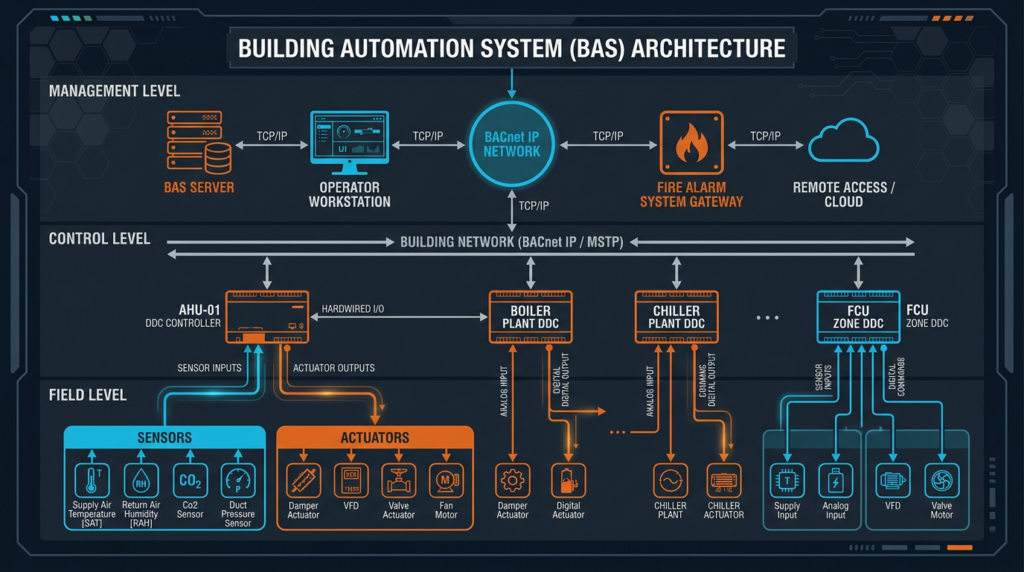
A typical BAS follows a hierarchical architecture with three distinct levels:
- Field devices form the lowest level, encompassing all sensors, actuators, and terminal equipment controllers. These devices collect data from the physical environment and execute commands from higher-level controllers.
- Controllers occupy the middle tier and come in several forms. Zone controllers manage individual spaces or zones. Terminal unit controllers handle specific equipment like VAV boxes, fan coil units, and unit ventilators. Central plant controllers coordinate major equipment such as chillers, boilers, cooling towers, and primary pumps. Modern controllers feature 32-bit processors capable of running complex sequences and storing weeks of trend data locally.
- The Central Management System (CMS) sits at the top of the hierarchy, serving as the primary operator interface. The CMS provides graphical user interfaces with dynamic floor plans and system schematics, data logging and trending with configurable intervals (typically 1 to 15 minutes), alarm management with priority levels and escalation procedures, automated scheduling, energy reporting, and remote access through web-based interfaces or mobile applications.
Communication Protocols
Reliable communication between all system components depends on standardized protocols:
- BACnet (Building Automation and Control Networks), defined by ASHRAE Standard 135, is the most widely adopted open protocol in the industry. BACnet/IP operates over standard Ethernet networks, while BACnet MS/TP uses RS-485 serial communication for field-level device networks. BACnet’s object-oriented data model promotes interoperability between equipment from different manufacturers.
- Modbus is a serial communication protocol developed in 1979 that remains popular due to its simplicity. Modbus RTU operates over RS-485 networks, while Modbus TCP/IP uses Ethernet. It is commonly used for integrating power meters, VFDs, and packaged equipment.
- LonWorks uses a peer-to-peer networking architecture and was historically prominent in building automation, particularly in Europe. Its market share has declined relative to BACnet but remains significant in legacy installations.
- Other protocols include KNX (the European standard for building control), Zigbee and Bluetooth Low Energy (for wireless sensor networks), and various proprietary protocols from major BAS manufacturers.
Cybersecurity Considerations
As BAS systems become increasingly connected to enterprise IT networks and the internet, cybersecurity is a critical concern. Vulnerabilities in BAS networks have been exploited in high-profile attacks, including the 2013 Target data breach, which originated through an HVAC contractor’s network credentials. Best practices include network segmentation, encrypted communications, role-based access control, regular firmware updates, and adherence to frameworks such as NIST SP 800-82 for industrial control system security.
Advanced Control Strategies and Optimization
Demand Controlled Ventilation
Demand Controlled Ventilation (DCV) adjusts outdoor air intake based on real-time occupancy rather than fixed maximum rates. CO2 sensors in occupied zones serve as proxies for occupancy density. When CO2 levels drop below a threshold (typically 800 ppm for office spaces), the system reduces outdoor airflow, saving significant energy on conditioning outside air. DCV can reduce ventilation-related energy costs by 20% to 40% in spaces with variable occupancy such as conference rooms, auditoriums, and retail spaces, while simultaneously improving indoor air quality during peak occupancy.
Optimal Start and Stop
Optimal start/stop algorithms calculate the latest possible time to start HVAC equipment so the building reaches comfort conditions exactly when occupants arrive. The algorithm considers outdoor air temperature, building thermal mass, zone temperature at startup, and historical performance data. Rather than starting equipment at a fixed time with a large safety margin, optimal start can reduce pre-occupancy run time by 30 to 60 minutes daily, yielding measurable energy savings across heating and cooling seasons.
Chiller Plant Optimization
Central cooling plants offer substantial optimization opportunities through BAS-managed strategies:
- Chiller sequencing ensures the most efficient combination of chillers operates at any given load, avoiding part-load inefficiency.
- Chilled water supply temperature reset raises chilled water temperature during periods of low cooling demand, improving chiller COP by approximately 1% to 2% per degree of reset.
- Condenser water temperature optimization balances chiller and cooling tower energy to minimize total plant power consumption.
- Free cooling uses waterside or airside economizers to provide cooling with minimal compressor operation when outdoor conditions permit.
Predictive Maintenance
BAS trend data enables predictive maintenance strategies that identify equipment degradation before failure occurs. By analyzing patterns in vibration data, motor current draw, temperature differentials across coils, and refrigerant pressures, facility teams can schedule repairs during planned downtime. Machine learning algorithms improve prediction accuracy over time. Studies indicate that predictive maintenance can reduce maintenance costs by 25% to 30% and decrease unplanned downtime by up to 75% compared to reactive maintenance approaches.
Integration with Other Building Systems
Modern BAS platforms integrate with lighting control systems to coordinate occupancy-based dimming and daylight harvesting. Integration with access control and security systems enables occupancy-driven HVAC scheduling at a granular level. Fire alarm system integration is essential for smoke control sequences, duct smoke detector response, and emergency pressurization of stairwells and elevator shafts. Building Information Modeling (BIM) integration allows design teams to link BAS points to 3D building models, streamlining commissioning and ongoing facility management.
Common Misconceptions and Challenges
- BAS is too expensive for small buildings. Scalable, cloud-based BAS solutions now serve buildings as small as 10,000 square feet with reasonable payback periods of two to four years. Wireless sensor technologies have further reduced installation costs.
- BAS is a set-it-and-forget-it system. Without ongoing monitoring, optimization, and periodic recommissioning, BAS performance degrades significantly. Studies by Lawrence Berkeley National Laboratory show that buildings lose 15% to 30% of their initial energy savings within three to five years without active management.
- All BAS systems are created equal. Significant differences exist in processing power, protocol support, analytics capabilities, and long-term vendor support. Specifying open protocols like BACnet protects building owners from vendor lock-in.
Persistent industry challenges include interoperability issues between products from different manufacturers, growing cybersecurity threats, and a skilled labor shortage. The Bureau of Labor Statistics projects strong demand growth for BAS technicians and controls engineers through 2030, but training programs have not kept pace with industry needs.
Future Trends and Innovations
The Internet of Things (IoT) is expanding the sensor landscape dramatically, with low-cost wireless sensors enabling monitoring of parameters and locations previously uneconomical to instrument. Artificial intelligence and machine learning are moving beyond pilot projects into production deployments, enabling real-time optimization that adapts continuously without manual tuning. Digital twins, virtual replicas of physical buildings and their systems, allow operators to simulate control strategy changes before implementing them, reducing risk and accelerating optimization. Edge computing pushes processing power to local controllers, reducing cloud dependence, lowering network latency, and improving system resilience. These technologies are converging to create buildings that are not just automated but genuinely intelligent, capable of self-optimizing in response to weather, occupancy, energy prices, and grid conditions.
Practical Applications
Hospital
A 500-bed regional hospital implemented a comprehensive BAS to maintain operating room temperatures within plus or minus 1°F and humidity between 30% and 60% RH per ASHRAE Standard 170. Automated pressure relationships ensure proper isolation room performance. The system reduced annual energy costs by 22%, totaling approximately $840,000 in savings, while improving compliance with Joint Commission environmental requirements.
Commercial Office Building
A 400,000-square-foot Class A office tower deployed BAS with DCV across all conference rooms and open office areas, combined with chiller plant optimization and optimal start/stop. The building achieved a 28% reduction in energy use intensity (EUI) compared to the ASHRAE 90.1 baseline, contributing to LEED Gold certification. Tenant comfort surveys showed a 15% improvement in satisfaction scores following system commissioning.
University Campus
A state university connected 45 buildings to a centralized BAS platform, enabling campus-wide energy monitoring, automated fault detection, and predictive maintenance across 2.8 million square feet. Within the first two years, the system identified over 1,200 operational faults, reduced campus energy consumption by 18%, and cut maintenance emergency calls by 35%.
Key Takeaways
HVAC controls and Building Automation Systems are fundamental to achieving energy efficiency, occupant comfort, and operational excellence in buildings of all sizes. Success depends on selecting appropriate control strategies, specifying open communication protocols, investing in quality sensors and actuators, and committing to ongoing system optimization. As IoT, artificial intelligence, and digital twin technologies mature, BAS platforms will continue to grow more capable and more essential. Building owners and facility managers who invest in robust automation today position themselves for lower operating costs, improved occupant satisfaction, and the flexibility to adopt emerging technologies as they become available. The most important step is recognizing that a BAS is not simply a piece of equipment but an ongoing operational strategy that requires skilled personnel, continuous attention, and periodic recommissioning to deliver its full value.