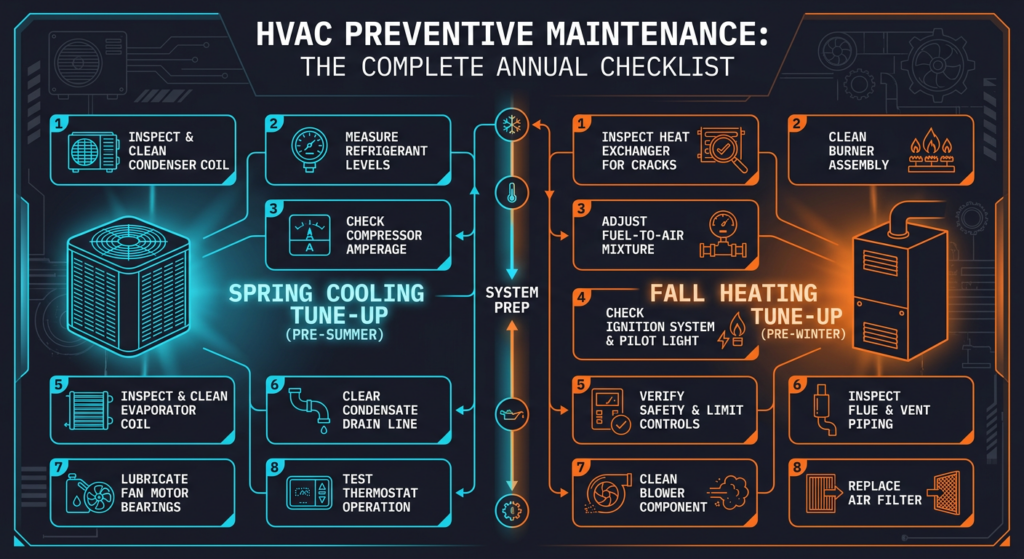
A dirty air filter can increase your energy consumption by up to 15%, according to the U.S. Department of Energy. Scale that across an entire year of heating and cooling, and you are looking at hundreds of dollars in wasted energy, accelerated wear on components, and degraded indoor air quality. The worst part? It is entirely preventable. HVAC preventive maintenance is the single most effective strategy for extending system lifespan, reducing utility bills, and avoiding emergency repair calls. HVAC stands for Heating, Ventilation, and Air Conditioning, and these systems do far more than regulate temperature. They manage humidity, filter airborne contaminants, and in the case of gas-fired equipment, must operate safely to prevent carbon monoxide exposure. This article provides a complete annual HVAC maintenance checklist that homeowners, building managers, and small business owners can follow season by season to keep their systems running at peak performance.
Understanding Your HVAC System
Basic Components
Before working through any checklist, it helps to understand the major components you will be inspecting and maintaining:
- Heating equipment: This includes gas furnaces, oil furnaces, electric furnaces, and heat pumps. Gas furnaces remain the most common in colder climates, while heat pumps are gaining popularity for their dual heating and cooling capability.
- Cooling equipment: Central air conditioners, heat pumps operating in cooling mode, and ductless mini-split systems all fall into this category. Each has an outdoor condenser unit and an indoor evaporator coil or air handler.
- Ventilation: Ductwork, supply and return registers, exhaust fans, and the air handler itself form the ventilation network that distributes conditioned air throughout your space.
- Thermostat: The control center for the entire system. Traditional programmable models and modern smart thermostats both require periodic attention.
System Types and Variations
Forced-air systems with ductwork are the most common residential configuration, but radiant heating systems, ductless mini-splits, and geothermal heat pumps each have unique maintenance requirements. Always consult your owner’s manual for model-specific recommendations. Manufacturers like Carrier, Trane, Lennox, and Rheem publish detailed maintenance schedules that may differ from general guidelines.
Safety First
Before performing any maintenance task, shut off power to the system at the breaker panel and, for gas equipment, know the location of the gas shutoff valve. Never attempt to handle refrigerant without EPA Section 608 certification. Electrical work, gas furnace combustion analysis, and refrigerant charging should always be performed by a licensed HVAC technician. Attempting these tasks yourself can void manufacturer warranties and create serious safety hazards.
The Complete Annual HVAC Preventive Maintenance Checklist
Air Filters
Frequency: Inspect monthly. Replace or clean every 30 to 90 days depending on filter type, household size, pets, and local air quality.
Air filters are the frontline defense for both your equipment and your indoor air quality. A clogged filter restricts airflow, forces the blower motor to work harder, and can cause the evaporator coil to freeze in cooling mode or the heat exchanger to overheat in heating mode.
- Locate your filter at the return air grille or inside the air handler cabinet.
- Check the MERV rating (Minimum Efficiency Reporting Value). Filters rated MERV 1 through 4 capture large particles like dust and pollen. MERV 8 through 13 filters trap finer particles including mold spores, pet dander, and some bacteria. MERV 13 is generally the highest rating recommended for residential systems without modifications, as higher-rated filters can restrict airflow beyond what the system was designed to handle.
- For reusable electrostatic filters, wash with water and allow to dry completely before reinstalling.
- If you use an electronic air cleaner, clean the collector cells every one to three months following the manufacturer’s instructions. Replace UV germicidal lamp bulbs annually, as their effectiveness degrades over time even if the bulb still illuminates.
Cooling System (Air Conditioner and Heat Pump)
Frequency: Perform these tasks each spring before the cooling season begins.
Outdoor Unit (Condenser):
- Clear all vegetation, leaves, grass clippings, and debris from around the unit. Maintain a minimum clearance of 2 to 3 feet on all sides for proper airflow.
- Gently rinse the condenser fins with a garden hose from the inside out. Never use a pressure washer, as the high-pressure stream will flatten the delicate aluminum fins and reduce heat transfer capacity.
- Inspect the fins for bending or damage. Use a fin comb to carefully straighten bent fins.
- Visually inspect the refrigerant lines (the insulated copper tubing running between the indoor and outdoor units) for oil residue, which can indicate a leak. If you suspect a refrigerant leak, contact a certified technician immediately. Common residential refrigerants include R-410A and the newer R-32. As of January 2025, R-410A is being phased down under EPA regulations due to its high global warming potential, making proper handling and leak repair even more critical.
- With power off, inspect electrical connections at the disconnect box for tightness and signs of corrosion or overheating (discolored wires, melted insulation).
- Verify that the concrete or composite pad beneath the unit is level. A tilted condenser can cause vibration, refrigerant distribution issues, and premature compressor wear.
Indoor Unit (Evaporator):
- Inspect the condensate drain line for clogs. A blocked drain can cause water to back up into the drain pan, overflow onto floors or ceilings, and create conditions for mold growth. Flush the drain line with a cup of distilled white vinegar or use a wet/dry vacuum on the outdoor drain termination to clear blockages.
- Place algaecide tablets in the condensate pan to prevent algae and slime buildup throughout the cooling season.
- Inspect the evaporator coil for accumulated dirt and debris. A dirty evaporator coil reduces cooling capacity and efficiency. Light surface dust can be removed with a soft brush, but heavy buildup requires a no-rinse foaming coil cleaner or professional cleaning.
Heating System
Frequency: Perform these tasks each fall before the heating season begins.
Gas Furnace:
- Install or test carbon monoxide detectors on every level of the home and near sleeping areas. Replace detector batteries annually and replace the units themselves according to manufacturer specifications (typically every 5 to 7 years).
- Schedule an annual professional inspection. A qualified technician will perform a combustion analysis, check gas pressure, inspect the heat exchanger for cracks, and verify safe venting.
- Visually inspect the burner flames through the furnace sight glass. Healthy flames are blue and steady with small yellow tips. Predominantly yellow, orange, or flickering flames indicate incomplete combustion and require immediate professional attention.
- Inspect the flue pipe and venting for rust, corrosion, separations at joints, and proper slope. Any deterioration in the venting system can allow combustion gases, including carbon monoxide, to enter the living space.
- Clean the blower motor housing and fan blades. Accumulated dust on blower blades reduces airflow efficiency. Lubricate motor bearings if the motor has oil ports (many modern motors are sealed and require no lubrication).
- Check the furnace AFUE rating (Annual Fuel Utilization Efficiency) listed on the equipment nameplate. Standard efficiency furnaces operate at 80% AFUE, while high-efficiency condensing furnaces achieve 90% to 98.5% AFUE. If your furnace is older and rated below 80%, upgrading to a high-efficiency model can significantly reduce fuel costs.
Electric Furnace:
- With power off, inspect heating elements for visible damage, discoloration, or sagging.
- Check electrical connections and wire terminals for tightness.
- Clean the blower motor and fan blades as described above.
Heat Pump (Heating Mode):
- Follow the same outdoor unit cleaning and inspection steps listed under the cooling system section.
- Verify that the defrost cycle operates correctly. During winter operation, frost will accumulate on the outdoor coil. The system should periodically reverse to defrost mode, melting the ice. Excessive ice buildup that does not clear indicates a defrost control issue, low refrigerant, or a faulty reversing valve.
- Test the backup heat source (typically electric resistance heat strips). Set the thermostat to emergency heat mode and confirm that warm air is delivered.
Thermostat
- Test both heating and cooling modes to verify proper operation and accurate temperature readings. Compare the thermostat reading to a separate thermometer placed nearby.
- Replace batteries annually in battery-powered models. A low battery can cause erratic system behavior or complete shutdown.
- Review and update programmed schedules for seasonal changes.
- Consider upgrading to a smart thermostat if you have not already. Models from Ecobee, Google Nest, and Honeywell Home can learn your schedule, respond to occupancy, and provide energy usage reports. The EPA estimates that proper thermostat use can save approximately 8% on heating and cooling costs annually.
Ductwork
- Inspect accessible ductwork in attics, basements, and crawl spaces for visible gaps, disconnected joints, and damaged insulation. Seal leaks with mastic sealant or UL-listed foil-backed tape. Do not use standard cloth duct tape, which degrades quickly under temperature cycling and loses its adhesion within a few years.
- Check duct insulation for compression, moisture damage, or missing sections. Replace damaged insulation to prevent energy loss and condensation.
- Vacuum supply and return registers to remove dust accumulation.
- Consider professional duct cleaning every 3 to 5 years, or sooner if you notice visible mold growth, pest infestations, or excessive dust despite regular filter changes.
Ventilation and Exhaust
- Clean bathroom exhaust fan blades and housings. Remove the cover and vacuum or wipe the fan assembly. A clogged exhaust fan cannot remove moisture effectively, leading to mold and mildew growth.
- Clean the kitchen range hood grease filter. Most metal mesh filters can be washed in hot soapy water or run through the dishwasher.
- If you have a whole-house ventilation system (ERV or HRV), clean or replace the filters and inspect the core for debris buildup according to manufacturer instructions.
Efficiency Ratings and What They Mean
Understanding efficiency metrics helps you evaluate your system’s performance and make informed upgrade decisions:
- SEER2 (Seasonal Energy Efficiency Ratio 2) measures cooling efficiency. As of January 2023, the minimum standard for residential air conditioners is 14.3 SEER2 in the northern United States and 15 SEER2 in the southern region. Higher SEER2 ratings mean lower electricity consumption per unit of cooling.
- HSPF2 (Heating Seasonal Performance Factor 2) measures heat pump heating efficiency. The current minimum is 7.5 HSPF2. High-performance cold-climate heat pumps can exceed 10 HSPF2.
- AFUE measures furnace fuel efficiency. A 96% AFUE furnace converts 96 cents of every fuel dollar into heat, with only 4 cents lost through exhaust.
Common Misconceptions About HVAC Maintenance
- “If it is not broken, do not fix it.” HVAC systems degrade gradually. By the time a failure occurs, secondary damage to compressors, motors, or heat exchangers may already be extensive and expensive. Preventive maintenance catches small problems before they become large ones.
- “I can handle all maintenance myself.” Homeowners can and should handle filter changes, basic cleaning, and visual inspections. However, combustion analysis, refrigerant work, electrical diagnosis, and heat exchanger inspection require professional training, specialized tools, and in many cases, legal certification.
- “All air filters are the same.” A MERV 1 fiberglass filter and a MERV 13 pleated filter have vastly different particle capture rates. Choosing the right filter involves balancing filtration needs against your system’s airflow capacity.
- “Duct tape works fine on ducts.” Standard duct tape was never designed for HVAC ductwork sealing. It fails under the temperature fluctuations inside a duct system. Use mastic sealant or purpose-built foil tape instead.
- “Closing vents in unused rooms saves energy.” In a properly designed forced-air system, closing vents increases static pressure, which can reduce efficiency, stress the blower motor, and worsen duct leakage.
When to Call a Professional
Certain situations always warrant a call to a licensed HVAC technician:
- Refrigerant issues: Charging, recovering, or repairing refrigerant circuits requires EPA Section 608 certification. Low refrigerant is never normal and always indicates a leak that must be found and repaired.
- Gas furnace concerns: Any smell of gas, yellow burner flames, frequent cycling, or carbon monoxide detector alarms require immediate professional response.
- Electrical problems: Tripped breakers, burning smells near the equipment, or visible wire damage call for a qualified electrician or HVAC technician.
- Major component failures: Compressor replacement, heat exchanger cracks, and blower motor failures are complex repairs that affect system safety and warranty coverage.
- Unusual noises or smells: Grinding, banging, screeching, or persistent musty odors from the system indicate mechanical or biological issues that need diagnosis.
- Annual professional tune-up: Even with diligent DIY maintenance, schedule a comprehensive professional inspection at least once per year. Many contractors offer a Preventive Maintenance Agreement (PMA) that includes priority scheduling, discounted repairs, and one or two annual tune-ups for a flat fee, typically between $150 and $300 per year.
Practical Tips for Staying on Schedule
- Create a written maintenance calendar. Mark filter checks monthly, cooling system prep in March or April, and heating system prep in September or October. Set phone reminders for each task.
- Buy filters in bulk. Purchasing a 4-pack or 6-pack of the correct size and MERV rating saves money and removes the excuse of not having a replacement on hand.
- Take advantage of seasonal pricing. HVAC contractors are typically busiest during the first heat wave and the first cold snap. Schedule your professional tune-up during the shoulder seasons (spring and early fall) when you are more likely to get preferred appointment times and potential discounts.
- Combine maintenance with other efficiency measures. When you are inspecting ductwork, also check weatherstripping on doors and windows. Adding attic insulation, sealing air leaks, and maintaining your HVAC system together produce compounding energy savings.
- Keep records. Document every maintenance task, professional visit, and part replacement with dates. This history is valuable for warranty claims, real estate transactions, and tracking system performance over time.
Key Takeaways
Consistent HVAC preventive maintenance is not optional if you want reliable comfort, safe operation, and reasonable energy bills. Change your air filters monthly, clean and inspect your cooling system each spring, service your heating system each fall, and seal any ductwork leaks you find. Handle the tasks within your skill level and call a licensed professional for combustion analysis, refrigerant work, electrical repairs, and your annual comprehensive system inspection. A well-maintained HVAC system can last 15 to 25 years, while a neglected one may fail in half that time. The checklist in this article gives you a clear, actionable framework. Start today, stay consistent, and your system will reward you with years of efficient, trouble-free performance.