HVAC pricing remains one of the most misunderstood aspects of the heating, ventilation, and air conditioning industry. Homeowners frequently encounter wide price variations between contractors and struggle to understand why a seemingly simple repair or installation carries the cost it does. For contractors, setting rates that cover expenses, remain competitive, and sustain a profitable business is an ongoing challenge. This guide breaks down exactly how HVAC contractors set their rates, what drives costs up or down, and how both sides of the transaction can make better decisions.
Understanding the Building Blocks: Components of HVAC Pricing
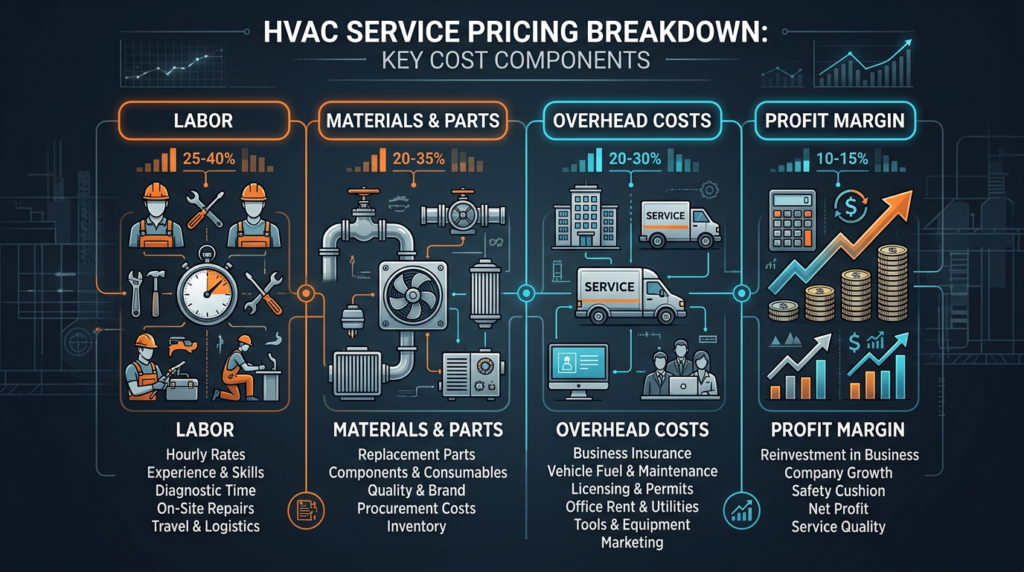
Every HVAC price tag is built from four fundamental components: labor, materials, overhead, and profit. Understanding each one explains why that quote on your kitchen counter looks the way it does.
Labor Costs
Billable hours represent the time a technician spends actively working on a project, but the actual cost to the contractor extends well beyond those hours. Travel time, diagnostic work, paperwork, and post-job cleanup all factor in. According to the Bureau of Labor Statistics, the median hourly wage for HVAC mechanics and installers was approximately $25.90 in 2023, but that figure varies significantly by region. Technicians in metropolitan areas like New York, San Francisco, or Boston often command $35 to $50 or more per hour, while rates in rural areas may fall between $20 and $30.
Beyond the base wage, contractors must account for labor burden, which includes payroll taxes, workers’ compensation insurance, health insurance, retirement contributions, and paid time off. Labor burden typically adds 25% to 40% on top of an employee’s base wage. A technician earning $30 per hour may actually cost the company $40 to $42 per hour once burden is factored in. This is why the rate a homeowner sees on a bill is always higher than the technician’s take-home pay.
Material Costs
Equipment costs form the largest material expense on most HVAC projects. A residential central air conditioner ranges from $2,500 to $7,500 for the unit alone, depending on the brand, SEER2 efficiency rating, capacity, and features. A high-efficiency heat pump can range from $3,500 to $10,000 or more. Furnaces typically fall between $1,500 and $5,000 for the equipment.
Contractors apply a material markup, usually between 15% and 35%, to cover the costs of procurement, storage, transportation, handling, and the risk of damage or defective parts. This markup is standard across virtually all construction and service trades.
Consumables such as refrigerant, copper tubing, wiring, duct tape, sheet metal screws, PVC fittings, and sealants may seem minor individually, but they add up across a project. Refrigerant costs in particular have risen sharply. R-410A, once the industry standard, has seen prices climb from roughly $75 per 25-pound jug in 2020 to over $200 in 2024 due to the EPA’s phasedown schedule under the AIM Act.
Overhead Costs
Overhead encompasses every business expense that is not directly tied to a specific job. Fixed overhead includes rent or mortgage on shop space, general liability insurance, vehicle insurance, business licenses, software subscriptions for dispatching and accounting, and marketing expenses. Variable overhead includes fuel, vehicle maintenance, advertising spend, office supplies, and continuing education.
A well-run HVAC company typically operates with overhead costs that represent 25% to 50% of total revenue. Contractors who fail to accurately calculate and allocate overhead into their pricing will inevitably underprice their work and risk business failure.
Profit Margin
Profit margin is not a luxury; it is a business necessity. Profit funds reinvestment in equipment, training, warranty support, and business growth. Industry benchmarks suggest that healthy HVAC companies target a net profit margin of 8% to 15% on installations and 15% to 25% on service and repair work. Maintenance agreements often carry margins of 10% to 20%. Companies operating below these thresholds may struggle to weather slow seasons, honor warranties, or invest in the skilled workforce that quality work demands.
Pricing Models in the HVAC Industry
HVAC contractors generally use one of four pricing models, and some use a hybrid approach depending on the type of work.
Cost-Plus Pricing
Cost-plus pricing calculates the total cost of labor, materials, and allocated overhead for a job, then adds a predetermined percentage for profit. If a job costs the contractor $3,000 in total expenses and the target markup is 30%, the customer pays $3,900. This model is straightforward but can lead to unpredictable final bills when job scope changes, which makes some homeowners uncomfortable.
Flat-Rate Pricing
Flat-rate pricing assigns a fixed price to specific services, regardless of how long the work takes. A capacitor replacement might be priced at $275, whether the technician completes it in 20 minutes or 45 minutes. This model offers homeowners predictability and eliminates the anxiety of watching the clock. For contractors, it rewards efficiency. The downside is that unusually complex versions of standard jobs may result in the contractor absorbing unexpected costs.
Time and Materials Pricing
Time and materials (T&M) pricing bills customers for actual labor hours and materials used. This model works best for diagnostic work, complex repairs where the scope is unclear at the outset, or emergency service calls. Transparency is critical with T&M pricing. Contractors should provide detailed invoices showing hours worked, hourly rates, and itemized material costs.
Value-Based Pricing
Value-based pricing sets rates according to the perceived value delivered to the customer rather than strictly on costs incurred. A contractor with an outstanding reputation, exceptional customer service, extended warranties, or specialized expertise in high-efficiency systems may charge a premium that reflects the additional value they bring. This model works for established companies with strong brand recognition and a loyal customer base.
Factors That Influence HVAC Pricing
Beyond the basic cost components, several external factors cause significant price variation from one project to the next.
- Location: Cost of living differences between regions can shift project costs by 30% to 50%. Permit fees alone vary from $50 in some municipalities to over $500 in others.
- Seasonality: Peak seasons (summer for cooling, winter for heating) drive higher demand and often higher prices. Scheduling work in the shoulder seasons of spring and fall can sometimes yield 10% to 20% savings.
- System complexity: A straightforward furnace swap in an accessible basement costs far less than a full system replacement in a multi-zone home with complex ductwork modifications.
- Accessibility: Equipment located in tight attics, crawl spaces, or rooftops requires more labor time and sometimes specialized rigging equipment, increasing costs.
- Permits and inspections: Most jurisdictions require permits for HVAC installations and major modifications. Skipping permits can result in fines, voided warranties, and complications during home sales.
- Warranty and guarantees: Contractors who offer extended labor warranties or satisfaction guarantees build those costs into their pricing. A company offering a 5-year labor warranty will price higher than one offering 90 days.
- Technology and smart home integration: Adding smart thermostats, zoning controls, air quality monitors, or Wi-Fi-enabled equipment increases both material and labor costs.
Recent Changes and Challenges Affecting HVAC Pricing
The HVAC industry has faced significant cost pressures since 2020, and several trends continue to shape pricing in 2024 and beyond.
Inflation has driven up the cost of metals, plastics, and petroleum-based products used in HVAC manufacturing and installation. Copper prices, a key input for refrigerant lines and electrical wiring, have fluctuated between $3.50 and $4.50 per pound through 2023 and 2024, well above the pre-pandemic average of approximately $2.75.
The skilled labor shortage remains acute. The HVAC industry needs an estimated 115,000 new technicians annually, according to the Air Conditioning Contractors of America (ACCA), but training programs are not producing enough graduates to meet demand. This scarcity drives wages upward and gives experienced technicians significant leverage in the job market.
Refrigerant regulations are reshaping equipment costs. The EPA’s phasedown of HFC refrigerants under the AIM Act reduced the production and import allowance of R-410A by 40% starting in 2024. New equipment is transitioning to A2L refrigerants such as R-454B and R-32, which are mildly flammable and require updated safety standards, new tools, and additional technician training. All of these factors add cost to both equipment and labor.
Government incentives offer a partial offset. The Inflation Reduction Act (IRA) provides federal tax credits of up to $2,000 for qualifying heat pump installations and up to $600 for high-efficiency furnaces and central air conditioners. Additional state and utility rebates can reduce net costs further. Homeowners should check the ENERGY STAR Rebate Finder and consult with their tax advisor to determine eligibility.
Common Misconceptions About HVAC Pricing
Several persistent myths lead to unrealistic expectations and poor purchasing decisions.
- “All contractors charge the same.” In reality, contractors have different overhead structures, supplier relationships, experience levels, and business models. Pricing differences of 20% to 40% between companies bidding on the same job are common and expected.
- “The lowest price is always the best deal.” The cheapest bid may indicate cut corners, substandard materials, lack of proper insurance, or unlicensed workers. The cost of fixing a bad installation almost always exceeds the savings from choosing the cheapest option initially.
- “HVAC systems are overpriced.” A properly installed HVAC system operates 2,000 to 3,000 hours per year, lasts 15 to 20 years, and directly impacts health, comfort, and property value. When viewed on a per-year or per-hour-of-use basis, even premium systems represent reasonable value.
- “Repairs should cost next to nothing.” A service call involves a trained professional driving a stocked vehicle to your home, diagnosing a problem using specialized tools, and installing parts that may cost hundreds of dollars at wholesale. A $150 to $250 diagnostic fee reflects real costs.
- “Online pricing tools are always accurate.” Web-based estimators provide rough ballpark figures. They cannot account for local code requirements, site-specific conditions, ductwork needs, or equipment accessibility at your specific home.
Tips for Homeowners: Evaluating Bids and Making Smart Decisions
Homeowners who approach HVAC purchases systematically get better outcomes and better value.
- Get at least three written quotes from licensed, insured contractors. Verbal estimates are unreliable and unenforceable.
- Compare bids on equal terms. Make sure each bid specifies the same equipment model or equivalent, the same scope of work, warranty terms, and included permits. A $5,000 bid without ductwork modification is not comparable to a $7,000 bid that includes it.
- Ask essential questions: Is the company licensed and insured? How many years of experience do they have? Will they pull permits? What warranty do they offer on labor? Can they provide references from recent jobs?
- Check reviews and verify credentials. Look at Google reviews, BBB ratings, and state licensing board databases. Contact at least one reference.
- Understand the warranty. Manufacturer warranties cover parts but typically require professional installation by a licensed contractor. Installer warranties cover labor. Know the duration and terms of both.
- Consider maintenance agreements. Annual maintenance plans typically cost $150 to $300 per year and can extend equipment life, maintain efficiency, and prevent costly breakdowns.
Consider this real-world scenario: you receive three bids for a new air conditioning system. Bid A is $4,800 but includes no labor warranty and uses a builder-grade unit. Bid B is $6,200, includes a 10-year parts warranty and 2-year labor warranty, and uses a 16 SEER2 unit from a major brand. Bid C is $8,500, includes a premium 20 SEER2 system with smart thermostat integration and a 5-year labor warranty. The best choice depends on your budget, how long you plan to stay in the home, and your comfort priorities, but Bid A’s apparent savings may prove costly within a few years.
Tips for HVAC Contractors: Setting Competitive and Profitable Rates
- Track every cost meticulously. Use accounting software to monitor labor, materials, and overhead. You cannot price profitably if you do not know your true costs.
- Research competitor pricing through mystery shopping, industry surveys, and trade association data. Know where you stand in the market without racing to the bottom.
- Differentiate on value, not price. Superior customer service, faster response times, specialized certifications (NATE, EPA Section 608), and strong online reviews justify premium pricing.
- Offer financing options. Partnering with third-party financing companies removes the sticker shock barrier and helps close larger installation jobs.
- Communicate pricing transparently. Detailed, professional proposals build trust. Show customers what they are getting and why it costs what it does.
- Invest in training. Well-trained technicians work faster, make fewer mistakes, and generate fewer callbacks. The return on training investment is substantial.
- Use field service management software to streamline scheduling, dispatching, invoicing, and inventory tracking. Operational efficiency directly improves profitability.
Key Takeaways
HVAC pricing is not arbitrary. Every dollar on a contractor’s invoice traces back to labor costs, material expenses, business overhead, or the profit margin that keeps the company operational. Homeowners benefit from understanding these components because it allows them to evaluate bids critically and choose contractors based on value rather than price alone. Contractors benefit from disciplined cost tracking and transparent communication because it builds trust and sustains profitability. With refrigerant regulations tightening, labor costs rising, and new efficiency standards taking effect, both parties should expect continued price evolution in the years ahead. The best outcomes happen when both sides understand what drives the numbers and work together toward quality results that last.