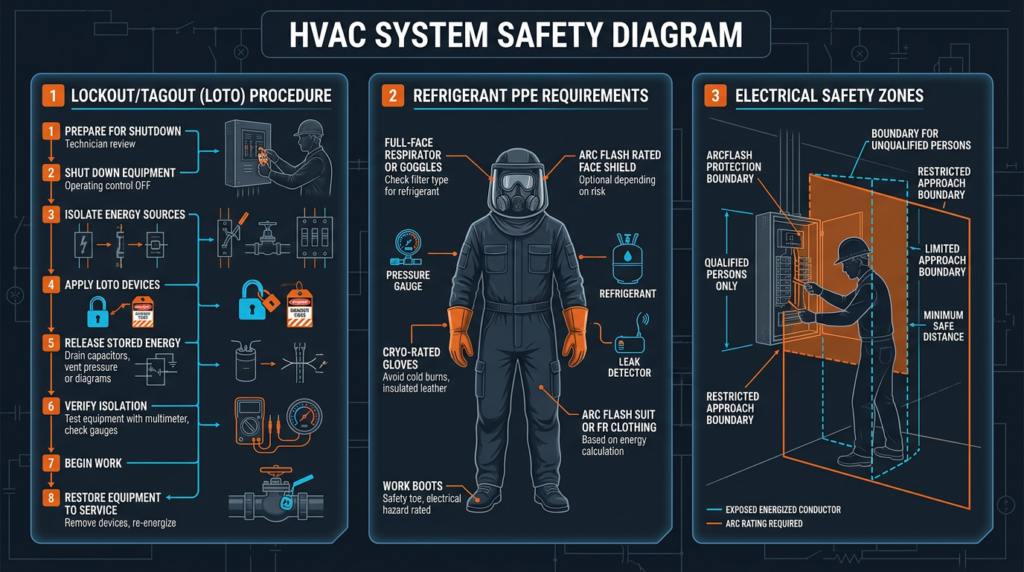
HVAC work ranks among the most hazardous occupations in the construction and service trades. Technicians routinely encounter voltages capable of causing fatal electrocution, handle refrigerants that can displace oxygen in confined spaces, and work in environments where a single procedural shortcut can result in severe injury or death. Electrical hazards and refrigerant handling represent the two most significant safety categories in the field. Understanding the risks, regulations, and proper procedures associated with each is not optional. It is a professional and legal obligation governed by OSHA, the EPA, the National Electrical Code (NEC), and ASHRAE standards.
Electrical Hazards in HVAC Work
Every HVAC system relies on electricity. Residential systems commonly operate at 120V and 240V, while commercial installations use 208V, 480V, and occasionally higher voltages. Even low-voltage control circuits, typically 24V, pose real dangers under certain conditions. A thorough understanding of electrical hazards is the foundation of safe HVAC practice.
Voltage, Amperage, and Ohm’s Law
Ohm’s Law (V = I × R) describes the relationship between voltage, current (amperage), and resistance. Voltage drives current through a circuit, and resistance determines how much current flows. The human body’s resistance varies widely, from roughly 100,000 ohms for dry, intact skin down to as low as 1,000 ohms when skin is wet or broken. At 240V with wet skin, current through the body can reach 240 milliamps, far exceeding the 100 to 200 milliamp threshold that causes ventricular fibrillation and death.
A common misconception holds that low voltage is always safe. This is false. A 24V control circuit in a wet mechanical room can deliver a painful and potentially dangerous shock. Current, not voltage alone, kills. Technicians must treat every circuit with respect regardless of its rated voltage.
Grounding and Bonding
Grounding provides a low-resistance path for fault current to return to the electrical source, enabling overcurrent protection devices to trip and de-energize the circuit. The National Electrical Code (NEC) requires all HVAC equipment to be properly grounded. NEC Article 250 specifies requirements for grounding conductors, ground rods, and bonding techniques.
Bonding connects all metal components of an installation to ensure they remain at the same electrical potential, preventing shock hazards from stray voltages. Improperly grounded HVAC equipment can energize metal cabinets, ductwork, and refrigerant piping, creating lethal contact hazards for technicians and occupants.
Overcurrent Protection
Circuit breakers and fuses protect conductors and equipment from damage caused by overloads and short circuits. NEC Article 430 governs motor protection and specifies that overcurrent devices must be sized according to the motor’s full-load amperage and the manufacturer’s maximum overcurrent protection rating. Installing an oversized breaker to prevent nuisance tripping is a dangerous and code-violating practice that eliminates the safety margin designed to prevent fires and equipment damage.
Lockout/Tagout (LOTO) Procedures
Lockout/Tagout (LOTO) is mandated by OSHA under 29 CFR 1910.147 for the control of hazardous energy during maintenance and repair. LOTO applies to all HVAC equipment, not just large or complex systems. The misconception that small equipment does not require LOTO has contributed to numerous preventable injuries and fatalities.
A proper LOTO procedure follows these steps:
- Identify all energy sources. HVAC systems may have multiple electrical feeds, stored energy in capacitors, pressurized refrigerant, and potential gravitational energy from suspended components.
- Notify affected personnel. All workers in the area must be informed before equipment is de-energized.
- Shut down equipment using normal operating controls.
- Isolate all energy sources. Open disconnects, close valves, and block any mechanical energy sources.
- Apply individual locks and tags to each energy isolation device. Each technician working on the equipment must apply their own lock.
- Verify isolation. Attempt to start the equipment and use a calibrated voltage tester to confirm zero energy. Test the tester itself on a known live source before and after verification.
- Perform the work.
- Remove locks and tags only after all tools are cleared, guards are replaced, and personnel are accounted for. Only the person who applied a lock may remove it.
Arc Flash Hazards
An arc flash occurs when electrical current travels through ionized air between conductors or from a conductor to ground. Temperatures at the arc point can reach 35,000°F, roughly four times the surface temperature of the sun. Arc flash events produce intense light capable of causing permanent eye damage, a pressure wave (arc blast) that can throw workers across a room, and molten metal shrapnel.
NFPA 70E requires employers to perform an arc flash hazard analysis and label equipment with the incident energy level (measured in calories per square centimeter) and the required PPE category. Technicians must consult these labels before opening any energized electrical panel.
Personal Protective Equipment for Electrical Work
OSHA mandates appropriate personal protective equipment (PPE) for all electrical work. Required PPE varies by voltage level and arc flash risk:
- Insulated gloves: Rated by class (Class 00 for up to 500V AC through Class 4 for up to 36,000V AC). Most HVAC work requires Class 00 or Class 0 gloves. Gloves must be inspected before each use and tested periodically.
- Safety glasses or face shields: Required for all electrical work. Full face shields are necessary when arc flash risk is present.
- Arc-rated clothing: Clothing rated in cal/cm² appropriate to the arc flash hazard level. Standard work clothing made of synthetic fabrics can melt onto the skin and worsen burn injuries.
- Insulated tools: Tools rated for the voltage being worked on.
- Voltage-rated footwear: Dielectric boots or shoes for work near energized conductors.
A basic set of insulated gloves, safety glasses, and arc-rated shirt and pants typically costs between $200 and $500. This is a minimal investment compared to the cost of a serious electrical injury.
Refrigerant Handling Safety
Refrigerants are the working fluids that make cooling and heat pump systems function. They operate at high pressures, can cause severe injury on contact, and pose environmental hazards when released. Federal law strictly regulates their handling, and technicians must hold proper certification to work with them.
Common Refrigerant Types and Their Hazards
R-22 (HCFC-22) was the dominant residential refrigerant for decades but has been phased out of production under the Montreal Protocol due to its ozone depletion potential. It remains in older systems and can only be serviced using recovered or recycled stock.
R-410A (an HFC blend) replaced R-22 and became the standard for residential and light commercial systems. It operates at significantly higher pressures than R-22, with normal operating pressures reaching approximately 400 to 600 psi on the high side. R-410A has a global warming potential (GWP) of 2,088, making it a target for phase-down under the AIM Act of 2020.
R-32 and R-454B represent the next generation of lower-GWP refrigerants. R-32 has a GWP of 675, and R-454B has a GWP of 466. Both are classified as A2L refrigerants, meaning they have low toxicity but are mildly flammable. This flammability classification introduces new safety considerations that did not apply to R-22 or R-410A.
Key refrigerant hazards include:
- Asphyxiation: Refrigerants are heavier than air and can displace oxygen in confined spaces such as mechanical rooms, basements, and crawlspaces. Oxygen levels below 19.5% are immediately dangerous.
- Frostbite: Liquid refrigerant released at atmospheric pressure undergoes rapid evaporation and cooling. Contact with skin can cause severe frostbite within seconds.
- Chemical burns: Refrigerant-oil mixtures can cause chemical irritation on prolonged skin contact.
- Toxic decomposition: When exposed to open flames or hot surfaces above approximately 600°F, many refrigerants decompose into hazardous compounds including phosgene, hydrogen fluoride, and carbonyl fluoride. Technicians must never use open flame leak detection methods with any refrigerant, and brazing should only occur on fully evacuated systems.
- Flammability (A2L refrigerants): R-32 and R-454B can ignite under specific conditions, though their burning velocity is low (less than 10 cm/s). Updated safety standards including UL 60335-2-40 establish requirements for equipment design, installation clearances, and leak detection systems for A2L refrigerants.
EPA Section 608 Regulations and Certification
EPA Section 608 of the Clean Air Act requires all technicians who maintain, service, repair, or dispose of equipment containing regulated refrigerants to hold appropriate certification. Four certification types exist:
- Type I: Small appliances (containing 5 pounds or less of refrigerant)
- Type II: High-pressure equipment (most air conditioning and heat pump systems)
- Type III: Low-pressure equipment (large centrifugal chillers)
- Universal: All equipment types
EPA 608 certification does not expire, but a common misconception is that it requires no further effort. Technicians are legally obligated to stay current with regulatory changes, and many employers and jurisdictions require continuing education. The cost of EPA 608 certification testing typically ranges from $20 to $50, and numerous online and in-person preparation courses are available.
Refrigerant Recovery, Recycling, and Disposal
Federal law prohibits the intentional venting of refrigerants. Before any system is opened for service, the refrigerant must be recovered using certified recovery equipment that meets EPA and AHRI standards. Recovered refrigerant is stored in approved DOT cylinders, which must not be filled beyond 80% of their rated capacity to allow for thermal expansion.
Recovery machines range in price from approximately $800 for basic residential units to $3,000 or more for high-capacity commercial equipment. Technicians must ensure recovery equipment is certified and maintained according to manufacturer specifications.
Recycled refrigerant has been cleaned through oil separation and single or multiple passes through filter-drier cores. Reclaimed refrigerant has been reprocessed to meet AHRI 700 purity standards and can be resold. Contaminated refrigerant that cannot be reclaimed must be disposed of through an EPA-certified reclaimer.
Leak Detection and Repair
The EPA mandates leak detection and repair for systems containing regulated refrigerants. Leak rate thresholds vary by equipment type: commercial refrigeration systems must be repaired if the annual leak rate exceeds 20%, while comfort cooling and all other systems must be repaired at a 10% annual leak rate threshold.
Approved leak detection methods include:
- Electronic leak detectors: Capable of detecting leaks as small as 0.1 oz/year. Must be calibrated regularly per manufacturer instructions.
- Soap bubble solution: Applied to suspect joints and connections. Effective for locating the exact point of a known leak.
- UV fluorescent dye: Added to the system oil and detected with a UV lamp. Useful for finding slow leaks over time.
- Nitrogen pressure testing: The system is pressurized with dry nitrogen and monitored for pressure drop. Never pressurize with oxygen or compressed air, as this creates an explosion risk.
Refrigerant Charging Procedures
Proper refrigerant charging is critical for system efficiency, longevity, and safety. Overcharging increases head pressure and can cause compressor failure. Undercharging reduces capacity and may cause the compressor to overheat.
Charging methods depend on the system type. Fixed-orifice systems are charged by superheat, while systems with thermostatic expansion valves (TXVs) are charged by subcooling. The manufacturer’s specified charge, measured by weight, is the most accurate method for new installations. A quality digital refrigerant scale costs between $100 and $400 and is an essential tool for any HVAC technician.
Transportation of Refrigerant Cylinders
DOT regulations govern the transportation of refrigerant cylinders. All cylinders must be properly labeled, secured in an upright position, and transported in well-ventilated areas of the vehicle. Disposable cylinders must never be refilled. Reusable (returnable) cylinders must have current hydrostatic test certification. Transporting unmarked or damaged cylinders is a federal violation.
The Refrigerant Transition and Current Regulatory Landscape
The AIM Act of 2020 directs the EPA to phase down HFC production and consumption by 85% over a 15-year period. This directly affects R-410A availability and pricing. As of 2024 and 2025, manufacturers are introducing equipment designed for R-454B and R-32, and technicians must be trained in A2L refrigerant handling before servicing these systems.
The transition coincides with updated efficiency standards. SEER2 ratings, which use a more realistic testing methodology than the original SEER protocol, took full effect on January 1, 2023. Minimum efficiency for residential central air conditioners is now 14.3 SEER2 in the northern United States and 15 SEER2 in the southern United States. Updated HSPF2 and EER2 ratings apply to heat pumps and commercial equipment respectively.
The Inflation Reduction Act (IRA) provides homeowners with tax credits of up to $2,000 per year for qualifying high-efficiency heat pumps and $600 for other qualifying HVAC equipment. Low-income households may qualify for additional rebates through state-administered programs. These incentives are driving increased demand for system upgrades and replacements, reinforcing the need for a well-trained workforce operating under proper safety protocols.
Emergency Procedures
For electrical shock incidents, the first priority is to de-energize the circuit without touching the victim. Call emergency medical services immediately. If the victim is unresponsive and not breathing normally, begin CPR. Even if the victim appears to recover, they must be evaluated at a hospital because cardiac arrhythmias can develop hours after an electrical contact event.
For refrigerant releases in enclosed spaces, evacuate the area immediately and ventilate the space. Do not re-enter until oxygen levels have been confirmed at or above 19.5% using a calibrated oxygen monitor. Provide fresh air to anyone who has inhaled refrigerant vapor and seek immediate medical attention. Under EPA regulations, releases of 100 pounds or more of certain refrigerants within a 24-hour period must be reported.
Key Takeaways
- Treat every electrical circuit as energized until verified otherwise with a calibrated tester. Follow LOTO procedures without exception.
- Select and wear PPE appropriate to the voltage level and arc flash hazard rating of the equipment being serviced.
- Never vent refrigerant. Recover it using certified equipment into approved cylinders.
- Hold and maintain current EPA Section 608 certification. Stay informed on regulatory updates including A2L refrigerant requirements.
- Understand that A2L refrigerants like R-32 and R-454B are mildly flammable and require adherence to updated safety standards and installation codes.
- Perform proper leak detection and repair within EPA-mandated leak rate thresholds.
- Follow DOT regulations for transporting refrigerant cylinders.
- Maintain training on emergency response procedures for both electrical incidents and refrigerant releases.
- Consult the NEC, ASHRAE Standard 15, NFPA 70E, and OSHA regulations as primary references for safe work practices.
Safety in HVAC work is not a checklist completed once and forgotten. It is a continuous discipline built on knowledge, proper equipment, regulatory compliance, and a professional commitment to protecting yourself, your coworkers, and the public.