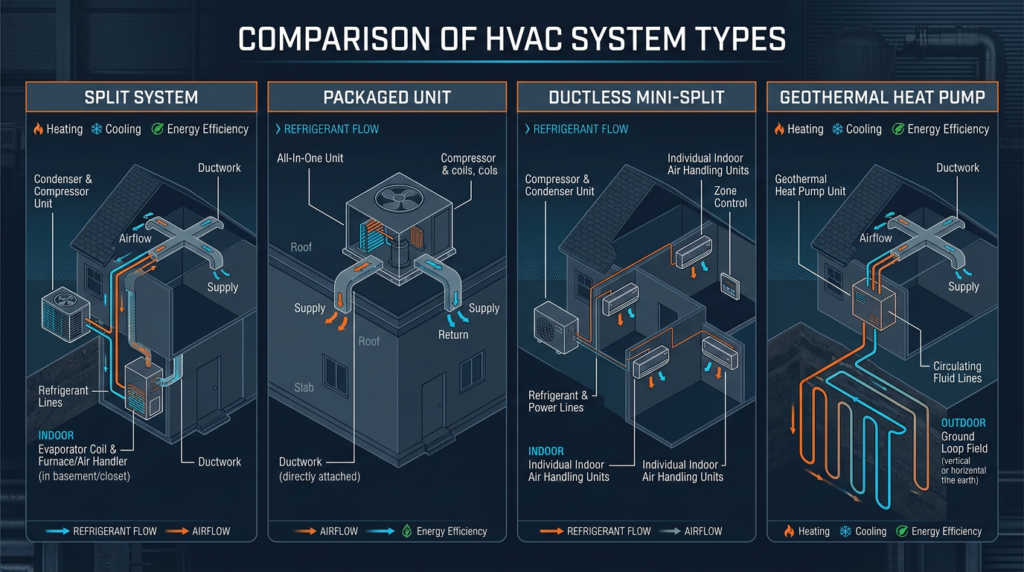
Choosing the right HVAC system determines how comfortable your building stays year-round, how much you spend on energy bills, and how often you deal with maintenance headaches. With residential and commercial heating and cooling accounting for roughly 35% of total energy consumption in U.S. buildings, the stakes are high. Four primary system types dominate the market today: split systems, packaged systems, mini-split (ductless) systems, and geothermal systems. Each brings distinct advantages and trade-offs depending on your climate, building layout, budget, and efficiency goals. This article breaks down how each system works, what components it uses, where it performs best, and what it costs to own and operate.
Split Systems
The split system is the most common HVAC configuration in North American homes. As the name suggests, it splits its components between two locations: an outdoor unit and an indoor unit, connected by refrigerant lines and electrical wiring.
Components and Operation
The outdoor unit (often called the condenser unit) houses the compressor, condenser coil, and a fan. During cooling mode, this unit rejects heat absorbed from inside the building into the outdoor air. The indoor unit (the air handler or furnace) contains the evaporator coil, blower motor, and air filter. It absorbs heat from indoor air and circulates conditioned air through the building’s ductwork.
Refrigerant lines carry refrigerant between these two units, enabling heat transfer. The most widely used refrigerant has been R-410A, but regulatory changes driven by Global Warming Potential (GWP) concerns are pushing the industry toward lower-GWP alternatives. R-454B and R-32 are leading replacements. Under the EPA’s AIM Act, production of R-410A is being phased down starting in 2024, with significant reductions expected through 2028 and beyond.
In cooling mode, the refrigerant absorbs heat at the indoor evaporator coil, travels to the outdoor condenser coil where it releases that heat, and cycles back. In heating mode, a heat pump version of the split system reverses this cycle, extracting heat from outdoor air and moving it inside. Standard split-system air conditioners provide cooling only and rely on a separate furnace (gas, oil, or electric) for heating.
Efficiency Ratings
Split system efficiency is measured by SEER2 (Seasonal Energy Efficiency Ratio 2), which replaced the original SEER metric in January 2023. The new testing procedure (M1) reflects more realistic installation conditions. Current federal minimums require 13.4 SEER2 in northern U.S. regions and 14.3 SEER2 in southern regions for air conditioners. High-efficiency models reach 20 SEER2 or higher. For heating, heat pump efficiency is rated by HSPF2 (Heating Seasonal Performance Factor 2), with a current minimum of 7.5 HSPF2.
Advantages
- Relatively affordable upfront cost, typically $3,000 to $7,500 installed for a standard system
- Widely available with extensive dealer networks and parts supply
- Broad range of models, capacities (1.5 to 5 tons), and efficiency levels
- Familiar technology that most HVAC technicians can service and repair
- Heat pump variants provide both heating and cooling from one system
Disadvantages
- Requires a duct system, which can be expensive or impractical to install in older homes
- Duct leakage can waste 20% to 30% of conditioned air according to ENERGY STAR estimates
- Outdoor units generate noticeable noise, particularly older or lower-tier models
- Professional installation is mandatory for proper refrigerant charging and electrical connections
Best Applications
Split systems work best in single-family homes and small commercial buildings that already have ductwork in place. They are the default choice for new residential construction in most of the United States. Homeowners should prioritize proper duct sealing and insulation to maximize efficiency and consider filters with a MERV rating of at least 8 to maintain good indoor air quality.
Packaged Systems
A packaged system consolidates all major HVAC components into a single outdoor cabinet. The compressor, condenser coil, evaporator coil, blower motor, and air filter all reside in one unit, which connects to the building’s ductwork through a wall or roof penetration.
Types of Packaged Systems
- Packaged air conditioners: Provide cooling only, paired with electric resistance heating elements inside the cabinet
- Packaged heat pumps: Offer reversible heating and cooling using the same refrigeration cycle
- Packaged gas/electric systems: Combine a gas furnace for heating with an electric air conditioner for cooling, offering strong performance in regions with cold winters and hot summers
Operation
Packaged systems operate on the same refrigeration principles as split systems. The key difference is physical layout. Because all components sit in a single enclosure, refrigerant lines are shorter and factory-sealed, which reduces the chance of refrigerant leaks. Conditioned air travels through supply and return ducts that connect directly to the unit.
Advantages
- Simplified installation since there is no need to run refrigerant lines between separate indoor and outdoor units
- Saves interior space because the air handler, furnace, or heat pump components are not located inside the building
- Factory-sealed refrigerant connections reduce leak potential
- Well-suited to rooftop installations on commercial buildings
Disadvantages
- Generally lower efficiency than comparable split systems due to the compact design and longer duct runs
- All components are exposed to weather, increasing the risk of corrosion and storm damage
- Noise from the compressor and blower concentrates in one location
- Repair access can be more difficult, particularly on rooftop units
Best Applications
Packaged systems are a practical choice for homes built on concrete slabs without basements or crawl spaces, manufactured and modular homes, and commercial buildings where rooftop placement keeps equipment out of occupied areas. They are especially common in the southern and southwestern United States.
Mini-Split Systems (Ductless Systems)
A mini-split system, also called a ductless system, connects a single outdoor unit to one or more wall-mounted, ceiling-mounted, or floor-mounted indoor units without using ductwork. Each indoor unit conditions a specific zone, giving occupants independent temperature control in different rooms.
Components and Operation
The outdoor unit contains the compressor and condenser coil, similar to a conventional split system. Each indoor unit contains an evaporator coil, a quiet blower fan, an air filter, and a wireless remote control or wall-mounted thermostat. Refrigerant lines and a small conduit (typically 3 inches in diameter) connect the outdoor unit to each indoor unit through a small hole in the wall.
Mini-splits transfer heat directly to and from individual rooms. In cooling mode, the indoor unit absorbs room heat and sends it through refrigerant lines to the outdoor unit for rejection. In heating mode, the cycle reverses. Most mini-splits function as heat pumps, providing year-round climate control.
Key Features
Zoned control is the defining advantage of mini-splits. A multi-zone system might connect four or five indoor units to a single outdoor unit, with each room set to a different temperature. Unoccupied rooms can be turned off entirely, saving significant energy compared to whole-house ducted systems.
Inverter technology is standard on virtually all modern mini-splits. Rather than cycling the compressor on and off at full capacity, an inverter-driven compressor adjusts its speed continuously to match the exact heating or cooling load. This results in tighter temperature control, lower energy use, quieter operation, and less compressor wear. High-end mini-splits achieve SEER2 ratings above 20, with some models exceeding 30 SEER2.
Advantages
- Exceptional energy efficiency due to inverter compressors and the elimination of duct losses
- Independent zone control reduces energy waste and allows personalized comfort
- No ductwork required, making installation faster and less invasive
- Whisper-quiet indoor operation, often below 25 decibels on low fan speed
- Improved indoor air quality with multi-stage filtration and no ducts to harbor dust or mold
- Compatibility with smart thermostats and home automation platforms for remote scheduling and monitoring
Disadvantages
- Higher upfront cost per ton of capacity compared to ducted split systems, typically $3,000 to $5,000 per zone installed
- Indoor wall units are visible and may not suit every interior design preference
- Heating performance drops in extremely cold temperatures, though cold-climate models (hyper-heat) now operate effectively down to -13°F (-25°C)
- Multi-zone systems require careful sizing by a qualified installer to avoid short-cycling and humidity problems
Best Applications
Mini-splits excel in room additions, sunrooms, converted garages, older homes without ductwork, and any situation where running ducts is impractical or too expensive. They are also increasingly specified in high-performance new construction and net-zero energy homes. The global mini-split market has grown steadily, driven by electrification trends and incentive programs that favor heat pump technology.
Geothermal Systems
A geothermal system, technically called a ground source heat pump (GSHP), uses the Earth’s stable underground temperature to heat and cool buildings. While outdoor air temperatures swing from below zero to over 100°F seasonally, the ground temperature 6 to 10 feet below the surface stays between 45°F and 75°F year-round, depending on geographic location. Geothermal systems exploit this consistency to achieve the highest operating efficiency of any HVAC technology available today.
Components
A geothermal system has three primary components:
- Ground loop: A closed network of high-density polyethylene pipes buried underground or submerged in water. These pipes circulate a water-based heat-transfer fluid (often water mixed with antifreeze) that exchanges thermal energy with the earth.
- Heat pump unit: Located inside the building, this unit contains a compressor, heat exchanger, and controls. It transfers heat between the ground loop fluid and the building’s air or hydronic distribution system.
- Distribution system: Typically ductwork (like a conventional split system), though some geothermal systems use radiant floor heating or fan coil units.
Ground Loop Types
- Horizontal loops: Pipes are laid in trenches 4 to 6 feet deep. This is the most affordable loop option but requires substantial yard space, typically 1,500 to 3,000 square feet per ton of capacity.
- Vertical loops: Pipes are inserted into boreholes drilled 150 to 400 feet deep. Vertical loops require far less surface area, making them suitable for smaller lots, but drilling costs are significantly higher.
- Pond or lake loops: Coils of pipe are submerged in a nearby body of water at least 8 feet deep. This is often the least expensive option when a suitable water source is available on the property.
Operation
In heating mode, the ground loop fluid absorbs heat from the warmer earth and carries it to the indoor heat pump, which concentrates that heat and distributes it throughout the building. In cooling mode, the process reverses: the heat pump removes heat from indoor air and transfers it through the ground loop into the earth, which acts as a heat sink. Many geothermal systems also include a desuperheater, which captures excess heat during cooling to preheat domestic hot water at no additional energy cost.
Efficiency and Cost
Geothermal heat pump efficiency is measured by Coefficient of Performance (COP) for heating and EER (Energy Efficiency Ratio) for cooling. A typical GSHP delivers a COP of 3.0 to 5.0, meaning it produces 3 to 5 units of heating energy for every 1 unit of electrical energy consumed. By comparison, even a high-efficiency gas furnace converts fuel at 96% to 98% efficiency (a COP equivalent of roughly 0.96 to 0.98).
The upfront cost of a geothermal system is substantial, typically ranging from $18,000 to $45,000 depending on system size, loop type, and local geological conditions. However, the federal Investment Tax Credit (ITC) currently provides a 30% tax credit for geothermal heat pump installations through 2032, dropping to 26% in 2033 and 22% in 2034. Many states and utilities offer additional rebates. Operating costs run 30% to 60% lower than conventional systems, and ground loops carry warranties of 50 years or more.
Advantages
- Lowest operating costs of any HVAC system type
- Dramatically reduced carbon emissions, especially when paired with renewable electricity
- Extremely quiet operation with no outdoor fan or compressor noise
- Ground loops last 50+ years; indoor heat pump units last 20 to 25 years
- Eligible for significant federal and state tax credits and incentives
- Provides consistent comfort regardless of outdoor temperature extremes
Disadvantages
- High upfront installation cost, particularly for vertical loop systems
- Horizontal loops require large open land areas
- Local geology (rock, clay, water table) significantly affects drilling costs and loop performance
- Requires contractors with specialized geothermal design and installation expertise
- Not every property is suitable due to space or soil constraints
Best Applications
Geothermal systems perform well in virtually any climate, from Minnesota winters to Texas summers. They are ideal for new construction where loop installation can be incorporated into site work, as well as for homeowners and facility managers who plan to stay in a building long enough to recoup the higher upfront investment through energy savings. Schools, government buildings, and large residential developments are increasingly adopting geothermal for its long-term cost and environmental benefits.
Common Misconceptions
Several persistent myths lead buyers toward the wrong system or away from a good one:
- “Split systems are always the cheapest option.” While their upfront costs are often lower, duct losses and lower efficiency ratings can make them more expensive to operate over 15 to 20 years compared to ductless or geothermal alternatives.
- “Packaged systems are only for commercial buildings.” Packaged units serve hundreds of thousands of residential homes, especially slab-on-grade construction and manufactured housing.
- “Mini-splits are hard to install.” A single-zone mini-split installation is typically completed in one day with minimal structural modification, far less disruptive than retrofitting ductwork.
- “Geothermal only works if you have a pond or lake.” Pond loops are just one option. Horizontal and vertical ground loops work on standard residential lots without any water feature.
- “Geothermal systems only work in moderate climates.” Because ground temperature remains stable regardless of surface weather, GSHPs perform efficiently in both extreme cold and extreme heat.
Key Takeaways
Selecting the right HVAC system depends on your building’s structure, your climate, your budget horizon, and your efficiency goals. Split systems remain the reliable workhorse for homes with existing ductwork, offering a strong balance of cost and performance. Packaged systems solve space and layout challenges in slab homes, manufactured housing, and commercial rooftops. Mini-splits deliver outstanding efficiency and zone control without ductwork, making them the top choice for retrofits, additions, and high-performance buildings. Geothermal systems offer the lowest lifetime operating costs and the smallest carbon footprint but require higher initial investment and suitable site conditions.
Before committing to any system, schedule a professional energy audit to assess your building’s insulation, air sealing, and load requirements. Consult with licensed HVAC contractors who can size equipment properly and explain available rebates and tax credits. Proper installation and regular maintenance, including filter changes, refrigerant checks, and duct inspections where applicable, will ensure any system delivers its full efficiency potential for years to come. As refrigerant regulations evolve, heat pump adoption accelerates, and smart controls become standard, the HVAC industry continues to move toward cleaner, more efficient solutions across all four system categories.