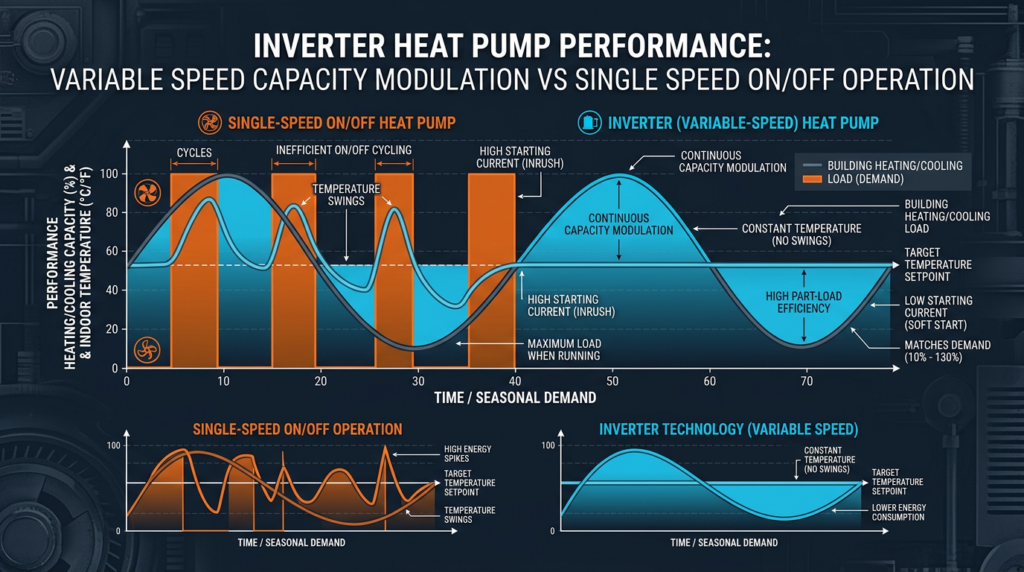
Inverter-driven heat pumps represent the most significant advancement in residential and light commercial HVAC technology in decades. Unlike traditional single-stage systems that cycle fully on and off to maintain temperature, these units use a variable-speed compressor controlled by an electronic inverter to continuously adjust heating and cooling output. The result is a system that precisely matches the building’s load at any given moment, delivering superior efficiency, comfort, and durability. With modern units achieving SEER2 ratings above 20 and capable of heating homes in sub-zero temperatures, inverter technology has fundamentally reshaped what a heat pump can do.
How Inverter Technology Works
A conventional heat pump compressor operates at one speed. When the thermostat calls for heating or cooling, the compressor starts at full capacity. When the setpoint is reached, it shuts off entirely. This binary operation creates temperature swings, wastes energy during startup surges, and places mechanical stress on the compressor.
An inverter solves this by converting the incoming fixed-frequency AC power (60 Hz in North America) into variable-frequency AC power. By changing the frequency supplied to the compressor motor, the inverter controls the motor’s rotational speed. A lower frequency means a slower compressor speed and reduced output; a higher frequency means more speed and greater capacity. Most residential inverter-driven heat pumps can modulate output from roughly 25% to 120% of rated capacity.
Key Components
The inverter is only one piece of a tightly integrated system. Four components work together to enable variable-speed operation:
- Variable-Speed Compressor: Typically uses a brushless DC (BLDC) motor paired with a scroll or rotary compressor mechanism. BLDC motors offer high efficiency across a wide speed range with minimal electrical losses. These compressors are engineered with tighter tolerances and enhanced lubrication systems to handle continuous operation at varying speeds.
- Inverter Board: The electronic control module that manages power conversion and compressor speed. It includes control algorithms, fault detection, and communication interfaces. Modern inverter boards also incorporate soft-start functionality, which eliminates the large inrush current associated with conventional compressor startups.
- Electronic Expansion Valve (EEV): A stepper-motor-driven valve that precisely meters refrigerant flow into the evaporator. Unlike a fixed-orifice device or a thermostatic expansion valve (TXV), the EEV adjusts in real time to match changing compressor speeds and load conditions. This ensures optimal superheat and subcooling across the full operating range.
- Variable-Speed DC Fan Motors: Both the indoor blower and outdoor fan use electronically commutated motors (ECMs) or similar DC motor designs. These fans adjust airflow to match the compressor’s current output, maintaining proper coil temperatures and static pressure regardless of operating speed.
A sophisticated control system ties everything together. Multiple sensors monitor suction pressure, discharge pressure, outdoor ambient temperature, indoor return air temperature, coil temperatures, and refrigerant superheat. The controller uses this data to continuously optimize compressor speed, fan speed, and EEV position.
Benefits of Variable-Speed Operation
Energy Efficiency
Variable-speed operation is inherently more efficient than fixed-speed cycling. A compressor running at 40% capacity consumes far less than 40% of its full-load energy because compressor efficiency improves at lower speeds due to reduced friction, lower discharge temperatures, and better heat transfer across the coils.
Typical efficiency comparisons illustrate the gap clearly:
- Single-stage heat pump: SEER2 of 13.4 to 15, HSPF2 of 7.5 to 8.5
- Two-stage heat pump: SEER2 of 15 to 17, HSPF2 of 8.0 to 9.0
- Inverter-driven heat pump: SEER2 of 17 to 24+, HSPF2 of 9.0 to 13+
A homeowner upgrading from a 10-year-old single-stage system (roughly SEER 13, equivalent to about SEER2 12.5) to a modern inverter unit rated at SEER2 20 can expect cooling energy savings of approximately 35% to 45%. Heating savings vary by climate but are often 30% to 50% compared to older heat pump systems, and substantially more when replacing fossil fuel equipment.
Comfort
Because an inverter-driven system runs continuously at the speed needed to maintain the setpoint, temperature swings are dramatically reduced. A traditional system may allow indoor temperatures to fluctuate 2 to 4 degrees Fahrenheit above and below the setpoint during each cycle. An inverter-driven system typically holds temperature within 0.5 degrees of the setpoint.
Continuous operation also eliminates the blasts of hot or cold air that occur when a fixed-speed system kicks on at full capacity. Supply air temperatures are more moderate and consistent, reducing drafts and eliminating the noticeable “surge” of conditioned air.
Humidity Control
In cooling mode, longer run times at lower speeds provide superior latent heat removal (dehumidification). When a conventional system cycles off, moisture that condensed on the evaporator coil can re-evaporate into the airstream. An inverter-driven system running at reduced capacity keeps the coil cold for extended periods, continuously pulling moisture from the air. Indoor relative humidity levels of 45% to 50% are more easily maintained, compared to the 55% to 60% common with oversized or single-stage systems in humid climates.
Noise Reduction
Compressor noise scales with speed. Since inverter-driven heat pumps spend most of their operating hours at partial load, they are significantly quieter than fixed-speed alternatives. A typical inverter-driven outdoor unit operates at 50 to 58 dB(A) at full speed but drops to 40 to 48 dB(A) at low speed. For comparison, a single-stage outdoor unit typically produces 68 to 76 dB(A) whenever it runs. Indoor units see similar reductions; a variable-speed air handler at low speed can operate below 40 dB(A), which is quieter than a library.
Equipment Longevity
Each compressor start-stop cycle generates mechanical stress, including torque spikes, pressure equalization surges, and lubrication disruption. A single-stage system in a typical home may cycle 6 to 10 times per hour on mild days. An inverter-driven system avoids most of these cycles by running continuously at reduced speed. Fewer start-stop events translate directly to reduced wear on the compressor, contactor, and other components. Many manufacturers now offer 10- to 12-year compressor warranties on inverter-driven units, reflecting confidence in their durability.
Efficiency Ratings and Standards
In 2023, the U.S. Department of Energy (DOE) implemented updated testing procedures that replaced SEER and HSPF with SEER2 and HSPF2. The new ratings use higher external static pressure during testing (0.5 inches of water column versus 0.1 to 0.2 previously), which more accurately reflects real-world duct system conditions. As a result, SEER2 values are numerically lower than SEER values for the same equipment, typically by about 5% to 8%.
Approximate conversion references:
- SEER 15 corresponds roughly to SEER2 14.3
- SEER 16 corresponds roughly to SEER2 15.2
- SEER 20 corresponds roughly to SEER2 19
- HSPF 8.8 corresponds roughly to HSPF2 7.5
Current DOE minimum efficiency requirements vary by region:
- Northern Region (most states outside the South and Southwest): Minimum SEER2 of 13.4 and HSPF2 of 7.5
- Southeast Region (AL, AR, DE, FL, GA, KY, LA, MD, MS, NC, OK, SC, TN, TX, VA): Minimum SEER2 of 14.3 and HSPF2 of 7.5
- Southwest Region (AZ, CA, NV, NM): Minimum SEER2 of 14.3 and HSPF2 of 7.5
Equipment performance is certified through the AHRI (Air-Conditioning, Heating, and Refrigeration Institute) under standards including AHRI 210/240 for unitary equipment and AHRI 1230 for variable refrigerant flow systems. Commercial installations must also meet ASHRAE 90.1 minimum efficiency requirements.
Refrigerant Considerations
The refrigerant landscape is shifting rapidly. R-410A, the dominant refrigerant in residential heat pumps for over two decades, has a global warming potential (GWP) of 2,088. Under the AIM Act (American Innovation and Manufacturing Act of 2020), the EPA is mandating a phasedown of high-GWP hydrofluorocarbon (HFC) refrigerants. Beginning in 2025, new residential and commercial air conditioning and heat pump equipment must use refrigerants with a GWP of 700 or less.
Two leading replacements are emerging:
- R-32: GWP of 675. Widely used internationally, particularly in Asia and Europe. Offers approximately 10% higher energy efficiency than R-410A in many applications. Classified as A2L (mildly flammable), which requires updated safety standards and handling procedures.
- R-454B: GWP of 466. A zeotropic blend of R-32 and R-1234yf. Also classified as A2L. Many North American manufacturers have selected R-454B as their primary R-410A replacement. It operates at similar pressures to R-410A, simplifying the transition for equipment design.
Both refrigerants require updated installation practices, including leak detection equipment, proper ventilation considerations, and technician certification for handling A2L refrigerants. Inverter-driven systems are particularly well suited to these new refrigerants because their precise control over compressor speed and refrigerant flow allows manufacturers to optimize performance for each refrigerant’s unique thermodynamic properties.
Application and Sizing Considerations
Proper Sizing
Correct sizing is critical for inverter-driven heat pumps, arguably more so than for conventional equipment. A properly sized unit spends most of its time modulating in the efficient middle of its operating range. An oversized unit, even with inverter technology, may be forced to its minimum speed and still produce more output than needed, leading to short cycling, poor dehumidification, and wasted energy.
Every installation should begin with a thorough Manual J load calculation performed by a qualified HVAC professional. This calculation accounts for building envelope characteristics, window area and orientation, insulation levels, infiltration rates, occupancy, and local climate data. The goal is to select equipment whose rated capacity closely matches the calculated heating and cooling loads.
Ductwork
Existing ductwork must be evaluated before installing a variable-speed system. Leaky or undersized ducts create excessive static pressure that can limit airflow and reduce efficiency. The DOE estimates that typical duct systems lose 25% to 40% of the energy put into them through leaks, poor insulation, and design flaws. Sealing and insulating ducts before or during heat pump installation can improve system performance by 20% or more.
Cold Climate Performance
Modern inverter-driven heat pumps have shattered the old perception that heat pumps cannot work in cold weather. Cold climate heat pumps (ccHP) use enhanced vapor injection (EVI) compressors, optimized defrost cycles, and larger heat exchangers to maintain heating capacity and efficiency at low ambient temperatures. The NEEA (Northwest Energy Efficiency Alliance) maintains a qualified products list for cold climate heat pumps, requiring units to deliver at least 70% of rated heating capacity at 5°F and operate down to -15°F or below.
Top-performing cold climate models can deliver a coefficient of performance (COP) of 2.0 or higher at 5°F, meaning they produce twice as much heat energy as they consume in electrical energy. At more moderate temperatures of 30°F to 47°F, COPs of 3.0 to 4.5 are common. Supplemental electric resistance heat or a fossil fuel backup may still be warranted in extreme cold climates as an emergency backup, but many homes in USDA climate zones 5 through 7 now rely on inverter-driven heat pumps as their primary heating source.
Home Envelope
An inverter-driven heat pump performs best in a well-insulated, air-sealed home. Reducing the building’s heating and cooling loads allows the heat pump to operate at lower speeds for longer periods, maximizing efficiency and comfort. Before investing in premium HVAC equipment, homeowners should address insulation deficiencies, air leaks, and window performance. These improvements compound the energy savings delivered by the heat pump.
Costs, Incentives, and Return on Investment
Inverter-driven heat pumps carry a higher upfront cost than single-stage or two-stage alternatives. Typical installed costs for residential ducted systems range from $5,000 to $12,000 for equipment and installation, depending on capacity, brand, efficiency tier, and regional labor rates. A comparable single-stage heat pump installation might cost $3,500 to $7,000. Ductless mini-split inverter systems typically range from $3,000 to $8,000 installed for single-zone to multi-zone configurations.
Federal incentives significantly offset the price difference. The Inflation Reduction Act (IRA) provides a 25C tax credit (now under Section 25C of the Internal Revenue Code) of up to $2,000 per year for qualifying heat pump installations. To qualify, the heat pump must meet specific efficiency thresholds established by the CEE (Consortium for Energy Efficiency) or ENERGY STAR program. The High-Efficiency Electric Home Rebate Act (HEEHRA) offers additional point-of-sale rebates for qualifying low- and moderate-income households, potentially covering up to $8,000 of heat pump costs. Income limits apply, with full rebates available to households earning less than 80% of area median income and partial rebates for those earning 80% to 150% of AMI.
Many state and utility programs provide additional rebates. Combined federal and local incentives can reduce the effective cost of an inverter-driven heat pump to near parity with a conventional system.
A typical life cycle cost analysis shows that a homeowner paying $0.14 per kWh who upgrades from a SEER2 14 single-stage system to a SEER2 20 inverter system can save $300 to $600 annually on cooling costs alone in a warm climate. Including heating savings and factoring in available incentives, the payback period for the incremental cost often falls between 3 and 7 years.
Installation and Maintenance
Professional installation by a trained, licensed HVAC contractor is essential. Inverter-driven systems have tighter tolerances for refrigerant charge, airflow, and electrical connections than conventional equipment. An incorrect refrigerant charge of even 5% to 10% can reduce efficiency by 10% to 20% and trigger fault codes on the inverter board. Nitrogen pressure testing, proper evacuation to below 500 microns, and accurate weighing of refrigerant charge are non-negotiable steps.
Routine maintenance requirements are similar to those of any heat pump:
- Replace or clean air filters every 1 to 3 months
- Clean indoor and outdoor coils annually
- Inspect and clean the condensate drain
- Check refrigerant charge and electrical connections during annual professional service
- Keep the outdoor unit clear of debris, snow, and vegetation (maintain at least 24 inches of clearance)
Troubleshooting inverter-driven systems requires specialized knowledge and diagnostic tools. Inverter boards communicate fault codes that indicate issues such as overcurrent, overvoltage, communication errors between indoor and outdoor units, and sensor failures. Technicians should have training specific to the manufacturer’s inverter platform, and generic troubleshooting approaches used on conventional systems are often insufficient.
Future Trends
Several developments are poised to further advance inverter-driven heat pump technology:
- Grid Integration: Utilities are increasingly enrolling heat pumps in demand response programs. Inverter-driven systems are ideal candidates because they can reduce output gradually rather than shutting off entirely, maintaining occupant comfort while reducing grid strain during peak demand.
- Predictive Maintenance: Connected inverter systems can stream operational data to cloud-based platforms, enabling predictive analytics that identify developing issues before they cause failures.
- Advanced Compressor Designs: Ongoing research into oil-free compressors, magnetic bearing technology, and next-generation motor designs promises further efficiency gains.
- Refrigerant Evolution: Development of ultra-low-GWP refrigerants (GWP below 150) continues, with natural refrigerants like R-290 (propane, GWP of 3) gaining traction in smaller-capacity systems.
- Integration with Solar PV and Battery Storage: Pairing inverter-driven heat pumps with rooftop solar and home battery systems can dramatically reduce or eliminate heating and cooling energy costs while maximizing self-consumption of generated electricity.
Key Takeaways
- Inverter-driven heat pumps use variable-speed compressors to precisely match heating and cooling output to the building’s load, running at the speed needed rather than cycling on and off.
- Efficiency gains are substantial. Inverter-driven units achieve SEER2 ratings of 17 to 24+ and HSPF2 ratings of 9 to 13+, compared to 13.4 to 15 SEER2 and 7.5 to 8.5 HSPF2 for single-stage systems.
- Comfort, humidity control, noise levels, and equipment lifespan all improve significantly with variable-speed operation.
- Proper sizing through a Manual J load calculation and quality ductwork are essential to realizing the full benefits of the technology.
- Modern cold climate inverter heat pumps operate effectively at temperatures well below 0°F, making them viable as primary heating systems in most U.S. climate zones.
- The refrigerant transition from R-410A to lower-GWP alternatives like R-32 and R-454B is underway, with 2025 marking a key compliance milestone.
- Federal tax credits of up to $2,000 and additional rebates through the IRA and HEEHRA programs can substantially reduce the cost of installation, often bringing payback periods to under 5 years.
- Professional installation and manufacturer-specific technician training are critical for proper system performance and longevity.