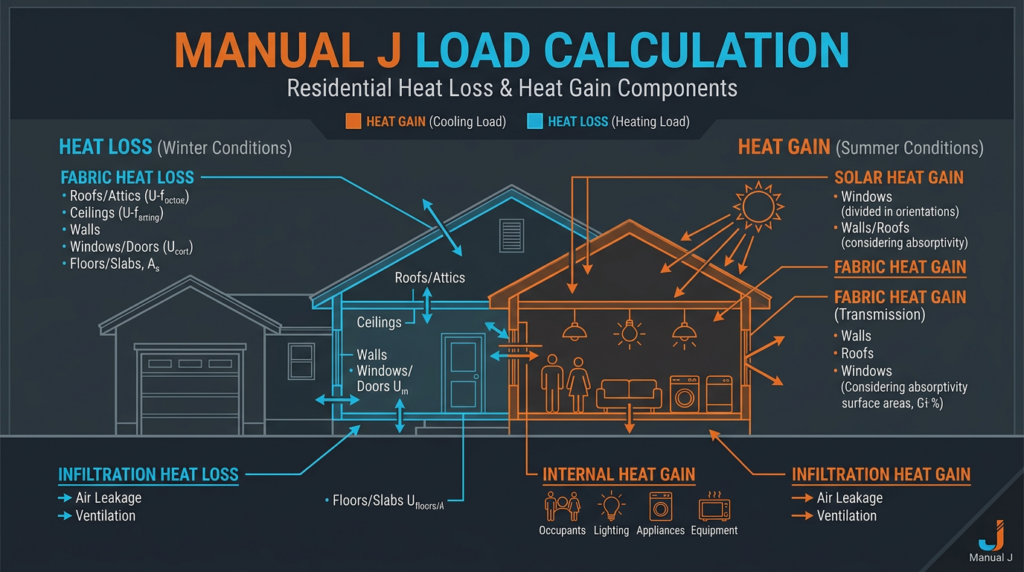
Manual J is the industry-standard method for calculating residential heating and cooling loads, published by the Air Conditioning Contractors of America (ACCA). Now in its 8th edition (Manual J8), it provides a rigorous, room-by-room procedure for determining exactly how much heating and cooling capacity a home requires. Every reputable HVAC system design begins here. An accurate Manual J calculation prevents oversized equipment that short-cycles and wastes energy, undersized equipment that cannot maintain comfort, and the chronic humidity problems that plague homes across North America. Building codes, utility rebate programs, and federal tax credits increasingly require a completed Manual J before installation can proceed.
What Is a Load Calculation and Why It Matters
A load calculation quantifies the amount of thermal energy that must be added or removed from a building to maintain desired indoor conditions. The heating load represents the rate of heat loss during the coldest expected conditions. The cooling load represents the rate of heat gain during the hottest expected conditions. Both are expressed in British Thermal Units per hour (BTU/h).
Manual J replaced older estimation methods that relied on square footage alone. Those “rule of thumb” approaches, such as assigning 400 to 600 square feet per ton of cooling, routinely produce errors of 30% or more. The consequences are serious: oversized cooling systems cycle on and off rapidly, failing to run long enough to dehumidify indoor air. Undersized systems run continuously without reaching setpoint. Both scenarios increase energy bills, reduce equipment lifespan, and create occupant discomfort.
The International Residential Code (IRC) Section M1401.3 requires heating and cooling equipment to be sized according to ACCA Manual J or an equivalent approved method. The International Energy Conservation Code (IECC) reinforces this requirement. Compliance is not optional in most jurisdictions.
Principles of Heat Transfer
Conduction, Convection, and Radiation
Three mechanisms drive heat flow in buildings. Conduction is heat transfer through solid materials, such as heat moving through a wall assembly from the warm side to the cool side. Convection is heat transfer by air movement, including warm air rising to the ceiling and cool air sinking to the floor. Radiation is heat transfer through electromagnetic waves, most notably solar energy passing through windows. Manual J accounts for all three.
Key Thermal Properties
Several material properties directly affect Manual J calculations:
- R-value: Resistance to heat flow. Higher R-values mean better insulation. A typical 2×6 wall with fiberglass batt insulation has an R-value near R-19.
- U-factor: The inverse of R-value (U = 1/R), representing the rate of heat transfer. Windows are rated by U-factor; a good double-pane low-e window has a U-factor around 0.30.
- Solar Heat Gain Coefficient (SHGC): The fraction of solar radiation admitted through a window. A lower SHGC (0.25 or less) blocks more solar heat, critical for cooling-dominant climates.
- Visible Transmittance (VT): The fraction of visible light passing through glazing. Not a direct Manual J input but affects lighting loads and occupant decisions about window coverings.
Sensible and Latent Heat
Sensible heat is the heat that changes air temperature, measurable with a thermometer. Latent heat is the energy associated with moisture changes in air, specifically the energy needed to condense or evaporate water vapor. In humid climates like Houston or Miami, latent loads can represent 30% or more of the total cooling load. Ignoring latent loads leads to equipment that cools the air temperature adequately but leaves occupants uncomfortable due to high indoor humidity. Manual J calculates both sensible and latent components separately for each room.
Manual J Inputs: The Data Gathering Process
Accuracy depends entirely on input quality. Manual J is only as good as the data fed into it.
Climate Data
Manual J uses outdoor design temperatures specific to each location. These are not record extremes but statistically derived values representing the 99% heating design temperature (exceeded 99% of winter hours) and the 1% cooling design temperature (exceeded only 1% of summer hours). ACCA provides these through its SpeedSheet database, and the ASHRAE Handbook of Fundamentals publishes comprehensive climate data for thousands of locations. Indoor design conditions are typically 70°F for heating and 75°F with 50% relative humidity for cooling.
Building Envelope
Every surface separating conditioned space from unconditioned space must be measured and characterized. This includes:
- Exterior walls: dimensions, framing type, insulation type and thickness, exterior finish, interior finish
- Roof and ceiling assemblies: attic insulation depth and type, radiant barrier presence, roof color
- Floors: slab-on-grade, crawlspace, or basement; insulation levels; soil temperature assumptions
- Windows: size, orientation, frame type, number of panes, low-e coating presence, SHGC, U-factor
- Doors: material, insulation, glass area
Orientation matters significantly. A west-facing window wall produces dramatically higher afternoon cooling loads than a north-facing wall of identical construction.
Occupancy and Internal Loads
Manual J assumes a default occupancy based on the number of bedrooms plus one. Each occupant contributes approximately 230 BTU/h sensible and 200 BTU/h latent heat during typical activity. Internal loads from appliances, lighting, and electronics add to the cooling load. Manual J uses conservative default values: typically 1,200 BTU/h for kitchen appliances and 1,200 BTU/h for other internal gains in an average home. Diversity factors account for the reality that not all appliances operate simultaneously.
Infiltration and Ventilation
Infiltration is uncontrolled air leakage through cracks, gaps, and penetrations in the building envelope. Manual J offers three approaches to estimating infiltration: default values based on construction quality (tight, semi-tight, or average), visual inspection, or a blower door test that directly measures air leakage in cubic feet per minute at 50 Pascals (CFM50). Blower door testing is by far the most accurate method.
Ventilation is the intentional introduction of outdoor air for indoor air quality. ASHRAE Standard 62.2-2022 specifies minimum whole-building ventilation rates for residential buildings. This ventilation air introduces both sensible and latent loads. Heat Recovery Ventilators (HRVs) and Energy Recovery Ventilators (ERVs) reduce the load impact by pre-conditioning incoming air. An ERV can recover 70% to 80% of both sensible and latent energy, substantially reducing the ventilation load component.
Ductwork
Ducts located in unconditioned spaces such as attics, crawlspaces, or garages gain or lose heat to their surroundings. A duct system in a 140°F attic adds significant cooling load. Manual J includes adjustments for duct location, insulation level, and estimated leakage. Duct leakage rates of 15% to 25% are common in older homes. Proper duct design follows ACCA Manual D, a separate but complementary procedure.
Manual J Calculation Methods
Calculating Heat Gains and Losses
For each building component, Manual J multiplies the area by the heat transfer factor (based on the component’s thermal resistance and the temperature difference between indoor and outdoor design conditions). For cooling calculations, the method uses Cooling Load Temperature Difference (CLTD) values that account for thermal mass and time lag in roofs and walls. Window loads incorporate both conductive heat transfer and solar heat gain using the Cooling Load Factor (CLF) and SHGC.
A simplified example: a 100-square-foot west-facing double-pane low-e window (U-factor 0.30, SHGC 0.25) in Phoenix, AZ, with an outdoor design temperature of 108°F and indoor temperature of 75°F, produces a conductive gain of roughly 100 x 0.30 x (108 – 75) = 990 BTU/h, plus a solar gain component that can exceed 3,000 BTU/h during peak afternoon hours.
Room Sensible Heat Ratio
The Room Sensible Heat Ratio (RSHR) is the ratio of sensible cooling load to total cooling load (sensible plus latent) for each room. This ratio is critical for equipment selection because it must match the equipment’s operating characteristics. A home in a dry climate might have an RSHR of 0.85 or higher, while a home in a humid climate might have an RSHR of 0.65 to 0.75.
Summing the Loads
Individual room loads are summed to produce whole-house totals. The block heating load is the sum of all room heating loads. The block cooling load is the sum of all room cooling loads, calculated at the time of peak conditions. Note that the whole-house peak does not necessarily equal the sum of individual room peaks, because rooms on different orientations peak at different times of day.
Manual J Software
While Manual J can be performed by hand, the process is tedious and error-prone. Most professionals use ACCA-approved software. Popular options include:
- Wrightsoft Right-Suite Universal: Full Manual J, D, and S integration
- Elite Software RHVAC: Widely used for residential calculations
- CoolCalc: Web-based, popular for smaller firms
- LoadCalc and other ACCA-approved tools
Software automates the lookup of climate data, material properties, and correction factors while reducing arithmetic errors. However, it still requires accurate input data to produce valid results.
Equipment Selection
Manual J determines the load. ACCA Manual S provides the procedure for selecting equipment to meet that load. The two are distinct but inseparable. Equipment capacity should closely match the calculated load. ACCA guidelines permit equipment to exceed the cooling load by no more than 15% for single-speed systems and no more than 25% for heating loads (due to the wider range of heating equipment increments).
Equipment performance is verified through AHRI directories using current efficiency metrics: SEER2, EER2, and HSPF2 for heat pumps and air conditioners, and AFUE for gas furnaces. These ratings, based on AHRI Standard 210/240, reflect equipment performance under standardized test conditions. Correction factors adjust rated capacity for actual installation conditions, including altitude, entering air temperature, and airflow rate.
Variable-speed and inverter-driven equipment deserves special consideration. These systems modulate capacity to match part-load conditions, which represent the majority of operating hours. A variable-speed heat pump that can ramp down to 40% capacity provides far better dehumidification and comfort than an oversized single-speed unit.
Common Errors and Misconceptions
- “Bigger is better”: This is the most damaging misconception in residential HVAC. Oversized cooling equipment short-cycles, runs in short bursts that cool air temperature quickly but fail to remove moisture. The result is a cold, clammy house with high energy bills and premature compressor failure.
- Using rules of thumb: “One ton per 500 square feet” ignores insulation levels, window area, climate, orientation, and dozens of other variables. Two identical-sized homes in the same city can have cooling loads that differ by 50% or more based on construction quality and orientation.
- Incorrect R-values: Assuming wall insulation exists when it does not, or using nominal R-values without accounting for framing factors, produces significant errors.
- Ignoring duct losses: A duct system in a hot attic with 20% leakage can add 30% or more to the effective cooling load.
- Default value overreliance: Software defaults are starting points, not substitutes for field measurements. A “tight” construction default applied to a 1970s home with no air sealing will underestimate infiltration dramatically.
- Confusing Manual J with Manual D or Manual S: Manual J sizes the load. Manual S sizes the equipment. Manual D sizes the duct system. All three are required for a proper HVAC design.
Manual J and Building Codes
The IRC and IECC both reference ACCA Manual J as the accepted method for residential load calculations. Many state and local codes have adopted these requirements. Some jurisdictions require a completed Manual J calculation to be submitted with the building permit application. Others require it only for new construction, while retrofit projects may have less stringent enforcement.
The EPA Energy Star program requires Manual J calculations for certified new homes. HERS (Home Energy Rating System) raters use Manual J outputs as inputs for energy modeling. Increasingly, utility rebate programs and federal tax credits under the Inflation Reduction Act (IRA) require documentation of proper sizing, making Manual J calculations a financial prerequisite for homeowners seeking incentives.
Recent Updates and Industry Changes
SEER2 and New Efficiency Standards
As of January 1, 2023, the Department of Energy implemented new minimum efficiency standards using updated testing procedures. SEER2, EER2, and HSPF2 ratings replaced the previous SEER, EER, and HSPF metrics. The new M1 testing procedure uses a higher external static pressure (0.5 inches of water column versus 0.1 to 0.2 inches previously), better representing real-world installations. Minimum efficiency is now 14.3 SEER2 in the northern region and 15.0 SEER2 in the southern region for split-system air conditioners. These changes affect equipment selection following a Manual J calculation.
Refrigerant Transition
The industry is transitioning from R-410A to lower global warming potential (GWP) refrigerants, primarily R-454B (marketed as Opteon XL41). R-454B has a GWP of 466, compared to 2,088 for R-410A. Starting in 2025, new equipment will increasingly use R-454B. Because R-454B is mildly flammable (A2L safety classification), equipment designs and installation practices are changing. The refrigerant transition does not change Manual J calculations directly, but it affects available equipment options in Manual S.
Inflation Reduction Act Provisions
The IRA provides up to $2,000 in federal tax credits for qualifying heat pumps and up to $600 for qualifying furnaces. The High-Efficiency Electric Home Rebate Act (HEEHR) offers additional rebates for qualifying households. Many of these programs require documentation that equipment is properly sized, which in practice means a Manual J calculation. Some state-administered rebate programs explicitly require an ACCA-approved load calculation as part of the application.
Practical Applications and Costs
A professional Manual J calculation typically costs between $150 and $500 for a single-family home, depending on the building’s size and complexity. This is a small fraction of the $5,000 to $15,000 cost of a typical residential HVAC system replacement. The investment prevents costly sizing errors that persist for the 15- to 20-year life of the equipment.
For new construction, Manual J is performed during the design phase, using architectural plans and specifications. For retrofit projects, a field survey is required to verify construction details, insulation levels, and window characteristics. Blower door testing adds $150 to $300 but significantly improves infiltration accuracy.
Key Takeaways
- Manual J is the ACCA-published standard for residential heating and cooling load calculations, required by most building codes.
- Accurate load calculations require detailed, site-specific input data covering climate, building envelope, occupancy, infiltration, ventilation, and duct conditions.
- Oversizing is not a safety margin. It causes short-cycling, poor humidity control, higher energy costs, and reduced equipment life.
- Rules of thumb are not substitutes for Manual J. Homes with identical square footage can have dramatically different loads.
- Manual J determines the load. Manual S guides equipment selection. Manual D guides duct design. All three are necessary for a complete HVAC system design.
- Current efficiency standards (SEER2, HSPF2), the refrigerant transition to R-454B, and IRA incentives all make accurate load calculations more important than ever.
- The cost of a professional Manual J calculation is typically $150 to $500, a worthwhile investment against the $5,000 to $15,000 cost of the equipment it sizes.