What Is a Packaged Terminal Air Conditioner?
A packaged terminal air conditioner (PTAC) is a self-contained heating and cooling unit installed through an exterior wall to provide climate control for a single room. Found in nearly every hotel corridor in the world, PTACs also serve apartments, senior living facilities, hospitals, and office buildings. They offer what centralized systems cannot: independent temperature control for each occupied space, without ductwork, without complex piping, and without relying on a shared mechanical plant. For building owners, PTACs represent a practical balance between installation simplicity, maintenance accessibility, and per-room comfort. For occupants, they mean a thermostat on the wall and immediate control over their own environment.
Historical Context and Typical Applications
PTACs evolved from window air conditioners in the 1960s and 1970s as the hospitality industry demanded a more permanent, secure, and aesthetically acceptable solution. Window units blocked views, posed security risks, and leaked air. PTACs solved these problems by mounting into a dedicated wall sleeve, a metal enclosure built into the wall structure. The unit slides into the sleeve from the interior side, sealing against weather while keeping the window free.
Today, PTACs remain the dominant HVAC solution in several building types:
- Hotels and motels: The largest single market. Individual guest control, rapid unit replacement, and compatibility with energy management systems make PTACs ideal.
- Apartments and condominiums: Particularly in mid-rise and high-rise buildings where running ductwork is impractical or too expensive.
- Senior living and assisted living facilities: Individual room control supports varying comfort needs. ADA-compliant controls and remote operation add accessibility.
- Hospitals and clinics: Supplemental cooling for perimeter rooms or areas requiring independent temperature control.
- Office buildings: Spot cooling for server closets, conference rooms, or perimeter zones with high solar loads.
Components and Operation
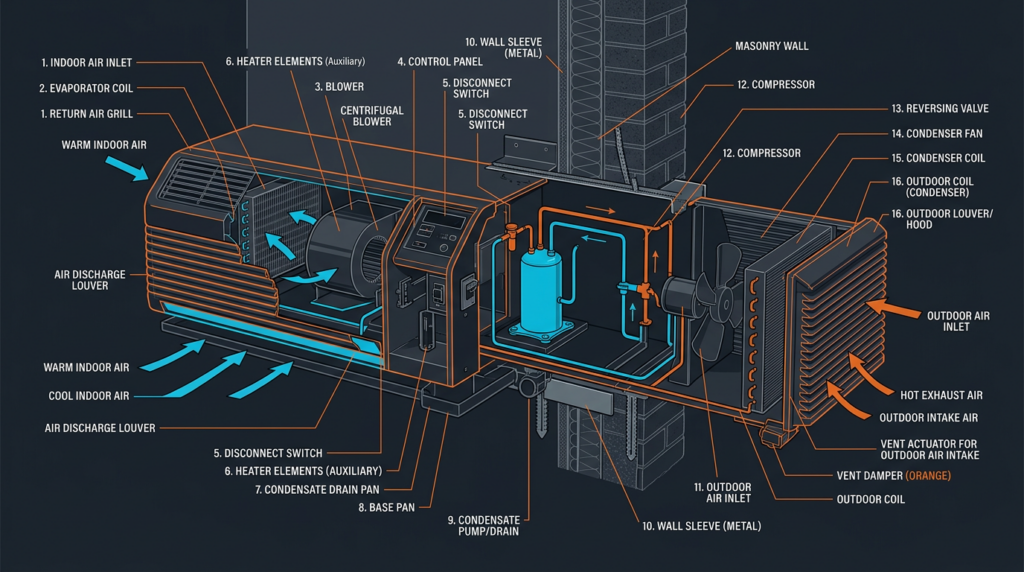
A PTAC contains an entire refrigeration system, airside components, heating elements, and controls within a single cabinet. Understanding each component clarifies how the unit works and why maintenance matters.
Refrigeration Circuit
The core of every PTAC is a vapor-compression refrigeration cycle with four essential components:
- Compressor: A hermetically sealed rotary or scroll compressor pressurizes refrigerant gas, raising its temperature and pressure. Most PTACs use single-speed compressors, though some newer models feature variable-speed designs for improved part-load efficiency.
- Condenser coil: Located on the outdoor side of the unit, this coil rejects heat to the outside air. An outdoor fan pulls air across the condenser fins.
- Metering device: Typically a capillary tube or thermostatic expansion valve (TXV) that reduces refrigerant pressure before it enters the evaporator.
- Evaporator coil: Located on the indoor side, this coil absorbs heat from room air. An indoor blower fan circulates air across the evaporator and back into the room.
The cycle works continuously: liquid refrigerant evaporates in the evaporator (absorbing room heat), the compressor raises the gas pressure, the condenser rejects heat outdoors, and the metering device drops pressure to restart the cycle.
Heat Pump and Reversing Valve
Heat pump PTACs include a reversing valve (also called a four-way valve) that reverses refrigerant flow. In heating mode, the outdoor coil becomes the evaporator (absorbing heat from outside air) and the indoor coil becomes the condenser (releasing heat into the room). This allows the unit to provide heating at a coefficient of performance (COP) of 2.0 to 3.5, meaning it delivers 2 to 3.5 times more heat energy than the electrical energy it consumes. By contrast, electric resistance heating always operates at a COP of 1.0.
Electric Resistance Heating
Most PTACs include electric resistance heating coils as either the primary heat source (in cooling-only models with electric heat) or as auxiliary and emergency backup heat in heat pump models. These coils convert electricity directly to heat at 100% efficiency (COP of 1.0). While simple and reliable, electric resistance heating costs significantly more to operate than heat pump heating in moderate climates.
Controls
PTAC controls range from basic mechanical thermostats with rotary dials to digital touchpad interfaces with LCD displays. Common control features include:
- Selectable modes: cool, heat, fan only, auto
- Fan speed settings: low, high, auto
- Setpoint temperature adjustment
- Remote control capability (infrared or wireless)
- Occupancy sensors for energy savings
- Integration ports for energy management systems (EMS)
Hotel-grade PTACs often connect to a building-wide EMS that adjusts setpoints based on occupancy status, time of day, or demand response signals from the utility.
Chassis and Cabinet
The chassis is the internal framework that holds all components. It slides into the wall sleeve on rails. The cabinet or grille is the visible interior face of the unit. Standard PTAC dimensions conform to industry sizes (typically 42 inches wide by 16 inches tall), allowing replacement units from different manufacturers to fit existing wall sleeves. This interchangeability is a key advantage in the hotel industry, where rapid unit swaps minimize guest disruption.
Types of PTACs
- Cooling-only: Provides air conditioning without any heating capability. Uncommon in most applications but used in warm climates or where a separate heating system exists.
- Cooling with electric heat: The most basic configuration. Affordable upfront but expensive to operate in heating-dominant climates.
- Heat pump with electric auxiliary heat: The most efficient option for moderate climates. The heat pump handles most heating loads, and electric coils supplement during extreme cold or defrost cycles.
- Smart PTACs: Feature Wi-Fi connectivity, mobile app control, cloud-based energy management, and integration with building automation or smart home platforms. Some models support voice control through Amazon Alexa or Google Assistant.
PTACs should not be confused with through-the-wall air conditioners (TTW units), which share a similar form factor but lack the standardized sleeve dimensions and commercial-grade construction of true PTACs.
Selection Considerations
Sizing and Capacity
PTAC cooling capacities typically range from 5,000 to 15,000 BTU/h (approximately 0.4 to 1.25 tons of cooling). Proper sizing depends on room square footage, ceiling height, insulation quality, window area and orientation, climate zone, and expected occupancy. A standard 300-square-foot hotel room in a temperate climate generally requires 9,000 to 12,000 BTU/h. Oversizing causes short cycling, poor humidity control, and wasted energy. Undersizing results in inadequate comfort during peak conditions.
Efficiency Ratings
PTAC efficiency is measured primarily by two metrics:
- EER (Energy Efficiency Ratio): Cooling output in BTU/h divided by electrical input in watts, measured at a single test condition. A unit producing 10,000 BTU/h while consuming 1,000 watts has an EER of 10.0.
- CEER (Combined Energy Efficiency Ratio): A more recent metric that incorporates standby power consumption into the EER calculation. Because PTACs in hotel rooms remain plugged in 24/7, standby power is a meaningful contributor to total energy use. CEER provides a more realistic picture of annual energy cost.
For heating performance, COP (Coefficient of Performance) measures heat output divided by electrical input, applicable to heat pump mode. Higher COP values indicate better heating efficiency.
Noise
Noise is a critical factor in hotels and residential buildings. PTAC sound levels typically range from 45 to 58 dB(A). Premium units with insulated compressor compartments, vibration isolation mounts, and variable-speed fans achieve the lower end of this range. Some manufacturers offer dedicated “quiet mode” settings that reduce fan speed and compressor cycling at the expense of some capacity.
Voltage and Electrical Requirements
Most PTACs operate on 208/230V single-phase power and require a dedicated circuit. Smaller units (typically 7,000 BTU/h and below) may be available in 115V configurations. Units are generally hard-wired rather than plugged in. Matching the voltage to the building’s electrical system is essential and must be verified before purchase.
Physical Dimensions
When replacing existing units, the new PTAC must fit the installed wall sleeve. Standard sleeve widths are 26 inches and 42 inches, with 16-inch heights common. Always measure the existing sleeve before ordering a replacement unit.
Installation
PTAC installation involves either a new wall penetration or replacement into an existing sleeve. New installations require cutting through the exterior wall, framing the opening, and securing the wall sleeve with proper flashing and weatherproofing. The sleeve must slope slightly toward the exterior to facilitate condensate drainage.
Key installation requirements include:
- Electrical connection: A licensed electrician should run a dedicated circuit and hard-wire the unit per local code. Improper wiring is a fire hazard and voids the warranty.
- Sealing and insulation: Gaps between the sleeve and the wall structure must be sealed with closed-cell foam or caulk to prevent air infiltration and moisture intrusion. Poor sealing degrades both comfort and efficiency.
- Condensate management: The unit must drain condensate to the exterior. Blocked drains cause water damage, mold growth, and compressor flooding.
- Structural support: The wall must support the unit weight, typically 60 to 120 pounds depending on capacity.
While sliding a replacement chassis into an existing sleeve is straightforward, the electrical, sealing, and drainage aspects require skilled tradespeople. This is not a casual DIY project.
Maintenance
Regular maintenance extends PTAC lifespan (typically 7 to 12 years) and preserves efficiency. The most impactful maintenance tasks are:
- Filter cleaning: The reusable indoor air filter should be cleaned every two to four weeks in active use. A clogged filter restricts airflow, reduces cooling capacity, and can cause evaporator coil icing.
- Coil cleaning: Both the evaporator and condenser coils should be cleaned at least annually. Dirty coils reduce heat transfer, increase energy consumption by 10% to 25%, and shorten compressor life.
- Condensate drain inspection: Check for blockages, algae growth, and proper drainage at least seasonally.
- Electrical connection inspection: Look for loose connections, frayed wiring, and signs of overheating.
- Chassis seal inspection: Verify that gaskets and weatherstripping between the chassis and sleeve remain intact.
Common Troubleshooting
- Insufficient cooling: Dirty filter, dirty coils, low refrigerant charge, or a failed compressor.
- Unusual noises: Loose fan blade, worn fan motor bearings, or compressor vibration against the chassis.
- Water leaking indoors: Blocked condensate drain, improperly leveled unit, or a frozen evaporator coil thawing.
- Unit not turning on: Tripped circuit breaker, failed thermostat, or a burnt control board.
Refrigerant charging, compressor replacement, and electrical repairs should always be performed by a qualified HVAC technician with EPA Section 608 certification.
Energy Efficiency and Regulations
Federal and Industry Standards
AHRI Standard 310/380 governs PTAC testing procedures and performance ratings. The U.S. Department of Energy (DOE) sets minimum efficiency standards for PTACs sold in the United States. Current DOE regulations require minimum CEER values that vary by capacity. For example, a 9,000 BTU/h unit must meet a higher CEER than a 15,000 BTU/h unit, reflecting the physics of smaller refrigeration systems.
ASHRAE Standard 90.1, the commercial building energy code adopted by most states, sets minimum EER requirements for PTACs in new construction and major renovations. The 2022 edition of ASHRAE 90.1 increased these minimums, pushing the market toward higher-performing equipment.
ENERGY STAR certification identifies PTACs that exceed federal minimums. ENERGY STAR-rated units typically deliver 10% or greater efficiency improvement over baseline requirements. Buyers should check the current ENERGY STAR specification online, as requirements are periodically tightened.
Refrigerant Regulations
The refrigerant landscape is shifting significantly. R-22, the standard PTAC refrigerant for decades, was fully phased out of new equipment production in 2010 and from all production and import in 2020 under the Montreal Protocol. R-410A became the dominant replacement but carries a high global warming potential (GWP) of 2,088.
Under the American Innovation and Manufacturing (AIM) Act and EPA regulations, the HVAC industry is transitioning to A2L (mildly flammable) refrigerants with significantly lower GWP. Leading candidates for PTACs include:
- R-32: GWP of 675, roughly one-third that of R-410A. Already widely used in Asia and Europe.
- R-454B: GWP of 466. A leading R-410A replacement in the North American market.
- R-452B: GWP of 698. Another A2L option with similar operating pressures to R-410A.
Manufacturers are actively releasing PTAC models using these newer refrigerants. Updated safety standards (UL 60335-2-40) and building codes are being adopted to address the mild flammability of A2L refrigerants. Technicians servicing these units will need updated training and tools.
Incentives and Rebates
The Inflation Reduction Act (IRA) of 2022 expanded federal tax credits and incentive programs for energy-efficient commercial equipment. Commercial building owners may qualify for deductions under Section 179D for installing high-efficiency PTACs that meet or exceed ASHRAE 90.1 requirements. State and utility rebate programs vary widely. The Database of State Incentives for Renewables and Efficiency (DSIRE) provides a searchable directory of available programs.
Costs
PTAC unit costs vary based on capacity, efficiency, features, and brand:
- Budget models (cooling with electric heat): $500 to $800 per unit
- Mid-range models (heat pump, digital controls): $800 to $1,200 per unit
- Premium models (high-efficiency heat pump, smart features, low noise): $1,200 to $1,500+ per unit
- Installation (new wall penetration): $500 to $1,500 depending on wall construction and electrical work
- Installation (replacement into existing sleeve): $150 to $400
For a 100-room hotel renovation, the total cost difference between budget and premium PTACs can exceed $70,000. However, the energy savings from heat pump models over electric resistance heating often recover the premium within two to four years, depending on local electricity rates and climate.
Future Trends
Several developments are shaping the next generation of PTACs:
- Lower-GWP refrigerants: Widespread adoption of R-32 and R-454B will become mandatory as EPA phasedown schedules tighten.
- Variable-speed compressors: Inverter-driven compressors modulate capacity to match the actual load, improving efficiency and reducing noise compared to on/off cycling.
- Cloud-connected energy management: Smart PTACs that report performance data, adjust setpoints based on occupancy patterns, and respond to utility demand signals are becoming standard in new hotel construction.
- Improved air filtration: MERV-13 compatible filters and optional UV-C germicidal inserts address post-pandemic indoor air quality concerns.
- Reduced standby power: DOE regulations and ENERGY STAR requirements continue to push standby consumption below 1 watt.
Key Takeaways
- PTACs provide independent room-by-room climate control and remain the standard HVAC solution for hotels, apartments, and similar buildings.
- Heat pump models offer significantly lower operating costs than electric resistance heating, with COP values of 2.0 to 3.5 versus a fixed 1.0 for resistance coils.
- Proper sizing matters. An oversized or undersized unit wastes energy and compromises comfort.
- CEER has replaced EER as the primary efficiency metric, accounting for the standby power that accumulates when units remain plugged in around the clock.
- The industry is transitioning from R-410A to lower-GWP A2L refrigerants like R-454B and R-32. Technicians and building owners should prepare for this shift.
- Regular filter and coil cleaning is the single most effective maintenance action, preventing efficiency losses of 10% to 25%.
- Installation quality, especially sealing, drainage, and electrical work, directly affects long-term performance, comfort, and safety.