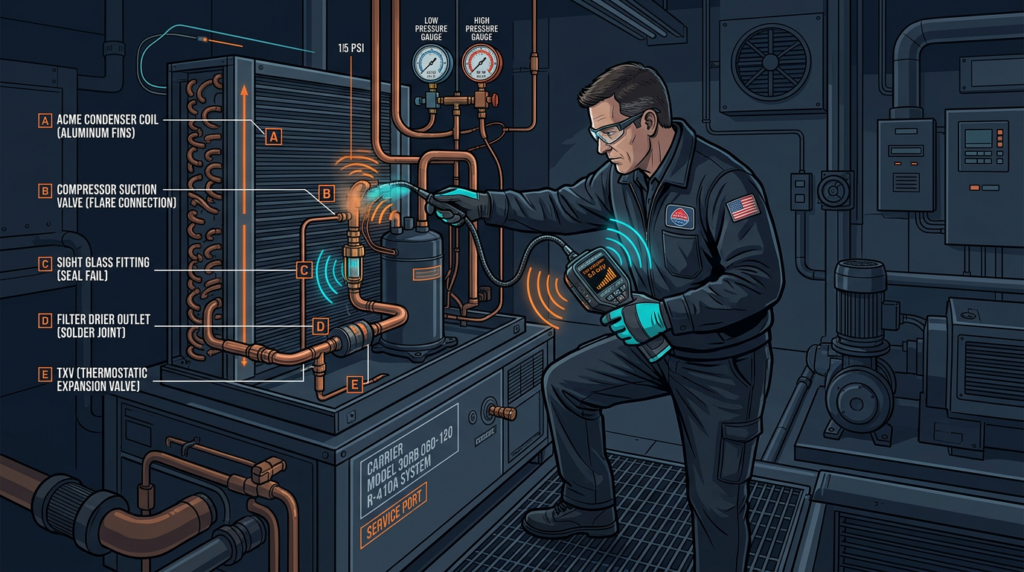
Refrigerant Leak Detection: Methods and Best Practices
Refrigerant leaks cost the HVAC industry an estimated $3 billion annually in wasted refrigerant, increased energy consumption, and equipment damage. Beyond the financial toll, leaked refrigerants contribute significantly to greenhouse gas emissions, with some common refrigerants carrying a global warming potential thousands of times greater than carbon dioxide. As the industry transitions toward lower-GWP alternatives and regulations tighten under EPA Section 608 and international frameworks, the ability to detect, locate, and repair refrigerant leaks has become one of the most critical skills for HVAC professionals. This article provides a comprehensive guide to refrigerant leak detection methods, regulatory requirements, prevention strategies, and emerging technologies that every technician, service manager, and building engineer should understand.
Understanding Refrigerant Leaks
A refrigerant leak is any unintended loss of refrigerant charge from a sealed HVAC or refrigeration system. Even small leaks measured in fractions of an ounce per year degrade system performance, increase energy costs, and accelerate component wear. No amount of refrigerant loss should be considered acceptable or normal.
Common Causes of Leaks
- Manufacturing defects: Imperfect welds, porous tubing, and faulty components such as Schrader valve cores or evaporator coils with micro-fractures.
- Installation errors: Improper brazing techniques, poorly formed flare connections, overtightened fittings that crack tubing, and mechanical damage during handling.
- Operational stress: Vibration from compressors and fans, pressure fluctuations during cycling, freeze-thaw cycles on evaporator coils, and thermal expansion and contraction of copper tubing.
- Age and wear: Degradation of O-rings, gaskets, rubber hoses, and valve packing over time, particularly in systems older than 10 years.
- External damage: Physical impacts, corrosion from salt air in coastal environments, chemical exposure from cleaning agents, and formicary corrosion caused by volatile organic compounds.
Consequences of Refrigerant Leaks
The consequences extend across environmental, economic, and operational domains. Environmentally, a single pound of R-410A released into the atmosphere has the warming equivalent of 2,088 pounds of CO2. Older refrigerants like R-22 also deplete the ozone layer. Economically, refrigerant replacement costs range from $50 to $150 per pound depending on the type, and a system operating with a 10% undercharge consumes approximately 20% more energy. Operationally, low refrigerant charge leads to reduced cooling capacity, elevated compressor discharge temperatures, potential compressor burnout, and ultimately system failure and costly downtime.
Regulatory Landscape and Leak Rate Thresholds
EPA Section 608 of the Clean Air Act establishes the primary regulatory framework for refrigerant management in the United States. The regulation requires that technicians be certified to handle refrigerants, prohibits venting of refrigerants, and mandates leak repair when systems exceed specific leak rate thresholds.
Leak Rate Thresholds
The EPA defines leak rate as the percentage of the total system charge lost per year. Current thresholds that trigger mandatory repair action are:
- Industrial process refrigeration: 30% annual leak rate
- Commercial refrigeration: 20% annual leak rate
- Comfort cooling and heating systems: 10% annual leak rate (applies to systems containing 50 or more pounds of refrigerant)
When a system exceeds these thresholds, owners and operators must repair the leak within 30 days of discovery or develop a retrofit or retirement plan within a specified timeline. Failure to comply can result in fines exceeding $44,000 per day per violation.
Record Keeping Requirements
Accurate records are not optional. The EPA requires documentation of all refrigerant purchases, quantities added to systems, leak inspection dates, repair activities, and recovery and disposal records. Systems containing 50 or more pounds of refrigerant require detailed maintenance logs that must be retained for at least three years.
Refrigerant Phase-Down and Emerging Alternatives
The AIM Act mandates an 85% phase-down in HFC production and consumption by 2036. R-410A, the current dominant residential and light commercial refrigerant with a GWP of 2,088, is being replaced by lower-GWP alternatives including R-32 (GWP 675), R-454B (GWP 466), and R-290/propane (GWP 3). Each alternative introduces specific leak detection considerations. R-32 and R-454B are mildly flammable (A2L classification), while R-290 is highly flammable (A3 classification). Systems using R-290 require specialized combustible gas detectors, strict charge limits (typically under 150 grams for domestic appliances), and dedicated ventilation procedures during service. Technicians must verify that their leak detection equipment is rated for the specific refrigerant they are testing.
Refrigerant Leak Detection Methods: A Detailed Overview
Visual Inspection
Visual inspection is the first and simplest step in any leak detection procedure. Technicians look for telltale signs such as oil stains or residue around brazed joints, flare connections, service valves, and compressor fittings. Refrigerant oil travels with the refrigerant, so an oily residue on tubing or components often indicates a leak point. Areas prone to leaks include compressor discharge and suction connections, evaporator coil U-bends, condenser coil headers, and Schrader valve cores. A bright flashlight and magnifying lens improve detection of small oil deposits. However, visual inspection alone can only identify relatively large or long-standing leaks and should always be supplemented with more sensitive methods.
Soap Bubble Testing
Soap bubble testing involves applying a commercially formulated leak detection solution to suspected leak areas while the system is pressurized. Escaping gas creates visible bubbles at the leak point. This method is effective for confirming leaks in accessible locations and can detect leaks as small as 1 ounce per year under ideal conditions. Best practices include using a non-corrosive, refrigerant-grade solution rather than household soap, cleaning the test area before application, applying the solution generously, and watching closely for 30 to 60 seconds. Wind, surface contamination, and vertical surfaces can reduce effectiveness. Always rinse residue from components after testing to prevent corrosion.
Electronic Leak Detectors
Electronic leak detectors represent the most widely used and versatile detection method. Three primary technologies dominate the market:
- Heated diode detectors pass sampled air over a heated ceramic diode. When halogenated refrigerant molecules contact the diode, they break down and create a measurable change in electrical current. These units typically detect leaks as small as 0.1 to 0.5 ounces per year. They are affordable ($150 to $400) and effective but require regular sensor replacement (every 50 to 100 hours of use) and can produce false positives from solvents, cleaning agents, and other gases.
- Infrared (IR) absorption detectors measure changes in infrared light absorption as refrigerant gas passes through a sensing chamber. IR detectors offer superior sensitivity (down to 0.006 ounces per year), longer sensor life (typically 1,000+ hours), and significantly fewer false positives. They cost more ($300 to $800) but provide faster, more reliable results. Models like the Fieldpiece SRL8 and Inficon D-TEK Select are widely used in commercial applications.
- Ultrasonic detectors pick up the high-frequency sound waves generated by pressurized gas escaping through a small opening. These are particularly useful for locating leaks in noisy environments when used with headphones and directional microphones. They are refrigerant-agnostic, meaning they work with any gas, but they cannot distinguish between refrigerant leaks and other pressurized gas leaks.
Regardless of type, electronic detectors require regular calibration using a reference leak or calibration cap. Sweep the probe at a rate of approximately 1 inch per second, keeping the tip within 1/4 inch of the surface. Move systematically along joints and connections, working from the bottom up since most refrigerants are heavier than air. Avoid contaminating the sensor by touching oily surfaces.
UV Dye Detection
UV fluorescent dye detection involves injecting a small amount of UV-reactive dye into the refrigerant system. The dye circulates with the refrigerant and oil, escaping at any leak point and leaving a fluorescent trace visible under ultraviolet light. This method excels at finding slow, intermittent leaks that other methods may miss. Modern LED-based UV lamps in the 365 to 400 nanometer range provide clear dye visibility. Use only dyes specifically formulated for the refrigerant type and lubricant oil in the system. OEM-approved dyes from manufacturers like Spectroline and Tracerline are recommended. After identification and repair, clean all dye residue from the system exterior to prevent confusion during future inspections. Note that some equipment manufacturers void warranties if unapproved dyes are introduced into their systems.
Pressure Testing
Pressure testing (also called standing pressure testing) involves pressurizing the system with dry nitrogen to the manufacturer’s specified test pressure, typically 150 to 500 PSI depending on the system type. After pressurization, the system is isolated and monitored for pressure drops over an extended period, ideally 24 hours. A calibrated digital pressure gauge or data logger with 0.1 PSI resolution improves accuracy. Ambient temperature changes affect pressure readings, so technicians must account for thermal expansion and use temperature-compensated calculations. This method can detect leaks in buried or otherwise inaccessible piping but requires system shutdown and evacuation first. Sectional isolation using service valves helps narrow down the leak location before using more precise methods for pinpointing.
Halide Torch (Historical Reference)
The halide torch draws air over a heated copper element; the flame changes color in the presence of halogenated refrigerants. This method is now considered obsolete due to low sensitivity, inability to detect non-halogenated refrigerants, and the production of toxic phosgene gas when chlorinated refrigerants decompose. Modern electronic detectors have entirely replaced this method. Do not use halide torches in professional practice.
Best Practices for Leak Prevention and Minimization
Proper Installation Techniques
- Use oxygen-free copper tubing and maintain a continuous nitrogen purge during all brazing operations to prevent internal oxidation and scale formation.
- Apply proper brazing temperatures (1,100 to 1,500°F depending on the alloy) and use appropriate silver-bearing filler metals for refrigerant joints.
- Form flare connections with a quality eccentric flaring tool, verify flare dimensions against SAE J513 specifications, and torque fittings to manufacturer values using a calibrated torque wrench.
- Handle all components with care during installation to prevent micro-cracks, dents, and stress points in tubing.
Regular Maintenance
- Clean condenser and evaporator coils at least annually to prevent corrosive buildup and formicary corrosion.
- Replace air filters on schedule to maintain proper airflow and reduce system stress.
- Install vibration isolation mounts on compressors and secure all refrigerant piping with proper hangers and supports spaced per code requirements.
- Inspect and replace rubber hoses, O-rings, and gaskets before they show visible signs of degradation.
Refrigerant Handling and System Monitoring
- Charge systems strictly to manufacturer specifications. Overcharging increases operating pressures and stresses components.
- Use certified recovery equipment and follow EPA procedures for refrigerant recovery and recycling.
- Monitor system pressures, superheat, and subcooling during routine service calls to detect charge changes early.
- Track energy consumption trends to identify efficiency drops that may signal a developing leak.
- For large commercial and industrial systems, consider continuous refrigerant monitoring systems that provide real-time alerts when ambient refrigerant concentrations exceed set thresholds.
- Use leak sealants only as a temporary measure for minor leaks and only with products verified as compatible with the system refrigerant and oil. Sealants are not a substitute for proper mechanical repair.
Addressing Common Misconceptions
- “A little refrigerant leak is normal.” False. A properly installed and maintained system should hold its charge indefinitely. Any measurable loss indicates a problem requiring diagnosis and repair.
- “All electronic leak detectors perform the same.” False. Sensitivity ranges from 0.5 oz/yr for basic heated diode models to 0.006 oz/yr for advanced IR units. Refrigerant compatibility also varies by model.
- “Leak sealant is a permanent repair.” False. Sealants are temporary and can clog metering devices, TXVs, and filter driers. They should only be used when a proper repair cannot be immediately performed.
- “Switching refrigerants fixes a leak.” False. Retrofitting to a different refrigerant addresses neither the physical leak point nor the underlying cause of the failure.
Practical Application Scenarios
Scenario 1: Grocery store display case. A medium-temperature display case shows elevated suction superheat and reduced cooling. The technician performs a visual inspection and finds faint oil residue near a brazed joint on the evaporator outlet. An IR electronic leak detector confirms refrigerant presence at 0.15 oz/yr sensitivity. The joint is repaired by re-brazing with a nitrogen purge, the system is evacuated, recharged, and verified leak-free.
Scenario 2: Commercial building chiller. A 200-ton centrifugal chiller has lost 8% of its 400-pound R-134a charge over six months. Maintenance staff perform a standing pressure test with nitrogen at 185 PSI, isolating the evaporator, condenser, and piping circuits separately. A pressure drop in the condenser circuit leads technicians to inject UV dye and run the system for 48 hours. UV lamp inspection reveals dye at a tube sheet gasket. The gasket is replaced and the system retested.
Scenario 3: Residential air conditioner. A homeowner reports poor cooling after two seasons. The technician measures low suction pressure and high superheat, confirming an undercharge. Using a heated diode electronic detector, the technician traces the leak to a poorly formed flare fitting on the indoor coil liquid line. Soap bubble testing confirms the exact location. The flare is remade with proper technique, the connection is torqued to specification, and the system is recharged and verified.
Future Trends and Emerging Technologies
The leak detection landscape is evolving rapidly. Advanced infrared imaging cameras can now visualize refrigerant gas clouds in real time, allowing technicians to scan large areas quickly without contact. Acoustic imaging devices combine ultrasonic detection with visual displays that overlay sound intensity onto camera images, making leak sources immediately apparent. IoT-connected refrigerant sensors provide continuous monitoring with cloud-based dashboards and automated alerts for facility managers. Artificial intelligence and machine learning algorithms are being developed to analyze system operating data and predict leak development before significant refrigerant loss occurs. Looking further ahead, drone-mounted gas detection systems are being tested for scanning rooftop equipment on large commercial buildings, reducing the time and safety risks associated with manual roof inspections.
Key Takeaways
Refrigerant leak detection is a fundamental competency for every HVAC professional, and its importance will only grow as the industry transitions to lower-GWP, often flammable, refrigerants under increasingly strict regulations. No leak is acceptable, and no single detection method is sufficient for all situations. Combine visual inspection with electronic detection, soap bubble testing, UV dye, and pressure testing as the situation demands. Invest in quality IR-based electronic detectors and maintain them through regular calibration. Prioritize prevention through proper installation techniques, routine maintenance, and system monitoring. Maintain thorough records of all refrigerant transactions and leak repairs to ensure regulatory compliance. Stay current with EPA requirements, AIM Act milestones, and manufacturer-specific guidelines for new refrigerant systems. Continuous learning through EPA 608 certification renewals, manufacturer training programs, and industry conferences will keep your skills and knowledge aligned with the profession’s evolving demands.