What Is Refrigerant Recovery and Why Does It Matter?
Refrigerant recovery is the process of removing refrigerant from an HVAC/R system and storing it in an approved external container for reuse, reclamation, or destruction. Federal law requires it. The EPA prohibits the intentional venting of regulated refrigerants into the atmosphere under Section 608 of the Clean Air Act. Violations carry fines of up to $44,539 per day per violation. Beyond legal compliance, proper recovery protects the ozone layer, reduces greenhouse gas emissions, and preserves valuable refrigerant that can be reclaimed and reused. As the industry transitions away from high-GWP refrigerants under the AIM Act, disciplined recovery practices have never been more critical.
The Refrigerant Lifecycle
Refrigerants follow a defined lifecycle: production, charging into equipment, field service, recovery, and ultimately reclamation or destruction. Recovery removes refrigerant from a system without necessarily testing or processing it. Recycling cleans recovered refrigerant using oil separation and single or multiple passes through filter-dryers, typically done on-site. Reclamation reprocesses refrigerant to meet the purity standards defined in AHRI Standard 700, restoring it to virgin-equivalent specifications. This can only be performed by EPA-certified reclaimers. Refrigerant that cannot be reclaimed is sent for destruction through high-temperature incineration, plasma arc technology, or other approved methods.
Common Refrigerants and Their Classifications
Understanding refrigerant types is essential before any recovery operation. Refrigerants are grouped by chemical composition and environmental impact.
CFCs (Chlorofluorocarbons)
- R-12: ODP of 1.0, GWP of 10,900. Fully phased out of production since 1996. Still encountered in legacy equipment.
HCFCs (Hydrochlorofluorocarbons)
- R-22: ODP of 0.055, GWP of 1,810. Production and import ended January 1, 2020. Existing supplies remain available through recovery and reclamation. Compatible with mineral oil.
HFCs (Hydrofluorocarbons)
- R-410A: ODP of 0, GWP of 2,088. The dominant residential AC refrigerant since the mid-2000s. Currently being phased down under the AIM Act. Compatible with POE (polyolester) oil. ASHRAE safety classification A1 (non-toxic, non-flammable).
- R-134a: ODP of 0, GWP of 1,430. Widely used in automotive AC, medium-temperature commercial refrigeration, and chillers. Compatible with POE oil. Classification A1.
HFOs and HFO Blends (Hydrofluoroolefins)
- R-1234yf: ODP of 0, GWP of less than 1. Replacing R-134a in automotive applications. Classification A2L (mildly flammable). Compatible with PAG oil in automotive systems.
- R-454B: ODP of 0, GWP of 466. A leading replacement for R-410A in residential and light commercial systems. Classification A2L. Compatible with POE oil.
- R-32: ODP of 0, GWP of 675. Used in ductless mini-splits and increasingly in unitary equipment globally. Classification A2L. Compatible with POE oil.
Natural Refrigerants
- R-290 (propane): ODP of 0, GWP of 3. Classification A3 (highly flammable). Used in small self-contained commercial units and some residential heat pumps. Charge limits apply per UL 60335-2-40.
- R-744 (CO2): ODP of 0, GWP of 1. Classification A1. Used in transcritical commercial refrigeration and industrial systems. Operating pressures can exceed 1,400 psi on the high side.
Flammability classifications follow ASHRAE Standard 34. The rise of A2L refrigerants like R-454B and R-32 means recovery equipment and procedures must account for mild flammability. Technicians need equipment rated for flammable refrigerants and must follow additional safety precautions, including eliminating ignition sources and ensuring proper ventilation.
Reasons for Refrigerant Recovery
Recovery is required whenever a technician opens a system in a way that would release refrigerant. Common scenarios include:
- System repair: replacing compressors, condensers, evaporators, or expansion valves.
- Equipment decommissioning: retiring old units and scrapping equipment.
- Leak repair: systems must be recovered before brazing or replacing components.
- Retrofitting: converting a system from one refrigerant to another, such as R-22 to an approved drop-in alternative.
- Contamination: removing mixed or degraded refrigerant from a system after a burnout or cross-contamination event.
EPA Technician Certification Requirements
Under EPA Section 608, any technician who maintains, services, repairs, or disposes of equipment containing regulated refrigerants must hold an appropriate certification. The four certification types are:
- Type I: Small appliances containing 5 pounds or less of refrigerant. Examples include window units, refrigerators, and PTACs.
- Type II: High-pressure and very-high-pressure appliances (excluding small appliances). Covers most residential and commercial AC and heat pump systems.
- Type III: Low-pressure appliances such as centrifugal chillers using R-11 or R-123.
- Universal: Covers all appliance types. Required for technicians who work across residential, commercial, and industrial sectors.
Certification exams are administered by EPA-approved testing organizations. As of 2024, no expiration date applies to Section 608 certifications, but technicians are responsible for staying current with regulatory changes, including those introduced by the AIM Act.
Refrigerant Recovery Procedures
Preparation
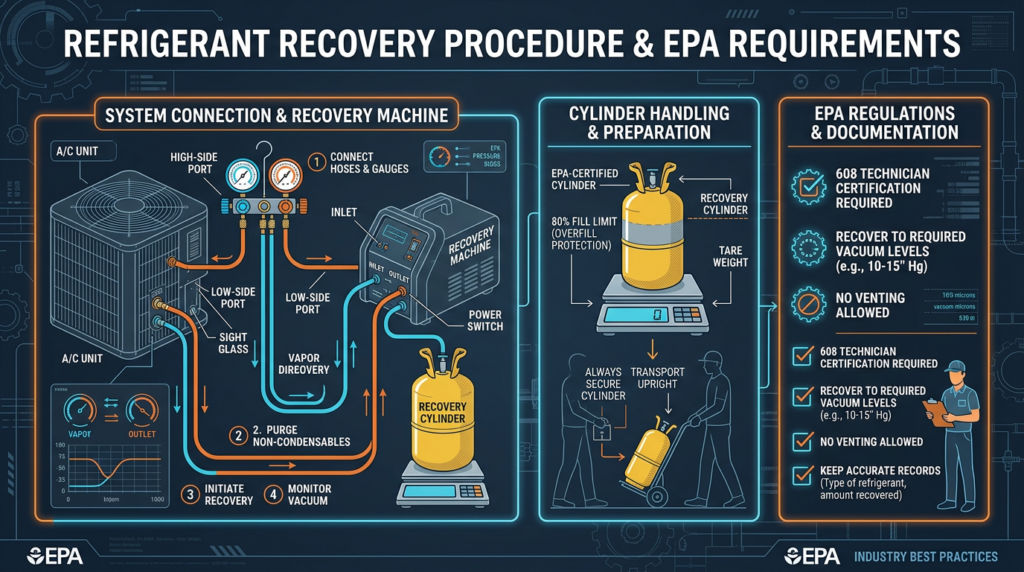
Before connecting any equipment, the technician must identify the refrigerant in the system. A refrigerant identifier analyzes a sample and confirms the type and purity. Mixing refrigerants contaminates both the recovered supply and the recovery cylinder, potentially ruining hundreds of dollars of refrigerant and damaging equipment. Once the refrigerant is confirmed, the technician selects the appropriate recovery machine, cylinder, and hoses rated for that specific refrigerant.
Vapor Recovery
Vapor recovery draws refrigerant out of the system in its gaseous state. The recovery machine compresses the vapor and condenses it into liquid inside the recovery cylinder. This method works for all system sizes but is slower for large charges. It is the primary method used for small appliances and the final stage of any recovery process, pulling remaining vapor after liquid has been removed.
Liquid Recovery
Liquid recovery removes refrigerant in its liquid state, which is significantly faster. The technician connects the recovery machine’s liquid inlet to the system’s liquid line or king valve. Since liquid is denser than vapor, more refrigerant moves per unit of time. This method is standard for systems with charges above approximately 10 pounds.
Push-Pull Recovery
For large commercial or industrial systems containing hundreds of pounds of refrigerant, the push-pull method dramatically speeds up recovery. The recovery machine creates a pressure differential by pumping vapor from the top of the recovery cylinder back into the system. This pressure pushes liquid refrigerant out of the system and into the recovery cylinder through a separate liquid line. Push-pull recovery can achieve rates of 5 to 10 pounds per minute or more, depending on the equipment.
Required Evacuation Levels
EPA regulations specify the vacuum level a technician must reach during recovery. The required level depends on the type of equipment and the date of manufacture of the recovery machine. For systems containing more than 200 pounds of refrigerant using high-pressure refrigerants, the required recovery level is 0 psig. For smaller high-pressure systems, the requirement is typically 0 psig or 10 inches of Hg vacuum, depending on the recovery equipment’s manufacture date. Low-pressure systems require 25 inches of Hg vacuum or 25 mm Hg absolute.
A common misconception is that reaching 0 psig means all refrigerant has been removed. Significant amounts of vapor can remain trapped in the system at 0 psig. Proper recovery requires reaching the EPA-mandated vacuum level and holding it to verify no pressure rise from residual refrigerant boiling out of oil or releasing from system dead spots.
Oil Management
Refrigerant oil absorbs refrigerant. During recovery, oil may carry over into the recovery machine or cylinder. Quality recovery machines include oil separators to prevent excessive oil from entering the cylinder. After recovery, the system’s oil should be evaluated. In compressor burnout situations, acid-contaminated oil must be replaced. POE oil is hygroscopic and absorbs moisture rapidly, so containers must be kept sealed. The oil type must match the refrigerant: mineral oil for R-22, POE for R-410A and most HFCs, PAG for automotive R-1234yf, and PVE as an alternative in some applications.
Recovery Equipment
Recovery Machines
Recovery machines vary widely in capability. Key specifications include recovery rate (measured in pounds per minute), compatible refrigerants, and whether the unit handles flammable refrigerants. AHRI Standard 740 rates the performance of recovery equipment under standardized conditions. Self-contained recovery machines handle the entire process internally. Features to consider include automatic high-pressure shutoff, oil-less compressors for reduced maintenance, and digital pressure monitoring.
- Residential-grade machines typically recover at 0.5 to 1.0 lb/min and cost $500 to $2,000.
- Commercial-grade machines recover at 2 to 6 lb/min or more and range from $2,000 to $5,000+.
- Machines rated for A2L refrigerants feature spark-free motors and are increasingly necessary as R-454B enters the market.
Recovery Cylinders
Recovery cylinders must meet DOT specifications, typically DOT-4BA or DOT-4BW. The standard color coding is a gray body with a yellow top, indicating the cylinder is for recovered refrigerant. Cylinders have a rated service pressure (typically 400 psi for standard refrigerants, higher for R-410A at 600 psi). They must never be filled beyond 80% of capacity by weight to allow for liquid expansion with temperature changes. Overfilling creates a hydrostatic condition that can cause catastrophic cylinder failure.
Vacuum Pumps
After recovery and system repair, a vacuum pump evacuates the system to remove moisture and non-condensable gases. A proper deep vacuum should reach below 500 microns, with many manufacturers specifying 300 to 400 microns. Vacuum pumps used for evacuation are separate from the recovery process but are critical tools in the overall service workflow. Regular oil changes and proper valve maintenance keep vacuum pumps performing to specification.
Refrigerant Identifiers
Portable refrigerant identifiers cost between $800 and $3,000 and pay for themselves by preventing contamination. They detect the refrigerant composition and can identify unknown blends, air contamination, and cross-contamination. Using an identifier before every recovery operation is best practice and protects the technician’s entire recovered refrigerant inventory.
Handling, Storage, and Transportation
Recovered refrigerant cylinders must be clearly labeled with the refrigerant type, date of recovery, and any known contaminants. Storage areas should be cool, dry, well-ventilated, and secure. Cylinders must be protected from direct sunlight and heat sources. Transport of refrigerant cylinders falls under DOT hazardous materials regulations. Cylinders must be secured upright in vehicles, and proper shipping papers may be required depending on the quantity transported. Technicians transporting more than the excepted quantities must comply with HAZMAT training requirements.
Regulations and Compliance
EPA Section 608 and the AIM Act
Section 608 of the Clean Air Act established the framework for refrigerant management. The AIM Act, signed into law in December 2020, specifically targets HFCs with a phasedown schedule that reduces production and consumption by 85% by 2036, using a 2011-2013 baseline. Key milestones include a 10% reduction by 2024, 40% by 2029, 70% by 2034, and 85% by 2036. The EPA’s Technology Transitions Rule, finalized in 2023, restricts the use of high-GWP HFCs in specific sectors and provides a pathway for lower-GWP alternatives.
Leak Rate Thresholds
EPA regulations set leak rate thresholds for systems containing 50 pounds or more of refrigerant. As of the most recent updates:
- Commercial refrigeration: 20% annual leak rate threshold.
- Industrial process refrigeration: 30% annual leak rate threshold.
- Comfort cooling and other appliances: 10% annual leak rate threshold.
When these thresholds are exceeded, owners must repair leaks within 30 days or develop a retrofit or retirement plan. Extensions may be available, but documentation is mandatory. The EPA has extended refrigerant management requirements to HFCs under the AIM Act, not just ODS (ozone-depleting substances).
Recordkeeping
Facilities with systems containing 50 or more pounds of refrigerant must maintain records of refrigerant purchases, additions, recoveries, and disposals. Service technicians should document every recovery operation including the date, system type, refrigerant type, quantity recovered, and certification number. These records must be retained for a minimum of three years.
Penalties
The EPA actively enforces refrigerant regulations. Penalties for knowingly venting refrigerants can reach $44,539 per day per violation under the Clean Air Act. The agency has also offered bounty payments to individuals who report violations, with awards up to $10,000. Notable enforcement actions have resulted in fines exceeding $100,000 for commercial operations with poor refrigerant management practices.
Troubleshooting Common Recovery Issues
- Slow recovery rates: Check for restrictions in hoses or filter-dryers. Verify that hose diameters are adequate. Ensure the recovery cylinder is not overfilled or too warm.
- High discharge pressure on recovery machine: The recovery cylinder may be overfilled or exposed to high ambient temperatures. Cool the cylinder with a fan or relocate to shade.
- Contaminated recovered refrigerant: Usually caused by skipping refrigerant identification. Mixed refrigerants must be sent to a certified reclaimer or destroyer.
- Vacuum level won’t hold: Indicates a leak in hoses, fittings, or the system itself. Isolate sections to identify the leak source.
- Recovery machine won’t start or trips overload: Check power supply, ambient temperature, and compressor oil level. High head pressure from a full cylinder can also trigger overload protection.
Practical Considerations by Application
Residential Systems
A typical residential split system contains 6 to 12 pounds of R-410A. Recovery takes 15 to 30 minutes using a standard recovery machine. With the R-410A phasedown accelerating, technicians replacing old systems will recover R-410A for reclamation while charging new systems with R-454B or other approved alternatives. The transition to SEER2 standards has also changed system designs, which can affect refrigerant charge amounts and recovery logistics.
Commercial Refrigeration
Supermarket rack systems may contain 1,000 pounds or more of refrigerant. Push-pull recovery is standard for these applications. Leak detection and repair programs are essential to stay below EPA leak rate thresholds. Many large retailers employ dedicated refrigerant management software to track system charges, leak rates, and compliance documentation.
Industrial and Chiller Applications
Large centrifugal chillers using low-pressure refrigerants like R-123 or R-1233zd(E) require Type III certified technicians and specialized recovery procedures. These systems operate below atmospheric pressure during portions of the cycle, making air infiltration a concern. Recovery from chillers often involves hundreds of pounds of refrigerant and can take several hours even with commercial-grade equipment.
Key Takeaways
- Refrigerant recovery is legally required under EPA Section 608. Intentional venting of any amount of regulated refrigerant is illegal.
- Always identify the refrigerant before recovery. Cross-contamination is costly and preventable.
- Match your recovery equipment to the job: machine capacity, refrigerant compatibility, and flammability rating all matter.
- Never fill recovery cylinders beyond 80% of capacity by weight. Use a scale during every recovery operation.
- The AIM Act is driving rapid change. HFC production will drop 85% by 2036, making recovered and reclaimed refrigerant increasingly valuable.
- A2L refrigerants like R-454B and R-32 require recovery equipment rated for mildly flammable gases. Standard equipment is not acceptable.
- Maintain detailed records of every recovery, including refrigerant type, quantity, date, and destination. Keep records for at least three years.
- Stay current with EPA regulations, AHRI standards, and ASHRAE classifications. The regulatory landscape is changing faster than at any point since the original CFC phaseout.