Refrigerant Types: R-22, R-410A, R-454B, R-32 Compared
When a homeowner’s air conditioner fails on a 95°F afternoon, the type of refrigerant inside that system can determine whether the repair costs $200 or whether a full system replacement is the only viable option. Refrigerants are the lifeblood of every vapor-compression cooling and heating system, and the HVAC industry is in the middle of its most significant refrigerant transition in decades. Environmental regulations have already eliminated R-22 from new production and are now phasing down R-410A, while next-generation options like R-454B and R-32 are entering the market. For technicians, business owners, home inspectors, and informed homeowners, understanding the differences between these four refrigerants is no longer optional. This article provides a thorough comparison of R-22, R-410A, R-454B, and R-32, covering their thermodynamic properties, environmental impact, safety classifications, practical applications, and the regulatory forces driving the industry forward.
Fundamentals of Refrigerants
What Is a Refrigerant?
A refrigerant is a chemical substance that cycles through phase changes (liquid to vapor and back) inside a closed-loop system to absorb and release heat. In the vapor-compression refrigeration cycle, the refrigerant evaporates at low pressure inside the evaporator coil, absorbing heat from indoor air. The compressor then raises the pressure and temperature of the refrigerant vapor. In the condenser coil, the high-pressure vapor releases its heat to the outdoor environment and condenses back into a liquid. Finally, the expansion device (typically a thermostatic expansion valve or electronic expansion valve) reduces the pressure, and the cycle repeats. Every air conditioner, heat pump, refrigerator, and chiller relies on this fundamental process, and the refrigerant chosen for the system directly affects its efficiency, capacity, operating pressures, and environmental footprint.
Key Properties of Refrigerants
Several categories of properties determine whether a refrigerant is suitable for a given application:
- Latent heat of vaporization: The amount of heat a refrigerant absorbs when it changes from liquid to vapor. A higher latent heat means more cooling per pound of refrigerant circulated, which generally improves system efficiency.
- Critical temperature and pressure: The point above which the refrigerant cannot exist as a liquid regardless of how much pressure is applied. Systems must operate well below critical conditions for the condensation process to work properly.
- Volumetric refrigerating effect (VRE): The cooling capacity per unit volume of refrigerant vapor. A higher VRE allows smaller compressors and piping, reducing equipment size and cost.
- Coefficient of performance (COP): The ratio of cooling output to energy input. Higher COP values indicate greater efficiency.
- Ozone Depletion Potential (ODP): A relative measure of how much a substance damages the stratospheric ozone layer compared to the reference compound R-11 (ODP = 1.0). The Montreal Protocol of 1987 established the international framework for phasing out ozone-depleting substances.
- Global Warming Potential (GWP): A measure of how much heat a greenhouse gas traps in the atmosphere over a specific time period (usually 100 years) relative to carbon dioxide (GWP = 1). The Kigali Amendment to the Montreal Protocol targets the phase-down of high-GWP hydrofluorocarbons (HFCs).
- Toxicity and flammability: ASHRAE Standard 34 classifies refrigerants using a letter-number system. The letter indicates toxicity (A = lower toxicity, B = higher toxicity), and the number indicates flammability (1 = no flame propagation, 2L = lower flammability with a burning velocity under 10 cm/s, 2 = flammable, 3 = higher flammability). An A1 refrigerant is the easiest to work with from a safety standpoint, while A2L refrigerants require additional precautions.
- Material compatibility: Refrigerants must be compatible with the metals (copper, aluminum, steel), elastomers (O-rings, gaskets), and lubricating oils used in the system. Incompatible combinations can cause corrosion, seal degradation, or compressor failure.
Refrigerant Naming Conventions
The ASHRAE numbering system follows a specific pattern. For single-compound refrigerants derived from methane or ethane, the digits represent the number of carbon, hydrogen, and fluorine atoms using the formula (C-1)(H+1)(F). For example, R-32 (difluoromethane, CH2F2) breaks down as 0 carbons beyond one, 2 hydrogen atoms plus one, and 2 fluorine atoms, yielding “032” or simply “32.” Blends like R-410A and R-454B receive 400-series designations, with the letter suffix distinguishing blends that share the same components but in different proportions.
Refrigerant Profiles and Comparison
R-22 (Chlorodifluoromethane)
Chemical formula: CHClF2
R-22 was the workhorse refrigerant of the HVAC industry for more than 50 years. It powered residential central air conditioners, commercial rooftop units, chillers, and refrigeration systems worldwide. Its popularity stemmed from excellent thermodynamic performance, moderate operating pressures (around 68 psig on the low side and 260 psig on the high side at typical air conditioning conditions), a favorable COP, and an A1 safety classification (non-toxic, non-flammable).
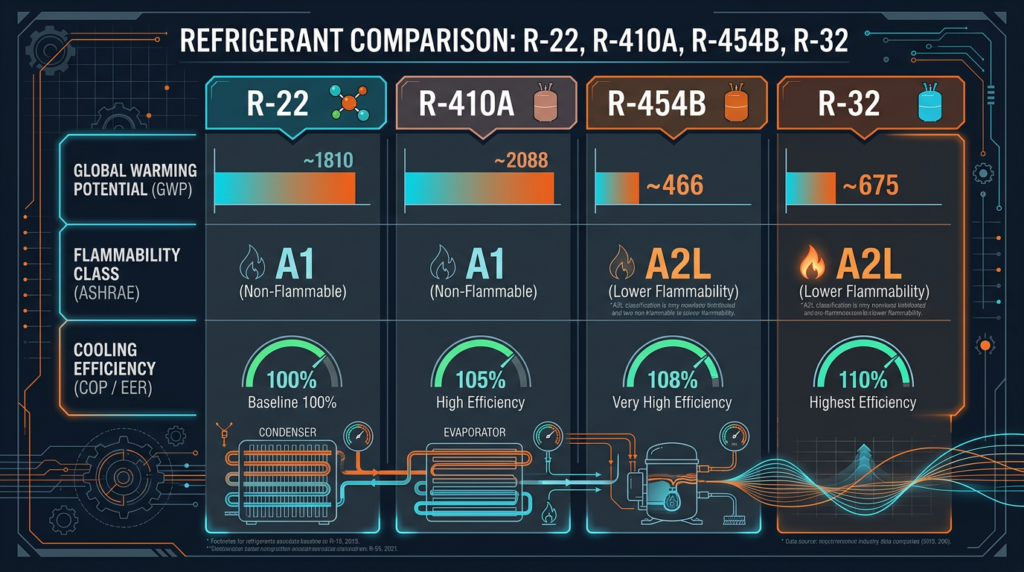
However, R-22 is a hydrochlorofluorocarbon (HCFC), and the chlorine atom in its molecule gives it an ODP of 0.055. Under the Montreal Protocol, developed nations committed to phasing out HCFCs. In the United States, production and import of R-22 ended on January 1, 2020. Only reclaimed or recycled R-22 remains available for servicing existing equipment, and its price has risen dramatically as supplies shrink. Any system still running on R-22 faces escalating maintenance costs, and replacement is almost always the most economical long-term decision. R-22 also carries a GWP of 1,810, making it a significant greenhouse gas in addition to its ozone-depleting properties.
R-410A (Difluoromethane/Pentafluoroethane Blend)
Chemical formula: 50% R-32 (CH2F2) / 50% R-125 (CHF2CF3) by weight
R-410A emerged as the primary replacement for R-22 in residential and light commercial air conditioning starting in the early 2000s. As a hydrofluorocarbon (HFC) blend, it contains no chlorine, giving it an ODP of zero. It also operates as a near-azeotropic mixture, meaning its two components evaporate and condense at nearly the same temperature, which simplifies charging and servicing compared to zeotropic blends.
R-410A operates at significantly higher pressures than R-22 (approximately 118 psig on the low side and 400 psig on the high side), requiring systems designed with thicker-walled tubing and components rated for higher pressures. It is classified as A1 (non-toxic, non-flammable), and technicians who already hold EPA Section 608 certification can work with it, though the higher pressures demand appropriate gauges, hoses, and recovery equipment. R-410A is not a drop-in replacement for R-22; the two refrigerants require completely different system designs, lubricants (POE oil for R-410A versus mineral oil for R-22), and expansion devices.
The critical drawback of R-410A is its GWP of 2,088, which is actually higher than that of R-22. Under the AIM Act (American Innovation and Manufacturing Act of 2020) and the broader Kigali Amendment framework, the United States is implementing a stepwise phase-down of HFC production and consumption. Starting January 1, 2025, new residential and light commercial air conditioning and heat pump equipment must use refrigerants with a GWP of 700 or less, effectively ending R-410A’s use in new systems. Existing R-410A equipment can continue to operate and be serviced, but refrigerant costs will likely rise over time as allocation quotas tighten.
R-454B (Difluoromethane/2,3,3,3-Tetrafluoropropene Blend)
Chemical formula: 68.9% R-32 (CH2F2) / 31.1% R-1234yf (CF3CF=CH2) by weight
R-454B, marketed by some manufacturers under brand names like Opteon XL41, is a leading candidate to replace R-410A in residential and light commercial air conditioning and heat pump systems in North America. It has an ODP of zero and a GWP of 466, well below the 700 threshold established by EPA regulations for new equipment.
R-454B carries an ASHRAE safety classification of A2L, meaning it has lower toxicity but is mildly flammable. The “2L” designation indicates that while it can sustain flame propagation under specific laboratory conditions, its burning velocity is very low (under 10 cm/s), and it requires a relatively high concentration and an ignition source to ignite. In practical terms, the risk is far lower than that of propane (R-290, classified A3) or even standard R-32 in a pure state, but it still demands changes to installation and service practices.
Operating pressures for R-454B are slightly lower than those for R-410A, and its cooling capacity is approximately 5% to 8% lower, depending on conditions. System designs account for this difference through optimized heat exchangers and compressor sizing. Efficiency (COP and SEER2 ratings) is comparable to or slightly better than R-410A in well-designed equipment. R-454B is a zeotropic blend with a temperature glide of about 1.5°F, which is small enough that it behaves similarly to R-410A in most service scenarios but does require liquid-phase charging to maintain proper composition.
Major manufacturers including Carrier, Trane, Lennox, and others have released or announced R-454B equipment lines. Technicians must complete training specific to A2L refrigerant handling before working with these systems.
R-32 (Difluoromethane)
Chemical formula: CH2F2
R-32 is a single-component HFC with an ODP of zero and a GWP of 675, which meets the sub-700 threshold for new US equipment. It is classified as A2L (mildly flammable). R-32 has been widely adopted in Asia and parts of Europe, where manufacturers like Daikin have championed its use in ductless mini-split systems and variable refrigerant flow (VRF) systems since 2012.
From a thermodynamic standpoint, R-32 offers several advantages. It has a higher volumetric refrigerating capacity than R-410A, meaning systems can use smaller compressors and less refrigerant charge for the same cooling output. Its theoretical COP is also slightly higher. Because R-32 is a single component rather than a blend, it has zero temperature glide, which simplifies charging (it can be charged in either liquid or vapor phase) and eliminates concerns about composition shift during leaks.
Operating pressures for R-32 are similar to R-410A, and many system components are interchangeable. However, discharge temperatures run higher with R-32, which requires compressor designs with enhanced cooling or injection circuits to maintain reliability. R-32 is also a key building block: it constitutes 50% of R-410A and 68.9% of R-454B, making it one of the most important molecules in modern refrigeration chemistry.
In North America, R-32 adoption has been slower than in Asia due to the established R-410A infrastructure and the preference of some manufacturers for R-454B. However, several product lines using R-32 are now available in the US market, particularly in ductless and light commercial categories.
Quick Comparison Summary
- R-22: ODP 0.055 | GWP 1,810 | A1 | Fully phased out (production/import ended 2020)
- R-410A: ODP 0 | GWP 2,088 | A1 | Phase-down in progress; banned in new residential/light commercial AC equipment from 2025
- R-454B: ODP 0 | GWP 466 | A2L | Phasing in as primary R-410A replacement in North America
- R-32: ODP 0 | GWP 675 | A2L | Widely used globally; growing adoption in North America
Practical Considerations
Retrofitting vs. Replacing Systems
One of the most common questions is whether an existing R-410A system can be converted to run R-454B or R-32. The short answer is no. While operating pressures are similar, the differences in lubricant requirements, expansion device calibration, safety-rated electrical components, and system controls make field conversion impractical and potentially dangerous. Manufacturers do not support or warranty retrofitted systems. When an R-410A system reaches end of life, replacement with a new system designed for a low-GWP refrigerant is the correct path. For R-22 systems, replacement has been the standard recommendation for years given the scarcity and cost of reclaimed refrigerant.
Servicing Existing R-410A Systems
R-410A will remain available for servicing installed equipment for the foreseeable future. The AIM Act targets new equipment production, not the servicing of existing systems. However, as overall HFC allocations decrease, the price of R-410A will gradually increase. Technicians should continue to follow best practices for leak prevention and refrigerant recovery to minimize waste and cost. Systems installed today using R-410A (in categories not yet affected by the 2025 rule) will need servicing for 15 to 20 years, so the refrigerant will remain relevant in the field for a long time.
Working with A2L Refrigerants
The shift to A2L refrigerants like R-454B and R-32 requires updated practices across the board:
- Leak detection: Technicians must use refrigerant leak detectors rated for A2L substances. Many installed systems will include built-in leak detection sensors as required by updated building codes and UL 60335-2-40 safety standards.
- Ventilation: Work areas must have adequate ventilation during installation, brazing, and service. Concentrations of A2L refrigerants must remain well below the lower flammability limit (LFL).
- Charging procedures: R-454B must be charged in the liquid phase to maintain proper blend composition. R-32 can be charged as liquid or vapor since it is a single component.
- Equipment compatibility: Recovery machines, manifold gauges, hoses, and vacuum pumps should be rated or approved for use with A2L refrigerants. Using non-rated equipment can create ignition risks.
- Training and certification: EPA Section 608 certification remains required, and additional A2L-specific training is strongly recommended. Several industry organizations, manufacturers, and trade schools now offer dedicated A2L handling courses.
Choosing the Right Refrigerant
For new residential and light commercial installations in the US after January 2025, the choice is effectively between R-454B and R-32, depending on the equipment manufacturer and application. R-454B has gained the broadest manufacturer support for ducted split systems. R-32 is particularly strong in ductless mini-splits and VRF applications. Both meet current GWP requirements and deliver efficiency comparable to or better than R-410A. Cost, equipment availability, regional code adoption, and technician familiarity will all factor into the decision.
Common Misconceptions
- “R-454B is basically the same as R-410A.” While performance is similar, R-454B is a mildly flammable A2L refrigerant that requires different handling procedures, updated safety components, and specific training. The systems are not interchangeable.
- “I can top off my R-22 system with a newer refrigerant.” Mixing refrigerants or adding a different refrigerant to an R-22 system will damage the compressor, void warranties, and violate EPA regulations. R-22 systems require R-22 or an approved drop-in alternative specifically formulated for that purpose.
- “All new refrigerants are highly flammable.” A2L refrigerants burn slowly and only under narrow conditions. They are not comparable to propane (A3) or other highly flammable substances. Proper handling reduces risk to a manageable level.
- “The phase-down does not affect me.” Every building owner with an HVAC system will eventually face this transition. Rising refrigerant costs, equipment obsolescence, and code changes will affect maintenance budgets and replacement timelines.
Future Trends
The refrigerant landscape will continue to shift. Natural refrigerants such as CO2 (R-744), ammonia (R-717), and propane (R-290) are gaining traction in commercial refrigeration, industrial applications, and certain residential markets in Europe. R-290, with a GWP of only 3, is already approved for use in self-contained systems with small charge sizes in the US. Research into even lower-GWP synthetic options continues, and future regulatory steps under the AIM Act will further reduce allowable GWP levels.
Refrigerant management is becoming increasingly important. Proper recovery, recycling, and reclamation reduce emissions, conserve supply, and keep costs down. The EPA has strengthened leak repair requirements and record-keeping obligations for systems containing 50 or more pounds of refrigerant, and similar oversight is expanding.
On the equipment side, variable-speed compressors, advanced heat exchanger designs, and intelligent controls are being optimized specifically for low-GWP refrigerants. These system-level improvements often deliver efficiency gains that exceed what refrigerant substitution alone can achieve, reinforcing that the transition is not just about swapping chemicals but about building better systems overall.
Key Takeaways
R-22 is gone from production and increasingly expensive to source. R-410A remains serviceable in existing equipment but is no longer permitted in most new residential and light commercial systems as of 2025. R-454B and R-32 represent the current generation of low-GWP replacements, both carrying A2L classifications that require updated safety practices, proper training, and purpose-built equipment. Technicians and contractors who invest in A2L training now will be prepared for the systems that will dominate the market for the next two decades. For homeowners and building managers, understanding these changes helps inform smarter purchasing and maintenance decisions. The refrigerant transition is well underway, and staying current with the science, regulations, and best practices is essential for everyone in the HVAC industry.