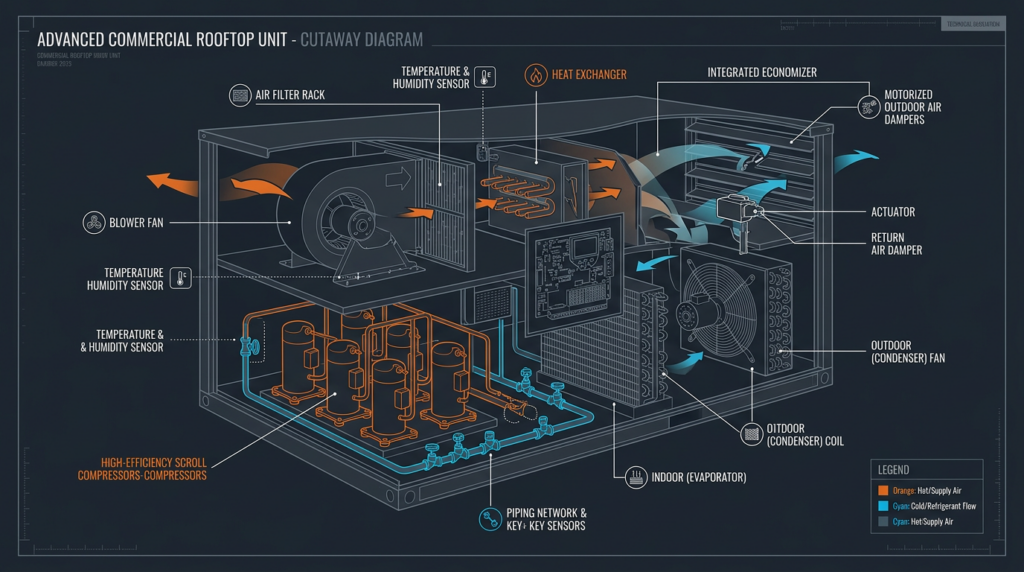
A rooftop unit (RTU) is a self-contained HVAC system designed for outdoor installation, typically on the roof of a commercial building. RTUs house all major components in a single cabinet: compressor, condenser coil, evaporator coil, blower, filters, and controls. They serve as the workhorse of commercial HVAC, conditioning everything from small retail shops to large industrial facilities. Their popularity stems from a simple advantage: they keep all mechanical equipment off the occupied floor, freeing up valuable interior space while simplifying installation and maintenance access. RTUs range from 3 tons (36,000 BTU/hr) for small commercial spaces to over 100 tons (1,200,000 BTU/hr) for large buildings, and understanding their selection, operation, and maintenance is essential for building owners, facility managers, and HVAC technicians alike.
Types of Rooftop Units
Not all RTUs serve the same purpose. The type selected depends on the building’s heating and cooling requirements, fuel availability, climate, and budget.
Cooling-Only RTUs
These units provide mechanical cooling with no integrated heating. They are used in climates where heating demand is minimal or where a separate heating system already exists. Cooling-only RTUs are the simplest and least expensive option.
Gas Heating / Electric Cooling RTUs
The most common configuration in commercial applications, these units use a gas-fired heat exchanger for heating and a direct expansion (DX) refrigeration circuit for cooling. Natural gas remains widely available and cost-effective in most regions, making this configuration a practical default for many buildings.
Heat Pump RTUs
Heat pump RTUs use the refrigeration cycle in reverse to provide both heating and cooling. They are increasingly popular due to electrification trends and can deliver heating efficiencies significantly higher than electric resistance heat. Their heating performance drops in extremely cold climates, though modern cold-climate heat pump technology has expanded their viable operating range.
Electric Heating / Electric Cooling RTUs
These units use electric resistance heating elements and a standard DX cooling circuit. They are used where natural gas is unavailable. Electric resistance heating is inherently less efficient than heat pump operation, with a coefficient of performance (COP) of 1.0 compared to 2.0 to 4.0 for heat pumps.
DOAS RTUs (Dedicated Outdoor Air Systems)
DOAS RTUs are specialized units designed to condition and deliver 100% outdoor air for ventilation purposes. They are often paired with other HVAC systems such as fan coils or VRF systems that handle the building’s sensible cooling and heating loads. DOAS units are particularly important in schools, healthcare facilities, and high-occupancy spaces where ventilation requirements under ASHRAE Standard 62.1 demand significant quantities of fresh air. AHRI Standard 920 governs their performance ratings.
Key Components and How They Work
An RTU operates on the basic vapor-compression refrigeration cycle. Refrigerant absorbs heat from indoor air at the evaporator coil, the compressor raises the refrigerant’s pressure and temperature, the condenser coil rejects that heat to the outdoor air, and an expansion device meters the refrigerant back to low pressure to repeat the cycle. All of this happens within the single rooftop cabinet.
Compressor
The compressor is the heart of the refrigeration circuit. Commercial RTUs use three main compressor types:
- Scroll compressors: The most common in RTUs up to about 25 tons. They are reliable, quiet, and efficient.
- Reciprocating compressors: Found in some smaller and legacy units. They offer good capacity control through cylinder unloading.
- Screw compressors: Used in larger RTUs, typically above 40 tons. They handle high-capacity loads efficiently and offer smooth modulation.
Modern RTUs increasingly use variable speed compressors driven by variable frequency drives (VFDs), allowing precise capacity modulation rather than simple on/off staging. This dramatically improves part-load efficiency.
Condenser and Evaporator Coils
The condenser coil is air-cooled in nearly all RTU applications. Propeller fans draw outdoor air across the condenser to reject heat. The evaporator coil is a direct expansion (DX) coil where refrigerant evaporates and absorbs heat from the return air stream. Keeping both coils clean is critical to maintaining rated efficiency.
Blower
The supply air blower moves conditioned air through the building’s ductwork. Blowers may be forward-curved centrifugal (common in smaller units) or backward-inclined (more efficient in larger units). Motor options include standard induction motors and electronically commutated motors (ECMs), which offer superior part-load efficiency and variable speed capability.
Economizer
An economizer is a damper assembly that introduces outdoor air for free cooling when ambient conditions are favorable. When the outside air temperature and humidity are lower than the return air conditions, the economizer opens to reduce or eliminate compressor operation. Control types include:
- Differential dry-bulb: Compares outdoor and return air temperatures.
- Differential enthalpy: Compares outdoor and return air total heat content (temperature plus humidity), providing more accurate control in humid climates.
Economizers require regular maintenance. Stuck or improperly calibrated dampers are one of the most common causes of wasted energy in commercial HVAC systems. Studies have shown that a malfunctioning economizer can increase energy consumption by 30% or more.
Filters
Air filters protect coils and improve indoor air quality. Filters are rated using the MERV (Minimum Efficiency Reporting Value) scale. Commercial RTUs typically use MERV 8 to MERV 13 filters. Higher MERV ratings capture smaller particles but increase static pressure, so filter selection must balance air quality goals with system airflow requirements.
Controls
RTU controls range from simple thermostats to full integration with a building automation system (BAS). Modern RTUs support BACnet, Modbus, and LonWorks communication protocols for remote monitoring, scheduling, and optimization. Advanced control strategies include demand control ventilation (DCV) using CO2 sensors, optimal start/stop programming, and supply air temperature reset.
Efficiency Metrics and Standards
Understanding efficiency ratings is essential for comparing RTUs and meeting code requirements.
IEER (Integrated Energy Efficiency Ratio)
IEER is the primary efficiency metric for commercial RTUs. It measures cooling efficiency across four part-load operating points (100%, 75%, 50%, and 25% load), weighted to reflect typical commercial building operation. IEER provides a far more accurate picture of real-world performance than a single full-load measurement. Higher IEER values indicate greater efficiency.
EER, SEER, and HSPF
- EER (Energy Efficiency Ratio): Measures cooling efficiency at a single operating point (95°F outdoor temperature). Useful for comparing peak-load performance.
- SEER (Seasonal Energy Efficiency Ratio): A seasonally weighted cooling efficiency metric used primarily for residential and small commercial equipment.
- HSPF (Heating Seasonal Performance Factor): Measures the seasonal heating efficiency of heat pump units.
SEER2, EER2, and HSPF2
Effective January 1, 2023, the Department of Energy implemented new testing procedures that account for higher external static pressure (0.5 inches of water column instead of 0.1 to 0.2 inches). The resulting SEER2, EER2, and HSPF2 ratings produce lower numerical values than the original metrics for the same equipment. Direct comparisons between SEER and SEER2 ratings are not valid without conversion factors. While these metrics apply primarily to residential and light commercial equipment, they influence the broader efficiency conversation and affect smaller commercial RTUs rated under AHRI 210/240.
Applicable Standards
- ASHRAE Standard 90.1: Sets minimum efficiency requirements for commercial buildings, including minimum IEER values based on equipment capacity and climate zone.
- AHRI Standards 210/240 and 340/360: Govern performance rating and certification of unitary air conditioning and heat pump equipment.
- DOE Federal Minimum Standards: Enforceable efficiency floors typically aligned with or exceeding ASHRAE 90.1.
- UL Listing: Underwriters Laboratories safety certification is required for electrical components and overall unit safety.
Refrigerant Transition
The commercial HVAC industry is in the middle of a significant refrigerant transition. R-410A, the dominant refrigerant in RTUs for over two decades, is a hydrofluorocarbon (HFC) with a global warming potential (GWP) of 2,088. The AIM Act of 2020 mandates an 85% reduction in HFC production and consumption by 2036, with interim reduction targets along the way.
The primary replacement refrigerants for commercial RTUs include:
- R-454B: A blend of R-32 and R-1234yf with a GWP of 466. It is classified as mildly flammable (A2L) and is the leading R-410A replacement for many manufacturers.
- R-32: A single-component refrigerant with a GWP of 675. Also classified as A2L. It offers good thermodynamic performance and is widely adopted internationally.
- R-290 (propane): A natural refrigerant with a GWP of 3. Its high flammability (A3 classification) limits its use to smaller charge sizes and specific applications.
The EPA’s SNAP (Significant New Alternatives Policy) program maintains an updated list of approved refrigerants for each end use. Building owners planning RTU replacements should factor in refrigerant availability and long-term serviceability. Existing R-410A equipment can continue to operate and be serviced, but the cost of R-410A refrigerant is expected to rise as production quotas tighten.
Selection and Sizing
Proper RTU sizing is one of the most consequential decisions in a commercial HVAC project. The process begins with a thorough load calculation using methodologies such as ACCA Manual N (for commercial buildings) or software tools based on ASHRAE load calculation procedures.
Factors in Load Calculation
- Building square footage and ceiling height
- Insulation levels and window area (glazing U-factor and SHGC)
- Building orientation and solar exposure
- Occupancy density and schedules
- Internal heat gains from lighting, equipment, and cooking
- Ventilation requirements per ASHRAE 62.1
- Climate zone and local design temperatures
The Dangers of Improper Sizing
Oversizing causes short cycling, where the compressor turns on and off frequently. This leads to poor humidity control, uneven temperatures, increased wear on components, and higher energy bills. Undersizing means the unit cannot meet the load on peak days, resulting in uncomfortable spaces and continuous operation that shortens equipment life. A correctly sized RTU runs longer cycles, dehumidifies effectively, and operates closer to its rated efficiency.
Installation Considerations
RTU installation involves several critical factors beyond simply placing the unit on the roof:
- Structural support: A commercial RTU can weigh from 400 pounds (3-ton unit) to over 10,000 pounds (large units). The roof structure must be verified by a structural engineer to handle the load, including roof curb and adapter considerations.
- Ductwork connections: Supply and return duct connections must be properly sealed to prevent air leakage. Even small gaps at the roof penetration can waste significant energy and allow moisture intrusion.
- Electrical connections: Common operating voltages are 208V, 230V, 460V, and 575V, all three-phase. Wiring must comply with the National Electrical Code (NEC) and local amendments.
- Condensate drainage: Proper drainage prevents water accumulation on the roof and potential interior water damage. Condensate lines must be routed and trapped correctly.
- Service clearances: Manufacturers specify minimum clearances around the unit for airflow and technician access. Violating these clearances impairs performance and complicates future maintenance.
Maintenance and Troubleshooting
Regular maintenance is the single most effective way to preserve RTU efficiency and extend equipment life. A neglected RTU can lose 5% to 15% of its rated efficiency within the first few years of operation.
Recommended Maintenance Schedule
- Monthly to quarterly: Replace or clean air filters based on building conditions and MERV rating.
- Semiannually (spring and fall): Clean condenser and evaporator coils, inspect and adjust belt tension (belt-drive units), lubricate motors and bearings, verify refrigerant charge, test economizer operation, calibrate sensors and controls, inspect condensate drains, and check electrical connections for tightness and signs of overheating.
- Annually: Full system performance test, including supply air temperature differential, airflow measurement, and control sequence verification.
Common Problems
- Refrigerant leaks: Cause reduced cooling capacity and compressor damage. Look for oil stains at fittings and coils.
- Compressor failure: Often caused by liquid slugging, loss of lubrication, or electrical faults. Monitoring suction and discharge pressures helps detect problems early.
- Economizer malfunction: Dampers stuck open waste heating energy in winter; dampers stuck closed forfeit free cooling in mild weather.
- Blower motor failure: Bearings wear over time. ECM motors are more durable but more expensive to replace.
- Dirty coils: Reduce heat transfer, increase head pressure, and force the compressor to work harder.
Replacement, Upgrades, and Cost Considerations
RTUs typically last 15 to 20 years with proper maintenance. Replacement should be considered when repair costs exceed 50% of the replacement cost, when the unit uses an obsolete refrigerant, or when efficiency has degraded substantially.
Ballpark Cost Ranges
- 3 to 5 ton cooling-only or gas/electric RTU: $4,000 to $8,000 for the unit; $2,000 to $5,000 for installation. Total: $6,000 to $13,000.
- 7.5 to 12.5 ton RTU: $8,000 to $20,000 for the unit; $4,000 to $10,000 for installation. Total: $12,000 to $30,000.
- 15 to 25 ton RTU: $15,000 to $40,000 for the unit; $8,000 to $20,000 for installation. Total: $23,000 to $60,000.
- Heat pump RTUs: Add 15% to 30% over comparable gas/electric units.
- High-efficiency and variable speed units: Premium of 20% to 50% over standard efficiency models, with payback periods typically ranging from 3 to 7 years depending on utility rates and operating hours.
Financial Incentives
The Inflation Reduction Act (IRA) provides significant incentives for energy-efficient commercial HVAC upgrades. Section 179D offers a tax deduction for energy-efficient commercial building improvements, with deductions up to $5.00 per square foot for buildings achieving 25% or greater energy savings compared to ASHRAE 90.1 reference buildings. The Investment Tax Credit (ITC) under Section 48 may also apply to certain qualifying equipment. State and utility rebate programs frequently offer additional incentives for installing high-IEER equipment. Always verify current eligibility requirements, as program details change.
Practical Scenarios
Small Retail Store (5,000 sq ft)
A single-story retail space in a moderate climate might require a 7.5-ton gas/electric RTU. Key considerations include store operating hours (often 12 or more hours per day), high door-opening frequency affecting load, and the need for an economizer (required by code in many climate zones for units 54,000 BTU/hr and above). A unit with an IEER of 15.0 or higher would qualify for utility rebates in many jurisdictions. Estimated total installed cost: $14,000 to $22,000.
Multi-Story Office Building
An office building with multiple aging RTUs benefits from a phased replacement strategy informed by an energy audit. Prioritize replacing the least efficient units first. Upgrading to variable speed RTUs with BAS integration enables coordinated scheduling, supply air temperature reset, and demand control ventilation. When replacing units, transitioning to R-454B equipment positions the building for long-term refrigerant availability.
School Building
Schools have high ventilation requirements due to dense occupancy and strict IAQ standards. A DOAS RTU paired with zone-level fan coils or VRF terminals can decouple the ventilation load from the space conditioning load, improving both air quality and energy performance. Occupancy schedules with long unoccupied periods (nights, weekends, summer) make optimal start/stop and setback programming especially valuable.
Key Takeaways
- RTUs are the dominant HVAC solution for commercial buildings, available in configurations from 3 to over 100 tons with cooling-only, heat pump, gas/electric, and DOAS options.
- IEER is the correct efficiency metric for comparing commercial RTUs. Higher IEER means better part-load performance and lower operating costs.
- The R-410A refrigerant phasedown under the AIM Act is underway. R-454B and R-32 are the primary replacements. Plan equipment purchases accordingly.
- Accurate load calculations prevent the costly problems of oversizing and undersizing. Use ACCA Manual N or ASHRAE-based methods.
- Economizers offer significant energy savings but only when properly maintained and calibrated.
- Regular maintenance preserves efficiency, prevents breakdowns, and extends equipment life from a minimum of 15 years to 20 years or more.
- Financial incentives under the Inflation Reduction Act and utility rebate programs can substantially offset the higher cost of premium-efficiency equipment.
- Variable speed compressors and ECM blower motors represent the most impactful efficiency upgrades available in modern RTU technology.