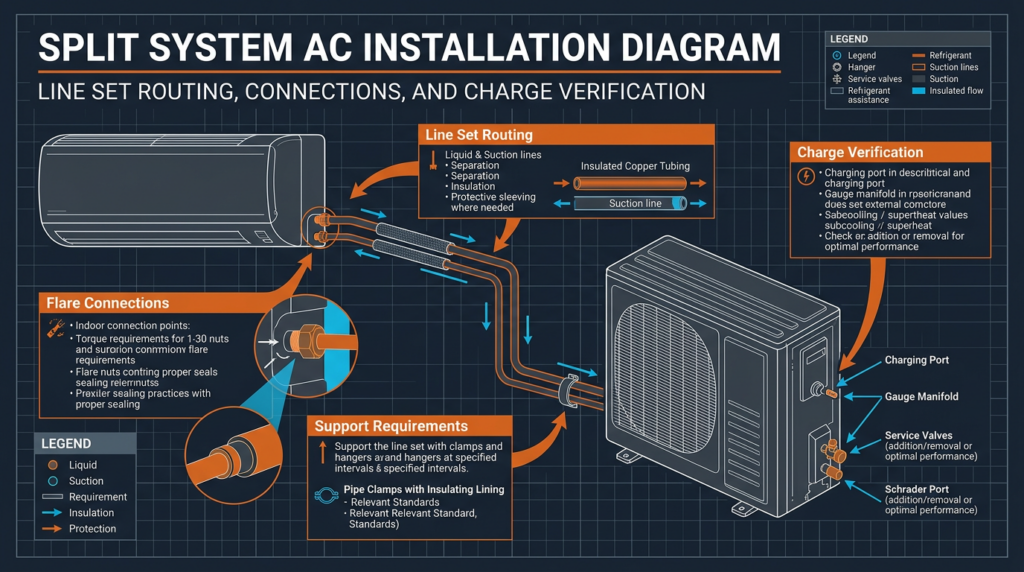
A split system air conditioner consists of two primary components: an indoor evaporator unit and an outdoor condensing unit, connected by refrigerant lines. This configuration is the most common residential cooling solution in the United States, serving millions of homes and small commercial spaces. Proper installation directly determines system efficiency, longevity, and occupant comfort. A poorly installed split system can waste 30% or more of its rated capacity through refrigerant issues, duct leaks, and airflow problems. This article covers the full scope of installation best practices, from pre-installation planning through commissioning and customer handoff, aligned with current codes and the post-2023 regulatory landscape.
Pre-Installation Planning and Preparation
Load Calculation (ACCA Manual J)
Every split system installation begins with a proper load calculation. ACCA Manual J is the industry-standard method for determining the heating and cooling loads of a building, measured in BTU/h. The calculation accounts for insulation values, window area and orientation, building envelope tightness, occupancy, internal heat gains from appliances and lighting, and local climate data.
Accurate load calculation prevents two costly errors: oversizing and undersizing. An oversized system short-cycles, turning on and off frequently. This leads to poor humidity control, uneven temperatures, increased wear on components, and higher energy bills. An undersized system runs continuously without reaching the desired temperature, especially on peak design days. Neither scenario delivers the comfort or efficiency the homeowner expects.
System Selection and AHRI Matching
Once the load is established, the installer selects equipment using ACCA Manual S guidelines. The indoor and outdoor units must be an AHRI-certified matched pair. The Air-Conditioning, Heating, and Refrigeration Institute (AHRI) publishes a Directory of Certified Product Performance that verifies the combined efficiency ratings of matched indoor and outdoor components. Mismatched systems may fail to meet rated efficiency and can void manufacturer warranties.
Key selection criteria include:
- SEER2 rating: Since January 1, 2023, new minimum efficiency standards use the SEER2 metric, which accounts for realistic duct static pressure. Minimum SEER2 is 13.4 in the Southeast and Southwest regions and 14.3 in the North.
- EER2 rating: Minimum EER2 is 11.7 for units under 45,000 BTU/h and 10.6 for units at or above 45,000 BTU/h.
- HSPF2 rating: For heat pumps, the minimum HSPF2 is 7.5.
- Refrigerant type: R-410A remains common but is in active phase-down under the AIM Act. R-32 and R-454B are the leading replacements, both with lower Global Warming Potential (GWP). Many new systems use A2L (mildly flammable) refrigerants, requiring compliance with UL 60335-2-40 and ANSI/ASHRAE Standard 15.
- Features: Variable-speed compressors, communicating controls, and smart thermostat compatibility affect both comfort and long-term operating cost.
Permitting and Inspections
Most jurisdictions require a mechanical permit before HVAC installation begins. The installer should verify requirements under the locally adopted edition of the International Mechanical Code (IMC) or International Residential Code (IRC). Inspections are typically required at rough-in (before walls are closed) and at final completion. Failing to obtain permits can result in fines, difficulty selling the property, and voided insurance claims.
Indoor Unit Installation
Location and Mounting
The indoor unit should be installed in a location that allows unobstructed airflow, easy filter access, and adequate service clearance. Avoid placing the unit near heat sources, in direct sunlight, or in areas prone to excessive dust or moisture. Wall-mounted and ceiling-mounted configurations must be secured to structural members and leveled precisely to ensure proper condensate drainage.
Condensate Drain
The condensate drain line must slope at a minimum of 1/4 inch per foot toward the termination point. A properly configured P-trap prevents sewer gases and unconditioned air from entering the system. Where gravity drainage is not feasible, a condensate pump is required. The drain line should terminate in an approved location, such as a floor drain or exterior discharge point, per local code. Clogged condensate drains are one of the most frequent service calls in residential HVAC, so installers should advise homeowners on regular drain line cleaning.
Refrigerant Piping Connections
Connecting the refrigerant lineset to the indoor coil requires clean brazing practices. Nitrogen must flow through the lines during all brazing operations to prevent copper oxide scale from forming inside the tubing. Even small amounts of oxide contamination can clog metering devices and damage compressors. After brazing, the installer performs a standing pressure test using dry nitrogen to verify joint integrity before proceeding.
Electrical Connections
All wiring must comply with the National Electrical Code (NEC) and the manufacturer’s installation manual. Verify correct voltage supply, wire gauge, and overcurrent protection sizing. The indoor unit must be properly grounded. Low-voltage thermostat wiring should be routed separately from line-voltage conductors to prevent interference.
Outdoor Unit Installation
Location and Clearance
The outdoor condensing unit requires adequate airflow on all sides. Manufacturer specifications typically call for 24 inches of clearance on the service side and 12 to 18 inches on remaining sides, with at least 48 inches of vertical clearance above the unit. Avoid placing the condenser in confined spaces, near dryer vents, or adjacent to vegetation that could restrict airflow. Consider noise impact on neighboring properties and proximity to bedroom windows.
Mounting
The unit must rest on a level surface. Acceptable options include a poured concrete pad (minimum 3 inches thick), a composite equipment pad, or manufacturer-approved wall-mounting brackets. The pad should be elevated above grade to prevent flooding and allow drainage. Rubber isolation pads between the unit and the mounting surface reduce vibration transmission.
Refrigerant Line Evacuation
Before releasing the factory refrigerant charge, the installer must evacuate the lineset and indoor coil using a vacuum pump. The target is a standing vacuum of 500 microns or less, held for a minimum of 10 minutes without significant rise. This process removes air and moisture, both of which degrade system performance and can cause compressor failure. A digital micron gauge is essential for accurate measurement. Analog compound gauges are not precise enough for proper evacuation verification.
Electrical Connections
The outdoor unit requires a dedicated circuit with a properly sized disconnect switch mounted within sight of the unit. Wire sizing must match the unit’s minimum circuit ampacity (MCA) listed on the nameplate. The maximum overcurrent protection (MOP) value on the nameplate dictates the largest allowable breaker or fuse size. Grounding must be continuous from the electrical panel to the unit chassis.
Ductwork Installation
For ducted split systems, the duct network is as important as the equipment itself. Leaky or undersized ducts can reduce delivered capacity by 25% to 40%, turning a high-efficiency system into a mediocre one.
Duct Design (ACCA Manual D)
ACCA Manual D provides the methodology for sizing ducts based on the equipment’s airflow requirements (CFM), available static pressure, and the layout of the building. Each supply run and return path is calculated to deliver the correct volume of conditioned air to each room. Proper design minimizes noise, maintains balanced room-to-room temperatures, and keeps total external static pressure within the equipment’s rated operating range.
Duct Materials and Sealing
Duct materials must comply with UL 181. Rigid sheet metal ducts offer the lowest airflow resistance. Flexible duct is acceptable when installed with minimal sag and without kinks or excessive length. All joints and seams must be sealed with tapes or mastics listed to UL 181A-P (for rigid duct) or UL 181B-FX (for flexible duct). Standard cloth duct tape is not acceptable for permanent duct sealing, as it degrades and fails within months.
Insulation and Static Pressure
Ducts routed through unconditioned spaces (attics, crawlspaces, garages) must be insulated to prevent energy loss and condensation. Minimum insulation values are specified in local energy codes, typically R-6 to R-8 for supply ducts. After installation, the technician measures total external static pressure using a manometer. Readings that exceed the equipment’s rated maximum indicate restrictions that must be corrected.
System Commissioning
Commissioning verifies that the installed system operates as designed. Skipping this step is one of the most common failures in residential HVAC installation.
Refrigerant Charge Verification
The installer verifies refrigerant charge using the superheat method (for fixed-orifice systems) or the subcooling method (for TXV/EEV systems). Target values are listed on the outdoor unit’s nameplate or in the installation manual. A system that is 10% overcharged or undercharged can lose 5% to 20% of its rated efficiency. Accurate digital manifold gauges and thermocouples are required for this measurement.
Airflow and Temperature Measurements
Airflow should be measured at each supply register using a flow hood or anemometer and compared against the Manual D design values. The temperature split between supply and return air is checked as a quick diagnostic. For most cooling systems operating under normal conditions, the expected supply-to-return temperature difference is 14 to 22 degrees Fahrenheit.
Electrical Verification
The technician records voltage at the disconnect (must be within plus or minus 10% of nameplate voltage), compressor amperage draw, and fan motor amperage draw. Capacitor values are checked with a capacitance meter. These baseline readings are documented for future service reference.
Control System Setup
The thermostat is configured for the specific equipment type (single-stage, multi-stage, or variable-speed). Heat pump systems require proper configuration of auxiliary heat lockout temperature, defrost settings, and emergency heat operation. Smart thermostats should be connected to Wi-Fi and registered with the manufacturer for firmware updates.
Refrigerant Transition: R-410A Phase-Down
The EPA’s AIM Act mandated a 30% reduction in HFC production and consumption beginning January 1, 2023, with further reductions scheduled through 2036. R-410A, the dominant residential refrigerant for two decades, has a GWP of 2,088. Its replacements offer significant environmental improvements:
- R-32: GWP of 675. Classified as A2L (mildly flammable). Already widely used in ductless mini-splits globally.
- R-454B: GWP of 466. Also classified as A2L. Gaining traction in ducted split systems from major US manufacturers.
Technicians installing A2L refrigerant systems must follow updated safety standards, including UL 60335-2-40 for equipment design and ANSI/ASHRAE Standard 15 for installation practices. Additional training on leak detection, charge limits, and ventilation requirements for A2L refrigerants is essential. Refrigerants are not interchangeable. Using the wrong refrigerant in a system designed for a specific type causes operational failure and potential safety hazards.
Financial Incentives: IRA Tax Credits and Rebates
The Inflation Reduction Act (IRA) of 2022 expanded federal tax credits for energy-efficient HVAC equipment. Under Section 25C, homeowners can claim a tax credit of 30% of the cost of qualifying equipment, up to $2,000 per year for heat pumps. The equipment must meet CEE (Consortium for Energy Efficiency) highest efficiency tier requirements to qualify.
State-administered rebates through the High-Efficiency Electric Home Rebate Act (HEEHRA) provide additional point-of-sale discounts for qualifying households, with amounts varying by state and household income level. Low- and moderate-income households may receive the largest rebates. Installers should inform customers about available incentives and help them identify qualifying equipment.
Common Installation Mistakes and Misconceptions
- Oversizing the system: A larger unit does not cool faster or better. It short-cycles, fails to dehumidify, and wastes energy. Proper Manual J sizing is non-negotiable.
- Ignoring ductwork: Even a 20+ SEER2 system cannot overcome a leaky, undersized duct system. Ductwork must be evaluated and corrected during any system replacement.
- “Topping off” refrigerant: Split systems are sealed. If refrigerant is low, there is a leak. The leak must be located, repaired, and the system properly evacuated and recharged. Adding refrigerant without fixing the leak is a temporary patch that harms the system and the environment.
- Assuming all installers are equal: Licensing, NATE certification, and manufacturer-specific training vary widely. A qualified contractor follows ACCA standards, obtains permits, performs load calculations, and commissions the system. The lowest bid often reflects shortcuts in these critical areas.
Practical Use Cases
New Construction
In new homes, HVAC design should be integrated from the earliest architectural stages. Manual J, D, and S calculations are performed before framing begins. Ductwork is installed during rough-in and inspected before drywall. Energy raters verify code compliance and may conduct duct blaster testing per ASHRAE Standard 152.
System Replacement
When replacing an existing system, the installer should perform a fresh Manual J calculation rather than simply matching the old unit’s tonnage. Building modifications such as new windows, added insulation, or room additions change the load. Existing ductwork should be inspected for leaks, damage, and proper sizing. This is also an ideal time to add zoning capabilities or upgrade to a variable-speed system.
Retrofitting Older Homes
Older homes present challenges including limited space for ductwork, outdated electrical panels, and potential asbestos in existing insulation. Ductless mini-split systems are often the most practical solution, requiring only a small penetration for the refrigerant lineset. High-velocity air conditioning systems using small-diameter flexible tubing offer another option for homes where traditional ductwork cannot be accommodated.
Typical Costs and Specifications
Installation costs for residential split systems vary by region, system size, and efficiency level:
- Basic system (13.4 to 15 SEER2, 2 to 3 ton): $4,500 to $8,000 installed, including equipment, labor, and materials.
- Mid-range system (16 to 18 SEER2, variable-speed): $7,000 to $12,000 installed.
- Premium system (20+ SEER2, inverter-driven, communicating controls): $10,000 to $18,000 installed.
- Ductwork modifications or replacement: $2,000 to $6,000 additional, depending on scope.
Systems using newer A2L refrigerants (R-32, R-454B) may carry a slight cost premium due to updated components and additional technician training requirements. Standard manufacturer warranties cover 5 to 10 years on parts and compressor. Extended warranties of up to 12 years are available from most major manufacturers, often requiring professional installation and product registration within 60 to 90 days.
Safety Considerations
Split system installation involves electrical hazards, refrigerant handling, and work at elevation. Technicians should observe these practices:
- De-energize circuits and verify zero voltage with a meter before making electrical connections.
- Use EPA Section 608-compliant recovery equipment when removing refrigerant from existing systems.
- Wear safety glasses and gloves when brazing. Ensure adequate ventilation and keep a fire extinguisher accessible.
- Follow OSHA ladder safety standards, including three-point contact and proper angle placement.
- For A2L refrigerant systems, verify room volume meets minimum charge concentration limits and ensure required ventilation provisions are in place per ASHRAE Standard 15.
Key Takeaways
- Perform a Manual J load calculation for every installation. Never size a system based on square footage alone or by matching the existing unit.
- Use AHRI-certified matched indoor and outdoor components to ensure rated efficiency.
- Seal and insulate all ductwork to UL 181 standards. Leaky ducts undermine even the best equipment.
- Evacuate refrigerant lines to 500 microns or below and verify charge using superheat or subcooling methods.
- Comply with current SEER2 minimums: 13.4 in the Southeast/Southwest and 14.3 in the North.
- Prepare for the refrigerant transition. R-410A is being phased down. R-32 and R-454B require A2L safety training and updated installation practices.
- Commission every system by recording electrical values, verifying airflow, and checking temperature split.
- Inform homeowners about IRA tax credits and state rebates that can offset the cost of high-efficiency equipment.
- Obtain permits, schedule inspections, and document all work for warranty and code compliance purposes.